
RaeRae Reviews: One Piece: Stampede
Bottom line
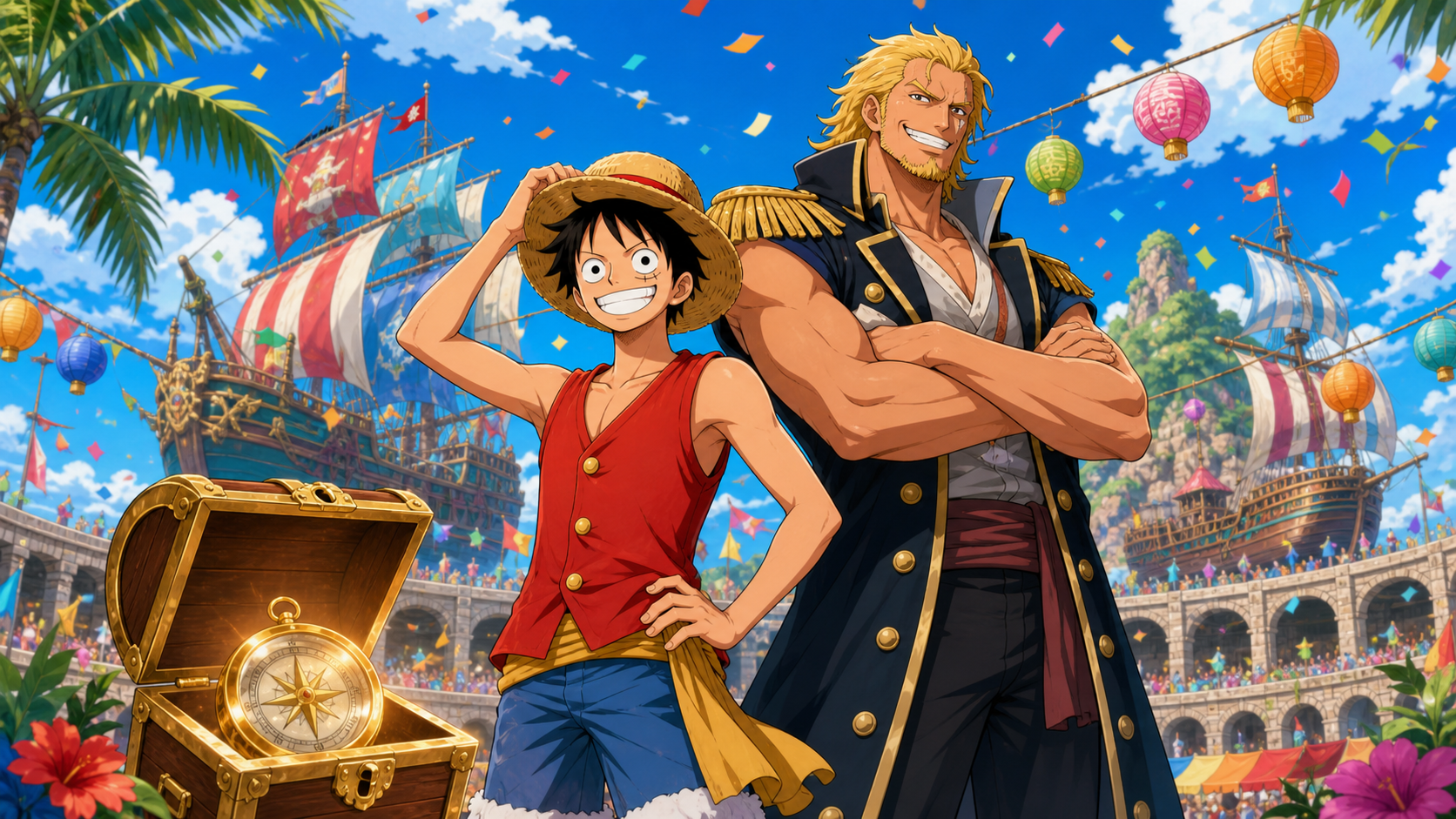
One Piece: Stampede is a twentieth-anniversary crowd roar shaped like a movie. Nearly every pirate, Marine, Revolutionary, and government agent who can fit onto Delta Island arrives for the Pirate Expo, then Douglas Bullet gives the whole guest list a reason to stop posing and cooperate.
Released in Japan on August 9, 2019, Stampede chooses momentum over intimacy. The film cannot give dozens of returning characters equal depth, so director Takashi Otsuka builds a festival of entrances, alliances, finishers, and visual callbacks around one useful idea: the strongest man in the room may still be the loneliest fool.
What happens
Buena Festa invites pirates to a massive Pirate Expo and promises a treasure connected to Gol D. Roger. The prize is an Eternal Pose pointing directly toward Laugh Tale, a shortcut capable of throwing the entire pirate age into chaos.
Douglas Bullet, a former member of Roger’s crew, uses the event to gather worthy opponents. Festa summons a Buster Call, Marines close in, and rival pirates discover that Bullet’s strength and the government’s annihilation order threaten everyone on the island.
The Pirate Expo sells belonging
The opening festival offers food, races, games, ships, and the rare sight of pirates celebrating among their own kind. People normally hunted by the state get a temporary public space where piracy becomes culture rather than criminal evidence.
Festa exploits that hunger for community. He gathers people through spectacle, then turns their joy into an audience for Bullet. A festival can become a trap when the organizer values the event more than the guests.
Buena Festa treats disaster as promotion
Festa calls himself the Master of Festivities and believes a historic catastrophe will make his name immortal. He does not need to win a fight. He needs the world to remember the show.
His vanity feels familiar because modern spectacle often rewards the person who creates attention without requiring responsibility for the damage. Festa wants credit for the explosion, not accountability for the bodies underneath.
Douglas Bullet survived by becoming a weapon
Bullet grew up inside war, learned that usefulness meant survival, and treated trust as a weakness others could exploit. Roger eventually defeated him and gave him a crew where strength did not have to mean isolation.
Roger’s death removed the one relationship capable of challenging Bullet’s worldview. He returned to the belief that absolute individual power could replace grief, community, and purpose.
Roger’s crew did not cure him
Membership aboard the Oro Jackson gave Bullet a different life, but belonging cannot heal someone automatically. Roger offered possibility. Bullet still had to accept dependence, vulnerability, and the fact that another person’s death could not be defeated through training.
His collapse after Roger shows why found family requires participation. A crew can open the door. The wounded person still has to live inside the room without turning every bond into a test of dominance.
The Eternal Pose is the wrong treasure
A compass pointing directly to Laugh Tale appears priceless. The device would bypass the route, discoveries, alliances, losses, and choices that make reaching the final island meaningful.
Luffy destroys the Eternal Pose because he does not want Roger’s answer handed to him. Becoming Pirate King means completing his own journey. A shortcut to the destination would steal the adventure rather than complete the dream.
Luffy understands freedom better than Bullet
Bullet thinks freedom means nobody can overpower him. Luffy accepts that friends can save him, rivals can assist him, and a shared victory does not reduce his identity.
That difference decides the battle. Bullet gathers machinery and mass into one body. Luffy gathers people without owning them. Cooperation becomes stronger because every participant retains a separate reason for helping.
The Worst Generation becomes a temporary crew
Law, Kid, Killer, Bege, Bonney, Hawkins, Apoo, Urouge, and Drake bring competing abilities and personalities into the treasure race. The film uses their presence as anniversary spectacle, but their rivalry also demonstrates how much the pirate world expanded after Sabaody.
They do not become friends. They coordinate when survival requires shared action, then preserve their own ambitions. Cooperation does not need permanent harmony to matter.
Law carries the investigation
Trafalgar Law notices the trap, studies Festa’s operation, and moves through the island with more caution than the pirates chasing the prize. His injuries create urgency without removing his strategic role.
Law has always understood that information can outweigh force. Stampede needs him because Luffy will run toward the loudest problem while someone else identifies who built the stage.
Boa Hancock gets one magnificent answer
Hancock arrives because Luffy is in danger and delivers one of the movie’s most memorable attacks against Bullet. Her speed and force remind viewers that beauty, comedy, and overwhelming combat ability occupy the same character.
The moment is brief but effective. She does not need a long explanation before acting. Hancock’s devotion may be exaggerated for humor, yet the power behind that devotion is never a joke.
Sabo brings the Revolutionary route
Sabo joins the final alliance and helps protect the escape from the Buster Call. His presence links Luffy’s personal survival to a movement already challenging the World Government.
The flame imagery near the ending also carries Ace’s memory without forcing another resurrection or imitation. Sabo protects Luffy as himself while honoring the brother they both lost.
Smoker refuses simple obedience
Smoker enters as a Marine pursuing pirates, but the island’s reality pushes him beyond a clean law-versus-criminal script. Festa manipulated the government, Bullet threatens everyone, and a Buster Call treats civilians and officers as expendable geography.
His cooperation with pirates does not erase his duty. Smoker chooses the immediate human truth over institutional convenience, which is exactly why he remains one of the Marines worth watching.
Lucci represents the government’s private agenda
Rob Lucci and CP0 pursue the Eternal Pose while the Marines and pirates fight openly. Their presence shows that the World Government wants control of the route to Laugh Tale even while publicly framing the operation as enforcement.
Government secrecy adds another layer to the chaos. The official side is not unified around public safety. Different branches chase power while a Buster Call prepares to erase the evidence.
The Buster Call proves the state learned nothing
A Buster Call does not distinguish between target, witness, captive, or bystander. Robin’s history already established the policy as collective punishment with warships.
Using the order at a festival full of enemies may sound strategically convenient, but convenience is the moral problem. The government repeatedly chooses destruction when investigation and accountability would expose too much.
Bullet’s giant form is accumulation without connection
The Clank-Clank Fruit lets Bullet combine machinery, weapons, and ships into an enormous body. His awakened power absorbs the island’s material until one man occupies the horizon.
The form makes his philosophy visible. He wants every useful object inside his strength while allowing no other person equal agency. The result is massive, impressive, and fundamentally alone.
Usopp earns the emotional victory
Usopp is injured early after trying to protect Luffy, but he plants Pop Greens that later help break Bullet’s giant structure. His delayed contribution becomes essential after stronger fighters exhaust their direct attacks.
Bullet dismisses him because visible power is the only value Bullet recognizes. Usopp proves that courage can look frightened, injured, and strategically patient. Strength includes leaving help behind for the moment when friends need that help most.
The final alliance is fan service with a thesis
Luffy, Law, Smoker, Hancock, Sabo, Buggy, and others attack from different moral positions. The lineup exists partly because anniversary audiences wanted impossible combinations.
The combination also refutes Bullet. No single ideology unites them. They act together because one man’s demand for supremacy threatens every future except his own.
The supporting cast is both joy and clutter
Stampede fills frames with returning pirates, Marines, Warlords, Supernovas, and familiar side characters. Spotting them can feel like walking through a living franchise archive.
The same density creates shallow appearances. Many characters arrive, perform one signature move, and disappear into the crowd. A celebration this large cannot also become a deep ensemble drama.
Animation prioritizes scale
The production moves from bright festival racing to rubble, smoke, Haki, and enormous mechanical forms. Camera movement and effects sell the sense that an entire era has collided on one island.
Clarity occasionally suffers when too many attacks occupy the same frame. The strongest sequences give one character, one trajectory, and one consequence enough space to register before the next entrance.
Direction and screenplay
Takashi Otsuka directs with the instincts of an event coordinator. He knows when to reveal a beloved face, when to hold a hero shot, and when to shift from carnival color into disaster.
Atsuhiro Tomioka’s screenplay keeps the Eternal Pose and Bullet’s challenge at the center, but character history often arrives in compact explanation. The structure favors anniversary momentum over the emotional patience found in Film Z.
Continuity and watch order
Stampede is a theatrical anniversary continuity rather than a manga-canon event. The cast combines characters whose simultaneous presence does not fit neatly into the television timeline.
Watch after Whole Cake Island and the Reverie material for the broadest recognition. Episodes 895 and 896 provide a promotional lead-in. No canon episode requires the Pirate Expo, Bullet, or the Eternal Pose story.
What works
The Pirate Expo is a joyful premise, the Eternal Pose creates a meaningful choice, Usopp receives the best character payoff, and the final alliance delivers combinations the regular story could rarely justify. Bullet’s power visually expresses his isolation.
Luffy destroying the shortcut is the movie’s smartest decision. The gesture protects the meaning of the entire series from a prize that would reduce adventure to coordinates.
What does not
Bullet’s childhood and Roger-era history need more room. Festa is an effective instigator but a thin person. The enormous cast turns several favorites into animated signatures rather than characters.
The climax becomes visually exhausting before the alliance finds a readable rhythm. Viewers looking for the emotional complexity of Baron Omatsuri or Film Z will find a louder and shallower celebration.
My read: I enjoy Stampede as a convention hall turned into a fistfight, then become exhausted for exactly the same reason. The cameos are the attraction and the structural problem. Bullet gives everybody a target, but celebrity recognition keeps replacing consequence. My best moments belong to smaller alliances where characters with incompatible loyalties cooperate without pretending the cooperation solved their politics.
RaeRae’s verdict
Stampede earns seven and a half out of ten. The movie is a packed convention hall where everyone has decided to demonstrate a finishing move at once. That chaos is tiring, funny, and occasionally glorious.
Usopp gives the spectacle a heart, and Luffy gives the treasure a verdict. Pirate King cannot be won by following Roger’s compass. The route has to become your own story, or the crown is only another souvenir from somebody else’s festival.
Official sources and routes
ONE PIECE.com: official Stampede page
Toei Animation: official Stampede page
Browse One Piece anime movies
Return to the One Piece anime hub