
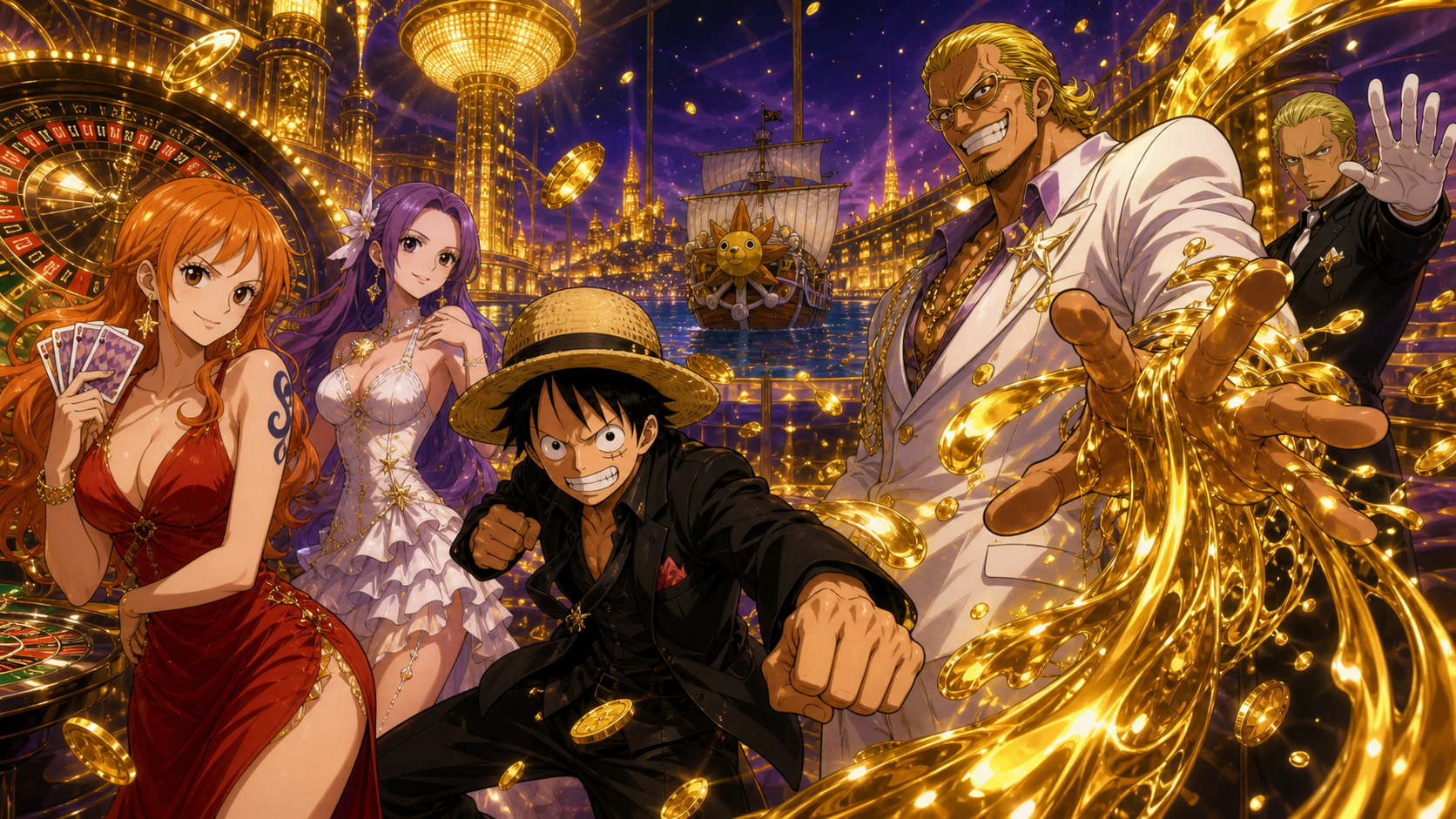
RaeRae Reviews: One Piece Film Gold
Bottom line
One Piece Film Gold turns a floating casino into a country-sized trap and asks what freedom means when debt, luck, entertainment, and government protection all belong to the same rich man. Gild Tesoro controls the gold touching every guest, but his real weapon is a system designed to make losing feel voluntary.
Released in Japan on July 23, 2016, Film Gold is colorful, loud, and built like a heist movie dressed for a red carpet. Director Hiroaki Miyamoto gives the Straw Hats tuxedos, racing cars, stage magic, and casino games. Under the glitter sits a blunt story about coercion. Gran Tesoro sells fantasy until the bill arrives.
What happens
The Thousand Sunny reaches Gran Tesoro, an enormous entertainment city recognized as an independent nation. The crew wins spectacularly at first, then Baccarat’s Luck-Luck Fruit strips Luffy of good fortune and turns a casino loss into an impossible debt.
Tesoro captures Zoro as collateral and gives the others a deadline. Nami reunites with Carina, a thief from her past, and joins a plan to steal the vault’s money. The apparent robbery becomes a larger attempt to break Tesoro’s control over guests, workers, prisoners, and the gold running through the city.
Gran Tesoro is a company town with chandeliers
The city offers gambling, racing, concerts, hotels, and luxury under one ruler. Tesoro owns the games, security, currency, information, and physical gold attached to visitors’ bodies. A guest can arrive believing money buys freedom and discover that the house also defines the debt.
The arrangement resembles a company town scaled into sovereign theater. Every pleasure routes back to the owner. Every loss increases dependence. The lights keep people watching the show instead of asking whether departure remains possible.
The casino manufactures consent
People choose to gamble, but Baccarat manipulates luck and Tesoro changes rules after the wager. Zoro’s execution threat transforms a financial loss into bodily coercion. The contract only looks voluntary because the fraud is hidden.
Film Gold understands a basic scam: power writes an unfair rule, forces the victim to accept the result, then points to the rule as proof of fairness. Tesoro does not beat the Straw Hats at a game. He uses a game to disguise capture.
Debt becomes a chain without metal
Gran Tesoro’s workers labor under debts they cannot realistically repay. The city treats the number as a moral judgment, turning poverty into evidence that the debtor deserves punishment.
The system lets wealthy spectators enjoy service without seeing captivity. Clean uniforms and smiling performances replace visible shackles. Film Gold knows exploitation becomes easier to sell when oppression has excellent lighting.
Gild Tesoro confuses ownership with safety
Tesoro’s Gold-Gold Fruit allows him to control gold he has touched. His wealth also buys political recognition, armed protection, information, and access to the World Nobles. He believes enough ownership can prevent anyone from humiliating or taking from him again.
Control cannot create safety because every relationship becomes another possession to monitor. He owns more than almost anyone and trusts nobody. The empire grows while the frightened young man at the center remains trapped inside the same loss.
Stella explains the wound, not the abuse
Before becoming Gran Tesoro’s ruler, Tesoro loved Stella, a woman enslaved by a World Noble after he could not buy her freedom. Her death and his torture destroyed his belief that love could survive without money.
That history deserves grief. His response repeats the crime against other people. Tesoro turns workers into property, punishes debtors, and builds a city where wealth decides whose body matters. Trauma can explain why a person reaches for control. Trauma cannot make slavery acceptable.
The World Government protects the casino
Gran Tesoro’s independence exists because Tesoro pays and entertains the people powerful enough to recognize his authority. World Government representatives enjoy the city while its ruler exploits guests and workers.
The relationship exposes law as a purchasable shield. Piracy receives public condemnation while a wealthy abuser receives diplomatic status. One Piece has always understood that legality and morality are not twins.
Nami recognizes the architecture of captivity
Nami spent childhood forced to steal for Arlong while trying to buy her village’s freedom. Tesoro’s debt trap, hostage leverage, and rigged promise echo that history without copying the same plot.
She knows a captor can name a price and still refuse release once payment arrives. Her heist instincts are practical, but her emotional understanding matters more. Nami has lived inside a deal where the powerful party never intended to honor the terms.
Carina and Nami share unfinished history
Carina is a singer, thief, and former rival who once crossed paths with Nami before the Straw Hats. Their reunion carries suspicion because both women survive through misdirection and understand how easily charm can conceal an exit plan.
Their rivalry works because neither is reduced to somebody’s romantic prize. They read rooms, perform roles, hide information, and measure risk. Trust arrives through action rather than a sentimental speech about friendship.
Carina refuses the role everybody assigns
Tesoro sees Carina as part of his show. The Straw Hats wonder whether she will betray them. The audience is encouraged to sort her into loyal ally or selfish thief.
Carina keeps rewriting the available choices. Her final move proves that a woman skilled at deception does not owe spectators a simple moral label. She can help free people, fool allies, and secure her own future during the same operation.
Baccarat weaponizes probability
Baccarat drains luck through touch, allowing absurd accidents to defeat stronger opponents. The ability fits a casino where chance is marketed as neutral while management secretly controls the outcome.
Her power creates one of the film’s cleanest metaphors. Wealth often calls success merit after arranging better odds for itself. Baccarat makes the rigging visible, then loses when chance swings beyond her control.
Tanaka turns walls into suggestions
Tanaka’s Through-Through Fruit lets him pass through inorganic material and move around the supposedly secure city. His ability makes him an ideal surveillance and security officer.
The power also shows that privacy belongs to management. Guests face locked doors and restricted zones while Tesoro’s employee crosses boundaries whenever authority requires. Security is freedom for the owner and confinement for everybody else.
Dice treats pain as entertainment
Dice is a muscular dealer and fighter whose masochistic pleasure turns violence into spectacle. He performs brutality with the same enthusiasm Gran Tesoro uses for concerts and races.
Zoro’s battle with him is deliberately excessive, but the matchup has a point. Dice assumes pain belongs to the show. Zoro treats combat as a test with consequences and ends the performance once the opponent’s gimmick stops being impressive.
Raise Max gives rebellion a memory
Raise Max, a legendary gambler and revolutionary, connects the casino’s prisoners to a history of resistance. His presence reminds the audience that Tesoro did not create the first unjust system and will not face the first people willing to challenge one.
He helps the captive workers recognize that individual escape is not enough. Gran Tesoro survives by isolating debtors inside shame. Collective action breaks that isolation.
The heist structure fits the Straw Hats
The crew divides into teams, assumes costumes, studies security, and moves through a plan built on timing. Their personalities constantly threaten the elegant operation, especially when Luffy approaches subtlety like a locked pantry door.
The tension between planning and improvisation feels right. Nami, Robin, Franky, and Usopp can build a layered deception. Luffy supplies the certainty that the plan will eventually need a direct punch.
Zoro as collateral changes the crew’s rhythm
Capturing Zoro removes one of the crew’s strongest fighters and creates a public execution deadline. The hostage arrangement forces the others to work through the casino rather than flattening every wall immediately.
Zoro remains calm because he trusts the crew. His confidence is not passivity. He studies the situation, waits for the opening, and returns to combat once the rescue operation reaches him.
Sanji and Robin work the room
Sanji’s social instincts and Robin’s composure suit a casino where appearances carry operational value. Both can perform sophistication without forgetting the violence underneath.
The film gives the crew glamorous outfits, but costumes function as tools. Presentation grants temporary access. The Straw Hats use the casino’s obsession with status against the people policing status.
Franky understands the machine behind the magic
Gran Tesoro looks supernatural because scale hides infrastructure. Franky’s mechanical eye helps the crew treat the city as a constructed system with pipes, controls, routes, and vulnerabilities.
That perspective matters politically as well as practically. Systems built by people can be dismantled by people. Tesoro wants his authority to feel natural and permanent. Franky sees hardware.
The gold coating is physical and political
Tesoro spreads gold dust across visitors on arrival, quietly placing their bodies within his Devil Fruit control. The welcoming spectacle is already an act of capture.
The image works because gold usually signals value. Here, the valuable substance becomes contamination. Wealth touches everybody, then the owner claims that contact gives him authority over them.
The seawater plan restores bodily freedom
The crew learns that seawater can wash away the gold dust and break Tesoro’s remote control. Their counterattack depends on distributing that freedom across the city rather than reserving escape for themselves.
A shower becomes liberation because the oppression was embedded on the skin. The visual is simple, public, and satisfying. Workers discover that Tesoro’s control can be removed.
Tesoro’s golden giant is fear made architectural
During the climax, Tesoro merges with an enormous gold construct and towers above the city. The transformation gives his private obsession the size of the system he created.
Bigger does not mean safer. The giant form isolates him further, placing more metal between Tesoro and every human connection. Luffy defeats a fortress built by someone terrified of ever feeling powerless again.
The ending lets Carina keep the last trick
After the casino falls, the apparent fortune and Carina’s choices leave the Straw Hats questioning who completed the best theft. Her exit preserves the playful rivalry with Nami.
The joke works because Carina helped destroy the captivity rather than merely taking money while workers remained chained. Freedom and self-interest occupy the same ending without becoming identical.
Direction, screenplay, and Oda’s role
Hiroaki Miyamoto directs a dense production full of racing, concerts, casino floors, prison routes, and large-scale combat. Tsutomu Kuroiwa’s screenplay builds the story around a heist before widening the operation into revolt.
Eiichiro Oda served as overall producer and designed or supervised major creative elements. Gran Tesoro feels visually specific to One Piece, while the crew’s formalwear gives the film a memorable identity beyond another island adventure.
Music and performance
Yuki Hayashi’s score moves between show-business swagger, heist tension, and heroic action. GLIM SPANKY performs the theme song “Ikari o Kure yo,” bringing a rough vocal edge that suits the movie’s anger beneath polished surfaces.
The musical production treats Gran Tesoro as a stage before revealing the backstage prison. Carina’s performance is never separate from the plot because entertainment is part of the city’s control system.
Continuity and watch order
Film Gold belongs to theatrical continuity rather than the manga’s numbered canon. The story uses the post-Dressrosa crew and assumes viewers know Sabo, Lucci, and the wider political world, though their appearances do not establish a canonical timeline.
Watch after Dressrosa for the smoothest character context. The television special Heart of Gold and the short Film Gold Episode 0 provide promotional setup, but the feature explains the essential conflict on its own.
What works
Gran Tesoro is one of the franchise’s best movie settings because visual spectacle and political meaning support each other. Nami and Carina carry the heist. Tesoro has a tragic history without receiving a moral pardon. Baccarat’s power makes rigged opportunity literal.
The crew’s costumes, team assignments, and casino games give almost everyone a role. The movie understands that a city built to sell freedom can become a convincing prison.
What does not
The crowded supporting cast leaves several cameos as fan-service punctuation. Tesoro’s history arrives late and could use more room between Stella’s loss and his transformation into an enslaver. Some final combat abandons the heist’s cleverness for familiar giant punches.
The movie also enjoys the luxury fantasy so enthusiastically that the criticism can blur during long spectacle sequences. Gran Tesoro looks fun because the trap has to tempt people, but the camera sometimes shares the temptation longer than the argument needs.
RaeRae’s verdict
Film Gold earns eight out of ten. The movie is a glitter bomb with a labor dispute hidden inside, and I mean that as praise. Nami gets a story that respects her history, Carina refuses to become predictable, and Tesoro proves that owning every room cannot make a person free.
The house always wins when the house controls luck, law, debt, and the police. The Straw Hats answer by flooding the floor, freeing the workers, and punching the owner out of his golden monument. Subtle? No. Satisfying? Absolutely.
Official sources and routes
ONE PIECE.com: official Film Gold page
Toei Animation: official Film Gold story page
Browse One Piece anime movies
Return to the One Piece anime hub