
RaeRae Reviews: One Piece Film Z
Bottom line
One Piece Film Z gives the Straw Hats their strongest theatrical opponent up to 2012 because Zephyr is more than a large man with a larger weapon. He is a former Marine admiral who trained generations of officers, lost his family and arm to pirates, watched the institution protect the pirate responsible, and answered betrayal with a plan that would kill countless civilians. Sympathy explains his collapse. Sympathy does not excuse mass murder.
Released in Japan on December 15, 2012, Film Z pairs blockbuster action with a sharp question: what happens when a man who taught justice decides only his pain deserves a future? Director Tatsuya Nagamine keeps the answer moving, but the movie never lets the volcanic spectacle erase the human failure underneath.
What happens
Z and his Neo Marines steal the Marines’ Dyna Stones, weapons said to rival the Ancient Weapons. He plans to detonate the three End Points, volcanic sites whose destruction could ignite the New World and erase every pirate along with millions of people who never chose that war.
The Straw Hats rescue Z after finding him adrift, then become his enemies once he recognizes them as pirates. Ain uses her power to reverse Nami, Robin, Brook, and Chopper’s ages. Binz controls plants. Kuzan watches the disaster take shape while Marines, pirates, and former students circle the teacher they failed to save.
Zephyr was built by the Marines
Zephyr believed in heroic justice as a child. He joined the Marines, rose to admiral, and trained recruits who later became major officers. His career gave the institution strength, discipline, and people willing to defend civilians.
The same institution treated his losses as acceptable collateral. Pirates killed his wife and child. Another pirate slaughtered most of his students and took his arm. When the World Government later made that pirate a Warlord, official justice told Zephyr that political convenience mattered more than his dead.
Betrayal does not make genocide logical
Z’s rage has a clear route. His conclusion remains monstrous. Destroying the End Points would not punish only pirates, corrupt officials, or the Warlord system. The blasts would consume islands, workers, families, children, ships, and communities across the New World.
He turns the same institutional logic against everybody else: sacrifice strangers for a goal declared necessary by the person holding power. Z hates the World Government for treating lives as expendable, then prepares an even larger grave.
The Neo Marines are a wounded family
Ain and Binz follow Z because he is their teacher and because the original Neo Marine unit survived catastrophe together. Their loyalty grows from shared trauma, gratitude, and the belief that Z gave their survival meaning.
That devotion also becomes dangerous insulation. Neither subordinate can challenge the plan without threatening the family structure holding their lives together. Love without honest opposition can become permission, especially when the beloved leader calls annihilation justice.
Ain’s power makes violation visible
Ain can reverse a person’s age by twelve years with each touch. The power turns several Straw Hats into younger bodies and makes the crew fight while their strength, reach, and social position have been forcibly altered.
The film sometimes uses the transformation for broad comedy and fan service, particularly around Nami and Robin. The stronger reading concerns stolen agency. Ain changes bodies without consent, reduces capability, and expects the victims to carry the humiliation while she continues serving a man who claims moral authority.
Nami refuses to become a visual gag
Nami remains the crew’s navigator and strategist after the age reversal. Her anger deserves more attention than the camera occasionally grants. A younger appearance does not erase her experience, memories, or right to control how other people see her.
Film Z works best when Nami’s changed body is treated as an attack to solve. The weakest shots treat that attack as audience decoration. One Piece can be funny without asking the woman who was violated to provide the joke.
Chopper’s regression changes the fight
Chopper becomes smaller and loses access to the adult body he had built through training. His medical knowledge remains, but physical capacity changes. The distinction reminds viewers that identity contains more than appearance while bodies still shape what somebody can safely do.
He keeps helping because care is his role, not because the transformation is harmless. His persistence should not be used to minimize Ain’s assault.
Robin and Brook expose the rule’s absurdity
Robin’s calm makes the reversal feel almost clinical, while Brook’s unusual body turns the age mechanic into a stranger problem. Their reactions show how a simple Devil Fruit rule creates different consequences across radically different lives.
The movie does not explore every implication, but the variation keeps Ain from feeling like a generic beam attacker. Her ability attacks history, embodiment, and readiness at once.
Luffy and Z are competing definitions of strength
Z believes strength comes from the power to eliminate threats permanently. Luffy sees strength as the ability to protect chosen people and continue forward without demanding that the entire world validate his pain.
Their conflict is not a debate conducted politely. Luffy punches through Z’s certainty because Z has put the crew and the New World in danger. Still, the final fight becomes intimate. Two stubborn men strip away fleets, titles, and weapons until belief has to survive bare fists.
The Battle Smasher tells Z’s whole story
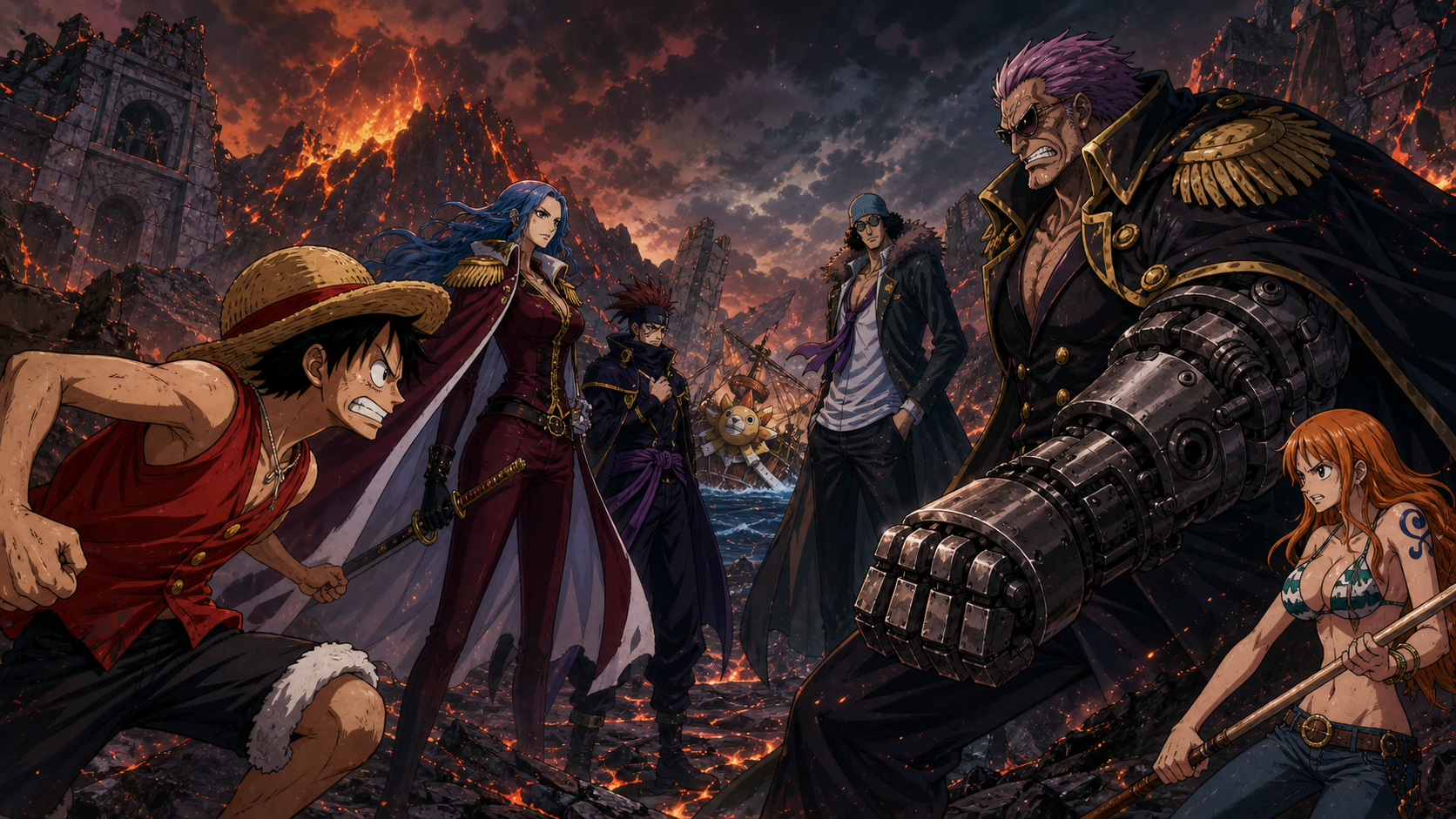
The enormous mechanical arm replaces what a pirate took from him. The weapon is protection, prosthesis, status symbol, and prison. Every blow announces that Z survived, but every movement also keeps the original loss attached to his body.
Technology allowed him to keep fighting. No machine repaired trust, grief, or the belief that justice had meaning. The Battle Smasher looks powerful because the emotional wound remains unresolved.
Kuzan arrives as witness and warning
Kuzan knows Z as a teacher. He also knows the Marines from the inside and has already walked away from active service. His presence connects Z’s past students to the institution’s uncertain future.
He does not excuse the End Point plan. He gives the audience context, carries respect for the man Z once was, and understands that stopping a former mentor can still involve mourning him. Adulthood sometimes means opposing the person who taught you because their lesson has curdled into destruction.
Kizaru represents institutional continuity
Borsalino approaches the conflict as a Marine admiral facing a catastrophic enemy. The history between teacher and student remains under the combat. Z trained him, yet both men now occupy positions that make reconciliation nearly impossible.
Kizaru’s light attacks against Z are not framed as joyful revenge. The battle shows an institution continuing after one of its builders breaks. Continuity can look cold when the system survives more easily than the people who served Zephyr.
The Marines cannot wash their hands
Z chooses the final atrocity, so responsibility belongs to him. The Marines and World Government still helped create the conditions. The Warlord appointment tells victims that political usefulness can erase accountability.
Film Z becomes more interesting when viewers hold both truths together. An institution can betray someone. That betrayal does not transfer moral innocence to every later choice the victim makes.
The Straw Hats act like a post-timeskip crew
This is the first One Piece theatrical film built around the nine Straw Hats after the two-year separation. Their confidence, techniques, and visual designs reflect the New World era.
Z overwhelms them early, which gives the later return weight. They gather information, recover from Ain’s effects, change clothing, and attack with a clearer understanding of the enemy. The rematch feels earned rather than scheduled.
Sanji, Zoro, and the lieutenants
Sanji faces Binz while Zoro confronts Ain, allowing the crew’s principal fighters to dismantle the Neo Marine support structure. Both fights provide spectacle and keep Luffy’s duel from pretending one captain can defeat an organization alone.
Ain and Binz remain loyal through defeat. Their pain after Z’s final decision lands because the movie established them as followers who see a father and teacher where the world sees a terrorist.
The final fist fight earns silence
Luffy and Z eventually fight without the Battle Smasher and without elaborate finishing tricks carrying the emotional load. The exchange becomes slower, bruising, and personal.
Z recognizes something he once believed in: a young person moving forward with absolute commitment. Luffy does not redeem him through kindness. The fight forces Z to look at courage that has not turned grief into permission to erase strangers.
Z’s last stand is not absolution
After losing to Luffy, Z stays behind to block the Marines and protect the Straw Hats’ escape. He dies fighting former students while Ain and Binz grieve.
The sacrifice restores a fragment of the teacher he used to be. The final stand does not cancel the attempted destruction of the New World. Redemption can mean choosing one right action at the end without pretending the earlier harm vanished.
Oda’s involvement sharpened the theatrical identity
Eiichiro Oda served as original creator and overall producer, giving the film a stronger design and character connection than many earlier entries. Z feels built for One Piece rather than imported from a generic action script.
Oda’s involvement does not make Film Z manga canon. The distinction matters for chronology and power debates, but creative oversight helps explain why the antagonist, costumes, and emotional themes fit the franchise so well.
Direction, screenplay, and scale
Tatsuya Nagamine directs with confidence across naval attacks, volcanic landscapes, comedy, and the stripped-down final duel. Osamu Suzuki’s screenplay keeps the End Point threat understandable while giving Z enough history to carry the film.
The middle section occasionally juggles too many detours, transformations, and costume moments. The production recovers whenever Z, Kuzan, or the institutional argument returns to the center.
Music and Avril Lavigne’s songs
Kohei Tanaka and Shiro Hamaguchi provide the orchestral score, connecting Film Z to the musical language of the television series while expanding the theatrical weight.
Avril Lavigne’s versions of “How You Remind Me” and “Bad Reputation” create an unusual international texture. “Bad Reputation” fits the pirates’ refusal to seek respectable approval. “How You Remind Me” carries a bruised memory that suits Z’s inability to live outside what happened.
Continuity and watch order
Film Z is a theatrical continuity story rather than a manga-canon chapter. The crew has reunited after the time skip, the Thousand Sunny carries all nine members, and New World concepts shape the setting.
Watch after the Fish-Man Island material and after the Film Z television tie-in episodes if you want the promotional route. The movie can stand alone once viewers know the post-timeskip crew. No later canon episode requires Z’s story.
What works
Z is a memorable antagonist with a believable history, a terrible plan, and relationships that make his defeat hurt. Kuzan adds moral texture. The final fist fight has restraint. The soundtrack, volcanic settings, and post-timeskip crew designs give the movie real theatrical scale.
The story also refuses the lazy idea that suffering automatically makes somebody correct. Z deserved justice for his losses. The people of the New World did not deserve to die because he never received that justice.
What does not
The age-regression material slips into framing that undercuts the violation. Several Straw Hats receive stylish combat without enough character work. The End Point science asks the audience to accept enormous geological stakes with little explanation.
The World Government’s Warlord betrayal remains intentionally vague because the responsible pirate was not named in the film. That choice preserves mystery but weakens the institutional confrontation that could have made Z’s history even sharper.
My read: I think Film Z earns the scale because Zephyr’s grief is tied to an institution that used him, discarded him, and kept demanding faith. Sympathy cannot excuse collective punishment. The movie understands that distinction. My favorite material lets Luffy reject Zephyr’s conclusion without pretending the Marines offered the old man justice.
RaeRae’s verdict
Film Z earns eight and a half out of ten. Zephyr is one of the franchise’s best movie villains because the audience can mourn the teacher without forgiving the would-be killer. His story understands how institutions manufacture loyalty, spend people, and act surprised when the discarded come back carrying weapons.
Luffy wins because he refuses Z’s final lie: pain does not grant ownership of everybody else’s future. That answer comes through fists, lava, a broken mechanical arm, and a crew that keeps choosing one another. One Piece rarely needs a courtroom when the moral evidence can throw a punch.
Official sources and routes
Toei Animation: official Film Z page
ONE PIECE.com: official Film Z page
Browse One Piece anime movies
Return to the One Piece anime hub