
RaeRae Reviews: Episode of Chopper Plus
Bottom line
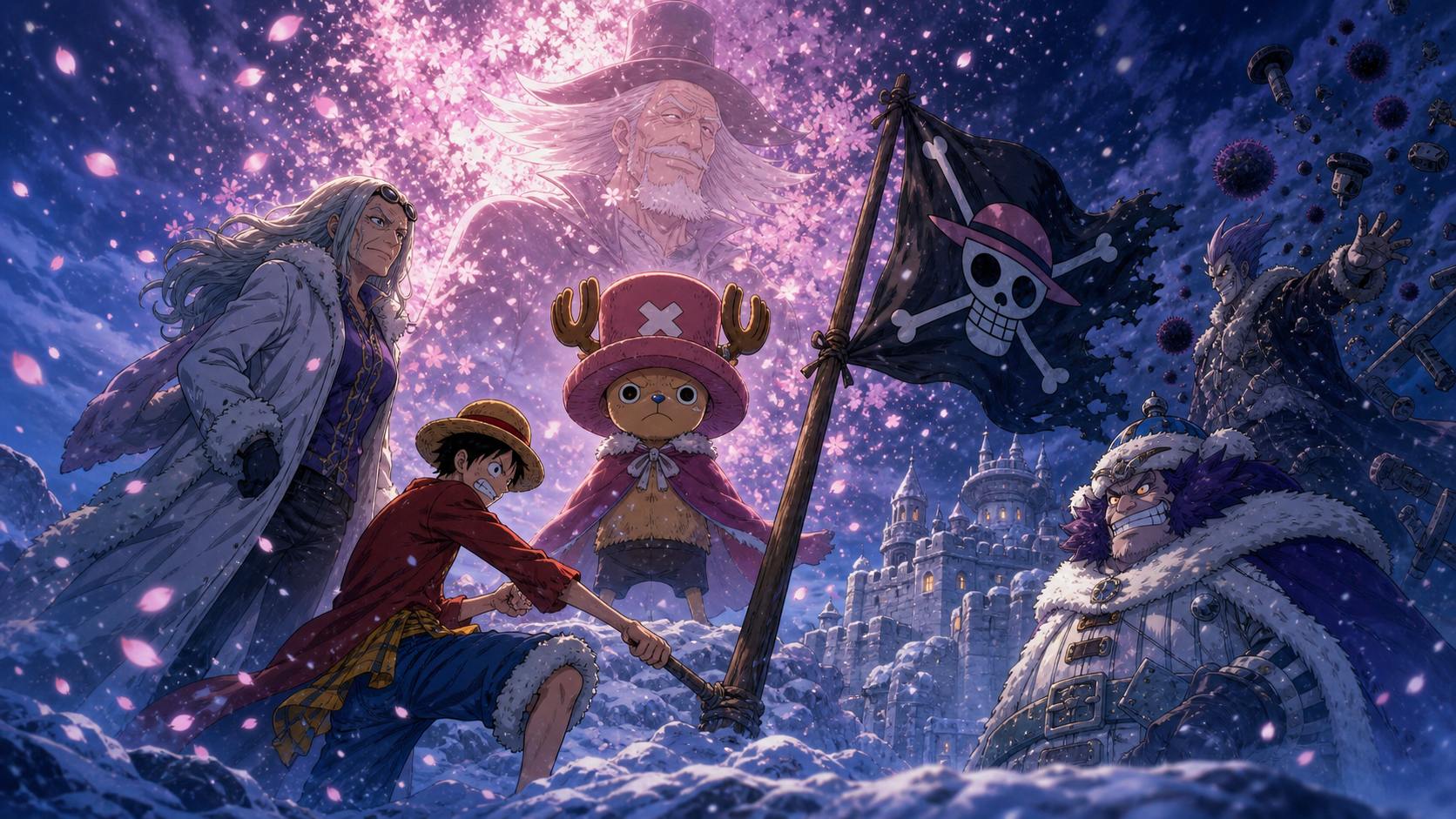
Episode of Chopper Plus: Bloom in Winter, Miracle Sakura takes the Drum Island story, moves the timeline around, adds Robin and Franky before Chopper joins, invents a second royal brother with mushroom powers, and somehow protects the emotional core better than Episode of Alabasta protected its kingdom.
Released in Japan on March 1, 2008, the ninth film remains an alternate retelling rather than a canon shortcut. Hiriluk, Kureha, Chopper, the flag, and the winter sakura still carry the movie. The continuity changes are loud. The grief is louder.
What the movie rebuilds
Nami becomes dangerously ill while the Straw Hats approach Drum Island. Luffy climbs the mountain with Nami and Sanji, nearly destroying his own hands to reach the only doctor available. Doctor Kureha treats them, and Chopper encounters a pirate crew that does not immediately treat a blue-nosed talking reindeer as a monster.
Wapol returns to reclaim the kingdom with his older brother Musshuru. The brothers attack the castle and Hiriluk’s flag. Chopper must decide whether belonging to his dead mentor requires staying beside the grave or carrying the doctor’s dream beyond the island.
This is an alternate timeline on purpose
Robin and Franky travel with the Straw Hats before Chopper joins. Vivi is absent. The Thousand Sunny replaces the Going Merry. Wapol gains a brother who did not exist in the original Drum Island arc.
Those changes make a clean canon placement impossible. The film does not ask viewers to squeeze a new event between episodes. The filmmakers rebuild the arc with a later crew configuration and test whether Chopper’s origin can survive the rearrangement.
Chopper’s loneliness still controls the story
Chopper is rejected by reindeer because of his blue nose, then feared by humans after eating the Human-Human Fruit. His body crosses categories without granting automatic access to either community.
The pain is not generic loneliness. Chopper learns that visibility can become danger before anybody hears him speak. Every offer of friendship must compete with years of evidence telling him that being noticed ends badly.
Hiriluk sees a person before a specimen
Hiriluk names Chopper, feeds him, argues with him, and gives their shared life the structure of family. The doctor does not require Chopper to become less strange before offering care.
That acceptance changes the boy’s idea of medicine. Healing becomes connected to dignity, imagination, and the stubborn belief that a person is larger than the condition everybody else can see.
Hiriluk is also a terrible doctor
The movie does not erase the uncomfortable fact that Hiriluk’s medical confidence exceeds his competence. He experiments, makes mistakes, and relies on belief where training should matter.
His value comes from recognizing people abandoned by the kingdom’s medical system, not from secretly being correct about every treatment. Kureha carries the clinical knowledge. Hiriluk carries a social diagnosis: a country can be sick even when the ruler’s body feels fine.
Chopper’s mushroom is love without knowledge
Chopper searches for a mushroom marked by a skull because he believes the symbol represents a miracle cure. He nearly dies retrieving the specimen and brings poison to the person he most wants to save.
The tragedy refuses to mock his effort. Love cannot replace literacy, training, or accurate information. Hiriluk accepts the mushroom because rejecting Chopper’s gift would crush the child before death arrives anyway. That kindness does not make the poison medicine.
Kureha refuses sentimental medicine
Doctor Kureha is skilled, abrasive, disciplined, and completely unimpressed by inspirational nonsense that ignores biology. She understands what Hiriluk cannot treat and what Chopper still needs to learn.
Her grief appears through action rather than softness. Kureha protects the castle, trains Chopper, preserves Hiriluk’s research, and eventually creates the sakura display. She does not become gentle to prove she cared.
Wapol governs through medical scarcity
Wapol gathers doctors under royal control and denies care to ordinary people unless obedience serves his power. Health becomes a permission system rather than a public need.
The policy explains why Hiriluk’s reckless practice found patients. When trained care is deliberately withheld, desperate people accept dangerous alternatives. Wapol creates the conditions that let quack medicine look like resistance.
Musshuru expands the disease metaphor
The film gives Wapol an older brother, Musshuru, whose Spore-Spore Fruit produces toxic fungal attacks. His power turns contamination into a visible threat across the snow.
Musshuru is not as thematically necessary as Wapol. He does give the retelling a new final opponent and prevents the movie from merely redrawing the television fights. His poison also forces Chopper’s medical identity closer to the action.
Robin changes the information balance
Robin’s presence means the crew already includes a scholar who recognizes history, political manipulation, and the importance of inherited symbols. She understands Chopper’s isolation from a position shaped by her own long exclusion.
The movie could use that parallel more directly. Robin mostly supports the expanded crew structure, but every quiet reaction reminds returning viewers that Chopper is joining people whose belonging was never simple.
Franky makes the timeline impossible and the theme useful
Franky should not be aboard before Chopper in canonical chronology. The contradiction is obvious and deliberate. His presence adds a crewmate whose body also crosses the boundary between human and visibly modified.
Franky treats unusual anatomy as construction rather than shame. The film does not build a large conversation between them, but the visual pairing supports Chopper’s future: this crew keeps collecting people the world categorizes too quickly.
Luffy’s mountain climb remains brutal
Luffy carries Nami and Sanji up a vertical frozen mountain while wind, ice, exhaustion, and bare hands strip away the adventure fantasy. Strength does not protect him from temperature or torn skin.
The climb proves leadership through labor. Luffy cannot heal Nami. He can refuse to drop her and place his body between his friends and the mountain. The distinction keeps the rescue from becoming another combat victory.
The pirate flag is a claim about belief
Hiriluk’s skull-and-crossbones does not represent legal piracy or a fleet. The flag represents a dream that survives public ridicule and state violence. Wapol attacks the flag because independent belief threatens rulers who demand ownership over every institution.
Luffy defends the symbol without knowing Hiriluk. He understands that a flag becomes real through the conviction attached to the cloth. Destroying fabric cannot defeat that conviction, but laughing at somebody’s dream still deserves a punch.
The sakura ending earns the tears
Hiriluk wanted to heal Drum Island by recreating the sight that once changed his own life: cherry blossoms across a winter sky. Kureha completes the chemical research and turns snow into a pink flowering spectacle.
The display does not cure every institution overnight. The sakura gives the country a shared interruption, a moment when grief, memory, and possibility become publicly visible. Beauty cannot replace reform. Beauty can help people imagine that the permanent winter was never permanent.
Chopper joins by running away from the goodbye
Chopper wants the sea and fears leaving the only home that ever accepted him. Luffy responds with volume because subtle recruitment has never been his department. Kureha responds by driving Chopper toward departure.
Her violence is comic staging around a serious parental act. She refuses to let gratitude become a cage. Training prepared Chopper to heal beyond Drum Island, and love means allowing that future to begin without asking him to manage her loneliness.
The remake keeps more connective tissue
Episode of Alabasta had to represent a national civil war, multiple cities, several officer battles, ancient weapons, and a long political conspiracy. Chopper Plus focuses on one island, one medical system, and one child’s origin.
The narrower story survives compression more effectively. Major emotions still receive setup, repetition, and consequence. Added action creates clutter, but the central relationships have time to breathe.
Director and screenplay
Official Toei records credit Junji Shimizu as director and Hirohiko Uesaka as screenwriter. The production redraws Drum Island with theatrical snow, expanded action, and a later-version crew.
ONE PIECE.com also records Eiichiro Oda’s participation from the planning stage. That involvement does not make the alternate continuity canonical. The planning connection helps explain why the changes feel like a deliberate remix rather than an accidental continuity collapse.
Japanese performances
Ikue Otani gives Chopper fear, rage, childish hope, and grief without turning his small voice into a permanent request for pity. Shigeru Ushiyama makes Hiriluk reckless, loving, and painfully aware of his remaining time. Masako Nozawa gives Kureha enough steel to cut through every easy tear.
Mayumi Tanaka makes Luffy’s defense of the flag sound morally immediate. Bin Shimada returns Wapol to loud entitlement, while guest performer Monta Mino gives Musshuru a theatrical menace suited to the expanded movie threat.
Continuity and watch order
Chopper Plus adapts canonical Drum Island material inside a deliberately altered continuity. Robin and Franky are present before Chopper joins, Vivi is absent, and Musshuru is film-original.
First-time viewers should watch the original Drum Island episodes, 78 through 91, or read the corresponding manga chapters first. Returning viewers can approach the movie as a “what if the later crew retold Chopper’s beginning?” production. No numbered episode follows this version.
What the movie gets right
Chopper remains the center. Hiriluk and Kureha retain different forms of love. Wapol’s medical monopoly stays political. The flag and winter sakura keep their symbolic force. The mountain climb still hurts.
The film understands that Chopper does not need acceptance because he is secretly normal. He needs people willing to expand their definition of who counts.
What the movie changes too far
Franky and Robin weaken the clean chronology, and the film never fully earns their insertion through new relationship material. Musshuru adds spectacle while pulling time from Dalton, the villagers, and the country’s political recovery.
The alternate structure also removes Vivi, whose compassion originally connects Drum Island to the responsibility waiting in Alabasta. The emotional center survives, but the voyage around Chopper becomes less continuous.
My read: I appreciate Episode of Chopper Plus as an alternate emotional experiment, not a cleaner Drum Island. Robin and Franky change the crew context, while the expanded villain material changes the pressure around Chopper’s choice. The additions are interesting, but Hiriluk, Kureha, and Chopper still need quiet space. More spectacle cannot substitute for the small terror of asking whether anybody wants you.
RaeRae’s verdict
Episode of Chopper Plus earns eight out of ten. The continuity is a snowman assembled with parts from three different winters, but Chopper, Hiriluk, Kureha, the flag, and the sakura still work. The film remembers that the origin is about medicine, exclusion, and permission to leave home.
Watch with the original arc already in your bones. Cry when the sky turns pink. Then give Kureha the credit, because Hiriluk supplied the impossible dream and she did the research required to keep that dream from poisoning anybody else.
Official sources and routes
ONE PIECE.com: official Chopper Plus page
Toei Animation: official story, cast, and staff
ONE PIECE.com: Oda planning participation and 2014 special edition
Browse One Piece anime movies
Return to the One Piece anime hub