
RaeRae Reviews: Episode of Alabasta
Bottom line
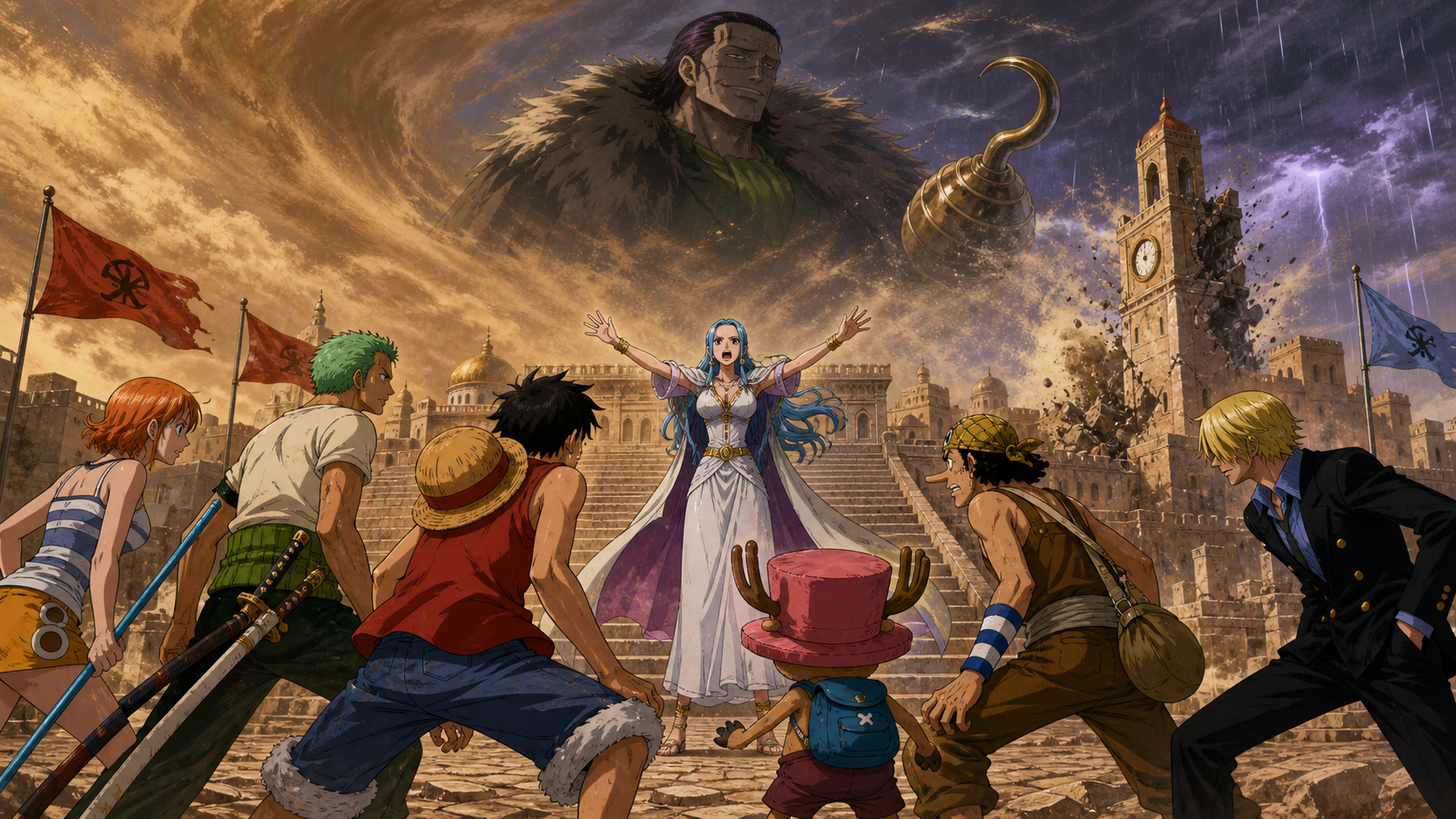
Episode of Alabasta: The Desert Princess and the Pirates tries to compress one of One Piece’s first great political sagas into ninety minutes. The movie keeps Vivi’s desperation, Crocodile’s conspiracy, the civil war, the clock-tower bomb, and the silent goodbye. The movie also cuts so much travel, trust, and social damage that several famous moments arrive before the audience has enough time to feel their full weight.
Released in Japan on March 3, 2007, this eighth theatrical film is not a replacement for Episodes 92 through 130. The remake works as a beautifully animated memory of Alabasta for people who already know the arc. New viewers receive the plot’s skeleton while the original series keeps most of the heartbeat.
What the movie retells
Princess Vivi returns to Alabasta with Luffy, Zoro, Nami, Usopp, Sanji, and Chopper. A manufactured drought and Dance Powder scandal have convinced citizens that King Cobra hoarded rain. Rebel leader Koza prepares to confront the royal army.
Crocodile created the crisis through Baroque Works while presenting himself as the kingdom’s hero. He wants the country weakened, Cobra captured, and information about the ancient weapon Pluton. The crew separates to fight officer agents while Vivi races to stop two armies from killing one another.
Vivi is the protagonist, even when Luffy gets the final punch
The title calls Vivi the Desert Princess because the story belongs to her impossible responsibility. She knows both sides are being manipulated. She loves the king, Koza, the royal guard, and citizens who no longer trust the palace. Every route toward peace requires reaching people before Crocodile’s manufactured evidence reaches them.
Luffy defeats the villain. Vivi carries the political and emotional argument. Her refusal to treat casualties as numbers separates leadership from Crocodile’s arithmetic.
The compression starts with missing distance
Alabasta is enormous, hot, and divided by unequal access to water. The television arc makes the crew cross that space, meet ordinary citizens, and understand how a national crisis looks outside the capital. The movie moves quickly between major locations.
Faster travel protects runtime, but distance is part of the conflict. Vivi cannot simply announce the truth because geography, rumor, military movement, and exhaustion control who can hear her. Removing the road makes several failures look less inevitable.
Dance Powder is political technology
Dance Powder creates rain in one location by stealing moisture that would have fallen elsewhere. Crocodile uses the substance and planted evidence to turn climate suffering into a legitimacy crisis.
The scheme works because citizens can see the result. Alubarna receives rain while other regions dry out. A lie attached to visible inequality travels faster than a distant explanation. Crocodile does not ask people to imagine betrayal. He manufactures conditions that make betrayal look obvious.
Crocodile understands public trust
Crocodile performs heroism while Baroque Works creates the emergencies he appears to solve. Citizens see a powerful Warlord defending them and have no reason to connect him with hidden agents or stolen rain.
His plan is stronger than simple conquest because the kingdom helps destroy itself. Once royal soldiers and rebels accept incompatible stories, Crocodile only needs to prevent communication long enough for bloodshed to become self-sustaining.
Koza needs more room than the movie gives him
Koza is not a random rebel who likes dramatic flags. He grew up with Vivi, organized around real suffering, and spent years watching communities lose water and faith. Crocodile manipulates him because Koza’s anger has evidence, even when the explanation is false.
The shortened version preserves his function but reduces his social history. Without Yuba, Toto, and the longer childhood connection, Koza risks looking like a man who could have solved everything by checking his messages.
Luffy and Vivi argue about the cost
Luffy refuses Vivi’s plan to protect everybody without risking the crew. He forces her to include their lives in the price of stopping the war. The confrontation is blunt because he recognizes that her self-sacrifice has become another form of control.
The movie keeps the core disagreement, but the television build gives the scene more force. Luffy has watched Vivi carry a nation alone across the desert. His challenge comes from attention, not a generic captain speech.
The crew fights show what friendship means politically
Zoro, Nami, Usopp, Sanji, and Chopper do not defeat Baroque Works merely to clear a path for Luffy. Every fight buys Vivi time. Their bodies become part of a political intervention in a country where they hold no office.
That choice gives the arc unusual scale. Friendship does not replace institutions, agriculture, or public trust. Friendship helps one person survive long enough to confront a system designed to make truth arrive late.
Nami versus Miss Doublefinger still matters
Nami’s first major Clima-Tact fight mixes fear, invention, weather knowledge, and a weapon whose instructions are nearly criminal. The comedy never erases the danger. She learns the tool while Miss Doublefinger attacks with lethal precision.
The movie condenses the learning curve, which makes the victory cleaner and less personal. The original battle works because Nami converts a ridiculous gift from Usopp into control over the same atmospheric forces Crocodile has exploited nationally.
Usopp and Chopper refuse the easy humiliation
Usopp and Chopper face Mr. 4, Miss Merry Christmas, and Lassoo with less raw power than their opponents. The fight depends on traps, endurance, teamwork, and Usopp’s refusal to let anyone mock Luffy’s dream.
Compression preserves the declaration but reduces the punishment that makes his stand land. Usopp’s courage is not the absence of fear. Courage is what remains after his body has offered several excellent reasons to stay down.
Sanji’s Mr. Prince work loses context
Sanji’s phone deception and rescue planning establish him as the crew member who can win before entering the room. The Mr. Prince identity matters because Crocodile thinks he has accounted for every Straw Hat.
The film keeps the main machinery of the rescue but has little space for the running misdirection. Sanji remains effective while one of the arc’s best strategic jokes becomes a faster plot function.
Zoro versus Mr. 1 is about perception
Mr. 1 turns his body into steel blades, forcing Zoro beyond ordinary strength. Zoro’s breakthrough involves hearing the breath of objects and understanding when to cut or not cut.
The duel belongs to his development, not merely a new attack. The remake delivers visual impact, but the television pacing lets failure, memory, danger, and insight build into one of his defining swordsman moments.
Bon Clay carries a different kind of loyalty
Bon Clay begins as an enemy agent whose Clone-Clone Fruit helps manufacture political evidence. His friendship with the Straw Hats complicates the clean division between Baroque Works and its targets.
The farewell sacrifice shows that affiliation and moral choice are not identical. The movie cannot fully develop every meeting and reversal, so his loyalty lands most strongly for viewers bringing television memory into the theater.
Robin is trapped by audience knowledge
During Alabasta, Nico Robin is Miss All Sunday, Crocodile’s partner, and a scholar pursuing the poneglyph. The film appeared years after viewers knew her as a Straw Hat. That later familiarity changes every antagonist scene.
The remake cannot restore original uncertainty. Yuriko Yamaguchi still gives Robin cool distance and private calculation, but audiences already know where her story travels. The tension shifts from “Who is she?” to “How does this alliance finally break?”
Luffy loses before the story lets him win
Crocodile defeats Luffy because sand drains moisture and ordinary punches cannot hold a dispersed body. Luffy returns using water, then eventually blood, to make Crocodile tangible.
The sequence teaches power-system rules through failure. Determination does not cancel mechanics. Luffy survives because others help him, he observes the weakness, and he accepts increasingly brutal costs. The movie’s speed makes the repeated defeats feel close together, but the escalation remains clear.
The civil war is the real weapon
The clock-tower bomb can kill thousands, yet Crocodile’s more dangerous weapon is the story each army believes about the other. Even after Vivi reaches the battlefield, noise and momentum prevent her voice from stopping the clash.
That failure is the point. Truth does not automatically defeat organized misinformation. People need access, trust, time, and a way to hear one another. Crocodile attacks all four.
Pell and the bomb still divide viewers
Pell carries the bomb away from the capital and appears to sacrifice his life. His later survival weakens the finality of a scene staged as death. The criticism is fair because consequence depends on what a story asks viewers to believe in the moment.
Pell’s action remains courageous. Survival does not erase his choice, but the refusal to hold the loss changes the emotional accounting. The movie inherits that problem from the source rather than solving the contradiction.
The silent goodbye survives compression
Vivi cannot openly acknowledge the Straw Hats without exposing the kingdom’s connection to pirates. The crew raises marked arms while sailing away, answering her question without creating evidence the Marines can use.
The image works because the relationship has moved beyond public language. Even in a shortened retelling, the raised X marks carry love, political caution, and a promise that distance does not revoke membership.
Direction and adaptation choices
Official Toei records credit Takahiro Imamura as director and Hirohiko Uesaka as screenwriter. The film uses updated theatrical animation, sharper effects, and condensed transitions to turn a long television saga into a single sitting.
The adaptation favors recognizable climaxes over connective tissue. That decision makes sense for returning fans and limits the movie for newcomers. Alabasta was never only a sequence of fights. The missing ordinary lives explain why the kingdom is worth saving.
Japanese performances
Misa Watanabe gives Vivi urgency without making every plea sound identical. Mayumi Tanaka separates Luffy’s anger at Crocodile from his frustration with Vivi’s self-erasure. Ryūzaburō Ōtomo makes Crocodile calm enough to sound like power already belongs to him.
Kazuya Nakai, Akemi Okamura, Kappei Yamaguchi, Hiroaki Hirata, and Ikue Otani carry major battles at compressed speed. Yuriko Yamaguchi plays Robin with the double awareness created by a prequel retelling released after her later development.
Continuity and watch order
Unlike the previous original films, Episode of Alabasta adapts canonical manga and television events. The movie is a separate condensed version, not an additional adventure inside the timeline.
First-time viewers should watch Episodes 92 through 130 or read the corresponding manga material before using this film as a recap. Returning viewers can watch the movie after Episode 130. Do not place the remake as a new event after Enies Lobby merely because the theatrical release came later.
My read: I cannot treat Episode of Alabasta as a replacement for the saga. The compression preserves famous images and loses the slow accumulation of drought, distrust, travel, and Vivi’s exhaustion. I value the special as a memory object for viewers who already know the country. New viewers deserve the full political build before the clock tower asks them to feel a nation tearing itself apart.
RaeRae’s verdict
Episode of Alabasta earns seven out of ten as a theatrical recap and five out of ten as an introduction. Vivi, Crocodile, the fights, the bomb, and the goodbye remain powerful. The country loses too much road, history, and civilian life to make the political crisis feel as complete as the series version.
Watch for refreshed animation and the emotional landmarks. Then watch the actual arc if the movie was your first visit. Alabasta deserves more than a highlight reel, and Vivi deserves enough time for every failed attempt to stop the war to hurt.
Official sources and routes
ONE PIECE.com: official Episode of Alabasta page
Toei Animation: official story
Toei Animation: official staff credits
Browse One Piece anime movies
Return to the One Piece anime hub