
RaeRae Reviews: The Giant Mechanical Soldier of Karakuri Castle
Bottom line
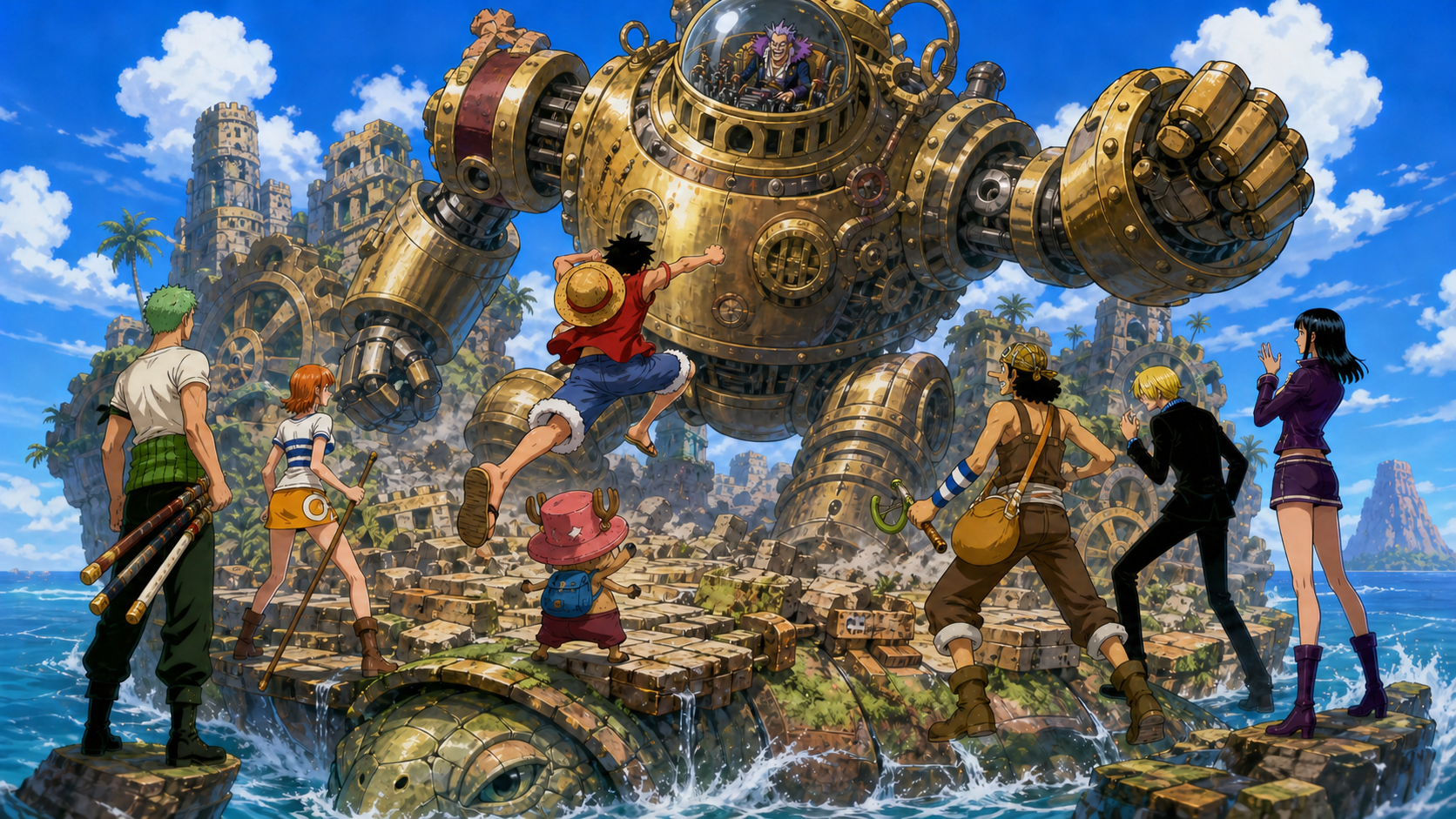
The Giant Mechanical Soldier of Karakuri Castle takes One Piece back to bright, shameless adventure comedy after Baron Omatsuri dragged everybody through a carnivorous grief nightmare. The seventh film has a grandmother inside a treasure chest, a smug inventor with the emotional maturity of a bent spoon, an island song full of clues, and a mechanical weapon built on top of a sleeping turtle.
Released in Japan on March 4, 2006, the movie is lighter than the franchise’s best films and much smarter about physical comedy than the title suggests. Director Kōnosuke Uda keeps the machinery readable, lets the crew solve problems together, and understands that an ancient island-sized turtle is already funny. Nobody needs to add twelve speeches about destiny.
What happens on Mecha Island
During a Grand Line storm, the Straw Hats rescue a treasure chest from a sinking pirate ship. The chest contains Roba, an elderly woman with golden dentures who offers them the legendary Golden Crown if they return her to Mecha Island.
Her son Ratchet rules the island from Karakuri Castle and calls himself a genius inventor. The crew follows clues hidden in a local song, survives elaborate traps, and learns that the island’s greatest treasure is tied to a colossal turtle. Ratchet wants to control that power with an expanding mechanical soldier.
Roba knows exactly how to manage pirates
Roba enters screaming because she believes another crew kidnapped her. Once she understands the situation, she offers treasure and transportation becomes negotiable. The old woman is frightened, opportunistic, sharp, and fully aware that Luffy will chase a shiny promise.
Her golden dentures turn the visual joke into character information. Roba likes display, knows the island’s stories, and refuses to behave like a fragile parcel. The movie gives her enough nerve to survive both pirates and her son’s ego.
The island song makes exposition useful
The Straw Hats treat a folk song as a treasure map. Each verse points toward geography, mechanisms, or local history. The device lets Robin, Nami, Usopp, and Chopper contribute without stopping the story for a lecture.
Oral tradition also fits the island better than a convenient written diagram. A song can survive rulers, broken buildings, and generations of people who no longer understand every reference. The clues feel embedded in community memory rather than planted for the protagonists.
Ratchet is genius without judgment
Ratchet can build machines. That fact does not make him wise, brave, or capable of recognizing a boundary. He treats invention as proof that every object and creature should submit to his control.
His vanity drives the conflict more than greed. The Golden Crown matters because ownership would confirm his self-image. Ratchet wants the island to applaud his intelligence while his plans repeatedly depend on information preserved by people he dismisses.
Maji and Honki turn loyalty into workplace comedy
General Maji and Colonel Honki support Ratchet with the exhausted energy of employees whose boss added “evil conquest” after lunch. Their physical confidence rarely matches the quality of the plan.
The pair keeps the villain plot from becoming heavy. They also expose Ratchet’s leadership. He demands admiration, delegates risk, and treats failure as somebody else’s personal defect. The machinery may be complicated. The management style is painfully ordinary.
The traps respect the crew’s different skills
Karakuri Castle works as an obstacle course because no single fighter can punch through every mechanism. Nami reads patterns. Robin notices history. Usopp understands improvised systems. Sanji and Zoro manage physical threats. Chopper handles scale and movement. Luffy creates several new problems while solving the first one.
The ensemble design gives the middle act momentum. A good One Piece puzzle lets intelligence and personality collide. The answer should feel obvious only after the crew has made the mechanism look ridiculous.
Nami and Robin do the actual treasure work
Nami keeps the Golden Crown objective connected to navigation, value, and risk. Robin approaches the island song as cultural evidence rather than a cute performance. Together, their questions reveal more than Ratchet’s machines.
The film never pretends the loudest person discovered the truth. Luffy reaches the final fight because other crew members interpret the island around him. That division of labor makes the victory belong to the group.
Usopp belongs in a mechanical adventure
Usopp understands tools as extensions of limited resources. Ratchet treats machines as monuments to superiority. The contrast could support an even larger rivalry, but the movie still gives Usopp useful reactions to the castle’s moving parts.
His fear also functions as assessment. When Usopp says a device looks unsafe, the audience should listen. A terrified inventor is still an inventor, and survival has taught him to notice exactly where a ridiculous machine may fail.
Chopper’s temporary voice change
Kazue Ikura performs Chopper in this movie while Ikue Otani was on maternity leave. The change is audible, especially for viewers who know Chopper’s television cadence, but Ikura does not turn the character into an imitation built from catchphrases.
Her performance keeps Chopper earnest, excitable, and physically small inside enormous mechanical spaces. The temporary casting belongs in the production record because voice continuity shapes how familiar a crew feels.
The turtle reveal is the movie’s best joke
Mecha Island is not merely shaped like a turtle. The land rests on a living ancient turtle whose awakening rearranges every assumption about the castle, treasure, and weapon.
The reveal works because the movie plants physical clues through tremors, geography, song lyrics, and mechanisms. Scale becomes the punch line. Ratchet has spent the story trying to dominate an island while failing to notice that the island can leave.
The Golden Crown means something different than gold
Ratchet imagines a treasure that can be possessed and displayed. The island song points toward an older relationship between people and the turtle. The crown is bound to knowledge, scale, and responsibility rather than a portable pile of wealth.
One Piece often rewards treasure hunters by changing the definition of treasure without mocking the desire to search. The crew still wants riches. The discovery matters because the journey teaches them what the island values.
The giant soldier stays visually readable
The mechanical soldier grows through multiple configurations, but the animation keeps joints, weapons, cockpit, and movement direction clear. Brass surfaces and large circular forms separate the machine from the stone castle.
Readable mechanics improve comedy and action at the same time. Viewers need to understand how a device should function before a failure becomes funny. Random metal noise cannot deliver a setup.
Luffy’s strange power-up looks familiar
During the climax, Luffy’s body briefly shows a speed-and-steam effect that resembles Gear Second. The film arrived while the anime had not yet broadcast Luffy’s canonical Enies Lobby debut of that technique.
The moment does not place the movie inside manga continuity, and the screenplay does not explain a formal transformation. Treat the scene as visual overlap or theatrical foreshadowing, not a secret canon origin. The resemblance remains one of the film’s most discussed details for a reason.
Comedy after Omatsuri is a deliberate reset
The previous film isolated the crew and turned familiar arguments into horror. Karakuri Castle immediately restores group rhythm. Crew members complain, chase treasure, solve traps, and protect one another without requiring suspicion to drive the plot.
That shift may disappoint viewers who wanted another formal experiment. The lighter tone also proves the movie line can change shape without declaring one mood more authentic than another. One Piece needs room for terror and giant-turtle nonsense.
Direction and screenplay
Official Toei records credit Kōnosuke Uda as director and Masahiro Ito as screenwriter. Uda understands the television ensemble because he directed major franchise material before this film. His staging favors momentum, reaction shots, and clean group action.
Ito builds the plot around escalating mechanisms and a solvable song. The story never reaches Omatsuri’s emotional depth, but the construction is tighter than the villain’s ego-first plan deserves.
Japanese performances
Mayumi Tanaka treats Luffy’s fascination with machines as sincere joy. Kazuya Nakai and Hiroaki Hirata keep Zoro and Sanji competitive without losing the protective boundary. Akemi Okamura gives Nami control over the treasure logic, while Kappei Yamaguchi lets Usopp panic with technical specificity.
Yuriko Yamaguchi makes Robin’s quiet deductions feel playful. Gorō Inagaki voices Ratchet with polished vanity rather than constant shouting. His restraint makes every self-declared genius line more irritating, which is exactly the assignment.
Continuity and watch order
The Giant Mechanical Soldier of Karakuri Castle is an anime-original companion film outside manga continuity. Robin and Chopper are present while Franky and later members are absent. The seven-member lineup broadly fits after Alabasta and before Franky joins.
Watch after Episode 130 for crew context. Viewers interested in the Gear Second resemblance may prefer watching after Enies Lobby, but no numbered episode depends on Mecha Island, Roba, Ratchet, or the turtle.
What the movie gets right
The crew behaves like a crew. The song rewards attention. Roba has personality. Ratchet’s machines reflect his ego. The turtle reveal pays off environmental clues instead of arriving as empty scale.
The film also gives the franchise a bright theatrical adventure without reducing every scene to noise. Physical jokes have setup, motion, and consequence. That craft matters even when the emotional stakes remain modest.
What the movie leaves behind
Ratchet lacks the threat or emotional force of the strongest film villains. Maji and Honki are funny but thin. The Golden Crown mythology could reveal more about the island’s people, and the crew rarely faces a choice that changes a relationship.
The movie knows what kind of ride the filmmakers built. The weaknesses limit depth rather than breaking the experience. A giant robot standing on a giant turtle does not need a manifesto. The people living there could still use another paragraph.
My read: I have a soft spot for Karakuri Castle because the movie understands that One Piece can be a ridiculous machine full of traps without apologizing for being ridiculous. Ratchet is entertaining precisely because his engineering intelligence never produces emotional maturity. The film stays light, but the jokes work best when Robin and Nami are allowed to notice the machinery before the loud men do.
RaeRae’s verdict
The Giant Mechanical Soldier of Karakuri Castle earns seven out of ten. The movie is energetic, clear, funny, and built around a genuinely satisfying reveal. Ratchet is not memorable enough to carry the threat alone, but the island, song, machinery, and crew problem-solving keep the adventure moving.
Watch when the franchise needs to feel playful again. Respect Roba’s negotiation strategy, listen when Usopp says a machine looks unsafe, and never build a castle on a turtle without checking whether the turtle agreed to the zoning plan.
Official sources and routes
ONE PIECE.com: official Karakuri Castle page
Toei Animation: official story, cast, and staff
Toei Animation: official English work listing
Browse One Piece anime movies
Return to the One Piece anime hub