
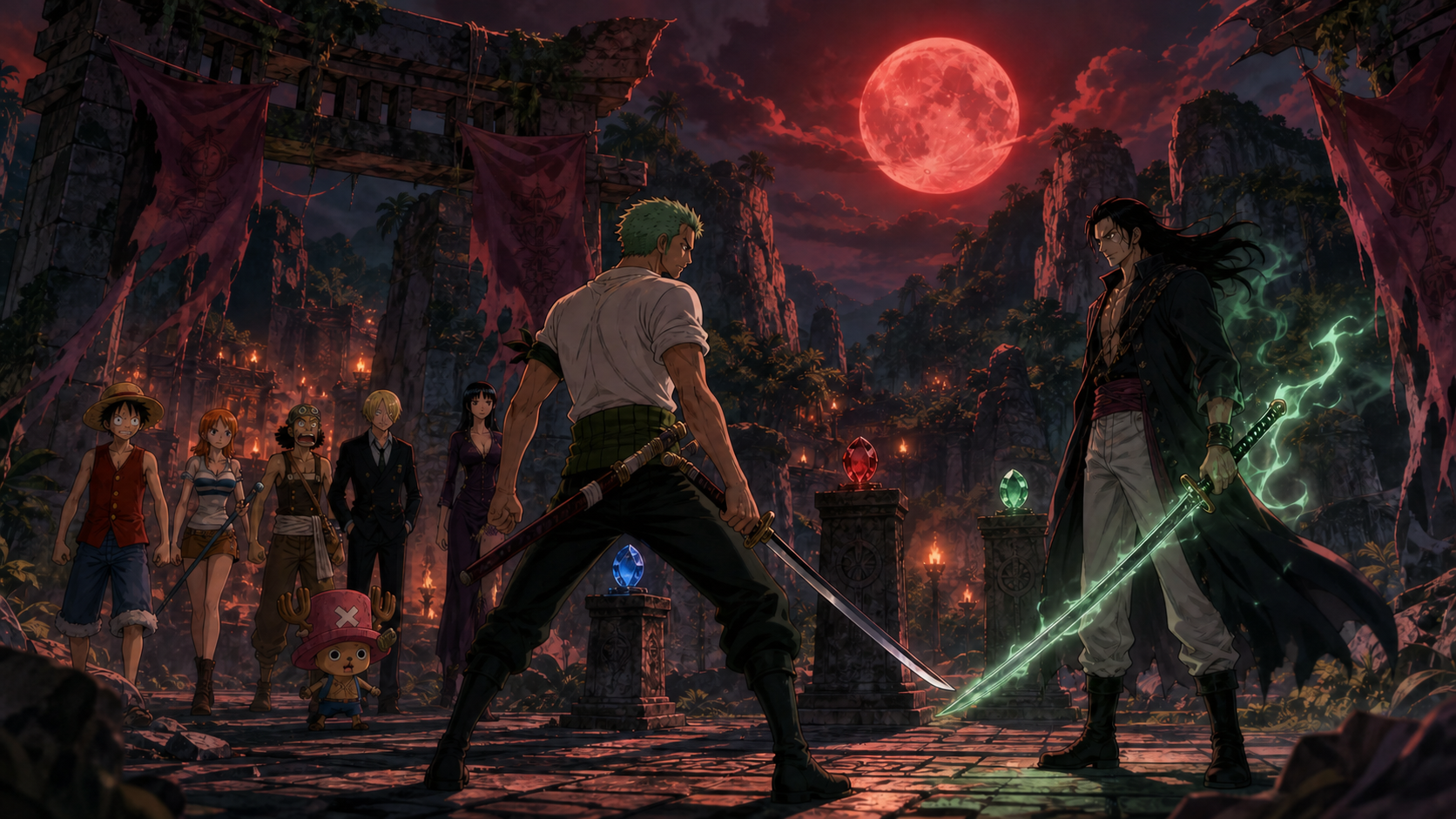
RaeRae Reviews: The Cursed Holy Sword
Bottom line
The Cursed Holy Sword has a gorgeous horror-adventure premise, a red moon hanging over Asuka Island, and a weapon that turns human weakness into mass destruction. Then the movie asks viewers to believe Roronoa Zoro would abandon his crew without one useful sentence. That choice is not mysterious. That choice is character sabotage wearing a dramatic cloak.
Released in Japan on March 6, 2004, the fifth One Piece film still delivers striking ruins, ritual mythology, and a conflict built around the danger of treating a sword as moral authority. Saga and Maya give the island a personal tragedy. The problem sits between those ideas and the crew member forced to behave badly so the plot can keep a secret.
What happens on Asuka Island
The Straw Hats arrive near Asuka Island, home of the legendary Seven Star Sword. Zoro disappears after encountering Marines connected to Saga, an old friend from his training years. Saga now carries the cursed blade and believes its power can protect the people he once failed.
Maya serves as a priestess tied to the ritual that restrains the sword. Three sacred jewels help seal the weapon when the red moon rises. Saga pursues those jewels, village defenders resist him, and the Straw Hats are split between finding Zoro and stopping a catastrophe they barely understand.
The Seven Star Sword is a good One Piece idea
One Piece repeatedly asks what power does to desire. The Seven Star Sword turns that question into a physical object. The blade promises protection, amplifies grievance, and gradually replaces judgment with appetite.
A cursed weapon also creates the right challenge for Zoro. He respects swords without worshipping them. His discipline depends on accepting responsibility for every cut. A blade that tries to choose the purpose of its wielder should be his philosophical opposite.
Saga confuses protection with control
Saga begins from recognizable pain. He could not protect Maya during an attack, and humiliation hardens into a promise that weakness will never decide his life again. The cursed sword offers certainty when grief has destroyed his trust in ordinary effort.
His fall works because he does not wake up craving conquest. Saga tells himself that domination will keep everyone safe. Protection without consent becomes control, and control backed by supernatural force becomes terror. The movie understands that progression even when the script rushes several steps.
Maya carries the cost of everybody else’s choices
Maya knows the ritual history, bears responsibility for the seal, and watches men repeatedly turn her safety into justification for violence. Saga claims power for her sake while refusing to hear her. The Marines pursue the jewels around her. Even village expectations define her through inherited duty.
Her strongest scenes reject Saga’s version of love. Care does not become care because the person causing harm uses protective language. Maya deserves more active problem-solving in the finale, but her moral position remains clear.
Zoro would not handle loyalty this way
Zoro values old promises, and meeting a damaged friend could absolutely pull him into a private investigation. Walking away without explaining the threat is another matter. He knows Nami will pursue missing crewmates. He knows Luffy will not treat silence as a request for space. He knows Chopper and Usopp can be placed in danger by missing information.
The movie uses silence to manufacture suspicion rather than letting Zoro make a difficult, recognizable choice. A stronger version would have shown Saga exploiting a direct promise, a hostage, or a genuine curse. Instead, Zoro withholds the basic facts because the screenplay needs the crew to think he betrayed them.
Friendship does not excuse the damage
Saga’s history with Zoro explains attention, not obedience. Zoro can remember a friend and still oppose the man standing before him. The distinction matters because loyalty is not permanent agreement.
One Piece usually treats friendship as a reason to confront somebody honestly. Luffy does not protect friends from consequences by helping them avoid truth. The film nearly reaches that point, but delays the confrontation through avoidable miscommunication.
Luffy trusts Zoro better than the plot does
Luffy’s faith in his first crewmate should end the betrayal question quickly. Their bond was built through execution platforms, bounty hunters, hunger, and repeated choices under pressure. Neither man requires a courtroom presentation to recognize the other.
The movie lets tension linger anyway. That creates noise rather than suspense. Viewers are not wondering whether Zoro joined Saga. Viewers are waiting for the characters to catch up with knowledge the franchise already earned.
Nami and Robin should own the investigation
The jewels, shrine, lunar cycle, and island history create a natural information problem. Robin can read ancient context and recognize how political stories disguise violence. Nami can track geography, timing, and the practical consequences of the red moon.
Both contribute, but the movie could have made their expertise the spine of the middle act. Ritual fantasy becomes stronger when characters test its rules instead of receiving every answer in a late explanation.
Usopp, Sanji, and Chopper keep the crew human
Usopp reacts to cursed ruins like a sensible person surrounded by reckless professionals. His fear gives the supernatural threat scale. Sanji protects the crew while refusing to let panic replace action. Chopper reads suffering before combat and remains alert to the human body beneath Saga’s corruption.
The three never become the main engine, yet their presence stops the island story from collapsing into two swordsmen and a prophecy. Crew chemistry remains the franchise’s strongest resource.
The sword mechanics need firmer rules
The Seven Star Sword absorbs malice, influences Saga, responds to the red moon, and depends on a seal involving three jewels. Those ingredients look excellent on screen. Their relationship becomes muddy whenever the climax needs another escalation.
A curse should create limits as well as effects. Clearer rules about distance, consent, possession, and the jewels would make every decision sharper. Mystery is useful. Moving goalposts are not mystery.
The three jewels give the climax a real shape
Red, green, and blue jewels placed around the island turn the conflict into more than a duel. Multiple objectives force the crew to divide labor, and the ritual deadline gives the red moon practical weight.
The jewel structure also connects spiritual responsibility to geography. The island community protects a system, not merely a treasure. Saga’s theft attacks collective memory as much as physical safety.
Action and visual direction
The production leans into deep reds, green supernatural light, ruined stone, jungle shadows, and blades crossing beneath an enormous moon. Asuka Island feels distinct from ordinary Grand Line ports. The final confrontation has strong silhouettes and clear visual stakes.
Director Kazuhisa Takenouchi frames Zoro and Saga as competing answers to the same fear of weakness. Some sword exchanges move too quickly to establish tactical progression, but the imagery understands why this story belongs in a theater.
Japanese performances
Kazuya Nakai gives Zoro controlled tension even when the writing denies him necessary dialogue. Mayumi Tanaka keeps Luffy’s anger focused on harm rather than wounded pride. Akemi Okamura, Kappei Yamaguchi, Hiroaki Hirata, Ikue Otani, and Yuriko Yamaguchi maintain the crew’s familiar rhythm around a heavier guest plot.
Guest performances sell Saga’s slide from conviction into possession and Maya’s refusal to accept violence dressed as devotion. The emotional argument lands more cleanly in the voices than in several exposition scenes.
Continuity and watch order
The Cursed Holy Sword is an anime-original companion film outside manga continuity. Robin and Chopper travel with the crew while Franky and later Straw Hats are absent. The lineup broadly places the adventure after Alabasta and before Water 7.
Watch after Episode 130 for comfortable crew context. No numbered episode requires Asuka Island, Saga, Maya, or the Seven Star Sword. Zoro’s behavior should not be used as evidence about his canon loyalty.
What the movie gets right
The island has atmosphere. The cursed weapon fits the franchise’s interest in ambition. Saga’s protective logic exposes how easily fear can call itself love. Maya refuses that excuse. The ritual provides a deadline and lets several crew members contribute.
Most importantly, the story recognizes that strength without self-command is weakness with better lighting. Saga does not master the sword. The sword gives his worst impulse permission.
What the movie gets wrong
The central misunderstanding requires Zoro to forget how his crew works. Several power rules arrive late. Maya carries tremendous narrative importance but too little control over the resolution. The Marines function more as plot machinery than a meaningful institution.
None of those flaws erase the production’s mood. They do keep a promising supernatural sword story from becoming the definitive Zoro movie the premise advertises.
My read: I remain frustrated by The Cursed Holy Sword because Zoro’s apparent betrayal should create sharper emotional consequences than the movie permits. Saga offers a useful warning about loyalty turned into possession, yet the plot keeps reaching for mystery when honest character conflict would hurt more. The sword action works. The relationships never receive equal discipline.
The Review standard matters most when characterization breaks
The Cursed Holy Sword has atmosphere, a usable myth, strong color, and a conflict large enough for theatrical action. Those strengths do not make Zoro’s behavior convincing. A Review should not protect a beloved character by blaming every problem on the script and moving along. The script is the finished film’s evidence.
RaeRae’s criticism follows the damage: secrecy replaces trust, Maya loses agency inside male promises, and the crew spends too long reacting to a loyalty rupture the story has not earned. The film remains watchable because craft and failure can occupy the same frame. Honest fandom criticism keeps both visible.
RaeRae’s verdict
The Cursed Holy Sword earns six out of ten. The red-moon visuals are fantastic, Saga’s downfall has substance, and the Seven Star Sword could anchor a brutal story about discipline versus domination. The screenplay then buys suspense by temporarily confiscating Zoro’s communication skills.
Watch for the atmosphere, the ritual adventure, and the argument hidden inside the cursed blade. Do not accept the fake betrayal drama as a fair reading of Zoro. A man can get lost on a straight road. He does not get lost about who his captain is.
Official sources and routes
ONE PIECE.com: official Cursed Holy Sword page
Browse One Piece anime movies
Return to the One Piece anime hub