
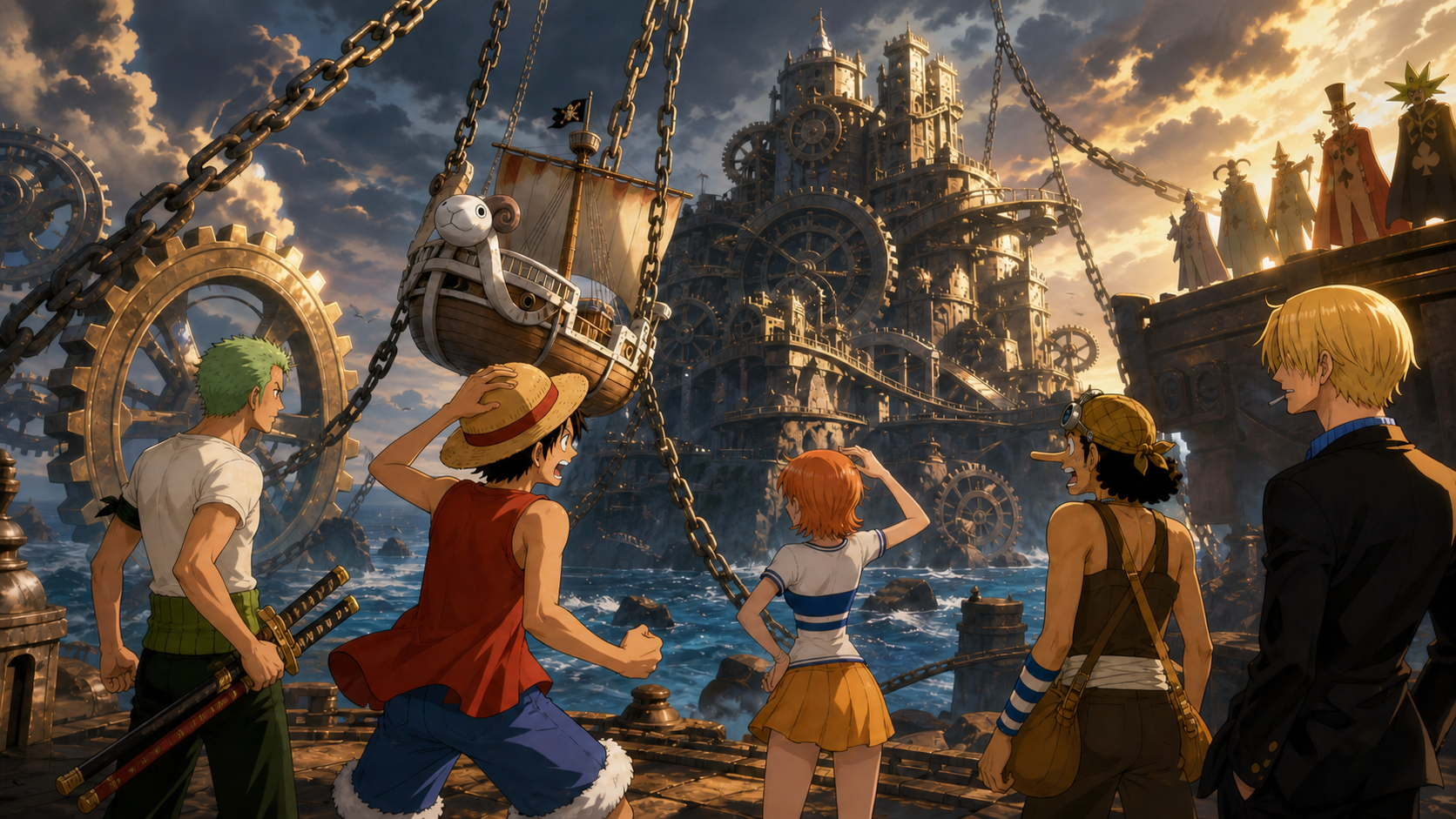
RaeRae Reviews: Clockwork Island Adventure
Bottom line
Clockwork Island Adventure improves on the first movie by giving the whole early crew a machine built to separate them. The Going Merry gets stolen, Nami gets kidnapped, Luffy loses the straw hat, and the Trump Siblings run an island where theft has been promoted to municipal policy.
Released in Japan on March 3, 2001, the second theatrical film runs about 55 minutes. The clockwork setting is clever, the crew chemistry is sharper, and the story has enough nerve to make their ship the first hostage. The forced-marriage material around Nami remains the part I would happily throw into the largest available gear.
What happens
The Straw Hats wake after a beach break to discover the Going Merry missing. Borodo and Akisu, self-described Thief Brothers, offer a lead: the Trump Siblings stole the ship and took the vessel to Clockwork Island. Borodo says he wants the island’s Diamond Clock, so help arrives with a visible price tag.
The climb toward the island becomes a sequence of traps, fights, separations, and additional theft. Bear King leads the Trump Siblings, kidnaps Nami, and announces that she will become his bride. Luffy, Zoro, Usopp, Sanji, and the brothers pursue the crew’s ship and navigator through machinery designed to make resistance physically exhausting.
Stealing the Going Merry is the correct opening move
The Going Merry is transport, shelter, stored food, navigation equipment, and Kaya’s gift to Usopp’s friends. Taking the ship removes the crew’s home and their ability to leave. The theft creates a better threat than another treasure map because every member has practical reasons to care.
The movie understands ship ownership as collective dependence. Luffy may be captain, but the loss hits Nami’s routes, Usopp’s emotional history, Sanji’s supplies, and everybody’s safety. Recovering the Merry is not a captain reclaiming property. The crew is rescuing the structure that lets five separate dreams move together.
Clockwork Island makes oppression mechanical
The island’s gears, lifts, chains, and vertical routes turn the environment into an enforcement system. Bear King does not merely occupy a palace. His rule is built into how people move, work, and reach the outside world. Machinery becomes government architecture.
That design gives the short film visual logic. Every higher level creates a new obstacle and opponent, while the captured ship remains visible as a goal. The production can escalate without inventing a new country every ten minutes.
Borodo sells freedom with somebody else’s property
Borodo presents himself as a professional thief chasing the Diamond Clock. His plan uses the Straw Hats’ loss as leverage and keeps Akisu inside another adult’s scheme. He has understandable motives, but understandable does not mean clean.
The relationship with Akisu gives the film a second family argument. Protection can become control when the adult makes every decision and calls secrecy love. Borodo eventually has to treat Akisu as a person participating in danger, not a package to move around the board.
Akisu refuses the child-shaped waiting room
Akisu wants agency while adults keep assigning him the safe position. The boy can be reckless, but passivity would not make the surrounding world safer. Clockwork Island already took his family and community.
His strongest function is not inspiring Luffy. Akisu forces Borodo to confront the difference between protecting a child and refusing to hear one. One Piece returns to that distinction because found family fails whenever affection becomes ownership.
Nami deserves better than the bride plot
Bear King treats Nami as an object he can select, dress, and marry. The movie frames his behavior as villainy, which clears the lowest possible bar. The camera and comedy still spend too much time turning her lack of control into spectacle.
Nami continues gathering information, resisting, and looking for openings. Her competence survives the plot imposed on her. I am not awarding the story feminist credit for letting the woman fight inside a kidnapping premise nobody needed. She had five other reasons to oppose the man who stole her ship.
Sanji’s protection needs a boundary
Sanji’s anger makes sense because Nami is in danger. His chivalry also risks translating her personhood into a contest between men. Rescue should restore Nami’s choices, not establish which man gets to define her.
Hiroaki Hirata gives Sanji speed, fury, and comic vanity without losing his combat focus. The movie works best when his kicking skill solves a physical obstacle and worst when romantic possession becomes the joke’s grammar.
Zoro and Pin Joker get the cleanest fight
Pin Joker’s blade-focused threat gives Zoro a direct technical matchup. Kazuya Nakai’s dry delivery makes the swordsman sound mildly inconvenienced until the opponent earns full attention.
The duel uses the island’s vertical space and mechanical danger instead of placing two men on an empty stage. Zoro does not need an invented childhood connection to care. A dangerous swordsman stands between the crew and the Merry. That is enough work for one movie.
Usopp belongs in a machine story
Usopp understands improvised systems, fragile plans, and the terror of being outmatched. Clockwork Island gives him an environment where observation matters as much as force. Kappei Yamaguchi keeps fear active without letting fear erase participation.
His relationship with Akisu also carries weight. Usopp knows that heroic performance can be rehearsal for real courage. He can recognize the child’s exaggeration without treating the child’s goal as fake.
Bear King has power and absolutely no interior decorator
Bear King wants control, the Diamond Clock, Nami, and a grand public image. The character is broad enough for the runtime, but the film wisely distributes personality across the Trump Siblings rather than demanding one villain carry every fight.
His Spring-Spring Fruit creates force through compression and release, a mechanical match for the island. The final confrontation lets Luffy turn elasticity against another body built around rebound. The thematic subtlety is not hiding, but the matchup moves.
The crew chemistry has advanced
Adding Sanji changes the rhythm from the first film. Food, flirtation, rivalry with Zoro, and another capable fighter widen the group without making anybody decorative. Nami’s authority as navigator also feels more established.
Mayumi Tanaka, Akemi Okamura, Kazuya Nakai, Kappei Yamaguchi, and Hiroaki Hirata sound like an ensemble that knows where to interrupt one another. The jokes move quickly because the relationships no longer need full introductions.
Continuity placement
Clockwork Island Adventure is an anime-original companion film outside the manga’s main continuity. Sanji is present while Chopper and Robin are absent, placing the status quo after Baratie and before Drum Island.
The cleanest viewing slot is after East Blue and before the Alabasta television material. Do not bend episode order into a pretzel trying to explain every ship position or costume. The film borrows the crew at a recognizable stage and returns them when the credits roll.
Direction, writing, and music
Junji Shimizu directs, with the screenplay credited to Hiroshi Hashimoto in Japanese reference listings. Kohei Tanaka’s music supports the mechanical adventure without making the short feature pretend to be a franchise finale.
The production uses clear silhouettes, stacked levels, and brass machinery to make the island legible. Gears are not automatically worldbuilding, but these gears control routes, labor, and the climax. Somebody remembered to give the aesthetic a job.
The Going Merry makes captivity personal
Stealing the ship does more than strand the crew. The Trump Siblings seize a home made from Kaya’s gift, Merry’s design, Nami’s navigation, Usopp’s repairs, Sanji’s kitchen labor, and every ordinary day shared on deck. Recovery carries emotional weight before the film needs to invent a larger world-ending device.
Clockwork Island extends that theft through machinery that converts people and space into parts of Bear King’s design. The island looks playful, but the system underneath depends on residents having no control over movement, labor, or public order. Mechanical spectacle becomes most useful when the machine shows who receives power and who becomes a component.
Nami’s treatment limits the movie
The forced-bride plot gives Nami information and resistance, yet the framing repeatedly asks viewers to consume her danger as costume comedy. Her intelligence deserves more control over the escape. Sanji’s anger cannot substitute for Nami’s perspective, and protection becomes less meaningful whenever the protected person is pushed outside the decision.
RaeRae’s verdict stays affectionate toward the crew rhythm, Akisu, Borodo, the Merry rescue, and the colorful production design. The criticism remains firm because a brighter palette does not make gendered coercion harmless.
RaeRae’s verdict
The second film is faster, stranger, and more confident than the first. Stealing the Merry gives the crew an immediate shared problem, and Clockwork Island turns the rescue into a physical climb through somebody else’s system.
The Nami material drags the score down because coercion does not become charming when the villain says “wedding.” Everything around that choice is lively enough to prove the movie never needed the shortcut. Seven out of ten: strong machine, good crew, return the bride plot to sender.
Official sources and routes
ONE PIECE.com: official Clockwork Island Adventure page
Toei Animation: The Adventure of Spiral Island
Browse One Piece anime movies
Return to the One Piece anime hub