
RaeRae Reviews: One Piece: The Movie (2000)
Bottom line
The first One Piece movie works because the production knows exactly how much story fits inside 51 minutes. One treasure island, one loud gold pirate, one child who has confused a legend with a life plan, and one old man carrying the part of the legend nobody put in the sales pitch. Nobody tries to squeeze Marineford into a lunch break.
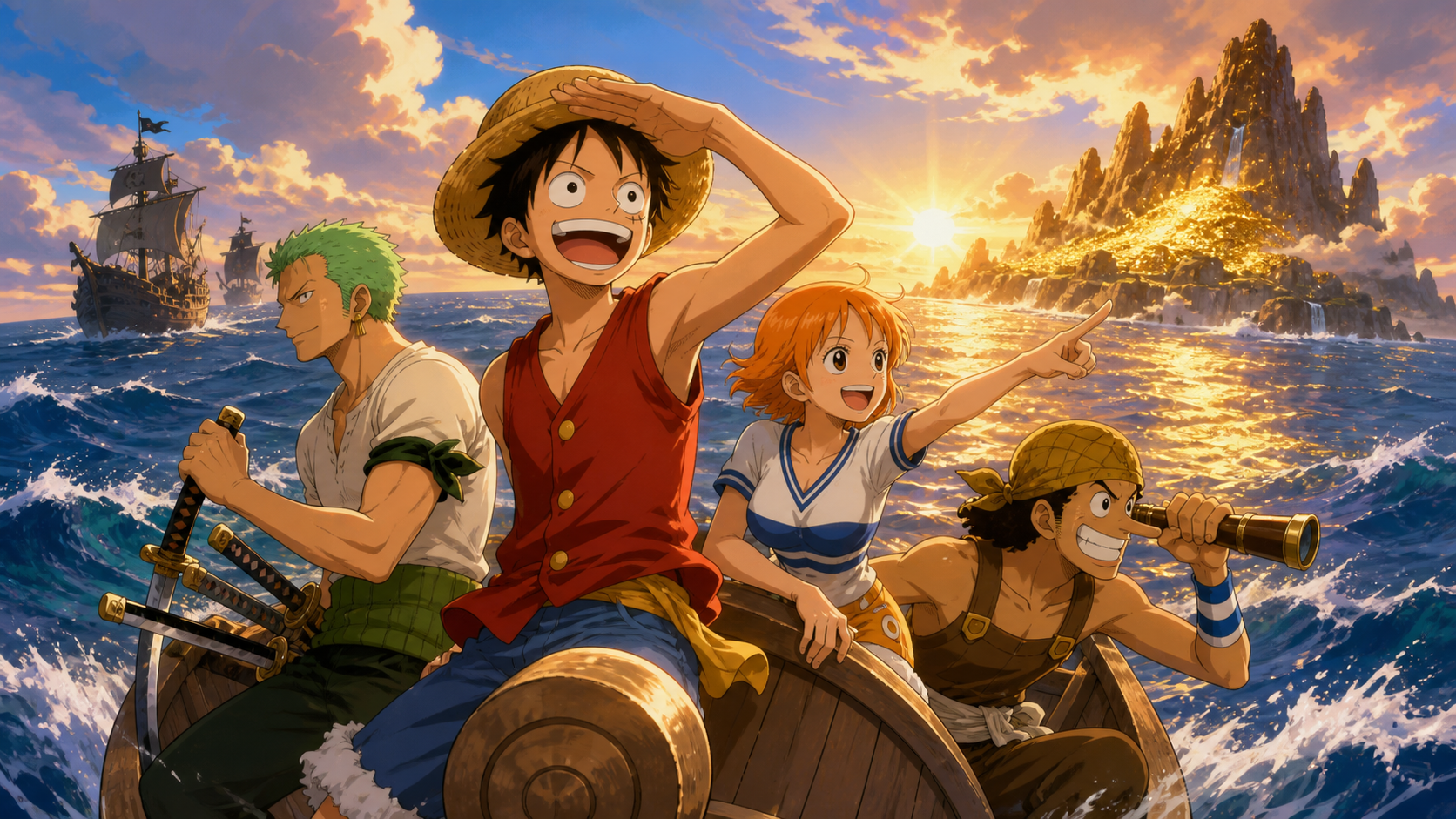
Released in Japan on March 4, 2000, the film belongs to the early East Blue crew. Luffy, Zoro, Nami, and Usopp are aboard. Sanji is not. That placement matters more than any attempt to force the movie into exact television continuity.
What happens
El Drago hunts the legendary treasure of the Great Gold Pirate Woonan. His Devil Fruit power turns his voice into destructive sonic force, which is basically what happens when a man decides indoor volume is a human-rights violation. Tobio, a boy who idolizes Woonan, wants adventure and has no patience for his grandfather Ganzo’s quiet life as an oden seller.
The Straw Hats collide with El Drago’s crew, Tobio, and a trio of thieves while Nami pursues the same gold for reasons that require no detective work. Luffy hears about a famous pirate and immediately decides Woonan might make a good crewmate. The group heads toward the hidden island, where the treasure hunt becomes a confrontation with what Woonan actually wanted and what Ganzo lost while waiting for him.
Woonan is the film’s real argument
Woonan’s legend promises the usual pirate fantasy: a mountain of gold so large every greedy man can imagine himself reflected in the pile. The story then asks a better question. What remains after a person spends a lifetime turning movement into purpose?
Ganzo knew Woonan before the legend hardened. Their relationship gives the gold emotional weight without pretending wealth is wisdom. Woonan’s final understanding does not erase the years he chose the chase over home. The film lets regret arrive without manufacturing a neat reunion.
Tobio wants the poster, not the person
Tobio idolizes Woonan because legends offer an exit from ordinary labor. Ganzo sells food, worries, repeats himself, and looks painfully uncool beside a pirate whose name can move fleets. The child sees a small life because he cannot yet read the loyalty inside the routine.
That conflict lands because One Piece never treats dreams as automatically noble. A dream can organize courage, or a person can use a dream to avoid seeing who keeps him fed. Tobio needs adventure, but he also needs to stop treating his grandfather like furniture placed between him and the horizon.
Ganzo makes food into memory
Ganzo’s oden is not decorative flavor. Preparing and serving food becomes his way of maintaining a bond Woonan left behind. The work is repetitive, physical, and easy for a child to dismiss. The movie understands that care often looks boring from the outside.
Sanji’s absence makes Ganzo’s role even more visible. Food still performs the franchise’s central labor: keeping bodies alive, creating a table, and giving memory a form somebody can share. Treasure can sit untouched in a cave. A meal only matters when somebody makes and receives the meal.
The East Blue crew feels right
Luffy follows the emotional truth faster than the plot explanation. Zoro handles the dangerous fighter. Nami calculates value while recognizing that money and meaning are not identical. Usopp understands Tobio because heroic stories are both his courage practice and his favorite hiding place.
The film does not flatten them into four attacks waiting for a finale. Their competing motives create movement. Nami can want gold without becoming heartless. Usopp can perform bravery and still notice another child doing the same thing. Luffy can misunderstand the details and recognize the promise.
El Drago is exactly enough villain
El Drago does not need a tragic childhood, a government conspiracy, and twelve episodes of executive backstory. He wants gold, enjoys domination, and has a power built for broad theatrical action. The simplicity suits the runtime.
His sonic attacks make greed loud and physically invasive. The character occupies the antagonist job without stealing the movie from Ganzo, Tobio, and Woonan. A lesser short film would spend its final minutes begging us to find hidden depth in the man shouting at a treasure map.
Golass gives Zoro a proper obstacle
Golass provides the sword fight while El Drago remains Luffy’s problem. Zoro’s material works as an early showcase of discipline and appetite for challenge. The duel does not rewrite his ambition or hand him a life-changing rival.
That restraint helps. Movie opponents can test established qualities without becoming secret missing pillars of canon. Golass gives Zoro resistance, steel, and a reason to stop smirking for a minute. Job completed.
Nami and the ethics of treasure hunting
Nami’s interest in Woonan’s gold is completely consistent with this stage of her life. Money means leverage, safety, and the possibility of buying back Cocoyasi Village. Greed is never only a cute character label, even when the movie uses the joke.
The ending distinguishes possession from value without shaming her for wanting resources. Gold can matter and still fail to answer Woonan’s regret. Nami is usually the first person in the room qualified to understand both sides of that sentence.
Continuity placement
The film is an anime-original theatrical story and does not belong to the manga’s main continuity. The four-person crew places the adventure after Usopp joins and before Sanji becomes part of the regular group, but exact insertion creates avoidable contradictions.
Watch after the Syrup Village material if you want the crew relationships to make sense. Do not treat the film as a required bridge into Baratie. Companion continuity is the honest label.
Direction and visual scale
Director Junji Shimizu and screenwriter Michiru Shimada build a compact Toei Anime Fair feature rather than a modern event film. The art carries the bright shapes, elastic reactions, and direct staging of early television One Piece while using the island and gold imagery to widen the frame.
The short runtime keeps action readable. The production does not bury every emotional turn under effects. Character silhouettes, comic timing, and the contrast between ocean blue and treasure gold do most of the visual work.
Japanese performances
Mayumi Tanaka gives Luffy immediate appetite and moral certainty without making him sound informed. Kazuya Nakai keeps Zoro dry and dangerous. Akemi Okamura lets Nami’s calculation remain funny without losing the urgency beneath her relationship with money. Kappei Yamaguchi makes Usopp’s performance of courage transparent and lovable.
The guest material depends on the gap between Tobio’s bright certainty and Ganzo’s lived grief. The film works when their argument sounds like family rather than a lesson delivered by two symbols.
What has aged, and what has not
The early franchise comedy is broad, and the villain barely clears the functional floor. Viewers arriving after the scale of Wano or Egghead may find the movie visually modest. Those limits are real.
The central argument has aged better. A famous dream can consume the relationships that made dreaming possible. Ordinary work can hold more loyalty than a legend. A child can love adventure and still owe an apology to the person serving dinner.
The first movie understands treasure as a relationship
Woonan’s gold matters because strangers turned a person into a legend large enough to hide the loneliness underneath. Tobio chases the heroic version while Ganzo remembers the ordinary boy who ate, argued, dreamed, and left. The film becomes stronger whenever gold stops functioning as a prize and starts revealing what memory chooses to preserve.
Luffy recognizes that distinction without delivering a lecture. He respects the dream but refuses to confuse another person’s treasure with permission to own the person. Nami’s interest in money remains practical rather than evidence of shallow morality. The crew can want treasure and still condemn El Drago’s belief that strength converts desire into entitlement.
A compact runtime exposes priorities
The film cannot give every Straw Hat a private arc, so crew behavior carries characterization. Zoro reads threats, Nami reads value and escape routes, Usopp performs confidence while contributing under pressure, and Luffy keeps moving toward the person whose freedom has been narrowed. The small East Blue lineup makes every missing role visible.
That compression also makes the quieter Ganzo and Tobio material more valuable. A longer fight would not deepen the argument. Food, memory, grief, and the difference between a public legend and a private relationship give the first theatrical film a reason to exist beyond novelty.
RaeRae’s verdict
This is not the biggest One Piece movie, the most beautiful, or the one I would use to prove what the franchise eventually becomes. The first film earns its place by refusing to inflate a clean idea past the available runtime.
Come for Luffy racing a screaming gold pirate. Stay for an old man whose oden has been carrying a friendship longer than the treasure carried any meaning. Seven out of ten, with one extra point awarded to every movie that understands 51 minutes is a boundary, not a personal insult.
Official sources and routes
ONE PIECE.com: official film page
ONE PIECE.com: official theatrical film archive
Browse One Piece anime movies
Return to the One Piece anime hub