
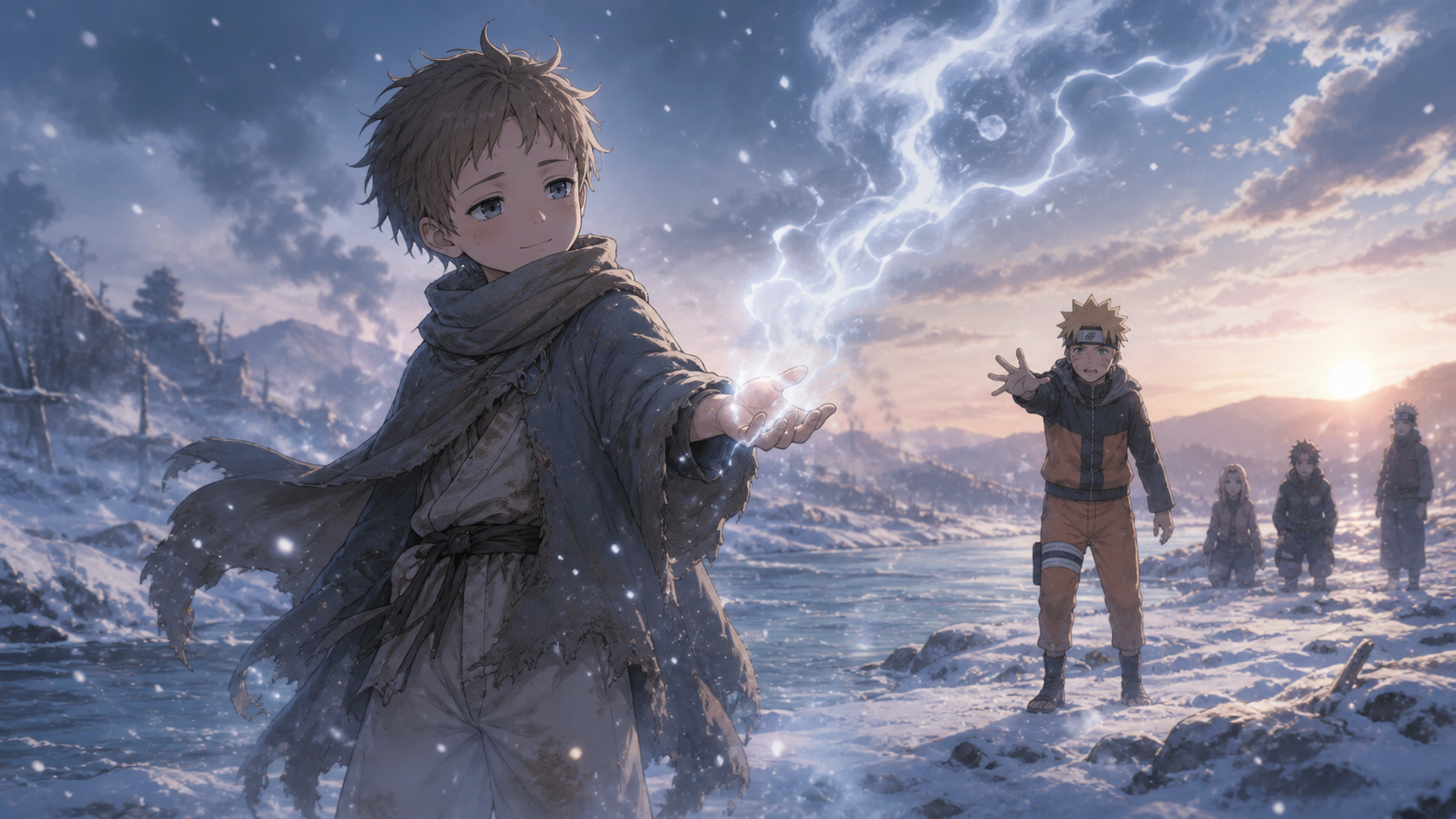
Lingering Snow
The false Yotas fall, the river memory returns, and Yota finally tells Naruto who died before their friendship ever began.
Bottom line
“Lingering Snow” closes Yota’s story by taking the blame away from the children who carried that burden for years. Naruto identifies three battlefield Yotas as White Zetsu copies, while the genuine reanimated Yota explains that he had already died before he ever entered Konoha. Orochimaru used Yota as an early Edo Tensei test subject. The river did not kill him. Yota saved Naruto and the others, erased their memories so they could live without the grief, and later chooses his own ending rather than remain Kabuto’s weapon. The episode gets messy around memory and continuity, but the emotional correction matters. Naruto did not fail a living child at the river. Adults exploited a dead child, and Yota still found enough freedom to protect his friends twice.
Four Yotas cannot all be genuine
Inoichi’s communication network gives Naruto the detail he needs. Sakura, Kiba, Akamaru, Shikamaru, Ino, and Chōji have all faced Yota in separate places, while Naruto has met the wind-whistling version.
The shared face once made everyone hesitate. The impossible number finally turns hesitation into evidence. A reanimated person can be copied, transformed into, or used as bait, and the Allied Forces are already fighting an enemy built around those tricks.
Naruto remembers the whistle
Naruto recognizes that Yota’s whistle came from him. That personal detail separates the genuine relationship from the copied performances happening elsewhere.
Memory does not hand Naruto a complete answer. The whistle gives him one reliable test, and he uses that test instead of treating every familiar face as sacred.
The false Yotas are White Zetsu
Naruto warns the other groups that their opponents are disguised White Zetsu. Once the friends understand the deception, they can fight without believing that every strike hurts the child they remember.
The reveal also exposes how White Zetsu warfare attacks judgment. A copied face can make compassion dangerous, yet abandoning compassion would hand the enemy another victory.
Recognition frees the separated teams
Sakura, Kiba, Akamaru, and Team Asuma’s surviving members defeat the impostors after Naruto shares the distinction. Coordination solves what isolated strength could not.
Ino deserves credit for making that solution possible. Her decision to connect the battlefields allowed one childhood clue to become actionable intelligence for everyone.
The memory returns to ANBU custody
The recovered childhood story resumes with Yota held by ANBU as a suspected spy. Konoha’s concern about an unknown weather-user is understandable during a dangerous period, but armed interrogation was never the only available response.
Yota looked like a frightened child because that was the body and mind the officers confronted. Nobody provided a guardian, medic, or advocate before treating him as an enemy asset.
Naruto volunteers to be the distraction
Young Naruto pulls ANBU attention toward himself so Shikamaru, Kiba, Akamaru, Ino, Chōji, and Sakura can reach Yota. The plan carries the reckless confidence of children who know their friend needs help and have no adult they trust to ask.
Naruto’s choice is brave. The need for that choice condemns the system around him. Children should not have to stage a covert extraction because every official route appears closed.
Shikamaru builds the rescue around timing
Even as a child, Shikamaru understands roles. Naruto creates noise, the others move through the opening, and Shadow Possession briefly restrains the officers.
The plan cannot survive trained ANBU resistance for long. Cleverness gives the children a chance, not the power or experience needed to control the consequences.
ANBU regains control
The officers break the children’s advantage and move against Naruto. Their response follows a security logic in which interference confirms danger.
That logic ignores who stands in front of them. The rescuers are village children, and the detainee is terrified. Escalation makes Yota’s weather more volatile while proving why the children expected no mercy.
Yota answers fear with lightning
Yota strikes the ANBU with lightning when Naruto faces danger. His power acts through emotion, so the attack is both defense and panic.
The moment does not prove that the officers were right to imprison him. A frightened child lashing out after capture is evidence that the detention method failed, not proof that care was impossible.
Escape leads everyone to the river
The children get Yota away from the interrogation site and try to move him beyond Konoha’s reach. Their route brings them to fast water that none of them can safely manage under pressure.
Freedom exists on the far bank, but the river turns the rescue into a survival emergency. The physical danger arrives after institutional failure has already narrowed every choice.
The current separates the children
Naruto, Shikamaru, and Chōji are swept into the water. Friendship cannot make them strong swimmers, and courage cannot cancel the force of the current.
The scene refuses the clean fantasy of children rescuing one another through determination alone. Someone must pay for the adults leaving them with an impossible job.
Yota saves the friends who tried to save him
Yota uses his weather power to pull the drowning children from the river. The boy everyone feared becomes the person who prevents multiple deaths.
His rescue changes the moral shape of the flashback. Naruto remembers failure because Yota disappeared beneath the water, but Yota’s final action at the river was protection.
Yota does not resurface
The children watch Yota vanish and believe the river killed him. That conclusion becomes the wound buried beneath their erased memories.
Naruto later interprets the loss as proof that their rescue caused Yota’s death. The sequence supports the guilt, even though the conclusion rests on information the children never possessed.
Memory erasure was Yota’s choice
Yota removes the children’s memories of him and their time together. He wants to spare them the pain of believing they watched a friend die after making the situation worse.
The kindness carries a cost. Taking memories also takes consent, shared mourning, and the ability to question what adults did. Protection through secrecy can reduce immediate suffering while creating a deeper confusion later.
The river was never Yota’s first death
In the present, Yota tells Naruto the truth: Yota was already dead when the children met him. Orochimaru had used his body as one of the earliest experiments with Edo Tensei.
The black eyes visible in those childhood meetings were not an ordinary feature. Konoha’s children befriended a reanimated boy whose freedom existed inside somebody else’s forbidden technique.
Orochimaru created the real violation
Orochimaru treated Yota’s remains and soul as experimental material. Kabuto’s war later repeats the same violation by forcing the child back into combat.
The episode should keep that responsibility named. Naruto’s rescue plan was reckless. Orochimaru’s decision turned a dead child into a test subject and made every later tragedy possible.
The early Edo Tensei experiment raises questions
Yota apparently moved, played, traveled, and formed relationships with unusual independence. That behavior suggests Orochimaru’s early control was incomplete or deliberately loose.
The explanation repairs the cause of death while opening continuity problems. A reanimated child wandering near Konoha should have attracted more investigation, and the episode offers little detail about how Orochimaru lost or released control at that stage.
Yota understood more than the others
Yota knew that the river could not kill an Edo Tensei body in the ordinary sense. The children did not. Their grief came from watching the only outcome available to their eyes.
Erasing their memories was his attempt to carry the burden alone. That choice fits a child who had just watched friends risk punishment and death for him.
Naruto’s guilt finally meets the missing fact
Naruto cannot be responsible for a death that occurred before their first meeting. The revelation does not erase the fear at the river, but the missing fact corrects the moral conclusion Naruto built from that fear.
He can mourn Yota without claiming ownership of Yota’s fate. That distinction matters for someone who repeatedly turns love into a promise to prevent every loss.
The adults still failed the children
The twist does not excuse ANBU’s conduct. Officers encountered an unknown child with abnormal eyes and unstable weather powers, then chose confinement and interrogation without giving frightened village children any trustworthy explanation.
A careful investigation might have uncovered Edo Tensei residue or evidence of Orochimaru’s work. Treating Yota only as a spy missed both the victim and the larger threat.
The friends get a goodbye they were denied
Naruto and the others can finally speak to Yota with their memories intact. The war has recreated their childhood loss, but this meeting gives everyone the truth that secrecy once removed.
They do not need a perfect explanation for every year. They need to know that the friendship was real, Yota chose to save them, and their love did not kill him.
Yota refuses another round of forced combat
Kabuto brought Yota back to weaponize that bond. Yota instead resists the purpose assigned to his body and soul.
Edo Tensei usually turns the dead into evidence of the summoner’s control. Yota makes his last appearance about personal choice, even when that choice costs him continued time with his friends.
Snow becomes a final covering
Yota surrounds himself with snow before calling down lightning. The weather that once exposed every feeling now helps him shape his own departure.
Snow can hide a body, soften a battlefield, and mark the cold reality of death. Here the image also belongs to Yota rather than Orochimaru or Kabuto.
Lightning breaks the remaining body
Yota directs lightning onto himself and leaves the reanimated form behind. Naruto and the others cannot save him by holding tighter or fighting harder.
The action is painful, yet agency changes the meaning. Yota is not being discarded by a summoner. He refuses to let another adult use him against the people he loves.
The title understands grief better than blame
Lingering snow remains after the storm that created the snowfall. The children’s grief survived even after the memories disappeared, showing up as recognition, hesitation, and an ache with no name.
Recovered memory does not melt every consequence. The friends can finally place that feeling beside the person who caused the weather and the adults who caused the harm.
Childhood friendship remains the arc’s strength
Yota’s bond with the Konoha children works because the episodes give them ordinary play, arguments, songs, and small acts of protection. Friendship develops before the plot asks anyone to grieve.
Naruto welcoming another isolated child feels especially honest. He recognizes loneliness because adults made loneliness part of his daily life.
Memory erasure remains the weak seam
The technique explains why none of the friends mentioned Yota during the original series. The explanation still feels built to insert a major childhood relationship after continuity had already moved on.
Emotional truth can survive a visible construction seam. The episode earns feeling through specific behavior, but the device should not receive praise merely because the ending hurts.
The three-part arc earns its resolution
Episode 313 introduced the impossible enemy. Episode 314 connected the weather and childhood memories. Episode 315 distinguishes the false bodies, completes the river story, and gives Yota control over his final departure.
The structure does real work across three episodes. No final reveal makes the earlier battles meaningless, and each friend’s hesitation contributes to the solution.
White Zetsu exploitation does not make the memories false
The battlefield copies use familiar faces to isolate teams, interrupt medical work, and redirect attention from real threats. Exposing the disguise solves the immediate tactical problem without erasing the childhood relationship that made the trick effective.
That distinction protects the witnesses from a second violation. Their recognition was manipulated, but their affection was not invented by White Zetsu. Command should correct the identification while treating the recovered memories as testimony worthy of care.
The rescue plan proves the children already understood teamwork
Naruto offers noise and motion, Shikamaru controls timing, and the others prepare the route. Their plan is imperfect because children lack authority and resources, yet the underlying coordination is real.
Konoha later celebrates these same instincts when they serve official missions. The painful irony is that adults did not recognize the skill when the children used it to protect an outsider. Institutional approval changes, but the children’s moral clarity was already present.
Yota’s river rescue reverses the power story
The friends believe they are saving Yota until the current places them in danger and he becomes their rescuer. His choice refuses the idea that vulnerability means helplessness or that care flows in only one direction.
He spends the last strength of that life protecting children who offered belonging. That sacrifice deserves grief, but it should not be romanticized as the natural duty of a child. The tragedy exists because adults allowed rescue to become his burden.
Consent complicates Yota’s memory erasure
Yota chooses to remove himself from their memories, apparently hoping to spare them pain. The choice gives him agency after custody and experimentation repeatedly stripped it away.
Still, consent over his own story does not automatically become consent over everyone else’s minds. Naruto and the others lose years of mourning, questions, and shared support. The episode can honor Yota’s motive while admitting that protective love sometimes makes decisions other people deserved to share.
Orochimaru turns an unrecorded death into available material
The real horror is not simply that Edo Tensei returns Yota. Orochimaru finds a dead child whose history is fractured, whose friends were made to forget, and whose disappearance appears to have produced no durable public accountability.
Secrecy creates the perfect conditions for abuse. A transparent death record, independent investigation, and preserved testimony would not stop every forbidden experiment, but they would make a vulnerable body harder to steal and a missing child harder to erase.
An early Edo Tensei experiment needs an evidence boundary
The anime-original timeline places Orochimaru’s experimentation around events that the central manga history does not describe. Viewers should not be asked to treat every added mechanism as settled franchise canon.
That boundary does not dismiss the episode’s emotional truth. We can discuss what this story says about experimentation, memory, and institutional silence while labeling the continuity honestly. Clear classification lets analysis stay generous without pretending contradiction is confirmation.
The friends deserve individual recovery after the goodbye
A shared memory does not produce identical grief. Naruto carries responsibility, Sakura may focus on the custody failure, Shikamaru may replay the plan, Ino may question communication, Chōji may remember care, and Kiba and Akamaru may hold sensory fragments.
Support should allow private accounts before the group settles on one version. Nobody needs to perform the same tears or accept the same meaning. Their bond can survive differences when adults stop demanding a tidy lesson from a child’s death.
Yota’s final refusal is resistance, not convenient closure
He rejects another cycle of forced combat and uses the remaining weather to end Kabuto’s claim over his body. The decision belongs to Yota, even though the episode structures it as a farewell for Naruto and the others.
The distinction matters. He is not merely a device that releases the heroes from guilt. He identifies the violence being done to him, protects the people he loves, and chooses the last action available. Agency does not make the surrounding exploitation acceptable.
Lingering snow asks the village to remember after melting
Snow covers the riverbank, softens the battlefield, and disappears. The title understands that grief can remain after every visible sign is gone.
Konoha’s obligation begins where the sentimental image ends. Preserve Yota’s name, document the custody and experimentation failures, support the surviving witnesses, and change how vulnerable children are questioned. Remembrance without institutional repair leaves the next child exposed to the same silence.
Goodbyes do not erase public accountability
Yota receives needed closure with the friends who loved him, but that farewell cannot close the village record. Someone needs to document the first detention, the failed search, the river death, the missing body, the memory loss, and Orochimaru’s access. Names of adults may remain unknown, yet unanswered questions should stay instead of being softened into fate. A memorial can hold affection while an inquiry holds institutions accountable. Both are forms of respect, and neither replaces the other. Naruto’s generation deserves the truth about what happened around them. Future children deserve procedures that make the sequence harder to repeat. If Konoha only remembers Yota as snow, the village keeps the feeling and abandons the lesson.
RaeRae’s verdict
“Lingering Snow” gives Yota the goodbye his friends lost and corrects Naruto’s misplaced guilt. The White Zetsu reveal rewards Ino’s communication plan, while the river memory shows why every child believed the worst.
The Edo Tensei twist is imperfect continuity glue, but the moral line is clear. Orochimaru exploited Yota’s death. Konoha’s adults mishandled a vulnerable child. Yota saved his friends, protected their memories in the only way he understood, and finally refused to remain a weapon.
RaeRae’s call
Yota’s final choice belongs to him, but the failures surrounding that choice belong to adults, ANBU secrecy, Orochimaru’s experimentation, and a village record that could not protect one child’s history. Let the friends grieve differently, preserve what happened, and make remembrance mean more than watching beautiful snow disappear.
Episode details and viewing routes
- Official episode reference: Naruto Official episode guide
- Licensed episode route: Crunchyroll licensed episode page
What I am carrying forward
Yota’s story ends here. The White Zetsu copies are defeated, the childhood memories are restored, Naruto learns that the river did not cause Yota’s original death, and Yota leaves the reanimated body by his own choice.
Episode 316 begins a different anime-original battlefield story with reanimated Allied shinobi. I am carrying forward the war’s larger rule: Kabuto keeps turning personal history into a weapon, and the Alliance must identify the human relationship inside each attack without letting recognition stop the mission.