
Rain Followed by Snow, with Some Lightning
Three versions of a lost childhood friend turn emotion into rain, snow and lightning across separate battlefields.
Bottom line
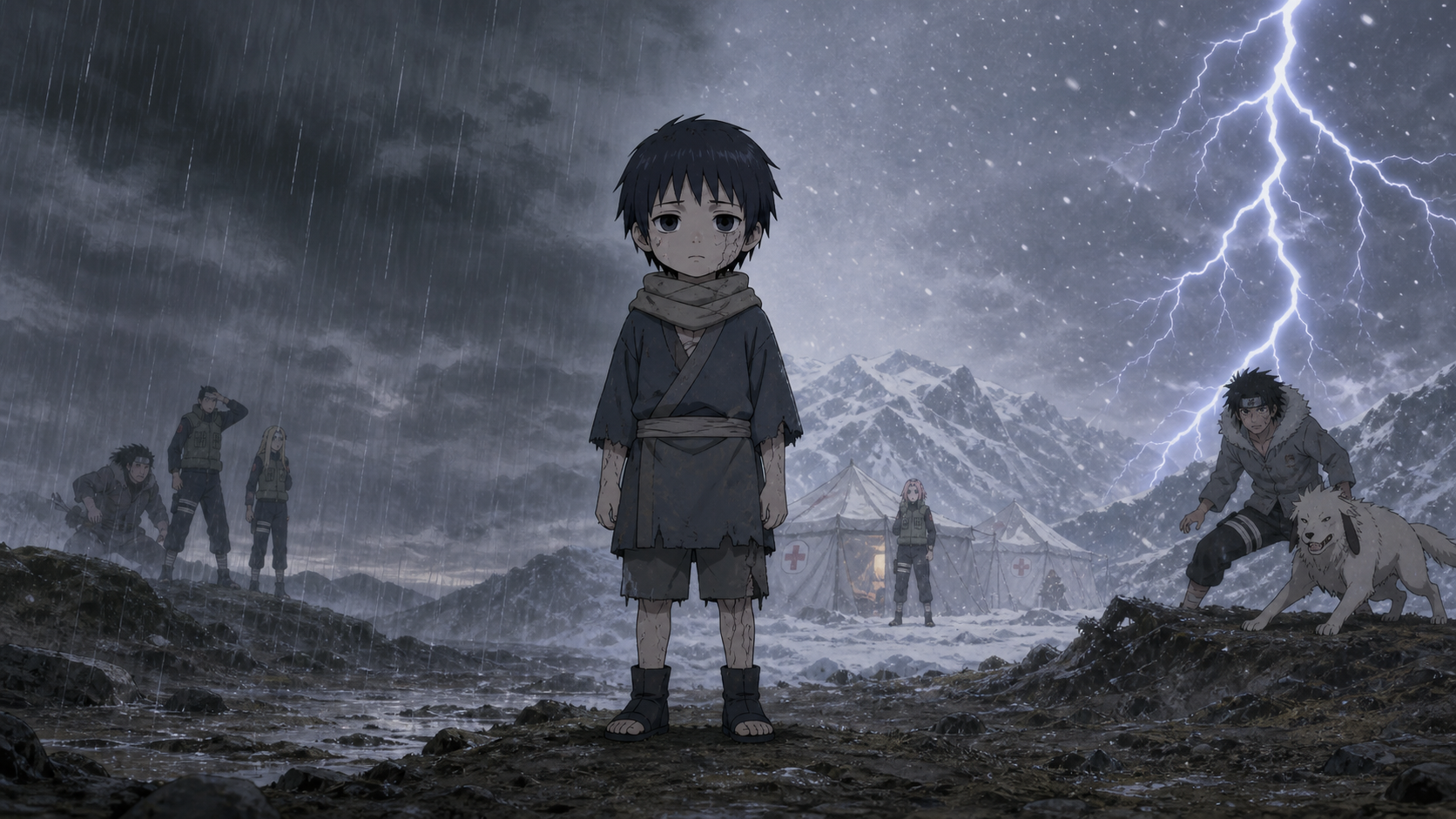
“Rain Followed by Snow, with Some Lightning” opens a three-part anime-original mystery by placing the same reanimated child on three battlefields at once. Shikamaru, Ino, and Chōji recognize Yota among White Zetsu forces as rain falls around him. Sakura meets another Yota in deepening snow at the Medical Division, while Kiba and Akamaru face a third beneath violent lightning. Each group remembers knowing the boy in childhood, yet their fragmented memories do not explain how he died or why three versions exist. Naruto notices the separated weather systems while moving across the war. The episode is strongest when emotion becomes environment and weakest when childhood nostalgia asks viewers to accept a major forgotten friendship without enough groundwork.
Rain arrives at Dan’s containment site
Allied shinobi continue fighting White Zetsu near the barrier restraining Dan Katō when rain begins without a natural transition. Weather becomes a tactical change before anyone identifies the source.
Wet ground affects footing, visibility, weapons, signals, and the electrical risk around a barrier team. A strange shower on a battlefield cannot be treated as atmosphere alone.
Shikamaru notices the child among enemies
Shikamaru spots a small figure moving through the White Zetsu forces and considers another Edo Tensei deployment. The body does not match the legendary adults Kabuto usually selects.
A child on the battlefield demands caution without removing danger. Reanimation can place lethal techniques inside a familiar, vulnerable appearance.
Ino and Chōji recognize Yota
When Ino and Chōji join Shikamaru, all three react to the boy's face. Yota belongs to a shared childhood memory none of them expected the war to return.
Their recognition creates a delay Kabuto can exploit. The team has to separate the person they remember from the controlled body standing among active enemies.
The rain responds to Yota’s mood
Yota's weather manipulation links sadness with rainfall. Emotion becomes a force affecting everyone nearby rather than an internal state he can hide.
The power makes distress impossible to ignore, but public visibility is not the same as support. People can see that a child hurts without understanding what the child needs.
Ino-Shika-Chō has to fight through memory
The trio's formation depends on fast trust and assigned roles. Recognition interrupts that rhythm because each member is trying to connect present danger with an unfinished past.
They need communication before attacking. If one person hesitates while another commits, Yota's weather and White Zetsu pressure can split the team.
Dan’s barrier cannot be abandoned
The unit still has responsibility for Dan, whose reanimated body remains dangerous if containment fails. Yota's appearance may be a diversion designed to pull defenders away.
Emotional urgency does not cancel the larger assignment. Shikamaru must protect the barrier, his teammates, and the child-shaped threat at once.
Sakura finds snow at the Medical Division
Elsewhere, snowfall spreads through the medical camp as Sakura confronts another Yota. The same face appears far from Shikamaru's battlefield with a different weather pattern.
Snow threatens patients through cold, blocked access, collapsing canvas, and slowed evacuation. A medical site has less tolerance for environmental disruption than an open combat line.
The camp’s tents begin to fail
Accumulating snow weighs on temporary structures not designed for winter conditions. Sakura must address the person creating the storm while protecting patients and supplies beneath unstable roofs.
Medical readiness should include environmental contingencies. Reinforced supports, cleared paths, warming stations, and distributed supplies matter when a jutsu changes the climate in minutes.
Sakura recognizes a boy she should remember clearly
Yota's face brings childhood emotion back before a complete account. Sakura knows him, but the surrounding memory feels incomplete.
That gap is part of the mystery rather than a simple continuity error inside the episode. Her certainty about affection and uncertainty about events exist together.
Snow makes sorrow look gentle
The visual softness of falling snow can make Yota seem harmless even as the camp begins to buckle. Beauty creates a dangerous mismatch with physical consequence.
The episode uses that tension well. A child's sadness can deserve compassion while the resulting conditions still require immediate containment.
Kiba and Akamaru meet lightning
On a third battlefield, Kiba and Akamaru encounter Yota beneath a violent electrical storm. Their version of the reunion is louder and more immediately dangerous.
Lightning can strike allies, ignite material, disrupt signals, and terrify animals. Akamaru's sensory distress deserves tactical attention rather than being treated as a comic reaction.
Kiba trusts scent until the impossible appears
Kiba and Akamaru often verify identity through smell. Edo Tensei, transformation, and White Zetsu mimicry complicate what scent can prove.
Recognition through face and memory should be checked against physical evidence. The war has repeatedly demonstrated that familiar appearance can be manufactured.
Three Yotas cannot share one ordinary explanation
Rain, snow, and lightning occur in separate locations around the same child. No normal movement technique accounts for simultaneous encounters across the battlefield.
The characters do not yet know whether they face clones, transformations, divided consciousness, or multiple reanimations. Preserving uncertainty is more honest than choosing the most comforting answer.
Different weather may mark different emotional fragments
Each Yota produces a distinct phenomenon. Rain suggests sadness, snow suggests loneliness or tenderness, and lightning suggests anger or fear.
That reading is an inference, not a diagnosis. A child should not be reduced to one emotion because a supernatural ability gives the feeling a visible form.
The war weaponizes childhood again
Kabuto has already used dead teachers, lovers, relatives, and village heroes to fracture Allied units. Yota extends the pattern to a relationship from childhood.
The tactic is cruel because early friendships shape identity before people have language for grief. Adult shinobi meet a child they lost while briefly becoming the children who knew him.
The adults around them never documented the loss
Several Konoha children remember Yota, yet no teacher, parent, mission record, memorial, or later conversation has preserved his place in their lives. That silence suggests the young group carried the experience without structured adult help.
Children can protect one another fiercely while misunderstanding death, blame, and secrecy. An adult response should have offered truthful explanation, grief support, and a safe way to remember Yota rather than leaving each child with fragments that only return under battlefield pressure.
Memory returns unevenly across the group
Ino, Shikamaru, Chōji, Sakura, and Kiba recall Yota through different encounters. No single perspective provides a complete history.
Collective memory can fill gaps, but shared confidence can also reinforce a false account. The team needs comparison, not a quick vote on whose version feels right.
The childhood addition strains continuity
Yota is introduced as meaningful to several central characters despite never appearing in their earlier stories. Anime-original history often inserts relationships into spaces the main narrative left open.
The emotional material can still work. The script must earn the bond through specific behavior rather than assuming nostalgia automatically creates depth.
Yota’s age changes the ethical stakes
Every Edo Tensei victim lacks consent, but a child soldier sharpens the violation. Yota's body, emotions, and unusual ability become military resources after death.
The Allied response should prioritize sealing and release rather than punishment. He may pose a lethal threat without holding moral responsibility for Kabuto's orders.
Weather control complicates safe restraint
Close combat may intensify Yota's fear and worsen the storm. Long-range attacks could injure the child-shaped body without ending reanimation.
A safer approach combines sensory verification, emotional de-escalation, environmental protection, and a sealing team. No single fighter should be asked to solve every layer.
Ino can connect the separated battlefields
Ino's communication abilities make her essential once the groups realize they share the same encounter. Information about appearance, speech, weather, and location can expose contradictions.
The episode begins with isolated reactions, but the mystery demands a networked response. Personal memory becomes operational intelligence only after comparison.
Shikamaru should distrust the perfect distraction
A familiar child appearing beside a critical containment site has obvious diversion value. Even genuine emotion can be positioned by an enemy to manipulate defenders.
Shikamaru's responsibility is not to suppress compassion. His responsibility is to prevent compassion from being predicted as a gap in the perimeter.
Sakura has two kinds of patients
The Medical Division holds wounded allies, while Yota is also a dead child being used against his will. Sakura faces competing care duties under worsening snow.
Treating Yota as a patient does not require allowing the storm to continue. Medical ethics can include restraint when uncontrolled power threatens other vulnerable people.
Kiba’s directness needs a slower check
Kiba tends to act quickly when his senses identify a threat. Lightning creates pressure to move before the situation worsens.
The impossible duplication should slow that instinct. A fast answer aimed at the wrong Yota could strengthen the enemy's deception or damage someone who might be reached through recognition.
Naruto sees the weather map from movement
Traveling between battlefields, Naruto notices rain, snow, and lightning affecting separated areas. His mobile perspective gives him information the stationary units cannot see.
The pattern may matter more than any single storm. Naruto can connect locations while his shadow clones expand the Alliance's ability to compare events.
Naruto’s absence preserves the mystery
Episode 313 keeps Naruto outside the direct reunions for most of the chapter. His friends carry their own memories instead of waiting for the protagonist to define Yota.
That choice gives the ensemble space. The eventual Naruto encounter will mean more after the weather has already established contradictory evidence.
The title functions like a warning forecast
“Rain Followed by Snow, with Some Lightning” sounds casual, almost like an inconvenient day. On the battlefield, each forecast element marks a separate supernatural threat.
The understatement fits Yota's childlike presentation. Something that sounds small can destabilize several Allied units at once.
The episode refuses an immediate answer
No group resolves who the real Yota is, why he appears three times, or what happened during childhood. The chapter ends with recognition and tactical preparation rather than a false conclusion.
As the first part of three, that restraint is correct. Episode 313 should establish questions strong enough to carry the memories that follow.
The pacing is fragmented by design
Repeated cuts between rain, snow, lightning, and Naruto's travel can make the episode feel scattered. The structure mirrors the characters' incomplete information.
The risk is emotional dilution. Each reunion receives less time because three versions compete for attention, so later chapters must deepen rather than merely repeat the encounters.
The anime-original arc has a clear hook
A forgotten childhood friend controlling weather could have been a simple sentimental detour. Simultaneous appearances transform the premise into an identity mystery with battlefield consequences.
Manga-only viewers can skip the arc. Ensemble fans receive a story that lets Ino, Shikamaru, Chōji, Sakura, Kiba, and Akamaru own pieces of a shared past.
Three weather fronts turn memory into a coordination problem
Rain, snow, and lightning appear around separate Allied groups that each recognize Yota differently. The pattern is too deliberate for private nostalgia and too dangerous for each unit to investigate alone.
Headquarters needs synchronized reports covering time, location, weather, injuries, speech, and recognition. The mystery becomes solvable only when the fragments stop living in separate conversations.
Yota’s child body changes the rules of engagement
He appears among enemy forces and controls weather capable of harming soldiers, patients, and shelters. He also looks, speaks, and reacts like a child the Konoha group once knew.
Containment should prioritize distance, barriers, and communication before lethal force. A dangerous technique does not erase the duty to ask whether Kabuto controls a child who cannot understand the war surrounding him.
Ino-Shika-Chō cannot abandon Dan’s containment
Yota arrives near a front where Dan already requires constant surveillance and sealing. The emotional distraction pulls attention away from an opponent whose escape could change the war.
Shikamaru needs separate teams for the established threat and the new contact. Familiarity should inform the response without allowing one memory to empty the whole defensive line.
Ino can turn scattered recognition into shared evidence
Her communication abilities offer the most direct route between people seeing different versions of Yota. She can compare exact words and emotional responses before memories reshape one another.
The connection needs consent and limits, especially when childhood grief is involved. Ino should facilitate testimony rather than force everyone into one blended emotional experience.
Sakura’s snowfall lands on a medical emergency
The snow looks gentle until weight, cold, and moisture threaten tents, medicines, exhausted patients, and the people maintaining the camp. Beauty does not reduce infrastructure risk.
Sakura needs crews clearing fabric, warming vulnerable patients, protecting supplies, and tracking whether the weather carries chakra. Recognizing Yota cannot pull her away from everyone already depending on medical command.
Kiba’s nose meets evidence that should be impossible
Scent usually gives him confidence when appearance lies. Yota disrupts that certainty because the familiar smell and remembered person do not explain multiple bodies across distant fronts.
Kiba’s direct response can protect people quickly, but he needs a pause before deciding what the scent proves. Reliable tools still require interpretation when the enemy can manipulate bodies and memory.
Akamaru’s response is separate evidence
His recognition, fear, or confusion should not disappear inside Kiba’s reaction. Akamaru carries his own sensory history and may notice differences Kiba misses.
The report needs both partners’ behavior recorded independently. Their bond strengthens analysis when nobody assumes one automatically translates the other without error.
Uneven memory is not proof that somebody is lying
Ino, Shikamaru, Chōji, Sakura, Kiba, and Akamaru recover different fragments under different emotional pressure. Childhood memories rarely return with identical order and detail.
Investigators should preserve first accounts before group discussion, then compare overlaps and contradictions. Variation can reveal manipulation, perspective, or ordinary forgetting without turning friends into suspects.
The missing adult record is its own failure
A strange child entered Konoha’s orbit, formed relationships, disappeared, and apparently left no accessible report strong enough to answer the current emergency. The children carried the loss alone.
Village archives should contain visitor records, medical notes, weather incidents, guardianship questions, and the search performed afterward. Silence left Kabuto a history he could weaponize without immediate challenge.
Weather control requires civilian warnings
Localized rain can flood trenches, snow can collapse tents, and lightning can strike communications or medical equipment. Each phenomenon demands different shelter advice.
Command should issue plain warnings without naming Yota publicly until identity is verified. Civilians need routes and precautions, not a rumor that one resurrected child controls the sky.
Shikamaru is right to distrust emotional perfection
The encounter arrives with exactly the face, weather, and unfinished feeling likely to pull his team away from current duties. A memory that fits too neatly can still contain real affection.
Suspicion should target the setup rather than punish the child. Shikamaru can question timing and mechanism while preserving the possibility that Yota is another person being used.
Naruto’s absence lets the others own the mystery
The episode resists sending a clone to identify malice and solve the first encounter immediately. Supporting characters must compare memory, manage their fronts, and decide what evidence means.
That space is valuable. Naruto can enter later without replacing the people whose childhood relationship gives the situation its emotional and tactical shape.
The continuity strain needs honest labeling
Adding a significant childhood friend this late asks viewers to accept missing memories and absent records around events that affected several central characters. The premise stretches established history.
Anime-original does not mean worthless. The label lets us evaluate the emotional story fairly without pretending the series always contained this relationship or forcing the addition into every canonical biography.
Recognition does not become permission
Adults can mistake recognition for permission. These shinobi knew Yota as children, but childhood affection does not authorize them to decide his identity, memories, or fate without listening to him now. They need questions for a frightened child, interpreters who understand coercion, and safeguards against Kabuto speaking through the body. If Yota can answer freely, his account belongs beside their memories rather than underneath them. If he cannot, the team should document every interruption, weather shift, and change in expression as evidence of control. Rescue begins with treating his voice as meaningful, even while everyone tests whether that voice is his. The war has turned too many people into tools. Familiar love should make the shinobi more careful about repeating that violence, not less.
RaeRae’s verdict
“Rain Followed by Snow, with Some Lightning” is an effective opening because the weather makes emotion physical and the three Yotas prevent easy sentiment. Every group knows the face, but nobody yet possesses enough truth to act with confidence.
The inserted childhood history needs careful support, and the war setting remains crowded with side stories. Still, the final pattern creates a real reason to continue beyond nostalgia.
The next chapter now has to earn every remembered bond through concrete choices rather than a soft-focus montage.
RaeRae’s call
Three groups recognize Yota under three kinds of weather, which means nostalgia has become a war-wide evidence problem. Protect the medical tents, keep Dan contained, compare first memories before everybody influences everybody else, and remember that a child with a dangerous technique may still be the person most in need of rescue.
Episode details and viewing routes
- Official episode reference: Naruto Official episode guide
- Licensed episode route: Crunchyroll licensed episode page
What I am carrying forward
I am carrying forward three simultaneous Yotas, rain near Dan's barrier, snow threatening Sakura's medical camp, lightning around Kiba and Akamaru, and Naruto noticing the impossible weather from between battlefields.
I am also carrying forward the missing evidence: whose memory is complete, which body is genuine, and how a child known by so many friends disappeared from every conversation until the dead began walking.