
The Vengeful
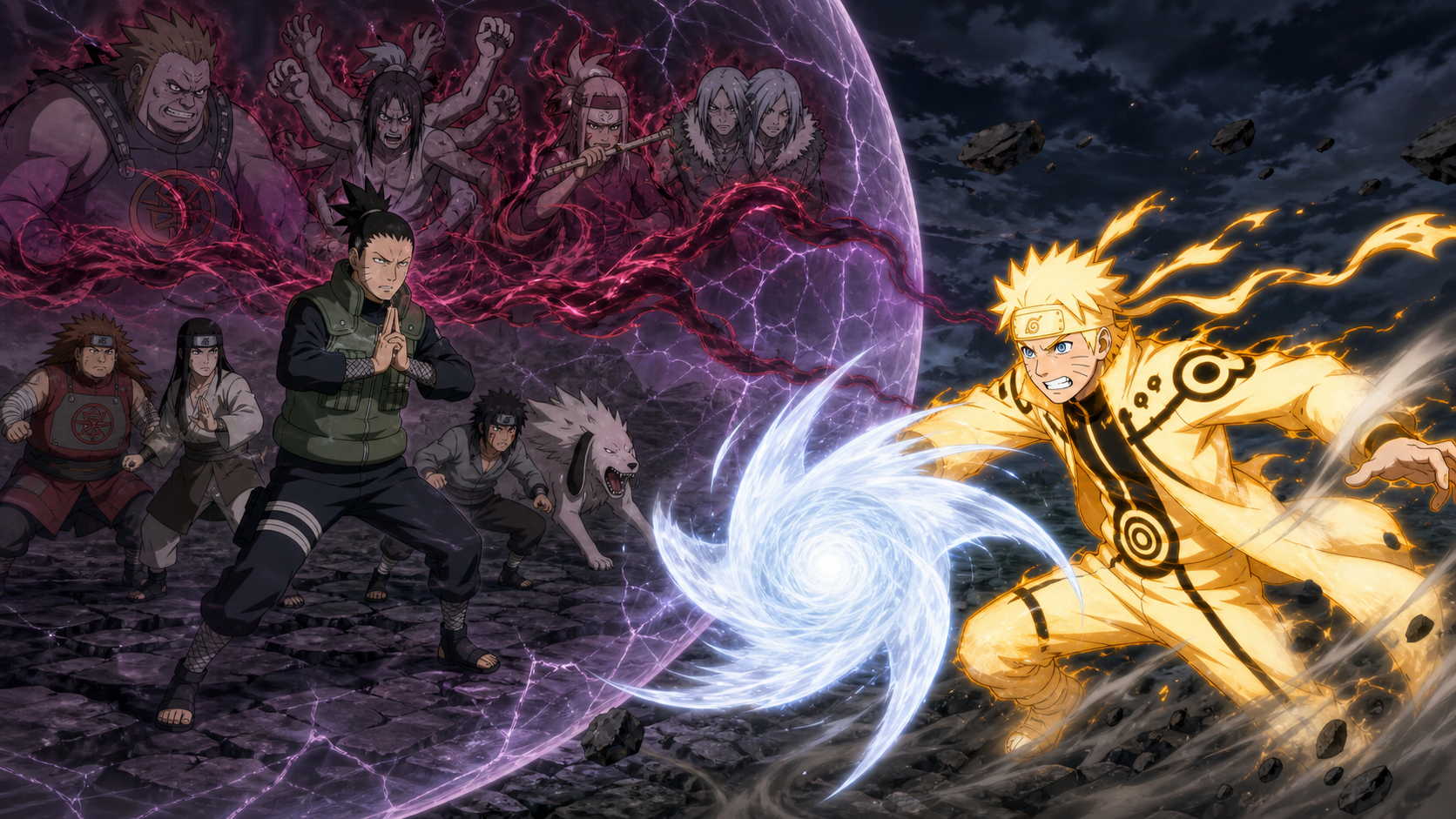
Shikamaru makes vengeance leak beyond the soul prison, giving Naruto a target for the Rasenshuriken that can bring five friends home.
Bottom line
“The Vengeful” saves the Sound Four detour by making hatred part of the prison's engineering. Shikamaru recognizes that the reanimated enemies grow stronger through vengeance and deliberately insults, frustrates, and redirects them until that hostility leaks beyond the sealed space. Naruto cannot sense the trapped souls through ordinary chakra, but Kurama's power lets him follow concentrated malice. The solution requires two forms of intelligence working across a wall: Shikamaru creates a signal from inside, and Naruto turns that signal into a target from outside. A massive Rasenshuriken breaks the barrier and returns five souls to bodies Ino and Shino nearly exhaust themselves keeping alive. The finale is loud, but the rescue belongs to the entire chain.
Time is killing the bodies outside
Ino and Shino continue feeding chakra into Shikamaru, Chōji, Neji, Kiba, and Akamaru. Their friends remain alive, yet every pulse weakens as the trapped souls fight in a separate space.
The caregivers cannot see progress inside the barrier. They work because stopping guarantees death. That choice gives the episode a physical clock without needing a countdown graphic.
The official routes establish the final barrier battle
Naruto Official catalogs Episode 305 as record `01_749`. Crunchyroll lists “The Vengeful” under watch ID `GYWEXMNKY`, released March 21, 2013. The licensed summary centers Ino and Shino exhausting their chakra while time runs out for the trapped Leaf shinobi.
The three-episode Sound Four return remains anime-original. This conclusion does not alter the manga's war events, but the story does complete the supporting-cast problem established in Episodes 303 and 304.
Naruto finally reaches communications
Naruto finds a member of the Communications Team and contacts headquarters. He expects strategy to produce an immediate rescue route because the missing people include his friends.
Headquarters has information but no sensor who can directly locate souls. The gap frustrates Naruto because institutional language sounds cold when bodies are failing in real time.
Naruto accuses Shikaku of indifference
Naruto lashes out when Shikaku explains the limits of the Alliance response. Shikamaru's father appears too calm to Naruto, who reads composure as distance from a son's danger.
The accusation is unfair and emotionally honest. Naruto has spent his life measuring care through who arrives, who fights, and who refuses to abandon him. Shikaku measures care through decisions that must protect an entire army, including the son he cannot personally reach.
Shikaku cannot command as one frightened father
Shikaku refuses to let panic control headquarters. As chief strategist, he must keep communication, troop movement, identity verification, and multiple battlefields functioning while Shikamaru remains missing.
His composure does not prove a lack of love. The job forces him to hold private fear inside public responsibility. Naruto needs the truth, but Shikaku does not owe the command network a performance of parental grief.
Ino and Shino spend their own reserves
The longer the barrier remains closed, the more chakra Ino and Shino transfer. Support work becomes self-endangerment because the rescuers cannot know how long they must sustain five bodies.
Command should rotate compatible chakra support before both caregivers collapse. The episode frames their persistence as devotion, but devotion does not replace resource planning.
The Sound Four become stronger through vengeance
Inside the prison, Jirōbō, Tayuya, Kidōmaru, Sakon, and Ukon reveal that their vengeful will amplifies them beyond the strength used in life. They believe Orochimaru restored them so they could punish the people tied to their deaths.
That belief turns hatred into both fuel and leash. The Sound Four feel powerful while repeating the emotional condition that made them disposable to Orochimaru in the first place.
They do not know Kabuto controls the resurrection
The Sound Four's loyalty depends on a false assumption. Kabuto performed Edo Tensei and deployed them as a timed diversion while preparing another move.
Their ignorance makes the revenge smaller, not grander. They believe they returned for personal justice. Kabuto needs them to radiate enough hostility to hold five targets and occupy Naruto.
Shikamaru starts provoking them on purpose
Shikamaru's teammates become confused when he keeps aggravating enemies who already gain power from rage. His attacks look indirect, and his insults appear reckless.
He is testing whether the barrier can contain emotion as completely as the barrier contains souls. If hatred strengthens the Sound Four, stronger hatred may create a detectable overflow.
A bad-looking plan can still be communication
Shikamaru cannot send a normal message through the sealed space. He has no radio, sensory link, or visible opening. His only available signal is the enemy's emotional output.
The plan requires faith that somebody outside can read that signal. Shikamaru knows Naruto gained the ability to sense malice. Their years together supply the missing communications protocol.
The teammates need to trust incomplete information
Chōji, Neji, Kiba, and Akamaru cannot see the entire calculation at first. They only see Shikamaru making powerful enemies angrier while their bodies approach death.
Trust does not mean passive obedience. They continue fighting, question what they see, and recognize the pattern as the signal grows. Mature teamwork allows uncertainty without collapsing into five separate plans.
Hatred leaks beyond the barrier
The Sound Four's resentment swells until the sealed space can no longer hide the emotional pressure. Naruto senses the hostile concentration and pinpoints the location.
The prison fails because the jailers confuse greater anger with greater control. Power increases while concealment breaks. Shikamaru turns their desired advantage into a beacon.
Naruto understands Shikamaru's signal
Naruto does not hear an explanation. He reaches the same conclusion from the shape and location of the malice. The moment respects his intelligence and his bond with Shikamaru.
Naruto often solves problems through empathy after others reduce him to force. Here, emotional perception becomes tactical literacy. He reads what Shikamaru made visible.
The Rasenshuriken attacks the prison from outside
Naruto forms an enormous Rasenshuriken and strikes the barrier's external location. The trapped team could not break the wall because the prison controlled their space and regenerated its defenders.
An outside attack changes the geometry. Shikamaru does not need to overpower the Sound Four forever. He needs to mark the cage long enough for Naruto to hit a boundary the jailers cannot defend from within.
The rescue is not a Naruto solo victory
Naruto delivers the final impact, but no single hero owns the result. Shikamaru creates the signal. Chōji, Neji, Kiba, and Akamaru keep the enemy occupied. Ino and Shino preserve the bodies. Communications connects Naruto to headquarters.
Removing any link kills the trapped shinobi. The episode's strongest statement about the Allied Force comes from that dependency, not from the size of the Rasenshuriken.
Five souls return to five bodies
The barrier breaks, the Sound Four vanish, and the missing souls return. Ino and Shino finally receive proof that their exhausting work preserved a route home.
The recovery should still require medical observation. Spiritual return does not guarantee stable chakra flow, and the caregivers also need treatment after transferring so much of their own reserves.
The Sound Four lose through the emotion they worship
Their hatred produces strength, but that same hatred exposes their location. The irony works because the failure comes from character rather than a surprise weakness invented after the fight.
They could not imagine restraint because vengeance had become their identity. Shikamaru wins by understanding what they will always choose when insulted.
Revenge keeps Orochimaru's hierarchy alive
The Sound Four died serving a system that used cursed seals, dependency, and promises of importance. Reanimation gives them one chance to reassess that loyalty, and they choose the same master in their own minds.
Their revenge never targets the institution that consumed them. They target children who survived. Kabuto benefits from that misdirected anger exactly as Orochimaru once did.
Naruto's anger and their anger follow different paths
Naruto knows resentment intimately. Konoha isolated him, adults lied to him, and hatred once produced Dark Naruto at the Waterfall of Truth. He did not erase those feelings. He acknowledged them without letting them select every target.
The Sound Four cling to grievance as proof of purpose. Naruto uses awareness of malice to locate people who need help. The contrast avoids claiming that anger itself makes someone evil. Direction and accountability matter.
Shikamaru repairs part of his first command
The Sasuke Retrieval Mission taught Shikamaru that a commander can make good decisions and still watch friends nearly die. Episode 305 returns the same group to another trap built by the same enemies.
This time he communicates through the battlefield, uses Naruto as an outside resource, and brings the team home. The rescue does not erase the first failure. The new outcome proves that guilt became experience rather than a permanent sentence.
Shikaku and Shikamaru solve different scales
Shikaku keeps the Alliance functioning while Shikamaru solves the sealed room. Father and son share strategic discipline, but responsibility operates at different ranges.
Naruto's confrontation with Shikaku exposes the human cost of command. The episode could spend more time on that tension instead of resolving the exchange quickly, because war repeatedly asks leaders to sound detached while people they love remain inside the casualty report.
The climax arrives faster than the setup deserves
After two episodes of barrier rules and repeated fighting, one Rasenshuriken ends the prison decisively. The visual release feels good, but the barrier's destruction risks making the earlier complexity look decorative.
The strategy saves the scene. Naruto can strike only because Shikamaru deliberately causes the emotional leak. Without that reasoning, the ending would be a protagonist arriving to erase a supporting-cast story with a larger attack.
The anime-original arc knows where to stop
Episode 305 completes the Sound Four return without extending the rematch beyond three episodes. The conclusion restores the souls, closes the vengeance mechanism, and returns attention to the wider war.
The arc remains optional for manga-canon viewers. For supporting-cast fans, the ending delivers enough character logic to justify the detour even when the repeated battles drag.
Naruto senses hatred across the wider battlefield
After the rescue, Naruto remains disturbed by negative emotions spreading through the war. One barrier has broken, but the world still contains fear, resentment, impostors, and reanimated grudges.
The final note prevents the victory from becoming a claim that Naruto purified hatred with one technique. His sensing ability reveals scale. Understanding every source and responding without losing himself will be harder.
The Japanese cast carries calculation beneath shouting
The licensed route confirms Japanese audio and the returning cast. Shikamaru's dialogue must make deliberate provocation sound reckless until the plan becomes visible, while Naruto's confrontation with Shikaku needs anger grounded in fear for friends.
I can verify the scene structure and credited roles. I am not inventing precise claims about vocal breath, pitch, or timing without a fresh lawful performance review.
Ino and Shino are spending time the bodies do not have
Every minute inside the barrier drains the people outside who are maintaining five lives without knowing whether rescue can reach them. Chakra becomes a clock written through shaking hands, weak pulses, and fading reserves.
Command should rotate support, bring medics closer, and document which body depends on which intervention. Invisible maintenance cannot remain an unlimited resource simply because the fighting happens somewhere else.
Naruto’s accusation lands on a father and a commander
He hears that Shikamaru is trapped and interprets Shikaku’s restraint as emotional distance. Naruto knows what abandonment looks like, so calm command can read like indifference when somebody he loves is dying.
Shikaku still cannot collapse an army’s coordination around his son. The honest answer is not pretending he feels nothing. The honest answer is naming the fear while continuing the work only he can do.
Shikamaru turns hatred into a transmission
Provoking the Sound Four appears reckless because their strength grows with vengeance. He is testing whether their emotion can cross a boundary ordinary chakra sensing cannot penetrate.
The plan treats behavior as signal. Shikamaru cannot call headquarters, but he can make the captors broadcast the one thing Naruto detects across impossible distance.
The team trusts Shikamaru without receiving the whole plan
Chōji, Neji, Kiba, and Akamaru have enough shared history to recognize when Shikamaru is deliberately escalating a situation. Trust does not require pretending the danger feels comfortable.
They continue resisting while watching for the opening his strategy may create. Their agency remains important because a commander’s cleverness should never turn teammates into silent pieces on a board.
The Sound Four mistake borrowed power for vindication
Kabuto restores their bodies, cursed seals, and resentment without telling them that resurrection itself serves another controller. They interpret increased strength as proof that history finally agrees with them.
The power does not restore their standing under Orochimaru or give them a future. Vengeance keeps them performing the same disposable role for a new master who values their hatred as fuel.
Naruto hears the signal because he knows the people sending it
Malice sensing identifies the Sound Four’s hatred, but relationship tells Naruto that Shikamaru would provoke that surge for a reason. Ability and knowledge work together.
A stranger might locate the threat and still miss the message. Naruto understands that the sudden emotional spike marks a target because he trusts Shikamaru’s habit of turning enemy behavior into openings.
The Rasenshuriken breaks a prison other people mapped
Naruto supplies the external force, yet the trapped team generates the signal, Ino and Shino preserve the bodies, Hinata guards Neji, and headquarters creates the route.
Calling the rescue Naruto’s victory would erase the chain that made his strike possible. His best contribution is arriving exactly where everybody else’s work told him to aim.
Five returning souls need five separate recoveries
Waking does not mean every person experienced the same captivity. Shikamaru carried command pressure, Chōji confronted old self-sacrifice, Neji met a former killer, and Kiba and Akamaru fought as an interdependent pair.
Medics should assess orientation, memory, chakra disruption, pain, and spiritual aftereffects individually. A group rescue does not create one group patient.
Akamaru cannot disappear inside Kiba’s chart
The transfer took both partners, and their combat decisions depend on a shared sensory and emotional bond. Akamaru needs his own examination for chakra disturbance, injury, fear, and changes in recognition.
Veterinary expertise belongs beside shinobi medicine. Treating him as equipment would misunderstand both the patient and the partnership that helped locate weaknesses inside the barrier.
Shikaku and Shikamaru work at different scales
The son manipulates four enemies inside a sealed world. The father keeps communications, reinforcements, medical support, and wider fronts moving while his child remains unreachable.
Neither form of strategy is colder or more intelligent. One works through immediate behavior. The other protects enough systems for the immediate plan to have somewhere safe to return.
The rescue should not become proof that secrecy worked
Shikamaru withholds the full plan because the barrier blocks communication and time is collapsing. That emergency does not justify commanders hiding information when channels exist.
After-action review should identify what each person knew, what signals worked, and where silence increased risk. Exceptional improvisation is evidence that the system needs improvement, not a reason to demand the same gamble next time.
The Sound Four deserve accurate responsibility
They choose cruelty, taunt the people they once harmed, and feed their own strength through vengeance. Kabuto also revived, controlled, and deployed them for a trap they did not understand.
The record can hold both facts. Coercion does not erase their actions, and their hostility does not erase the violation committed against their bodies.
Naruto’s anger finds a different destination
He becomes furious when he thinks leadership has accepted his friends’ deaths, but the anger drives him toward communication and rescue. The Sound Four use anger to keep an old hierarchy alive.
The difference is not that Naruto feels a purer emotion. The difference is what relationships and choices teach him to do with the feeling once power becomes available.
Reunion should begin with consent, not celebration
Friends will want answers and physical contact the moment the five wake. Patients returning from a soul prison may need quiet, orientation, distance, or one trusted person first.
Medics should ask before touch, explain where each body remained, and delay tactical interviews until stabilization. Coming home deserves care that does not immediately turn survival into another duty.
RaeRae’s verdict
“The Vengeful” gives the filler trilogy a conclusion based on character rather than random power. Shikamaru understands the Sound Four well enough to weaponize their resentment, and Naruto understands Shikamaru well enough to answer a message made from malice.
The oversized Rasenshuriken gets the final image, but Ino and Shino earn equal credit. They kept five doors open until the souls could come home.
RaeRae’s call
Shikamaru makes vengeance loud enough for Naruto to hear, but the rescue works because Ino and Shino keep five bodies alive, headquarters keeps searching, and the trapped team trusts an incomplete plan. Naruto breaks the barrier. He does not own the victory.
The aftercare record should also credit the people whose chakra kept the bodies alive. Ino and Shino need rest, food, medical assessment, and relief from any belief that one lapse would have killed their friends. Hinata needs space to process watching Neji remain unreachable. Caregivers can survive the emergency and still carry guilt, tremors, anger, or exhaustion afterward. The mission ends only when full support reaches the supporters too.
Episode details and viewing routes
- Official episode reference: Naruto Official episode guide
- Licensed episode route: Crunchyroll licensed episode page
What I am carrying forward
I am carrying forward the restored retrieval team, depleted caregivers, a broken Underworld Transfer barrier, the final defeat of the reanimated Sound Four, and Naruto sensing that hatred still saturates the battlefield.
I am also carrying forward the coordination pattern: create a signal inside the system, preserve the people outside the system, and strike the boundary from a position the jailers forgot to defend.