
The Underworld Transfer Jutsu
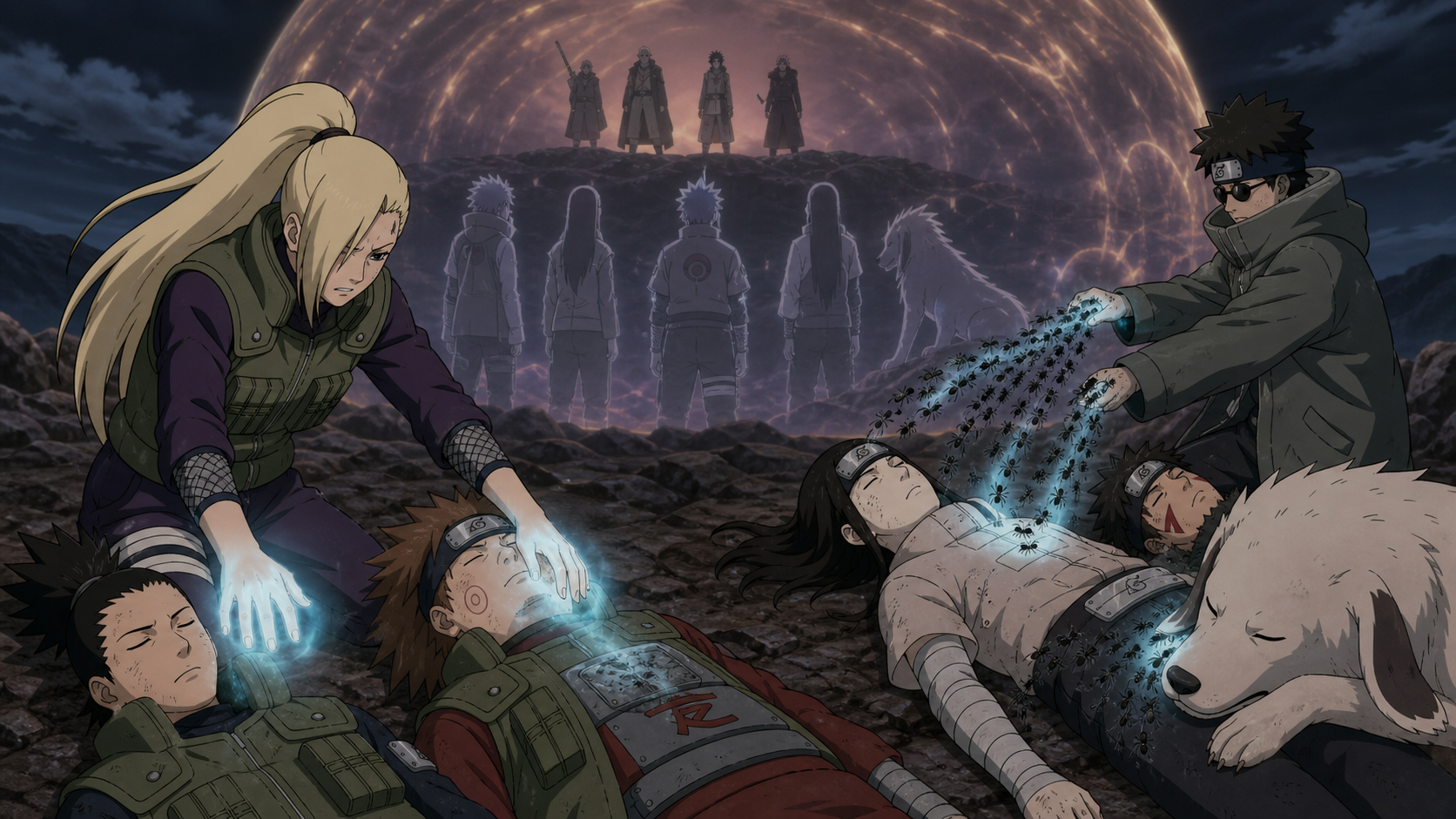
Five Konoha souls fight inside a sealed world while Ino and Shino sustain their abandoned bodies and Naruto follows the Sound Four malice.
Bottom line
“The Underworld Transfer Jutsu” turns Episode 303’s easy victory into a medical and spiritual emergency. Shikamaru, Chōji, Neji, Kiba, and Akamaru wake inside a sealed space while their bodies lie almost lifeless on the battlefield. The Sound Four can regenerate inside the barrier, and defeating them does not automatically release the stolen souls. Outside, Ino and Shino keep their friends' chakra moving while headquarters admits that normal sensory methods cannot locate what the technique removed. The episode slows the rematch down, sometimes too far, but the structure gives neglected supporting characters separate work. Shikamaru studies the prison. Ino and Shino sustain the bodies. Naruto follows malice rather than a normal chakra signature. Nobody gets to solve the entire crisis alone.
The bodies remain while the people are missing
Neji, Kiba, Akamaru, Shikamaru, and Chōji still have pulses, but their chakra flow has become weak and sluggish. The condition looks like suspended animation rather than ordinary injury. Medics can touch the patients, measure life, and still fail to reach the actual problem.
That separation makes the jutsu frightening in a practical way. The Alliance cannot treat a soul with bandages, antidotes, or battlefield surgery. Bodies need protection and continuous chakra support while another team identifies where the missing consciousness went.
The official routes identify the trap
Naruto Official catalogs Episode 304 as record `01_748`. Crunchyroll lists “The Underworld Transfer Jutsu” under watch ID `G6Q4M97PR`, released March 14, 2013. The licensed summary confirms that the defeated Sound Four used the technique to trap the Konoha shinobi's souls inside a barrier.
The story remains anime-original. The barrier conflict expands supporting-cast material without changing the manga's central war outcome. Fans following adaptation canon can skip the detour. Fans following Shikamaru, Chōji, Neji, Kiba, Akamaru, Ino, and Shino receive a rare team problem built around their specialties.
Ino refuses to let two teammates fade
Ino works over Shikamaru and Chōji, feeding chakra into bodies that cannot respond. The scene gives Team 10's bond a job instead of using friendship as background decoration. Her teammates won their visible battle, but their survival now depends on the person who was not inside the trap.
The labor is exhausting because Ino cannot receive confirmation from them. She must trust the weak pulse, maintain flow, and keep working without knowing whether either soul can return. That uncertainty feels closer to real care than a dramatic speech followed by instant recovery.
Shino uses insects as life support
Shino applies chakra through his kikaichū to sustain Neji, Kiba, and Akamaru. The method fits his established system because the insects already live through chakra exchange and can operate across several bodies.
Shino often disappears from Shippuden's major conflicts despite having one of Konoha's most adaptable toolkits. Episode 304 lets him solve a problem through control and observation rather than forcing him into a generic punch exchange. The insects become a distributed support network.
Hinata has to watch Neji without reaching him
Hinata arrives beside Neji's body and cannot use the Byakugan to retrieve a missing soul. Her dōjutsu can reveal chakra pathways and internal damage, but visibility does not equal access.
The limitation matters. Powerful eyes should not become universal answers. Hinata can confirm that Neji remains alive, protect the site, and support Shino's work. She cannot replace the sealing and sensory knowledge the crisis requires.
Headquarters cannot find the souls
Inoichi receives the field report and compares the condition to a genjutsu-like separation, but even headquarters' sensory barrier cannot locate the missing souls. The admission prevents expertise from becoming fake certainty.
The next step is retrieval, not diagnosis alone. Headquarters needs the technique's anchor, the barrier location, or a person who can sense the hostile intent attached to the Sound Four. A complete chakra map can still miss a target stored outside the mapped space.
The trapped team wakes inside a closed world
Shikamaru, Chōji, Neji, Kiba, and Akamaru regroup in an unfamiliar circular space. Their bodies feel present, yet the battlefield and allies outside cannot hear them. The prison resembles a constructed afterlife more than a physical room.
Their first job is orientation. Shikamaru checks the boundary, Neji examines the space, and the group confirms who crossed over. Panic would waste the limited time their bodies have outside.
The Sound Four explain only enough to hurt them
Jirōbō, Tayuya, Kidōmaru, Sakon, and Ukon reveal that the Konoha souls are trapped, then resume the rematch. Their confidence comes from the barrier's rules. Reanimated bodies regenerate, while living bodies outside continue weakening.
The explanation is also psychological warfare. Every minute of combat becomes evidence that unseen friends may be watching their bodies die. The Sound Four want revenge to feel inevitable rather than merely violent.
Regeneration destroys the meaning of a knockout
The Konoha team already proved that years of growth made them stronger than these enemies in a normal exchange. Inside the barrier, damage closes and the Sound Four return. Greater force cannot create a permanent result under the same rules.
Shikamaru needs to identify what sustains the regeneration and what connects the barrier to the physical world. Otherwise the team can win each minute and still lose the only clock that matters.
Four summoned beasts turn the prison into sectors
The Sound Four use the Four Beasts Encirclement Formation, placing a distinct summoned threat around the sealed space. The technique separates attention and encourages the Konoha shinobi to repeat their old one-on-one matchups.
That division favors the jailers. Shikamaru's team grew through cooperation, while the Sound Four want each survivor isolated with the enemy tied to an old wound. Breaking the emotional formation may matter as much as breaking the physical barrier.
Shikamaru treats the rules as the real enemy
Shikamaru does not mistake repeated victories for progress. He watches regeneration, timing, boundaries, and the Sound Four's need to keep talking about resentment. The prison has a mechanism, and mechanisms create dependencies.
His patience can look passive beside louder techniques. Episode 304 needs that pause. Attacking without a theory would spend chakra inside a space designed to waste effort while the bodies outside weaken.
Chōji carries power without the old poison
Chōji can confront Jirōbō without swallowing the pills that nearly killed him during Part I. His current strength proves that the first sacrifice did not define the ceiling of his ability.
The barrier changes the problem before that growth can become a clean celebration. Chōji can overpower an opponent and still fail to escape. Mature strength includes accepting when physical force needs another person's analysis.
Neji cannot see beyond every boundary
Neji's Byakugan supplies exceptional perception inside the prison, but the technique separates space, soul, and body in ways ordinary vision cannot solve immediately. The limit keeps the dōjutsu connected to rules rather than magic omniscience.
Neji also has to trust teammates whose abilities operate differently. Shikamaru reads intent, Kiba follows scent and instinct, Chōji supplies force, and allies outside maintain the bodies. The old prodigy no longer carries the whole answer alone.
Kiba and Akamaru keep testing the cage
Kiba responds to confinement through movement. He and Akamaru pressure the enemies, test angles, and refuse to sit quietly while their bodies fail elsewhere. That urgency matches both characters.
Shikamaru needs their aggression as data, but Kiba also needs a plan before repeated charges become fuel for the trap. Their friction is useful because real teams do not all process fear at the same speed.
The outside team performs invisible heroism
Ino and Shino do not receive the flashy battle animation, yet their sustained chakra work creates every second available inside the barrier. Without that support, Shikamaru's analysis would end beside five dead bodies.
War stories often treat medical and logistical work as a pause between fights. Episode 304 makes support labor simultaneous with combat. Survival becomes a chain where the least visible link may carry the greatest immediate responsibility.
Naruto identifies another White Zetsu impostor
While racing toward the malicious chakra, Naruto encounters Allied shinobi and exposes one transformed White Zetsu. The interruption reminds viewers that the larger identity crisis has not stopped for the Sound Four side story.
Naruto's negative-emotion sensing works where passwords and appearances fail. That advantage does not make every stranger guilty. He still needs to identify the hostile intent before striking, because an exhausted army cannot replace paranoia with indiscriminate violence.
Malice gives Naruto a route sensory maps missed
Headquarters cannot locate the displaced souls through standard chakra detection. Naruto can feel the Sound Four's concentrated hatred and move toward the barrier's emotional signal.
The solution grows from Kurama's power and Naruto's history with hostility. The village forced him to read resentment for years before he could name the source. War converts that painful sensitivity into a rescue tool, although the story should never pretend childhood abuse was worthwhile because the survivor later used the skill.
Kabuto designed the victory as an entrance fee
The Sound Four needed to lose on the physical battlefield so the formula could activate around the correct targets. Their bodies were bait, and the Konoha team's confidence completed the placement.
Kabuto's plan is clever because the first result flatters everyone. The heroes see proof of growth. The Alliance sees four enemies down. The Sound Four accept defeat because the defeat opens a space where regeneration and time favor them.
The barrier attacks relationships, not only souls
Each matchup carries an old fear: Chōji's near-fatal sacrifice, Neji's blind spot, Kiba's self-injury, and Shikamaru's command failure. The Sound Four want those memories to become fixed identities.
The Konoha shinobi need to recognize the past without reenacting the same emotional decisions. Chōji does not need poison. Kiba does not need another suicide move. Neji does not need to accept death. Shikamaru does not need to carry responsibility alone.
The episode exposes a military classification gap
The Alliance has medical divisions, sensory divisions, barrier teams, and sealing squads, yet a technique combining all four domains creates immediate confusion. Specialists hold pieces of the answer without a shared response protocol.
Future triage should mark unexplained low chakra, preserved pulse, and mass unconsciousness as a possible spiritual displacement event. Secure the bodies, sustain chakra, inspect seals, preserve the perimeter, and search for anchors before moving casualties.
The pacing loses pressure inside repeated exchanges
The barrier premise is stronger than several of the fights. Regenerating enemies create repetition by design, but animation still needs each cycle to reveal a new rule, cost, or emotional shift.
Episode 304 spends too long proving that ordinary defeat does not work after viewers already understand the point. More time with Inoichi's diagnosis, Ino's strain, Shino's method, or Shikamaru testing the boundary would make the stalemate feel like investigation rather than delay.
The anime-original detour earns part of its runtime
The story does not advance manga canon, and the Sound Four's return exists to fill broadcast space during the war. That production function remains visible. The episode cannot demand that every viewer treat the conflict as essential.
The supporting-cast work still has value. Ino and Shino receive meaningful responsibilities. Shikamaru confronts the shape of his first command. Naruto's sensing connects the side story to the White Zetsu emergency. Anime-original does not mean consequence-free inside the episode's own character argument.
The Japanese cast must carry two simultaneous crises
The licensed route confirms Japanese audio and the returning character lineup. The trapped team needs urgency without constant shouting, while Ino and Shino need strain that reflects sustained work rather than a single dramatic burst.
I am keeping performance analysis bounded because verified credits do not prove a remembered breath, pitch change, or pause. The script supplies the contrast I can support: fighters inside argue over escape while caretakers outside work without receiving an answer.
Ino and Shino hold a battlefield nobody can see
The trapped team receives the dramatic combat, while the people outside manage breathing, circulation, chakra stability, and physical protection for five defenseless bodies. One failure outside ends every possibility inside.
That is not passive waiting. Ino and Shino perform sustained emergency care under conditions headquarters cannot classify. Their work deserves command resources and the same narrative respect as a finishing technique.
Hinata’s vigil carries a family history
Neji lies unreachable after a childhood in which the Hyūga system taught both cousins that his body could be spent for the main family. Hinata cannot solve the barrier by loving him harder.
She can guard his body, report changes, and refuse to let command reduce him to another unavailable fighter. Care becomes political when the person being protected was raised to expect sacrifice.
The medical system needs a category for missing consciousness
Pulse, breath, and chakra remain while the person cannot respond and ordinary sensory methods cannot locate the soul. Calling the bodies unconscious understates the emergency.
Teams need separate monitoring for physical decline, chakra severance, hostile possession, and barrier changes. A classification creates protocols, supply requests, and a record that can help the next victims faster.
Regeneration makes ordinary victory meaningless
Inside the barrier, the Sound Four recover after every defeat. Shikamaru’s team cannot solve the prison by repeating stronger versions of attacks that already worked once.
Their real objective is finding what sustains the space, what counts as an exit, and whether the enemies or the trapped souls anchor the technique. Combat becomes investigation under pressure.
The four beasts split attention on purpose
Separate summoned threats pull each fighter toward the opponent and fear most familiar from childhood. Isolation makes the old battles easier to replay and harder to analyze together.
Shikamaru should preserve a shared reporting rhythm even when the sectors divide them. Naming injuries, regeneration, environmental changes, and timing may reveal one mechanism underneath four performances.
Neji’s Byakugan has a boundary the story should respect
His vision can map chakra and distance across extraordinary ranges, yet the spiritual barrier blocks the route he needs. A famous ability failing does not make the user foolish.
The failure defines the problem accurately. Neji contributes by stating what he cannot see, preventing the team from building a plan on false confidence.
Chōji’s growth is not only stronger chakra
He can fight without swallowing the pills that nearly killed him during the original mission. The physical improvement matters, but so does his refusal to measure loyalty through self-destruction.
A mature team should notice when an old emergency cost no longer applies. Survival becomes part of success rather than the price paid afterward.
Naruto’s sensing reaches the trap through malice
The barrier hides souls from standard sensory maps, yet the Sound Four’s hostility creates a signal Naruto can detect. That discovery offers a route without making him the only rescuer who matters.
He needs headquarters, the outside caregivers, and the trapped team’s resistance to translate detection into recovery. Sensing a prison is not the same as opening one.
Kabuto designed trust as the entrance fee
The Konoha team entered the formula after defeating enemies tied to unfinished history. Their confidence in one another helped them win the rematch and also kept them close enough to be transferred together.
The lesson is not to distrust friends. The lesson is to verify terrain and enemy remains before emotional closure lowers everybody’s guard.
The bodies need consent protections during rescue
Unconscious patients cannot approve invasive techniques, relocation, or experimental attempts to pull their souls back. Emergency authority must remain narrow and documented.
Ino, Shino, Hinata, medics, and command should record each intervention, expected benefit, and observed change. Desperation cannot become permission to use five friends as test subjects.
The episode’s best fight is maintenance
Spectacle happens inside the barrier, but survival depends on people holding bodies warm, breathing, guarded, and connected while no one can promise the souls will return.
That labor has no applause line and no instant result. The episode works when we understand that keeping somebody alive long enough for rescue is already a form of winning.
RaeRae’s verdict
“The Underworld Transfer Jutsu” has a good systems problem and an uneven fight loop. The soul prison makes physical victory useless, separates bodies from agency, and forces combat, medicine, sensory work, and emotional perception to cooperate.
The episode drags when regeneration repeats without enough new information. Ino and Shino save the hour from becoming a stalled rematch. Their quiet labor gives Shikamaru time to think and Naruto time to arrive.
RaeRae’s call
The Sound Four trap souls, but Ino, Shino, and Hinata keep bodies alive while headquarters searches for language and Naruto finds the malice hiding beyond ordinary senses. The rescue belongs to the fighters inside and the caregivers outside. Neither side survives without the other.
The rescue also needs a reunion protocol. If the souls return suddenly, medics should expect confusion, sensory overload, muscle weakness, memory gaps, and panic about how much time passed. Friends must not crowd the patients for an immediate explanation. Each person needs orientation, water, physical assessment, and a chance to identify who feels safe nearby. Headquarters should interview them separately only after stabilization, then compare accounts for details about the barrier. The first question cannot be whether Naruto saved them. The first questions are whether they know their names, recognize their bodies, understand where they are, and can choose what happens next.
Episode details and viewing routes
- Official episode reference: Naruto Official episode guide
- Licensed episode route: Crunchyroll licensed episode page
What I am carrying forward
I am carrying forward five trapped souls, five failing bodies, Ino and Shino sustaining chakra, headquarters unable to locate the prisoners, four regenerating enemies, and Naruto following malice toward the sealed space.
I am also carrying forward Shikamaru's unfinished question: the Sound Four built a prison around hatred, regeneration, and time. Escaping requires understanding which part of that system can be turned against them.