
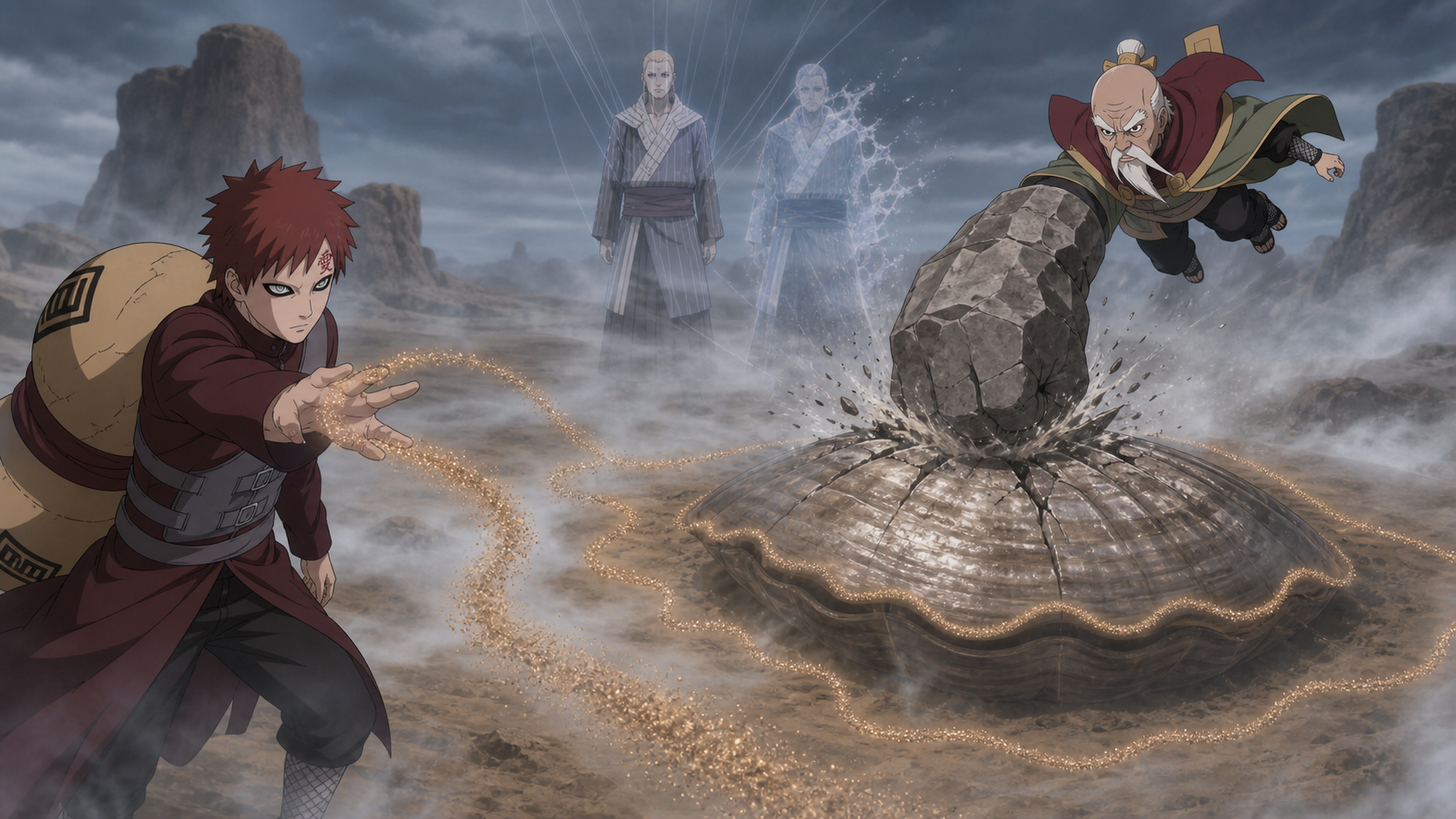
The Mizukage, the Giant Clam, and the Mirage
Gaara and Ohnoki stop attacking a mirage, locate the real clam through physical evidence, and turn the controlled Mizukage’s warnings into a successful counter.
Bottom line
“The Mizukage, the Giant Clam, and the Mirage” turns enemy testimony into tactical instruction. The Second Mizukage does not want to kill the Allied troops, so he explains that the visible body and clam are illusions and becomes increasingly frustrated when soldiers keep attacking them. Gaara and Ōnoki eventually combine sensory sand with a weighted stone fist to find and break the real clam. On another front, Naruto, Gaara, and Ōnoki coordinate to immobilize and seal Mū. The episode makes perception a shared responsibility: warnings, sensors, frontline observations, and specialist knowledge must connect before force has a useful target.
The former Kage break the first seal
The Second Mizukage and Third Raikage escape before Gaara’s sealing can finish. A nearly completed containment is not a completed containment.
The division should review why the seal failed before attempting another capture. Possible causes include insufficient restraint, damaged tags, mistimed activation, outside interference, or regeneration exceeding the barrier’s capacity. Recording the failure protects later teams from repeating the same sequence. Nobody should hide a near success to preserve morale. Honest after-action reporting gives the next sealing team better odds.
The official routes establish two fronts
Naruto Official catalogs the episode as record `01_744`. Crunchyroll lists Shippuden Episode 300 under watch ID `G6MG18W46`, released February 14, 2013. The official summaries place Gaara and Ōnoki against Mū while the remaining Fourth Company faces a Second Mizukage willing to be sealed.
Willingness helps, but Kabuto’s body control still forces lethal resistance.
Reanimated leaders teach their opponents
The former Kage name techniques and weaknesses because their voices retain limited agency. Every warning should enter the field log immediately.
Soldiers need one officer assigned to listen and relay while others maintain defense.
That officer should repeat each warning through a secured channel and mark whether field evidence confirms the claim. Reanimated speakers may lose control mid-sentence, mix truth with forced deception, or use language unfamiliar to current troops. A small interpretation team can compare testimony with archives and sensory readings. Listening becomes a structured tactical function rather than an informal favor.
The Second Mizukage summons the giant clam
The clam releases mist that supports a wide-area mirage. Fighters see targets that occupy no physical location.
The correct objective is finding the real summon, not increasing attacks against the projection.
Visible evidence becomes unreliable
Weapons pass through the Mizukage and clam images. Repetition confirms the illusion, yet frustration keeps the platoon attacking.
Command should define a stop condition: after two verified passes through a target, units shift to sensors and environmental testing.
The order must come before the illusion begins. Fighters under pressure often interpret failure as a demand for greater force. A prewritten threshold removes shame from changing tactics. Units can deploy dust clouds, water droplets, sound pulses, scent trackers, chakra-sensitive paper, and ground vibration checks. No single sensor should control the conclusion when a technique may fool several senses.
The Mizukage argues with his attackers
He tells them that the images are false and urges them to think. The comedy carries a grim fact: a prisoner must coach people being forced to fight him.
His testimony deserves credibility without automatic trust. Results can verify each instruction.
Mockery wastes the information window
Some soldiers focus on the Mizukage’s appearance and facial hair. Insults provoke him while contributing nothing to identification.
Stress humor can relieve fear, but harassment of a coerced combatant undermines the mission.
The Mizukage’s irritation also affects battlefield risk. Provocation may strengthen his resistance to helping, disrupt clear instructions, or create openings for Kabuto’s command to exploit. Leaders should redirect jokes away from personal features and toward shared coping that does not target a prisoner. Discipline includes protecting useful communication from the unit’s own behavior.
Gaara leaves to support Ōnoki
Gaara prioritizes Mū while assigning the Mizukage front to his division. Delegation is necessary across simultaneous threats.
The remaining unit needs sealing tools, sensor support, and authority to request Gaara’s return.
Ōnoki and Mū share Dust Release
Teacher and student trade techniques capable of erasing large areas. Their matching knowledge produces a dangerous stalemate.
Nearby troops need marked exclusion zones and warnings before either fighter fires.
Naruto arrives through a shadow clone
Naruto’s distributed support reaches the Kage front. His presence adds speed and a new attack angle without replacing Gaara or Ōnoki.
Clone identity should be confirmed through the same protocol used on every front.
Planetary Rasengan creates an opening
Mū evades Naruto’s first approach, but Gaara’s sand redirects the exchange. The attack succeeds through support rather than surprise alone.
The sequence shows why Naruto’s clones need local commanders who understand terrain and enemy movement.
Naruto’s original body also needs a route for receiving clone memories without cognitive overload. Headquarters should stagger high-risk dispersals, log which reports returned, and flag contradictory observations. A clone can bring crucial intelligence and still misunderstand local command. Field leaders remain responsible for validating the information before changing an entire division’s plan.
Ōnoki increases Mū’s weight
Added-Weight Rock Technique removes Mū’s mobility and lets Gaara’s sand secure him. A support technique becomes the decisive action.
Mission credit should include immobilization, capture, and sealing rather than only the visible strike.
Mū warns them before sealing
Mū tries to speak as containment closes. The interrupted warning should not be dismissed.
Headquarters should record exact words and investigate whether he split his body, hid an ally, or detected another threat.
The sealing team should preserve the location where Mū vanished, map chakra residue, and continue surveillance after containment. A sealed body count that does not match sensor data must remain an open incident. His reputation for invisibility and division makes the unfinished warning especially important. Confidence based on silence would create the perfect condition for a surviving fragment.
Shikaku explains Naruto’s deployment
Gaara questions why Naruto is on the battlefield, and headquarters supplies the authorization and strategic context.
That explanation protects unity. Independent action can look like disobedience when command changes do not reach field leaders.
Gaara challenges Naruto’s confidence
Gaara asks whether Naruto can truly control Nine-Tails chakra. Naruto answers that he will not die before becoming Hokage.
Determination is not a medical assessment. Gaara’s concern remains legitimate even when Naruto rejects the tone.
Rank does not settle friendship
Naruto reminds Gaara that becoming Kazekage does not give him permission to speak down to him. Their exchange holds equality beside official authority.
Friends can challenge one another without denying command responsibility.
The Fourth Company keeps missing the real clam
Large attacks strike empty space while the actual summon remains hidden. More force increases exhaustion and debris.
Sensors should track displaced dust, sound reflection, moisture, footprints, and chakra disturbances outside the visible image.
Gaara’s sand becomes a sensor network
Fine grains spread through the area and register contact with the real clam. The method tests physical space rather than visual appearance.
Environmental sensing succeeds because the mirage copies images, not every interaction with matter.
Gaara’s method should be documented as a principle rather than a technique available only to him. When an illusion controls sight, responders can look for pressure, heat, airflow, displaced material, acoustic reflection, scent, or changes in moisture. Training scenarios should reward teams for identifying which physical law the illusion fails to reproduce. The goal is adaptable reasoning, not memorizing one clam.
Oil weakens Gaara’s sand
The Mizukage’s oily water changes the sand’s cohesion and weight. Gaara must protect troops while adapting his material.
Support units should supply dry earth and rotate barriers so contaminated sand can be isolated.
Ōnoki chooses a physical solution
Low chakra prevents another Dust Release attack. Ōnoki weights his stone fist and strikes the located clam directly.
Adaptation matters more than repeating the most prestigious technique.
Breaking the shell ends the mirage
The clam’s destruction disperses the mist and restores a reliable view of the battlefield. One precise strike accomplishes what many attacks against projections could not.
Fragments and residue should be secured for medical and intelligence review.
Handlers need protective equipment because the shell may retain genjutsu mist, oil, chakra, or summoning residue. Samples should be divided between medical, sealing, and zoological specialists with one shared custody log. The summon’s remains cannot become trophies. Any later display or study requires a clear purpose and respect for uncertainty about the creature’s agency.
Ōnoki’s body pays the cost
The weighted blow strains his back and leaves him vulnerable. Age and accumulated injury are operational facts, not jokes.
A deputy should assume immediate protection while a medic assesses mobility.
Ōnoki should not be permitted to dismiss the injury because he can still speak or mold chakra. Back strain can impair balance, breathing, and technique control, especially after Added-Weight Rock use. Gaara can establish a sand shield while another officer manages movement orders. A planned handoff protects both Ōnoki and the soldiers standing near his next large-scale technique.
The Mizukage attacks the opening
Kabuto’s control forces the Mizukage to use the Hōzuki clan’s Water Gun Technique against Ōnoki. Cooperation through speech cannot stop the body command.
The team must shield Ōnoki without blaming the Mizukage for the forced shot.
Witness reports should describe the shooter, controller, and target separately. “The Mizukage attacked” is factually incomplete when Kabuto compelled the motion and the Mizukage had spent the battle revealing his own weaknesses. Precise language matters later when villages assess responsibility, honor the dead, and decide how to remember reanimated leaders.
Mirage response needs a formal protocol
Future units should stop direct fire, expand spacing, deploy multiple sensor types, map environmental contradictions, and target the source.
Training should include illusions that copy commanders, allies, terrain, and casualties.
Testimony and verification belong together
The Mizukage’s instructions are valuable because field evidence confirms them. Listening does not require surrendering judgment.
War doctrine should protect channels for coerced enemies who want to help.
Those channels need visible signals that a speaker can use even when command restricts speech. Hand positions, eye movement, pauses, deliberately missed attacks, and repeated technique patterns may carry warnings. Analysts should compare signals across reanimated encounters without assuming universal meaning. A protected debrief process can later ask freed or sealed subjects which actions were voluntary. Building that record respects agency while improving immediate defense.
The clam is also a summoned being
The summon participates in the technique, but the episode does not establish how much choice remains under reanimation.
Records should avoid assuming voluntary allegiance when a contract and controlled summoner shape the encounter.
Researchers should examine whether the clam responded to the Mizukage’s conscious request, Kabuto’s command, or an automatic contract. If the summon survived, communication and safe release should take priority over captivity. If the shell was destroyed, the summoning realm may still hold records or witnesses. Animal partners deserve the same caution against treating capability as consent.
The Mizukage is teaching people who refuse to listen
He names the mirage, points toward the clam, and practically begs the Fourth Company to attack the mechanism instead of his projection. The soldiers answer with frustration and another round of the same failure.
His insults do not help morale, but annoyance is not the main problem. Rank-and-file fighters have been trained to hit the visible enemy. They need permission and practice to stop, test perception, and trust information coming from a hostile body.
Reanimation turns enemy testimony into an operational resource
The former Kage cannot control their attacks, yet several can describe techniques and warn the people fighting them. That testimony is not automatically safe or automatically useless.
Command needs a verification lane: record the warning, compare the claim with sensory evidence, test at low risk, and distribute confirmed findings. Treating every statement as deception wastes the only cooperation some captives can offer.
The giant clam makes certainty the battlefield hazard
The projection looks solid, moves convincingly, and invites every fighter to believe direct observation is enough. The real body sits elsewhere sustaining the distortion.
A mirage protocol should require cross-angle reports, physical markers, scent, sound, chakra sensing, and attacks aimed only after two methods agree. More witnesses do not create truth when every witness receives the same manipulated image.
Mockery cannot substitute for a usable briefing
The Mizukage ridicules the company because they keep missing an answer he considers obvious. They respond to humiliation by becoming more reactive, which makes the technique even more effective.
A good instructor names the mechanism, the likely source, and a repeatable test. A good commander translates even badly delivered intelligence into action instead of letting wounded pride decide tactics.
Gaara’s sand becomes evidence rather than spectacle
He spreads particles across the field so contact can reveal the real clam. The same sand known for crushing force becomes a patient sensory network.
That shift fits Gaara’s leadership. He does not need the loudest attack in every scene. He creates information other people can use, then lets Ōnoki bring the physical answer once the target is real.
Oil exposes the limit inside Gaara’s signature defense
The Mizukage’s oil weakens sand cohesion and shows why a famous technique cannot become the entire strategy. A counter does not make Gaara ineffective. A counter makes coordination necessary.
Units should carry absorbent earth, heat, water-control options, and replacement sensors. Naming a weakness early keeps soldiers from improvising after the battlefield has already become slippery and blind.
Ōnoki chooses his body when Dust Release is not the answer
Breaking the clam requires a weighted stone fist and the willingness to place an old body close to a dangerous shell. The choice is effective and costly.
Age does not make his pain decorative proof of toughness. Medics need to assess muscle, joint, and spinal strain before the next attack. Veteran status should bring better care, not an expectation that accumulated damage no longer counts.
Naruto’s clone arrives inside somebody else’s command
His Planetary Rasengan helps create the opening against Mū, but Gaara and Ōnoki already understand the front, the terrain, and the reincarnated opponent.
Naruto’s power belongs inside their plan. Arriving as hope does not grant automatic command. The episode is healthier when Gaara can challenge him as a friend and Kazekage without the disagreement becoming jealousy.
Gaara refuses to confuse confidence with invulnerability
Naruto wants to cover every battlefield and speaks with the certainty that helped him survive impossible fights. Gaara hears the risk inside that certainty.
Questioning Naruto is care, not disrespect. Friends who only applaud become another audience demanding performance. Friends who notice exhaustion and bad assumptions protect the person underneath the symbol.
Mū and Ōnoki carry a teacher’s history into forced combat
They share Dust Release knowledge, old resentment, and a professional understanding sharp enough to make each movement personal. Kabuto exploits that history while denying both men a choice about the reunion.
Operational reports should separate useful testimony from emotional disclosure. The Alliance needs technique details. Ōnoki deserves control over which parts of the relationship become public record.
The clam is not invisible merely because nobody sees it
Sound, displaced dust, footprints, moisture, chakra flow, and impacts all create traces. The Fourth Company’s early failure comes from privileging sight over every other form of evidence.
Training should teach soldiers to ask what the environment is doing differently. A hidden mechanism still changes the world around it, and those changes can lead responders back to the source.
Breaking the mechanism does not finish the opponent
Once the shell cracks, the mirage falls and the Mizukage becomes targetable. The company celebrates the solved puzzle while his controlled body still carries lethal techniques.
Every suppression plan needs a second phase: contain the newly exposed fighter, protect the exhausted specialists, move sealing teams forward, and keep medics outside the first counterattack lane.
The summoned clam deserves a record beyond enemy equipment
The creature sustains the mirage and becomes the necessary target, but a summon is not automatically an object. The episode gives little evidence about consent, control, or the contract binding it.
After the battle, investigators should document the summon’s condition and whether release remains possible. Winning against reanimation should not normalize ignoring another being forced into somebody else’s war.
The episode rewards people who change the question
The soldiers keep asking how to hit the Mizukage harder. Gaara asks how to find the source. Ōnoki asks which physical tool can break the shell. Itachi’s lesson from the previous fight continues across a different front.
Power matters after the mechanism becomes visible. Until then, analysis, testimony, and coordination do the work that spectacle cannot.
RaeRae’s verdict
“The Mizukage, the Giant Clam, and the Mirage” rewards the moment the Alliance stops attacking what looks obvious. Gaara’s sensing and Ōnoki’s physical strike turn scattered clues into action.
The episode’s funniest character is also its clearest ethical witness: the man begging his opponents to defeat him correctly.
RaeRae’s call
The Fourth Company does not need a bigger attack. The company needs to stop punching the picture and find the machine making everybody see the same lie. Gaara supplies the method, Ōnoki supplies the fist, and the Mizukage supplies testimony from inside his own captivity. Listening becomes a battlefield skill. The soldiers also need permission to admit confusion before repeated attacks turn one distorted image into a battlefield full of unnecessary casualties.
Episode details and viewing routes
- Official episode reference: Naruto Official episode guide
- Licensed episode route: Crunchyroll licensed episode page
What I am carrying forward
I am carrying forward Mū’s unfinished warning, Ōnoki’s injury, the Second Mizukage’s forced Water Gun, and the rule that sealing never counts until the subject is fully contained.
I am also carrying forward the mirage protocol. When sight becomes unreliable, the answer is not louder certainty. The answer is multiple sensors, tested claims, and enough humility to stop hitting the wrong target.