
The Acknowledged One
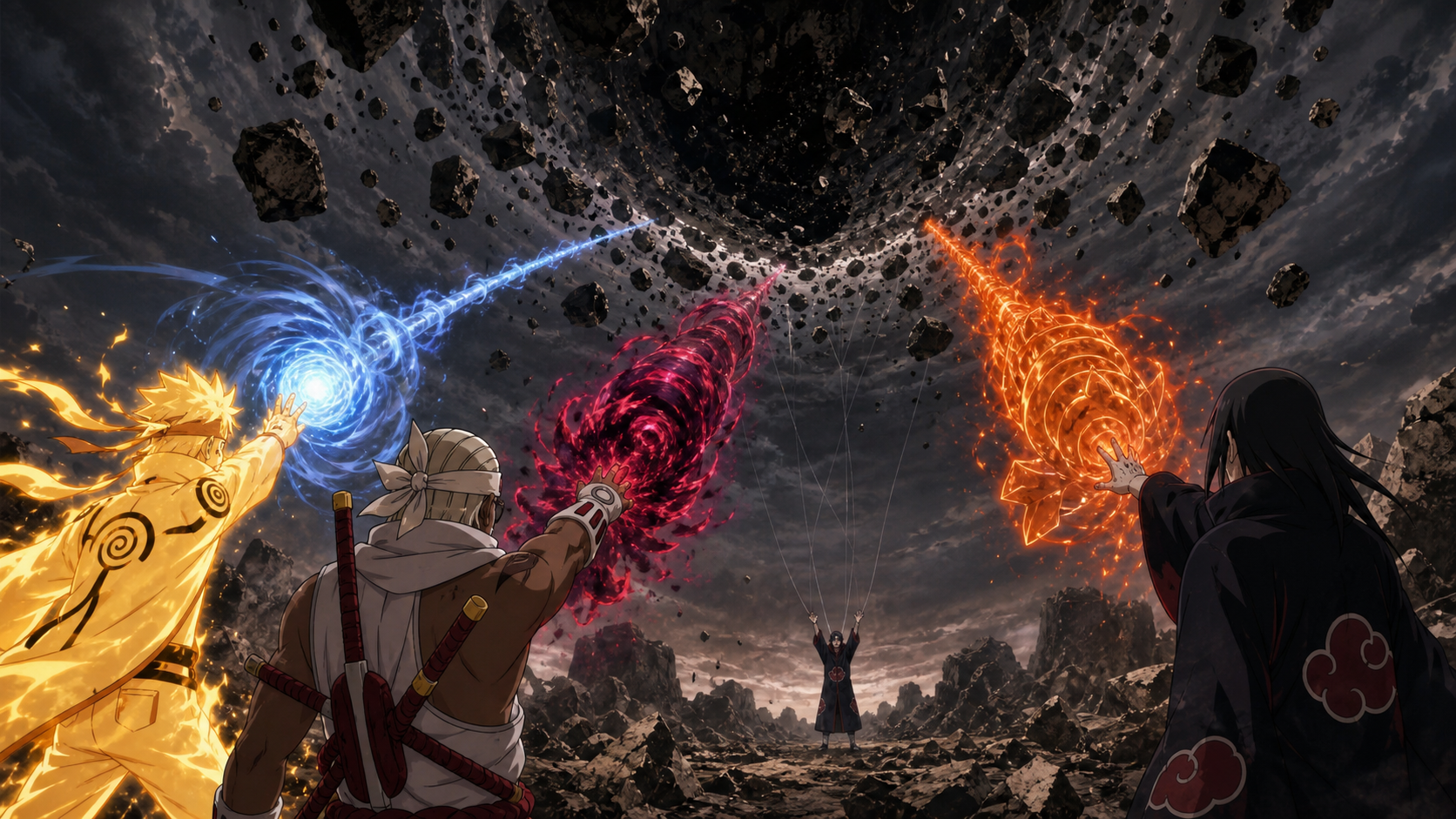
Naruto, Killer B, and Itachi defeat Chibaku Tensei together, free Nagato through sealing, and confront the limits of solitary heroism.
Bottom line
“The Acknowledged One” earns its title through recognition rather than rank. Itachi recognizes that Naruto cannot carry the war alone. Nagato recognizes Naruto as the successor who can complete the hope Jiraiya entrusted to them. Killer B recognizes danger quickly enough to intervene, while Naruto must recognize that confidence has become exhaustion. Their combined attack destroys Chibaku Tensei, and Itachi’s Totsuka Blade ends Kabuto’s control over Nagato. The victory belongs to coordinated judgment, not one invincible fighter. The harder truth follows: freeing a reanimated person still requires sealing his body, and protecting the living can look like another act of force against someone already denied consent.
Nagato begins by pulling Naruto’s soul
Kabuto directs Nagato to use the Human Path while Naruto struggles to keep his soul connected to his body. The attack threatens death and capture at once.
The official routes define the alliance
Naruto Official catalogs “The Acknowledged One” as record `01_743`. Crunchyroll lists Shippuden Episode 299 under watch ID `GYNQ1JD9Y`, released February 7, 2013. Both identify Itachi joining Naruto and Killer B against Nagato after Kotoamatsukami breaks his reanimation command.
The episode turns former enemies into a temporary rescue team while keeping Nagato’s coercion visible.
Soul extraction needs immediate interruption
Naruto cannot counter the Human Path through ordinary striking. The team needs to break Nagato’s grip, disrupt the chakra connection, and protect Naruto’s body.
Medical responders should treat partial extraction as neurological and spiritual trauma, not assume survival means no injury.
The field record should note how long the separation lasted, whether Naruto lost memory or sensation, and what contact restored stability. Medics need a quiet observation area away from command questions. A person who nearly lost his soul should not have to prove readiness through immediate performance. If spiritual injuries fall outside ordinary protocols, Sakura and the sealing corps should build a joint assessment rather than leaving symptoms undocumented.
Killer B attacks to rescue Naruto
B moves in when Naruto cannot free himself. The response reflects partnership rather than waiting for the famous hero to solve his own crisis.
Rescue plans should assign who interrupts, who shields, and who extracts. Improvisation becomes safer when roles remain legible.
Shared vision defeats the surprise attack
Nagato uses linked summons to see angles outside his direct view. B’s approach fails because the battlefield functions as one surveillance network.
Destroying a single eye line may not be enough. Teams must map every linked observer before attempting another blind-side attack.
The King of Hell adds a second danger
Nagato’s summon can receive the extracted soul, turning restraint into imminent disappearance. Protecting Naruto requires controlling both captor and destination.
Sealing barriers around the summon could delay transfer while Itachi attacks the mechanical restraints.
Nagato captures both jinchūriki
Kabuto uses mechanical arms and a close-range cannon, placing Naruto and B under simultaneous threat. Their tailed beasts make them valuable targets rather than protected people.
The scene repeats the war’s extraction logic. Power invites possession whenever institutions stop recognizing hosts as persons.
Itachi’s Susanoo creates the rescue opening
Itachi intervenes with Susanoo and cuts the captives free. His restored agency becomes meaningful through protection of people Kabuto intended to collect.
The rescue also proves why control-breaking research matters. One freed reanimation can save living targets and help free another prisoner.
Nagato regenerates under continued control
Damage cannot end the encounter because Reanimation Jutsu rebuilds his body. Kabuto resumes command without regard for Nagato’s wishes.
Allied tactics must separate physical interruption from final containment. Repeated lethal force only extends captivity.
Chibaku Tensei changes the scale
Nagato creates a gravitational core that pulls rock, earth, and people upward. The battlefield begins forming a crushing planetary mass.
Evacuation becomes difficult because debris and bodies move toward the same center. Responders need anchors, shields, and immediate communication.
Naruto remembers surviving the technique
Naruto knows Chibaku Tensei from the fight against Pain and initially treats the technique as nearly impossible to stop. Experience supplies warning but also fear.
Itachi asks the necessary question: if Naruto survived before, then the technique has limits worth identifying.
Itachi identifies the gravitational core
Rather than attack the growing shell, Itachi targets the black center drawing matter inward. The decision converts panic into a specific objective.
Command should teach this method with clear limits. Future versions may differ in strength, position, or supporting defenses.
Three attacks become one solution
Naruto, B, and Itachi launch their strongest long-range techniques at the core. No single contribution receives complete credit.
The combined strike works because timing and target selection align different powers. Cooperation becomes a technical fact rather than a slogan.
The explosion creates cover
Destroying the core releases a massive blast and dust cloud. That danger also hides Itachi’s approach toward Nagato.
The team should account for shockwave injuries and separation after the attack. Tactical cover cannot erase medical consequences.
The Totsuka Blade seals Nagato
Itachi’s Susanoo pierces Nagato with the spiritual blade, ending Kabuto’s control by sealing the reanimated body.
The technique stops further harm, but Nagato remains a conscious person during the final moments. His words deserve preservation.
Sealing is rescue and confinement
Nagato is freed from Kabuto while being placed inside another permanent containment. The immediate choice prevents mass death.
That necessity should never become casual language. Records must name both the rescue from control and the new loss of movement.
The sealing team should also document whether communication remains possible inside the Totsuka Blade and what Nagato understood before entry. If permanent containment cannot be reversed, the decision deserves review even when no safer battlefield alternative existed. Emergency necessity can explain an action without converting that action into an ideal. Future research should seek methods that release reanimated souls without trapping their consciousness elsewhere.
Nagato reflects on Jiraiya’s legacy
With control ending, Nagato speaks about the path shared by Jiraiya’s students. He believes his own chapter damaged their teacher’s hope.
Naruto should not be required to redeem every predecessor. Carrying a legacy can guide him without making him responsible for another person’s crimes.
Naruto becomes the final volume
Nagato asks Naruto to create the best ending to the story begun through Jiraiya, Yahiko, and himself. The metaphor recognizes Naruto’s agency.
A final volume does not erase earlier pages. Peace work must keep victims and failures visible alongside transformation.
Nagato’s farewell needs a complete record
His last statements occurred after release from direct control and before sealing completed. Witnesses should document wording and conditions.
Konan’s records, Rain Village testimony, and Konoha archives can provide context without letting one institution own his history.
The Rain Village should receive notice through trusted representatives before Konoha publishes Nagato’s final words. Residents lived under Pain’s rule, experienced both protection and coercion, and will hold different memories. Victims of the Konoha attack also deserve access to evidence without being asked to celebrate Nagato’s redemption. A shared archive can preserve conflict between accounts instead of forcing one official verdict.
Naruto tries to rush onward
After the battle, Naruto immediately turns toward the next front. His Nine-Tails Chakra Mode fails as exhaustion catches him.
The body supplies information ambition ignored. Continuing without recovery would endanger Naruto and nearby allies.
Itachi challenges solitary heroism
Itachi warns Naruto not to believe that acknowledgment makes him capable of doing everything alone. Becoming Hokage follows recognition by others; the title cannot manufacture trust afterward.
The warning answers Naruto’s old hunger for approval with a mature responsibility to rely on people.
Naruto’s friends are operational strength
Sakura, Kakashi, Shikamaru, Hinata, Gaara, and many others hold knowledge and commitments Naruto lacks. Delegation honors their agency.
Shared responsibility also prevents one injury from collapsing the entire war plan.
Naruto can set priorities without personally answering every request. Headquarters should assign clones by battlefield need, create rotation windows, and identify moments when a clone must withdraw. Friends can reject unsafe orders, report exhaustion, and take command when Naruto’s judgment narrows under stress. Trust means accepting that other people may choose methods he would not choose while still serving the shared mission.
B receives a care assignment
Itachi asks B to watch Naruto. The request recognizes B as partner, mentor, and person capable of challenging Naruto’s reckless pace.
B should not become a permanent caretaker without support. Care work belongs across the team.
Itachi chooses Kabuto as the next objective
Stopping Reanimation Jutsu could free many controlled fighters at once. Itachi leaves to locate the controller rather than chase individual fronts.
The strategy targets infrastructure. Coordination with headquarters would reduce duplication and friendly interference.
Shisui’s crow is destroyed
Itachi burns the crow carrying Shisui’s Mangekyō Sharingan because the eye cannot be used again for years and remains vulnerable to capture.
Destruction prevents exploitation while eliminating a unique biological and historical artifact. The choice needs documentation even under battlefield pressure.
Before destruction, Itachi should state the eye’s origin, trigger, expected recovery period, and reason for judging custody unsafe. Naruto and B can witness the decision. If ash or chakra residue remains, the team should secure the area so Kabuto cannot recover genetic material. A later review can assess whether containment was truly impossible without pretending that battlefield seconds offered perfect options.
Shisui cannot be reduced to a safeguard
The eye came from a person whose choices, death, and relationship with Itachi shaped every later contingency. Burning the carrier should not burn his name from the record.
Memorial practice should describe Shisui beyond the technique others wanted.
Kabuto’s control system remains the larger target
Nagato’s sealing ends one forced battle. Countless reanimated people remain bound to Kabuto’s commands.
Itachi’s mission must prioritize ending the system while preserving evidence about bodies, summoning contracts, and controller links.
Naruto needs medical recovery
Soul extraction, chakra depletion, gravitational force, and combat strain require assessment. A field check should cover breathing, cognition, chakra pathways, pain, and delayed symptoms.
Rest is not abandonment of the war. Rest protects the person whose sensory clones still support multiple fronts.
Recovery should have a named handoff point. B can report Naruto’s condition to headquarters, while a medic decides when travel resumes and which clone assignments remain sustainable. Naruto should hear that plan before sleeping so enforced rest does not feel like another confinement. Clear limits preserve trust while protecting every unit depending on his chakra.
Nagato’s body and victims need separate records
Recognizing his coercion during reanimation does not erase the people harmed through Pain. Recognizing his later change does not erase his own exploitation by Kabuto.
An honest archive can hold victim, perpetrator, survivor, and prisoner without flattening one identity into another.
That archive should connect names rather than only techniques. Jiraiya, Yahiko, Konan, the Rain residents, Konoha victims, and the bodies used for the Six Paths all belong in the historical map. Dates, locations, orders, and witness statements prevent mythology from replacing evidence. Nagato’s farewell gains meaning when readers can see both the hope he recovered and the damage that hope could not undo.
Nagato’s power returns without Nagato’s permission
Kabuto restores and drives a body whose owner understands every attack being forced through it. Regeneration makes Nagato more effective as a weapon while stripping away the final physical signs of what his life cost.
The episode never needs us to pretend that strength equals recovery. Nagato is alert enough to warn Naruto and trapped enough to keep hurting him. That combination is the horror of reanimation in one frame.
Soul extraction turns rescue into a seconds-long decision
Naruto cannot power through the Human Path by wanting freedom harder under pressure. Once Nagato starts pulling his soul, Killer B and Itachi have to interrupt the mechanism immediately.
Killer B attacks for Naruto and becomes captured too
B’s rescue attempt proves commitment, not foolishness. Nagato’s linked abilities punish the direct route and turn one endangered jinchūriki into two.
Command should study that failure without blaming the rescuer. A better protocol pairs immediate disruption with distance, sensory support, and a second extraction method. Courage deserves planning strong enough to keep courage alive.
Itachi sees the system because he stops watching the spectacle
Chibaku Tensei pulls the landscape upward and demands a response large enough to match the panic. Itachi identifies the core instead of wasting power against every piece of debris.
That analysis lets three different fighters aim at one mechanism. Intelligence does not replace force here. Intelligence gives force a target and prevents three impressive attacks from becoming three separate failures.
The combined attack works because nobody has to become smaller
Naruto, B, and Itachi do not merge into one interchangeable power source. Each brings a distinct technique, history, and reason for fighting.
Coordination preserves those differences while aligning the objective. That is a better image of alliance than everybody obeying one genius without question. Shared purpose can organize power without erasing the people carrying it.
The Totsuka Blade ends control through confinement
Sealing Nagato stops Kabuto from using his body and gives Nagato a conscious farewell. The blade also removes him from the battlefield through another power he did not choose.
Calling the moment rescue is fair if the coercion ends. Calling the method freedom would be less honest. The distinction matters for every reanimated person whose only available release arrives through permanent containment.
Nagato’s farewell belongs to him, not only to Naruto’s growth
He reflects on Jiraiya, failure, and the possibility that Naruto can carry the story forward. Those words shape Naruto, but they also close Nagato’s own final interval of awareness.
The record should preserve his warning, his resistance, and the fact that Kabuto forced him to attack people he had chosen to trust. His death cannot become another inspirational quote stripped from the body that paid for it.
The final volume is not a blank book Naruto owns
Nagato describes himself and Konan as earlier volumes in Jiraiya’s larger story, with Naruto carrying the conclusion. The metaphor gives Naruto responsibility, not permission to overwrite them.
A true ending has to retain the villages harmed, the children recruited into war, Konan’s decisions, Yahiko’s hope, and Nagato’s crimes and changes. Naruto succeeds by remembering those lives, not absorbing them into his legend.
Itachi tells Naruto the truth about recognition
Naruto wants to rush across every battlefield because people now look to him for rescue. Itachi warns that becoming Hokage does not make people acknowledge someone. Acknowledgment is what makes leadership possible.
That correction reaches the boy who once chased a title as proof he existed. The danger now runs in reverse: being acknowledged can tempt him to act as if he must personally fulfill every expectation.
Friends are not Naruto’s reserve supply
Itachi reminds him that others carried him to this point. Those relationships should not become a sentimental battery Naruto drains before running ahead alone again.
Sakura, Kakashi, Shikamaru, Hinata, B, and the wider Alliance possess judgment and agency. Trust means sharing information, accepting limits, and allowing somebody else’s plan to lead when that plan is better.
B’s care assignment should not become babysitting
Itachi asks Killer B to watch Naruto, recognizing the exhaustion and recklessness Naruto will ignore. B is a fellow jinchūriki and combat partner, not an attendant assigned to manage a difficult child.
The care works when both men can challenge each other and when command supplies actual medical support. Friendship should not become the excuse for leaving one person responsible for another’s survival without resources.
Destroying Shisui’s crow closes one danger and one archive
Itachi burns the crow after Kotoamatsukami activates, preventing Kabuto or somebody else from taking the eye. The act removes a tool designed to override Sasuke’s mind.
The destruction also eliminates unique remains and evidence of what Itachi placed inside Naruto. Before the record closes, Naruto deserves disclosure and Shisui deserves identification beyond the technique everybody wanted from his body.
Itachi chooses Kabuto because the system is the target
Defeating individual reanimated fighters cannot end a war replenished by one controller. Itachi turns toward Kabuto and the technique maintaining captivity across every front.
The strategic choice is sound, but he should not disappear into another solitary secret mission. Sharing the objective and route gives allies the chance to support him and prevents another necessary truth from depending on one man returning alive.
Naruto needs recovery before recognition becomes exploitation
He survives soul extraction, gravity, debris, and continuous chakra use, then immediately wants the next front. Public hope can make rest feel selfish when thousands expect him to arrive.
Medical authority must interrupt that pressure. A hero praised while being worked past collapse is still being used. Recognition should increase the care around Naruto, not raise the amount of pain everyone assumes he can absorb.
RaeRae’s verdict
“The Acknowledged One” succeeds because the largest technique falls through collaboration and the quietest warning lands after victory. Naruto is powerful enough to matter and tired enough to need people.
Itachi’s acknowledgment asks him to stop confusing self-sacrifice with leadership.
RaeRae’s call
Naruto survives because B reaches for him, Itachi reads the mechanism, and three different attacks hit one target. Nagato receives release, but release through sealing is not uncomplicated freedom. The episode earns its title by teaching Naruto that acknowledgment creates responsibility to trust people, not a command to save everybody alone.
Episode details and viewing routes
- Official episode reference: Naruto Official episode guide
- Licensed episode route: Crunchyroll licensed episode page
What I am carrying forward
I am carrying forward the combined strike against Chibaku Tensei, Nagato’s final trust in Naruto, the ethical tension inside sealing, and Itachi’s decision to attack the control system at its source.
I am also carrying forward Naruto’s failed chakra cloak. The war does not need a hero who burns through himself for applause. The war needs a living person who trusts others enough to share the work.