
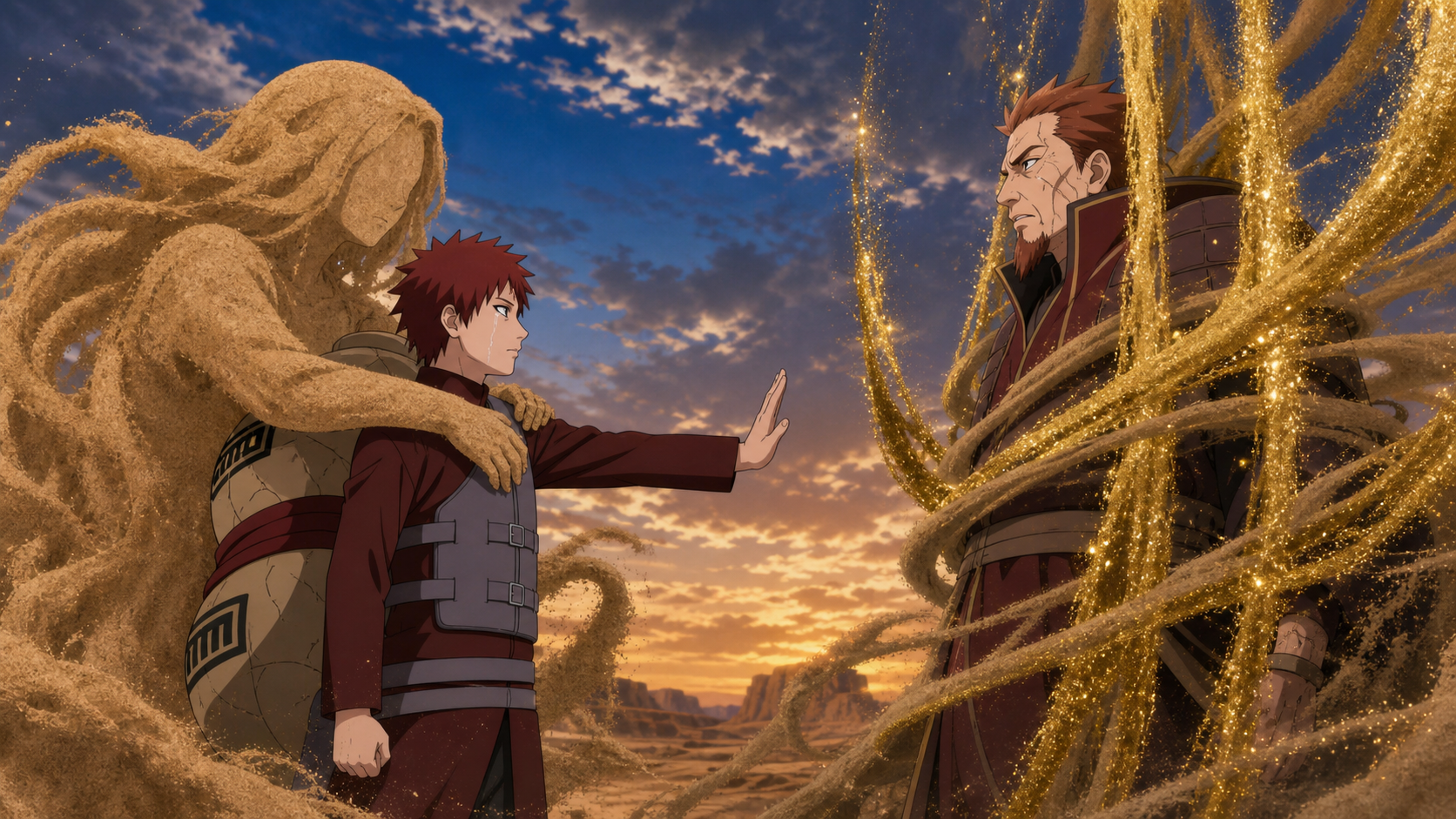
A Father’s Hope, A Mother’s Love
Gaara defeats the father who weaponized his childhood and learns that Karura’s love, not Shukaku alone, has always protected him through the sand.
Bottom line
“A Father’s Hope, A Mother’s Love” gives Gaara a truth he deserved as a child: Karura loved him, Yashamaru loved him, and the story that made him believe otherwise came from an order by his father. Rasa’s confession does not convert abuse into necessary leadership. The Fourth Kazekage sealed Shukaku into his unborn son, treated Gaara as a village asset, arranged a lethal emotional test, and authorized later assassination attempts. Gaara’s victory matters because he receives the truth without surrendering the person he built after that harm. His mother’s sand protected him. Naruto, his siblings, and Suna helped him heal. Rasa can finally acknowledge that growth, but he cannot claim authorship.
Gaara meets his father as a commander
Rasa returns through reanimation expecting the child and jinchūriki he once judged. Gaara stands before him as the Fifth Kazekage and commander of the Allied Fourth Company.
The official routes establish the confrontation
Naruto Official catalogs “A father’s Hope, A Mother’s Love” as record `01_741`. Crunchyroll lists Shippuden Episode 297 under watch ID `GYX04MWNR`, released January 24, 2013. Both summaries describe Rasa attacking Gaara to determine whether his son deserves the Kazekage title.
That framing exposes Rasa’s old habit. He still approaches Gaara through a test rather than a relationship.
Rasa first looks for Shukaku
The Fourth Kazekage sees Gaara’s sand and assumes the One-Tail created the attack. He has difficulty imagining his son’s strength outside the weapon imposed before birth.
Gaara answers that Akatsuki extracted Shukaku and killed him. Chiyo and his friends returned him to life.
Gaara names who made him a jinchūriki
Gaara tells Rasa that he is no longer the jinchūriki his father made him. The sentence assigns responsibility without decoration.
A child cannot consent to becoming a military container. Village need does not erase the parent and leader who approved the procedure.
Survival came through people Rasa never expected
Rasa learns that Gaara formed friendships, became Kazekage, and earned trust across villages. The facts contradict every conclusion drawn from the failed test.
Gaara did not become safe because fear finally worked. He changed because Naruto recognized his loneliness and others chose relationship over containment.
Understanding office does not excuse abuse
Gaara says that becoming Kazekage helped him understand the duty to protect Suna. Understanding institutional pressure is not the same as endorsing Rasa’s choices.
Leaders can face danger without using a child as equipment. Gaara’s own command proves that protection and personhood can coexist.
Rasa treated worth as battlefield performance
The revived father attacks to see whether Gaara merits the title. That test repeats the belief that a person’s value appears only under force.
The Alliance should judge leadership through preparation, protection, accountability, and public trust, not a parent’s private combat standard.
Gold Dust opposes Gaara’s sand
Rasa’s Magnet Release lets him control Gold Dust and counter Gaara’s large-scale sand. Their techniques fill the battlefield with a visual argument about inheritance.
Shared power does not create shared ethics. Gaara uses sand to shield troops while Rasa once used Gold Dust and political office to control him.
Gaara incorporates the Gold Dust
Gaara draws Rasa’s material into his own strategy and uses the weight to force an opening. He does not need to reject every inherited tool to reject inherited harm.
Survivors can repurpose family knowledge without owing loyalty to the person who misused that knowledge.
The mother-shaped sand reveals protection
Gaara’s automatic defense takes a form Rasa recognizes as Karura. The image gives visible meaning to protection that Gaara had been taught to misunderstand.
Rasa realizes the sand was not only Shukaku’s reflex. Karura’s love remained connected to her son.
Karura’s love was present from birth
Rasa remembers Karura promising to protect Gaara. Her death during childbirth did not mean rejection.
The false story told later converted maternal absence into deliberate abandonment. Correcting that record matters because Gaara built his earliest identity around the lie.
Yashamaru was ordered to lie
Rasa admits directing Yashamaru to tell Gaara that Karura never loved him and that Yashamaru resented him. The lie was designed to provoke emotional collapse.
Calling the event a test does not reduce responsibility. An adult authority arranged terror against a child, using the child’s trusted caregiver as the delivery system.
Yashamaru also acted under coercive authority
Yashamaru’s participation caused devastating harm. Rasa’s command and the village hierarchy shaped that participation.
A complete record must hold both facts: Yashamaru carried out the attack and lie, while Rasa designed the condition and wielded official power over him.
The paper-bomb attack was not care
The test placed Gaara in physical danger while destroying his only trusted bond. Emotional distress was not an accidental side effect.
The goal was to destabilize him enough to measure Shukaku’s response. That makes the harm experimental by design.
Later assassination attempts extended the same policy
Rasa concluded that Gaara was a failed weapon and authorized repeated efforts to kill him. The decision moved beyond one terrible night.
Institutional records should distinguish the original sealing, the Yashamaru operation, and each later attempt. A general apology cannot replace specific accountability.
Rasa’s confession restores facts, not childhood
Gaara learns that his mother loved him and that Yashamaru’s final words were ordered lies. The revelation repairs a central falsehood.
No confession can return the years spent believing that nobody loved him. Truth is necessary and still incomplete as repair.
Gaara’s tears belong to him
Gaara cries after learning the truth. The moment does not make him weak, childish, or suddenly dependent on his father’s approval.
His body responds to relief, grief, anger, and the collapse of a lie carried for years. Nobody should demand a cleaner emotion.
Karura deserves an identity beyond sacrifice
The story remembers Karura as Gaara’s mother and source of protection. Her life should not be reduced to dying during a weaponization project.
Suna’s archive should preserve her choices, relationships, words, and opposition where evidence survives. Maternal love is not merely fuel for a son’s technique.
Temari and Kankurō share the family history
Gaara’s siblings also grew under Rasa’s rule. They watched fear organize the household and village response around their younger brother.
Any family reckoning should include their memories without asking them to validate Gaara’s experience. Each child occupied a different position inside the same system.
Suna needs an institutional account
Rasa acted as father and Kazekage. Private apology addresses only one dimension of the harm.
The village needs records showing who approved Gaara’s sealing, who knew about the tests, who carried out orders, and who tried to protect the children.
That account should include meeting minutes, medical files, mission orders, payment records, and testimony from surviving staff. Gaps need labels rather than guesses. A survivor committee should help determine access, redaction, and the language used to describe Gaara. Terms such as asset, vessel, and failed experiment belong in quoted historical context, never as the archive’s own description of a child. Independent reviewers can identify where official records minimize injury or convert policy choices into unavoidable fate.
A village cannot hide behind national security
Some details about tailed-beast containment may require protection. The existence of child experimentation and assassination orders should not remain secret.
Security classification must never become a method for erasing victims or protecting former leaders’ reputations.
Gaara’s leadership is independent evidence
Rasa sees troops waiting for Gaara’s signal and learns that his son commands the Allied division. That trust came from work visible to others.
Gaara united soldiers from rival nations by speaking honestly about Naruto, fear, and shared responsibility. His title is not a gift his father can grant after death.
Rasa recognizes that Gaara surpassed him
Before sealing, Rasa acknowledges Gaara’s strength and entrusts Suna to him. Recognition gives the encounter closure without rewriting history.
Gaara had already surpassed his father before receiving permission. The words confirm reality rather than create reality.
Forgiveness must remain Gaara’s choice
Gaara can understand, forgive, refuse, or hold several positions at once. No audience or village council should define the correct emotional outcome.
Accountability does not depend on permanent hatred. Forgiveness does not make the original actions acceptable.
Gaara also has the right to revise his feelings later. A battlefield response made while facing a reanimated parent does not become a lifetime contract. Grief may change after the war, after reading records, or after speaking with Temari and Kankurō. Support should remain available without requiring public reconciliation. Rasa’s remorse can be sincere while Gaara’s boundaries remain firm. Two truths can occupy the same record without forcing a sentimental conclusion.
Reanimation creates a narrow truth window
Rasa can speak while his body remains controlled by Kabuto’s technique. The Alliance should record the confession with witnesses before sealing ends the encounter.
The conditions should be documented so later historians know which statements were voluntary, compelled, remembered, or inferred.
Sealing ends the battle, not the case
Gaara defeats and seals his father, preventing further attacks. Military containment closes the immediate danger.
Suna’s responsibility continues through archives, survivor support, family access, and public acknowledgment.
Gaara needs care after command
The Fourth Company still depends on him, yet the encounter reopens childhood trauma in the middle of war. A deputy should take routine decisions while Gaara receives a brief medical and emotional check.
Leadership continuity should never require pretending that family confrontation leaves no wound.
The troops should not consume private grief
Soldiers witnessed parts of the exchange. Command should stop rumor from turning Gaara’s history into morale entertainment.
Operational lessons can be shared without circulating intimate details beyond necessity. Gaara controls how his story enters public memory.
The episode separates inheritance from destiny
Gaara inherits sand, family history, political office, and the consequences of Shukaku’s sealing. None of those elements determines that he must govern like Rasa.
He chooses protection, coalition, and honest connection. Inheritance becomes material he can transform.
Mother’s love is not a substitute for policy
Karura’s protection gives Gaara a personal truth, but future children should not need supernatural parental will to survive state decisions.
Suna needs enforceable safeguards against involuntary sealing, child testing, secret assassination orders, and concentration of authority.
Those safeguards need more than promises from a compassionate Kazekage. Medical consent rules, council review, protected reporting channels, judicial warrants, guardian advocates, and periodic external audits can survive changes in leadership. Children connected to dangerous techniques need education, care, and ordinary friendships rather than constant surveillance. Emergency exceptions should expire automatically and receive public review. A village proves that lessons were learned by changing structures, not by praising the survivor who endured their failure.
Rasa begins by looking for the weapon, not his son
His first assumption is that Shukaku must still explain Gaara’s power. Even after death, Rasa reaches for the category that let him avoid seeing the child inside the policy he created.
His life outgrew Rasa’s assessment before Rasa admitted error.
The title asks for hope before Rasa earns any
A father’s hope can sound tender until the episode shows what Rasa called hope in practice. He ordered tests, lies, assassination attempts, and isolation because Gaara’s value depended on producing military results.
That is not a strict parent making hard choices. That is a state leader turning his child into infrastructure, then measuring the child’s humanity by whether the investment paid off.
Karura’s love does not absolve the village
The sand protecting Gaara reveals that his mother’s care remained with him when every official story said otherwise. The truth gives him something precious that Rasa and Yashamaru’s forced lie stole.
Love still should not have been the only barrier between a child and death. Suna needed laws, caregivers, medical oversight, and adults willing to refuse abusive orders. Karura’s devotion exposes institutional failure instead of covering it.
Yashamaru’s coercion deserves the whole sentence
Rasa ordered Yashamaru to attack Gaara and tell him that Karura hated him. That command placed an uncle inside an impossible conflict between state obedience, family duty, fear, and whatever survival he believed refusal would cost.
Coercion explains the route to the harm. Coercion does not make the paper bomb harmless or restore Gaara’s trust. The record should preserve both truths without simplifying Yashamaru into either innocent martyr or private monster.
Gaara’s tears are not forgiveness paperwork
He learns that the story shaping his childhood was false and that his mother’s protection never left him. Crying answers that loss and relief. The tears do not sign away Rasa’s responsibility.
Fandom sometimes rushes from a parent’s confession to a child’s absolution because reconciliation feels cleaner. Gaara can accept the truth, mourn what he missed, and still refuse to call the abuse necessary.
Rasa’s confession arrives where consequences cannot reach him
Reanimation gives him time to speak after death removed him from trial, repair, parenting, and public accountability. Gaara receives facts but cannot ask for years of changed behavior.
That imbalance matters. A beautiful apology scene should not make late honesty equal restitution. The living still have to repair the institutions Rasa helped build.
Temari and Kankurō belong inside the family history
Gaara carried the most visible violence, yet the same household shaped his siblings through fear, secrecy, distance, and the expectation that they manage their brother as a threat.
Suna should offer all three access to records and independent support. Gaara alone should not become the family archivist merely because his wounds produced the clearest battlefield revelation.
Gold Dust makes extraction look like inheritance
Gaara incorporating his father’s Gold Dust into the defense creates a striking image of taking something from the man who harmed him without taking the man’s worldview.
Inherited technique does not mean inherited destiny. Gaara uses power through the leadership and relationships he built. The material can enter his sand without Rasa reclaiming authorship over the person Gaara became.
The soldiers witness history they are not entitled to consume
The battlefield needs Gaara’s command decisions and the sealing of a reincarnated Kage. The surrounding troops do not need to turn his tears into morale content or gossip.
Reports can document Rasa’s operational statements while protecting the private portions of the family exchange. Public leadership does not cancel a leader’s right to grieve without becoming a village spectacle.
Suna owes more than a memorial sentence
An honest institutional account should name the jinchūriki policy, the ordered attack by Yashamaru, the assassination attempts, the officials who approved or concealed them, and the protections created afterward.
Calling the period difficult would blur deliberate decisions. Children currently living under military authority need proof that the village learned more than how to praise the survivor who became useful.
Gaara’s leadership is the evidence Rasa cannot manufacture
Rasa tested combat strength because he believed fear and utility defined a successful weapon. Gaara built trust across villages, protected soldiers who once feared him, and entered the war carrying responsibility instead of revenge.
Those results came through people Rasa discounted. Naruto, Temari, Kankurō, Suna’s citizens, and Gaara’s own choices formed the leader standing before him.
Sealing Rasa protects Gaara from another forced relationship
Reanimation compels the father to fight and compels the son to answer on the battlefield. Ending the technique stops both bodies from being used for Kabuto’s strategy.
The seal should not be framed as Gaara rejecting his father after hearing the truth. The seal restores the boundary death and war violated. Gaara can carry Karura’s love without carrying Rasa’s body any farther.
Karura deserves more than saintly motherhood
Her posthumous protection is central, but the story tells us about her mostly through what she gave Gaara. A complete record should also ask who she was, what she feared, what choices remained open, and how Suna treated her during pregnancy.
Reducing her to pure sacrifice can make another woman disappear inside the emotional development of powerful men. Her love matters because Karura was a person who loved, not because motherhood erased everything else.
The episode changes the meaning of Gaara’s sand
What once looked like Shukaku’s automatic defense also carries Karura’s will. That knowledge does not invalidate Gaara’s training or the years he spent learning control.
The sand now holds technique, survival, memory, and chosen purpose together. Gaara remains the person directing those layers. Love gives the defense history, not a new owner.
A child should never have to become exceptional to disprove abuse
Rasa recognizes Gaara after Gaara becomes Kazekage, protects thousands, and surpasses him in battle. The recognition is emotionally satisfying and morally insufficient.
Gaara deserved safety before he achieved anything. No abused child should need a title, a war record, or extraordinary forgiveness before adults admit the child was worth protecting.
RaeRae’s verdict
“A Father’s Hope, A Mother’s Love” works because Gaara receives confirmation without becoming smaller. The child who needed the truth and the Kazekage commanding an army occupy the same person.
Rasa’s best act comes too late: he tells the truth, admits failure, and stops claiming that his judgment defined Gaara’s value.
RaeRae’s call
Karura’s love gives Gaara back a truth Rasa’s policy stole, but maternal devotion does not make state abuse survivable or necessary. Gaara can grieve, accept the truth, seal his father, and keep every boundary he earned. He never owed greatness as proof that the child deserved care.
Episode details and viewing routes
- Official episode reference: Naruto Official episode guide
- Licensed episode route: Crunchyroll licensed episode page
What I am carrying forward
I am carrying forward Karura’s protective sand, Rasa’s admission that Yashamaru was ordered to lie, Gaara’s right to feel every part of the revelation, and the distinction between understanding a leader’s pressure and excusing a leader’s abuse.
I am also carrying forward the public record Suna still owes. Gaara’s personal closure cannot substitute for institutional accountability, and Rasa’s sealing cannot seal away the history created under his authority.