
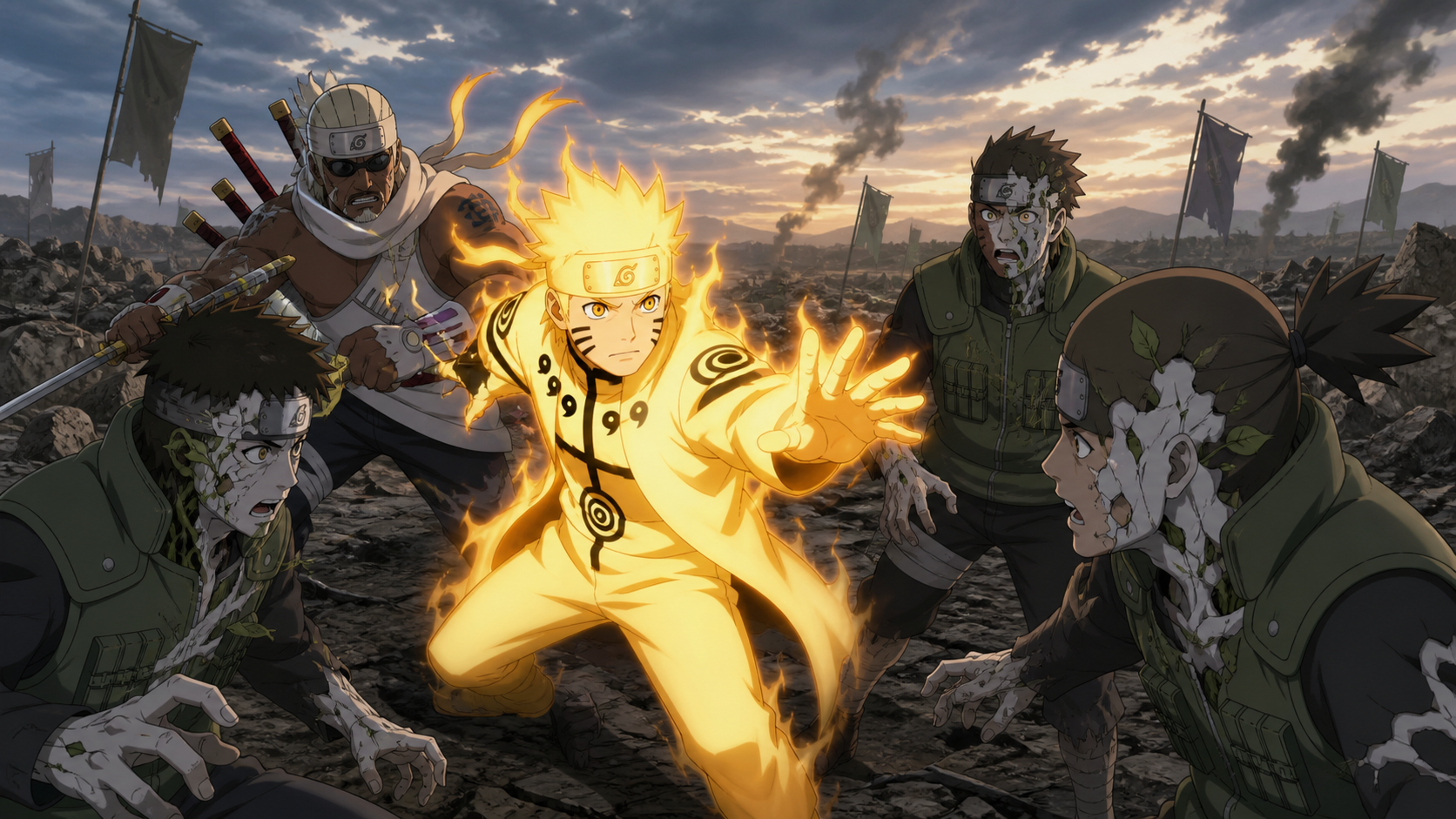
Naruto Enters the Battle
Naruto enters the war with a sensory advantage that exposes White Zetsu infiltration, but medicine, command, and sealing work still complete the defense.
Bottom line
“Naruto Enters the Battle” changes the Fourth Shinobi World War because Naruto brings something the Allied Forces cannot manufacture through rank or numbers: he can sense the malice hidden inside transformed White Zetsu. His arrival restores identification after infiltration shattered trust, while Killer B keeps movement disciplined and Shikaku turns new knowledge into battlefield assignments. The episode also refuses to make one hero the whole war. Sakura and Shizune produce the autopsy evidence that explains the enemy, sealing teams finish Toroi’s capture, and Gaara meets the father who once made his childhood unbearable. Information, care, command, and combat finally begin working as one system.
Naruto and Killer B enter an active war
Permission to fight does not give Naruto and B a gentle transition. They move directly from containment into scattered fronts where friendly uniforms no longer prove friendly identity.
The official routes confirm the new phase
Naruto Official catalogs “Naruto Enters the Battle” as record `01_740`. Crunchyroll lists Shippuden Episode 296 under watch ID `G67521GNR`, released January 17, 2013. Both official summaries emphasize Naruto using sensory power to identify and destroy transformed White Zetsu while Shikaku briefs him on current knowledge about Madara.
The episode’s chapter boundary is operational. Naruto no longer trains away from the front. His information becomes part of Allied command.
White Zetsu turned resemblance into a weapon
The transformed infiltrators copy faces, bodies, chakra, and memories closely enough to enter medical and military spaces. Every successful disguise damages trust among real allies.
Soldiers who survive infiltration may begin treating every colleague as a threat. Naruto’s ability must restore confidence without creating a new culture of unchecked accusation.
Malice sensing offers a new identification standard
Nine-Tails Chakra Mode lets Naruto detect hostile intent beneath a copied appearance. That capacity reaches a layer the enemy’s transformation cannot reproduce cleanly.
Command still needs documented confirmation procedures. One person’s perception should guide rapid action while witnesses, locations, and later review protect allies from irreversible mistakes.
Naruto proves the method against transformed attackers
Naruto and B encounter Allied-looking figures whose behavior masks White Zetsu bodies. Naruto identifies the hostility and attacks the correct targets.
The speed matters because infiltrators thrive on hesitation. The accuracy matters more because a false strike against a real soldier would deepen the same fear Zetsu created.
Killer B stabilizes Naruto’s entrance
B understands jinchūriki power, battlefield pressure, and the difference between confidence and careless acceleration. His presence keeps Naruto from becoming a lone sensor racing beyond support.
Partners should confirm routes, relay discoveries, and watch for exhaustion. Sensory advantage loses value when the sensor becomes isolated.
Shadow clones turn one gift into distributed support
Naruto sends clones toward multiple battlefields, giving separate units access to his identification ability. The tactic matches the scale of the emergency.
Each clone needs a named destination and contact. Untracked duplicates could add confusion inside a war already dominated by imitation.
Clone deployment needs command discipline
Shikaku should maintain a live map of Naruto’s clones, their routes, and each unit’s authentication phrase. Field leaders need clear instructions for receiving a clone without opening a new infiltration gap.
When a clone disperses, headquarters should record the final report and alert the affected unit. Silence cannot become ambiguous.
Shikaku converts discovery into strategy
Naruto’s sensing would remain a personal advantage without Shikaku’s coordination. Headquarters translates that advantage into priorities across many fronts.
Good command does not compete with the person holding new information. Good command makes that information usable by people who never meet him.
The Madara briefing protects Naruto from tunnel vision
Shikaku updates Naruto on what the Alliance knows about the masked enemy and battlefield movement. Urgency can make a young fighter chase the nearest threat without seeing the larger plan.
A concise briefing should separate confirmed facts, probable conclusions, and open questions. Naruto needs enough context to act without carrying every intelligence file in his head.
The Alliance needs a shared identity protocol
Naruto cannot stand beside every soldier forever. Units need layered checks using passwords, recent shared events, sensor review, buddy confirmation, and controlled movement.
No single test should decide life or death when several checks can operate quickly. Redundancy reduces both infiltration and wrongful accusation.
Suspected allies require protected holding
A person who fails one check should not be attacked automatically. A guarded separation area allows sensors and witnesses to review identity.
The process must protect medics, messengers, injured soldiers, and people whose trauma affects speech or memory. Confusion is not proof of hostile intent.
White Zetsu bodies become trees after defeat
The transformed attackers reveal their altered biology when Naruto’s attacks force them into tree-like forms. The change connects the army to cultivated bodies rather than ordinary recruits.
Battlefield teams should photograph, mark, and sample remains before disposal. Medical risk and intelligence value both require controlled handling.
Sakura and Shizune turn an autopsy into defense
The medical compound pauses around the central tent while Sakura and Shizune examine a White Zetsu body. Their work produces information headquarters needs.
This is not background labor. The autopsy explains how enemy bodies operate and helps command design detection and treatment protocols.
The medical tent needs evidence controls
Only named personnel should enter the autopsy space. Samples need labels, sealed containers, duplicate logs, and contamination tracking.
War pressure cannot excuse a broken chain of custody. Later decisions may depend on proving which body produced which finding.
Medical findings must travel in usable language
Sakura and Shizune understand biological detail that field commanders may not. Their report should separate immediate actions from deeper analysis.
Units need short guidance on identification, exposure, handling, and symptoms. Researchers need the complete record for follow-up.
The report should also explain uncertainty. A preliminary finding can guide precautions without becoming permanent doctrine. Sakura and Shizune should name which results came from direct observation, which came from comparison, and which remain hypotheses. Headquarters can then revise orders when new samples arrive instead of defending an early conclusion for political comfort. Medical intelligence works best as a living record with version dates, named authors, and a visible correction trail.
The support division deserves physical protection
An enemy built around impersonation will target the people developing countermeasures. Guards should secure entrances without obstructing urgent care.
Separate routes for patients, staff, samples, and messages reduce crowding. Everyone entering should have a recorded purpose.
Musai and Nonota face a reincarnated Toroi
Naruto and B reach Allied shinobi threatened by Toroi, a revived Magnet Release fighter. The encounter proves that White Zetsu infiltration is only one layer of the war.
Units must shift between disguised enemies and famous dead combatants with specialized techniques. A single response doctrine cannot cover both.
Toroi’s Magnet Release changes equipment risk
Metal weapons and marked objects can become liabilities when Magnet Release controls their movement. Fighters need nonmetal alternatives and wider spacing.
Medics should check wounds for embedded fragments before moving patients near magnetized zones. Equipment recovery can wait until sealing is complete.
Defeat is incomplete without sealing
Reincarnated fighters return after ordinary damage. Naruto and B can create an opening, but trained sealing personnel must finish containment.
The episode respects that division of labor. A spectacular hit does not replace the specialist who ends the threat.
Sealing teams need recognition in the record
Mission reports often name the fighter who landed the largest attack while omitting the people who restrained, transported, and sealed the enemy.
The official record should list every role. Accurate credit supports morale and preserves tactical knowledge for later fronts.
Gaara’s battlefield carries a family history
The Fourth Division faces reincarnated Kage, including Gaara’s father, the Fourth Kazekage. Military confrontation and childhood harm occupy the same ground.
Gaara must command thousands while meeting the man who treated him as a weapon and arranged attempts on his life. Leadership does not cancel that trauma.
Gold Dust meets Gaara’s sand
The Fourth Kazekage counters Gaara’s enormous sand attack with Gold Dust. Their powers share a visual language while representing different uses of authority.
Gaara’s sand now protects a coalition. His father used power and office to measure a child’s usefulness.
The former Kage initially mistakes the attack
The Fourth Kazekage expects Shukaku rather than Gaara. The assumption reveals how completely he once reduced his son to the tailed beast sealed inside him.
Gaara’s presence without Shukaku becomes evidence of personhood and growth. The son survived beyond the role imposed on him.
Gaara names the truth of his former status
Gaara tells his father that he is no longer the jinchūriki his father made him. The statement places responsibility where responsibility belongs.
He did not choose the sealing, isolation, or assassination attempts. Becoming Kazekage does not transform those decisions into necessary parenting.
Ōnoki faces Mū above the same front
Mū avoids Gaara’s sand capture, and Ōnoki answers the former Tsuchikage with Dust Release. Their collision leaves a massive crater.
Command must monitor friendly positions before techniques with such scale. Historical rivalries cannot override current civilian and troop safety.
The reincarnated Kage create testimony problems
The former leaders can speak, remember, and fight while controlled by another person. Their statements may contain valuable history, but coercion shapes the encounter.
Archivists should record their words while marking the conditions of reanimation. Neither automatic trust nor automatic dismissal is responsible.
Naruto’s entrance restores hope without ending fear
Allied soldiers see a long-awaited reinforcement who can expose infiltrators. Relief can improve coordination, but overconfidence creates new danger.
Naruto remains one combatant with limited stamina and many destinations. Units must keep their own protocols active after his clone leaves.
The episode values networks over saviors
Naruto senses malice. B supports movement. Shikaku assigns priorities. Sakura and Shizune explain enemy biology. Sealing teams contain Toroi. Gaara and Ōnoki hold the Kage front.
No contribution replaces another. The war becomes survivable when different kinds of knowledge connect.
That network also distributes moral responsibility. A sensor can identify danger without deciding every punishment. A commander can assign forces without overriding medical quarantine. A medic can describe biological risk without turning prisoners or remains into anonymous specimens. A sealing specialist can end a reincarnated attack while preserving evidence about the person whose body was used. Boundaries between roles prevent urgency from concentrating unchecked power in whichever person appears most useful.
The Alliance should preserve these lessons after the immediate front moves. Training notes, protected witness accounts, autopsy findings, clone-route maps, and sealing reports belong in one indexed archive with access rules. Future soldiers should not have to rediscover the same safeguards during another infiltration. Survivors should be able to learn how decisions were made, who authorized dangerous actions, and whether mistakes received correction.
Naruto enters a war built to keep him outside
The Alliance hid the battlefield from Naruto because his body was one of the enemy’s objectives. Once he learns the truth, entering combat becomes both a refusal of that containment and a new risk for everyone protecting him.
The episode lets his arrival feel triumphant without pretending the earlier deception vanished. Naruto can help thousands and still deserve an honest reckoning with leaders who decided that protecting him required controlling what he knew.
Malice sensing answers one problem and creates another
White Zetsu can reproduce a person’s appearance and chakra closely enough to turn every familiar face into a security question. Naruto’s new ability detects hostile intent beneath the disguise, giving the Alliance a tool nobody else possesses.
The transformed soldiers were victims before they were evidence
When defeated White Zetsu become trees, the battlefield gains a physical marker that can confirm Naruto’s identification. The bodies point to a long system of manufactured life and forced purpose.
Medical and intelligence teams should document tissue, chakra residue, transformation timing, and links to copied personnel. Studying the remains matters. Treating every body as disposable plant matter would repeat the enemy’s refusal to ask what was done to create them.
Allied soldiers need a way to survive being doubted
A real shinobi accused of being White Zetsu may be frightened, angry, injured, or unable to remember a challenge phrase. Those reactions do not prove hostile intent.
Protected holding areas, rapid medical checks, two-person review, and an appeal route can isolate risk without turning every mistake into a death sentence. Identity security should keep the Alliance together, not give panic a uniform.
Naruto’s clones multiply responsibility as well as strength
Sending shadow clones across several fronts distributes his sensing and combat power at impossible speed. Every clone also carries limited context into a battlefield crowded with allies, disguised enemies, traps, and orders already in motion.
Each unit needs a named liaison who can brief the arriving clone and challenge a bad assumption. Naruto’s confidence is an asset. Local knowledge keeps confidence from crashing through somebody else’s plan.
Killer B remains the adult partner in the room
B does not trail Naruto as decoration after helping him control tailed-beast power. He understands jinchūriki surveillance, battlefield pressure, and the cost of being treated as a container before being treated as a person.
His presence gives Naruto a partner who can recognize overextension without confusing restraint with obedience. Command should use that relationship as support, not exploit B as another leash.
Shikaku turns one discovery into public defense
Naruto proves that hostile intent can expose transformed White Zetsu. Shikaku’s job is to convert that personal ability into instructions thousands of people can use.
The briefing needs clear signs, containment steps, reporting channels, and limits. A strategy exists only when medics, messengers, sealing teams, and frightened soldiers understand what happens after somebody raises an alarm.
The medical tent is now part laboratory and part target
Sakura and Shizune identify what defeated White Zetsu become, which gives the Alliance a verification method. Their discovery makes the tent strategically valuable and therefore dangerous.
Evidence storage, patient care, and autopsy work need separate zones. Guards should protect clinicians without obstructing treatment, and duplicate notes should leave by different routes so one attack cannot erase the finding.
Toroi turns ordinary equipment into a delayed trap
His Magnet Release marks weapons and bodies so later contact becomes dangerous. Soldiers cannot judge safety by whether the first strike caused visible injury.
Units need marked disposal zones, nonmetal alternatives, medical screening, and warnings that travel faster than captured equipment. A dramatic technique becomes manageable when logistics staff receive the same information as elite fighters.
Reanimated Kage bring authority back without consent
The former leaders return with their skills, memories, and faces while somebody else directs their bodies. Allied soldiers may hesitate because rank and affection survive death even when command does not.
Briefings should name the person and the coercion together. Respecting a former Kage does not require obeying the body used against the living. Sealing becomes rescue from exploitation as much as battlefield necessity.
Gaara has to name the child his father failed
The Fourth Kazekage first reads Gold Dust resistance through the old assumption that Shukaku still defines Gaara. Gaara answers with the truth: the tailed beast was removed, and he remains Kazekage.
That statement carries years of being valued as a weapon and feared as a child. His authority now comes from relationships, judgment, and people who chose him after seeing the whole person. His father’s framework cannot explain that victory.
Hope cannot become another demand placed on Naruto
Soldiers cheer because Naruto can expose infiltrators and because his arrival makes survival feel possible again. Their relief is real. The danger begins when hope turns into the expectation that he must reach every front and save everyone personally.
Command has to ration his movement, protect recovery time, and keep other systems working. A symbol can inspire a network. A symbol cannot replace one.
The war finally connects its separate kinds of labor
Naruto senses malice, fighters contain threats, medics study bodies, Shikaku distributes intelligence, sealing teams finish reanimated opponents, and local units adapt. None of those jobs completes the defense alone.
The episode is strongest when the network remains visible. Naruto changes the war because his gift enters that network, not because everybody else becomes scenery when the hero arrives.
Entry is not the same as readiness
Naruto has new power and urgent purpose, but he also carries isolation, anger about the deception, and no lived experience of the fronts he is entering. The war will test judgment faster than training did.
Killer B, Shikaku, Sakura, and battlefield commanders should challenge him when necessary without denying his agency. Support means keeping him informed enough to choose well, not choosing for him and calling the silence protection.
RaeRae’s verdict
“Naruto Enters the Battle” delivers the entrance promised by the title while refusing to stop at applause. Naruto’s power matters because command, medicine, sealing, and field units can use the opening.
The strongest sequence is not simply a new attack. The strongest sequence is a broken identification system becoming trustworthy again.
RaeRae’s call
Naruto’s entrance matters because he gives the Alliance a way to see the enemy hiding inside familiar faces. The win is not one golden hero replacing an army. The win is sensing, medicine, intelligence, sealing, and local command finally working as one network without erasing the people doing the work.
Episode details and viewing routes
- Official episode reference: Naruto Official episode guide
- Licensed episode route: Crunchyroll licensed episode page
What I am carrying forward
I am carrying forward Naruto’s distributed clones, the identity protocols needed after White Zetsu infiltration, Sakura and Shizune’s medical evidence, and the rule that sealing completes battles against reincarnated fighters.
I am also carrying forward Gaara’s sentence to his father. He is no longer the jinchūriki someone made him. He arrives as a Kazekage, a commander, and a person whose life cannot be reduced to another leader’s weapon.