
Power – Episode 2
Naruto earns survivor trust through rescue while Kabuto escalates from massacre investigation to reanimated psychological warfare.
Bottom line
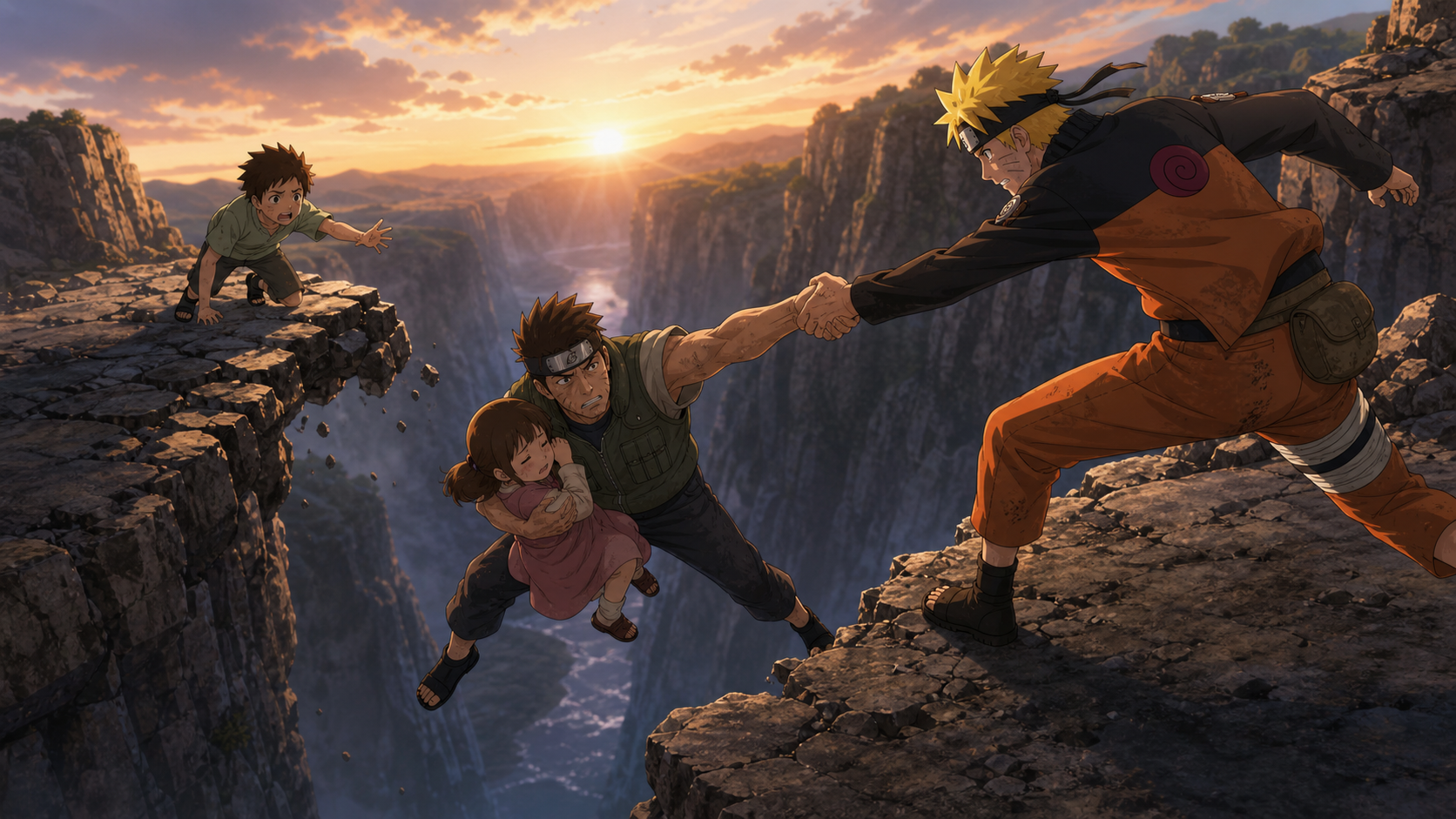
“Power – Episode 2” makes trust physical. Leo crosses a damaged route first, Dokku and Miina fall into the ravine, and Naruto saves them before any speech can repair the children’s fear of shinobi. Elsewhere, Kabuto treats reanimated people like adjustable tools, adding talismans and deploying Hidan and Deidara as controlled violence. The episode’s two lines meet around a clear contrast: Dokku carries children because their lives matter, while Kabuto carries bodies because their abilities are useful. Team Kakashi must stop the second system without letting combat overwhelm the first responsibility.
The survivors remain the mission’s center
Dokku and the five children lie low near Hachō Village while investigators search for answers. Hiding protects them from immediate pursuit, but secrecy also limits access to food, medicine, information, and ordinary contact.
A safe house needs more than a locked door. Someone must control visitors, inspect routes, schedule supplies, and decide what happens if the location is compromised.
The official routes confirm Kabuto’s escalation
Naruto Official catalogs “Power – Episode 2” as record `01_735` in the six-part Power sequence. Crunchyroll lists “Power – Episode 2” as Shippuden Episode 291 under watch ID `GYP81PJ5Y`, released November 29, 2012. The licensed summary identifies Kabuto’s confrontation with Naruto and the reanimation battle while Dokku shelters the five survivors.
The two official routes preserve both halves of the episode. That balance matters because the children are not a pause between fights. Their safety is the reason the investigation has moral weight.
Leo crosses before the adults
Leo goes across the dangerous route first. A child taking the first risk may look brave, but adults should ask why the formation allowed him to become the test.
Scouting, anchors, weight checks, and a safety line should precede civilian crossing. Survival should not require children to prove courage through exposure.
Dokku and Miina lose their footing
When Dokku and Miina fall into the ravine, the failure reveals how quickly one unstable route can defeat good intentions. Dokku cannot hold every child, monitor every surface, and serve as the entire evacuation system.
The incident should trigger a route review rather than simple relief after rescue. A near miss is evidence.
Naruto earns trust through action
Naruto catches Dokku and Miina before the fall becomes fatal. The rescue gives the children a concrete reason to reconsider their fear. A shinobi used strength to protect rather than destroy.
One rescue does not erase Tonika, and Naruto should not expect immediate affection. Trust grows when the protective action becomes a pattern.
Miina sees more than adults understand
Miina’s sensitivity to chakra and danger makes her reactions important evidence. Adults may dismiss humming, fear, or fragmented statements because the communication does not follow an investigator’s preferred format.
The team should record when her distress changes, who is nearby, and what chakra signatures are present. Observation can respect a child without turning her into an instrument.
Dokku needs another adult beside him
The ravine proves that Dokku cannot remain the only caregiver responsible for five children during an active pursuit. Shiseru, Sakura, or another trusted adult should share the work.
Backup protects the children and gives Dokku permission to sleep, grieve, and make decisions without exhaustion narrowing every option.
Kabuto speaks to bodies through control devices
In the graveyard, Kabuto communicates with Hidan and Deidara through scrolls and inserts another talisman into Deidara. The scene presents reanimation as a technical system stripped of consent.
Kabuto does not need cooperation when he can edit obedience. A person’s body, voice, memory, and technique become interfaces for somebody else’s strategy.
Deidara’s resistance still matters
Deidara retains enough personality to argue, complain, and recognize the indignity of control. The talisman tightens the boundary around that agency.
Documenting resistance matters because a reanimated fighter is not identical to the controller. The Allied response must stop the attack while preserving evidence of who directed each action.
Hidan’s return carries unfinished harm
Hidan represents specific trauma for the Leaf and for people connected to Asuma. Seeing his form active again can destabilize shinobi who believed that threat was contained.
Briefings should identify reanimated enemies before units encounter them. Surprise gives Kabuto another weapon.
Kabuto uses familiar enemies as psychological pressure
Hidan and Deidara bring more than techniques. Their faces reopen old missions, deaths, and failures. Kabuto can force opponents to fight memory while managing immediate danger.
Teams need permission to rotate when a personal connection compromises judgment. Emotional readiness belongs in deployment planning.
Naruto cannot chase every provocation
Kabuto understands Naruto’s anger and willingness to protect. A direct appearance can pull him away from Dokku, the children, and the investigation.
Yamato should define pursuit limits and maintain a retrieval plan. Catching Kabuto would matter, but losing the survivors while chasing him would be mission failure.
Sakura’s position should remain flexible
Sakura may be needed with Naruto during combat, with the children during evacuation, or near the village for medical response. Treating her as the automatic medic for every group creates a single point of failure.
She should establish supplies, delegate basic care, and clarify who takes over when she moves. Expertise becomes durable through distribution.
Sai and Yamato need to follow the motive
Kabuto’s presence confirms the attacker, but motive remains unresolved. Why Tonika, why the Hole, why these bodies, and why now are separate questions.
Yamato and Sai should compare local archives, missing objects, underground features, and Disonasu’s account. Identifying a perpetrator does not complete an investigation.
The graveyard is an operational site
Kabuto’s use of a graveyard suggests access to bodies, privacy, ritual space, and terrain suited to hidden preparation. Investigators need to map disturbed graves and identify every missing corpse.
Families and communities connected to those dead deserve notification. Reanimation is also desecration.
Talismans should be recovered as evidence
Any damaged or discarded control talisman can reveal materials, script patterns, chakra residue, and changes in Kabuto’s method. Combat teams should know how to secure one without triggering hidden effects.
Evidence handling needs sealed containers, named custody, and specialized examination. A powerful artifact tossed into a general supply bag can endanger everyone nearby.
The children should not witness avoidable combat
Dokku’s shelter needs distance from likely approach routes and a plan for noise, smoke, or sudden evacuation. Children who survived Tonika should not be placed where another shinobi battle becomes unavoidable spectacle.
If movement begins, one adult should explain each step in simple terms. Unexplained urgency can recreate the original panic.
Naruto’s rescue does not authorize intimacy
After saving Miina and Dokku, Naruto may want to reassure the children through closeness or humor. Some children may welcome that approach, while others may need space.
Protection does not create automatic consent for touch, questions, or emotional disclosure. Naruto can offer and let the child decide.
Leo’s earlier crossing needs follow-up
Leo may feel proud, frightened, guilty, or responsible for the later fall. Adults should tell him clearly that route safety belonged to them.
Children often convert survival into a private rule that they must always go first or remain strong. The caregiver’s job is to remove that burden.
The team needs separate combat and recovery logs
The combat log should record Kabuto, reanimated fighters, talismans, techniques, and movements. The recovery log should record the children’s location, condition, caregivers, supplies, and next placement.
A controlled link between the two logs allows threat information to reach caregivers without exposing private child records to every fighter.
Hachō Village needs a shelter audit
The neighboring village may look intact, but proximity to Tonika and Kabuto’s movement makes every public building a possible target. Officials should inspect exits, wells, clinics, food stores, and underground spaces before concentrating displaced residents in one place.
An evacuation map needs child-accessible landmarks rather than military coordinates alone. Caregivers should practice the route during daylight and assign each adult a small, known group. Confusion grows when everybody assumes somebody else counted the children.
Disonasu should not control survivor access
As local leader, Disonasu can provide resources, but he should not become the only gatekeeper between investigators and Tonika residents. Centralized access lets one official filter testimony, delay meetings, or pressure survivors.
An independent liaison should schedule interviews and record declined requests. Survivors need a way to report concerns without passing through the same office whose conduct may later require examination.
The attack timeline needs minute-level reconstruction
Investigators should align witness memories with fire spread, sound, chakra signatures, patrol routes, and the first external report. Even approximate times can reveal whether the attackers searched before destroying, moved toward the Hole, or waited for a signal.
Contradictions should remain visible rather than being forced into one clean version. Trauma changes recall, and different vantage points can produce different accurate fragments. A timeline is a working model, not a verdict.
Reanimation complicates the meaning of victory
Destroying a summoned body may stop an attack briefly, but regeneration and resummoning remain possible. Sealing, controller disruption, and body identification are necessary.
The team should never report a reanimated enemy “killed.” Language shapes whether command sends the right specialists next time.
Sealing teams also need advance notice about unusual talismans. Kabuto may be testing controls that respond differently from standard reanimation. Assuming familiar procedure could expose specialists to a body that detonates, transforms, or transmits chakra after restraint.
Naruto’s chakra requires its own safety protocol
Kabuto has studied Naruto before and may design attacks around extracting, provoking, or copying Nine-Tails chakra. Yamato should monitor changes, establish a suppression signal, and keep civilians outside the likely transformation radius.
Naruto deserves to know the plan rather than being treated as dangerous equipment. Consent and preparation make control more reliable. Secrecy from the person carrying the risk helps the enemy.
The five children need individual records
Grouping Leo, Miina, Faz, Lando, and Sora as “the survivors” makes administration easier but hides different needs. Each child should have a named file covering health, missing relatives, preferred caregiver, fears, skills, belongings, and expressed wishes.
Shared household information belongs in a separate family plan. Individual identity should not disappear because the children survived together.
Memorial decisions should wait for survivor input
Hachō officials or Konoha investigators may want to create a quick public memorial. Tonika’s survivors should decide location, names, symbols, and timing. A ceremony arranged by outsiders can feel like closure imposed before recovery begins.
Temporary remembrance can coexist with a later permanent site. Urgency belongs to care and evidence preservation, not to finishing grief on an administrative schedule.
Dokku’s household needs stability after relocation
Every move costs the children sleep, orientation, and familiar routine. Relocation should happen only for a defined threat, with possessions and food traveling with them.
The next shelter should be prepared before departure. Safety should not mean wandering.
Kabuto’s experiment depends on dehumanization
The graveyard scene and Tonika massacre belong to the same system. Kabuto treats the dead as equipment and the living as test conditions.
The Allied response must resist copying that logic. Survivors cannot become bait, and reanimated bodies cannot become nameless targets.
The ravine rescue exposes the cost of a single caregiver
Dokku is carrying logistics, grief, decisions, and five children’s fear. One bad surface turns that impossible workload into a fall. The incident is not evidence that he lacks devotion.
The failure belongs partly to a system that left him without another adult, route inspection, anchors, or rest. Naruto catches him. Recovery requires changing the conditions that made one catch necessary.
Miina’s body communicates before adults understand the message
Her distress may respond to chakra, danger, memory, or something the investigation has not named. Adults should observe patterns without forcing her to perform an ability.
A child is not a sensor assigned to the team. Miina needs safety even if her reactions never produce useful intelligence. Any information gained must remain secondary to her care and consent.
Leo’s courage should not become his permanent job
Crossing first may give Leo a sense of control after Tonika. Adults can accidentally reward that behavior until the child believes usefulness is the price of protection.
He needs to hear that testing routes belongs to trained people. Courage can mean reporting fear, waiting for an anchor, or letting somebody else go first. Survival does not make him the household scout.
Naruto earns one piece of trust instead of collecting a debt
Saving Dokku and Miina proves his power can protect. The children do not owe touch, disclosure, gratitude, or immediate comfort in return.
Naruto’s best next move is consistency. He can explain where he is going, return when promised, and accept distance. Trust grows when rescue is followed by behavior that keeps choices with the survivors.
Dokku’s protection and Kabuto’s control form the episode’s argument
Both men move bodies through danger. Dokku adjusts around the children’s lives. Kabuto adjusts bodies around the abilities he wants to deploy.
The visual parallel makes power ethical through purpose and consent, not scale. Carrying somebody can be care or possession. The difference appears in whether the carried person remains a person whose future directs the action.
The talisman makes coercion look technical and therefore neutral
Kabuto inserts a device, changes behavior, and observes output. Procedure can hide violence by making domination appear like maintenance.
The reanimated person’s complaint, hesitation, or remembered identity shows what the mechanism suppresses. Recording that resistance prevents alliance reports from collapsing controller and controlled body into one convenient enemy.
Hidan’s image is a weapon before his technique begins
Leaf shinobi connected to Asuma may freeze, rage, or abandon formation at the sight of him. Kabuto benefits from every unfinished response.
Briefings should name likely reanimations and provide rotation options. Emotional readiness does not make the grief smaller. It stops surprise from becoming another command system Kabuto can operate.
Deidara’s visible resistance carries intelligence
Complaints about the added talisman reveal that Kabuto is tightening control and may be testing different levels of autonomy. That change matters operationally.
A fighter who appears more obedient may also be less predictable because the controller can issue immediate commands. Analysts need to distinguish personality-driven choices from imposed behavior without assuming either remains fixed.
The graveyard should be treated as a harmed community site
Disturbed bodies are evidence, but graves also belong to families, rituals, and local memory. Investigators cannot enter as though technical urgency erases mourning customs.
Community representatives should help identify remains and guide restoration when safety allows. Kabuto violated the dead. The response should not add another layer of institutional possession.
Yamato’s pursuit plan needs a survivor anchor
No clue should pull the entire team away. A named person must retain responsibility for Dokku, the children, shelter security, and information updates.
The anchor can call reinforcement or halt pursuit when the safe house is threatened. This keeps Kabuto from using Naruto’s protective instinct to separate protection from the people who need it.
Sakura cannot be everywhere the story needs medicine
Combat, children, investigators, and local residents may all require her. A plan that writes Sakura beside every medical need is not a plan.
She should train helpers, stage supplies, define escalation thresholds, and protect time for the most complex cases. Distributing basic capacity lets her expertise remain available without treating her body as an endless resource.
Disonasu’s control of access is evidence itself
Who receives permission to speak, which archive appears first, and what route escorts use can reveal priorities before any document proves wrongdoing.
Yamato should log delays, substitutions, and refusals. Helpful presentation is not innocence. The shape of cooperation can show what a leader wants outsiders to notice and what he hopes remains administratively inconvenient.
Near misses deserve the same seriousness as injuries
Naruto prevents the fall, so an official summary might record no casualty. That would erase the unstable route, inadequate staffing, and child exposure that produced the emergency.
A near miss is free evidence purchased without a funeral. The team should inspect the crossing, change procedure, and document why future movement will not repeat the same conditions.
The children’s household needs a decision voice
Adults will choose shelter, food, interviews, and movement quickly. The children can still express who sleeps near whom, what belongings matter, which adult feels safe, and when they need a break.
Choice does not disappear because options are limited. Small control helps rebuild orientation after violence made every familiar decision irrelevant.
The arc’s mystery cannot consume the recovery clock
Kabuto’s experiment grows more urgent while bodies need identification, shelter supplies diminish, and children continue waking inside displacement. Both clocks are real.
Command should assign separate owners and scheduled exchanges between them. Solving the villain plot later cannot repair care that was neglected now. Recovery does not pause because investigators found a more dramatic clue.
That discipline keeps the rescue visible after Kabuto enters the frame and prevents mystery from swallowing the children inside somebody else’s plot entirely again.
RaeRae’s verdict
“Power – Episode 2” works because the ravine rescue and graveyard control scene mirror each other. Naruto uses power to keep people from falling. Kabuto uses power to remove choice.
The episode expands the threat without abandoning Dokku’s household. That balance needs to remain through the arc.
RaeRae’s call
Naruto’s catch matters because he returns Dokku and Miina to choices Kabuto would erase. The rescue earns one piece of trust, not ownership of the survivors’ story. The next responsible act is shared care, honest information, and a pursuit plan that never abandons the household.
Episode details and viewing routes
- Official episode reference: Naruto Official episode guide
- Licensed episode route: Crunchyroll licensed episode page
What I am carrying forward
I am carrying forward Miina’s unexplained sensitivity, the talisman evidence, and the need to investigate why Tonika mattered beyond the massacre.
I am also carrying forward a concrete recovery rule: Dokku cannot remain the only adult responsible for five children. Shared care is not a sign that he failed. Shared care is how the rescue continues.