
Danger: Jinpachi and Kushimaru!
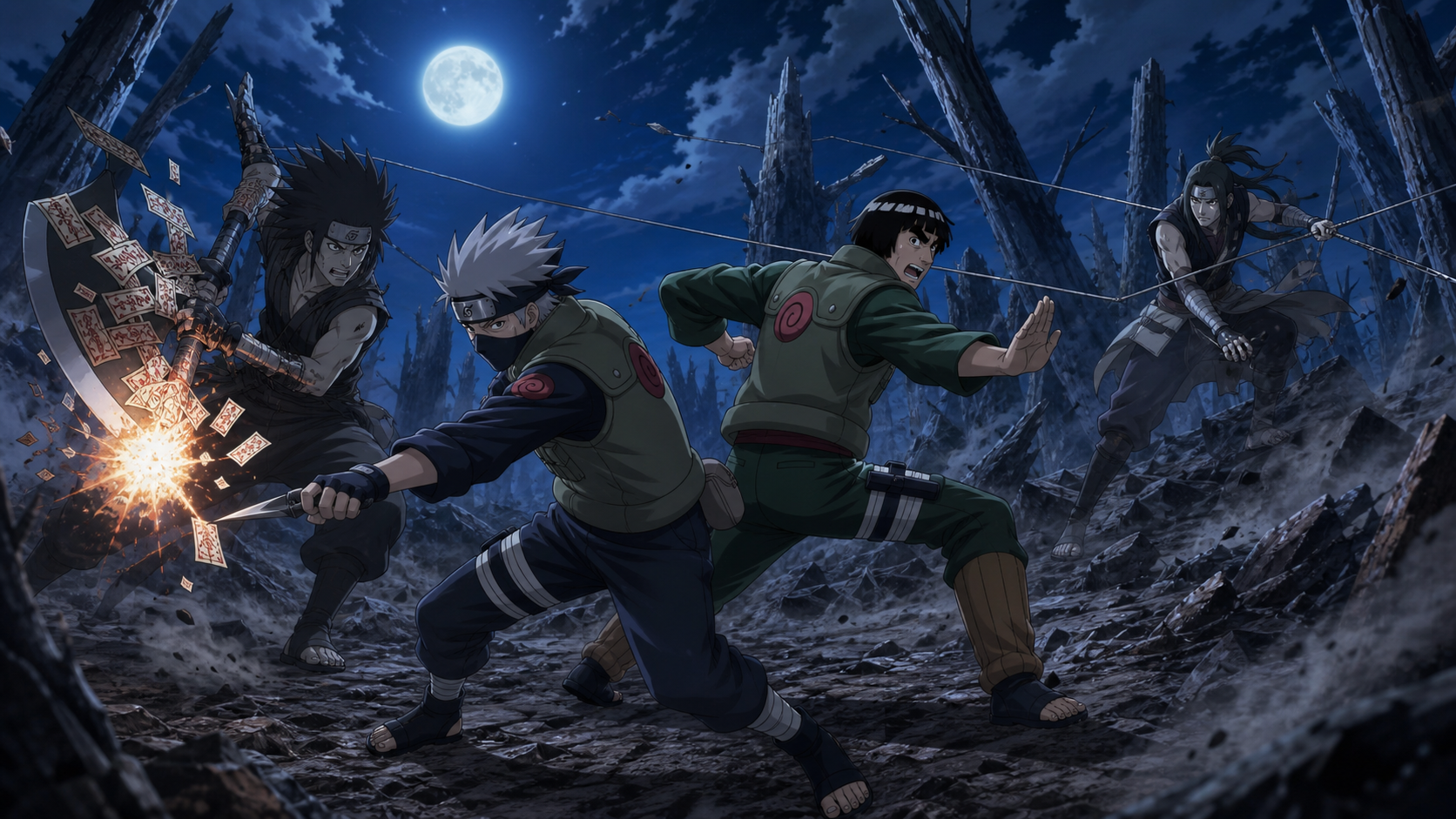
Kakashi and Guy use practiced trust to survive an explosive blade, a wired needle sword, and enemies who can attack through each other.
Bottom line
“Danger: Jinpachi and Kushimaru!” turns Kakashi and Guy’s friendship into a battlefield system rather than a sentimental speech. Jinpachi’s explosive blade punishes anyone who holds a fixed position. Kushimaru’s needle sword and wire turn movement itself into a trap. Kakashi and Guy survive because years of rivalry taught them how the other person reads distance, timing, and risk. Ran’s return with the sealing team completes the victory, proving again that elite combat can create an opening but specialist support must finish the mission.
Kakashi reaches a field already shaped by cruelty
Kakashi races toward the last confirmed location of Jinpachi Munashi and Kushimaru Kuriarare. The trail is not subtle. Fallen Allied shinobi and damaged terrain show that the two swordsmen are not testing opponents or seeking an honorable match. They are using reanimation to continue habits built around terror.
The carnage angers Kakashi, but anger cannot become the plan. Both enemies carry weapons designed to punish direct pursuit. A commander who charges without reading the field would add another body to the warning.
The official routes identify the paired threat
Naruto Official catalogs the story as record `01_732` in the Seven Ninja Swordsmen sequence. Its English title contains an official-site typo, “adn,” while Crunchyroll correctly lists “Danger: Jinpachi and Kushimaru!” as Shippuden Episode 288 under watch ID `G6195QE1Y`, released November 8, 2012.
Both summaries establish Kakashi’s response to the destruction and his decision to fight beside Might Guy. Preserving the verified route while using the licensed title spelling keeps the source trail honest without carrying a catalog typo into the editorial headline.
Jinpachi weaponizes the ground beneath every stance
Jinpachi wields Shibuki, the explosive blade. The weapon combines an axe-like edge with explosive tags, turning every strike into a second attack. Blocking the blade does not end the danger because detonation follows contact.
That design destroys comfortable defense. A shinobi must account for cutting range, blast radius, debris, and the next tag deployment at once. Jinpachi can also exploit his reanimated body, accepting damage that a living fighter would avoid.
Kushimaru makes open space into a stitched trap
Kushimaru’s Nuibari looks slender beside the heavier swords, but the needle blade carries wire that can pierce bodies, bind routes, and connect victims across the battlefield. The weapon turns trees, stones, and people into anchor points.
Movement becomes dangerous because an apparently clear lane may already be threaded. A fighter watching only Kushimaru’s hands can miss the line behind the strike. The correct defense requires constant mapping of where the wire has traveled.
The two swordsmen attack each other without consequence
Jinpachi and Kushimaru do not need ordinary teamwork ethics. Reanimation lets them include each other inside lethal attack zones, knowing damaged bodies will restore themselves. One can trigger an explosion through the other’s position or pull wire across a partner’s path.
That advantage is more disturbing than simple regeneration. Living teammates protect each other’s bodies. The reanimated pair can treat mutual destruction as a reusable tactic, forcing Kakashi and Guy to read attacks that ignore normal restraint.
Kakashi and Guy answer with trust built over years
Kakashi and Guy have competed since childhood. Their rivalry included races, sparring, games, and countless arguments about whose method was stronger. Those repetitions created practical knowledge. Each man knows how the other starts moving before a technique becomes obvious.
On this battlefield, familiarity reduces explanation time. Guy can enter a dangerous angle because Kakashi understands the intended opening. Kakashi can commit to a counter because Guy will not mistake restraint for hesitation.
Rivalry becomes useful only when ego leaves the center
Competition can sharpen skill, but pride can also split a team. Kakashi and Guy succeed because winning against each other is no longer the objective. Their history supplies rhythm without demanding that either man dominate the encounter.
This is the mature version of rivalry Naruto and Sasuke struggle to reach. Difference does not have to become ownership. Two people can challenge each other while still protecting a shared mission.
Ran carries information and an unfinished responsibility
Ran survives long enough to communicate the swordsmen’s location and help bring the sealing team. Her work is easy to overlook once Kakashi and Guy take center stage. Without her warning, the pair would arrive later or without the specialists needed to finish the fight.
Information runners face a specific kind of danger. They have to leave wounded comrades, cross hostile terrain, preserve exact details, and return toward the threat. Ran’s movement is part of the combat plan, not an errand outside the action.
The sealing team defines the real victory condition
Kakashi and Guy cannot win through damage alone. Reanimated enemies rebuild. The fight only matters if somebody creates enough control for sealing specialists to act.
That requirement changes every tactical choice. A dramatic finishing blow with no sealing follow-through wastes chakra and time. The elite fighters need to manage position, interrupt regeneration cycles, and keep the swordsmen contained until Ran returns.
Kakashi’s anger needs a documented target
Seeing Allied casualties makes Kakashi furious, but the episode directs that feeling toward protection rather than revenge. He does not abandon the division to chase spectacle. He joins the fight most likely to prevent further deaths.
Afterward, the unit should record which formations failed, how the wire was hidden, where explosions overlapped, and how many casualties occurred before reinforcement. Anger becomes useful when translated into better preparation.
Guy’s body reads what the Sharingan cannot solve alone
Kakashi’s visual analysis helps track weapons and trajectories, yet Kushimaru and Jinpachi create too many simultaneous hazards for observation alone. Guy’s taijutsu gives the team speed, physical interruption, and intuitive pressure.
The episode respects complementary expertise. Kakashi does not become less capable because Guy covers a gap. Guy does not need a dōjutsu to contribute equally. Different tools make the partnership resilient.
Nuibari demands battlefield housekeeping
Wire left across the ground remains dangerous after the immediate exchange. Support teams should mark, cut, or secure every visible line before medics and sealers enter. A successful counterattack can still end in avoidable injuries if the field is treated as safe too early.
Recovered wire also provides intelligence. Thickness, chakra response, anchor method, and tension pattern can inform later encounters with Kushimaru or similar weapons.
Shibuki turns debris into a secondary casualty source
Explosive tags do more than create a bright blast. Stone fragments, broken weapons, trees, and loose armor become projectiles. Teams outside the central duel can suffer injuries without ever entering Jinpachi’s striking range.
Commanders need wider evacuation zones and protected medical staging. The most visible circle of danger is not always the complete one.
Reanimation removes consent from every participant
Jinpachi and Kushimaru were violent in life, but Kabuto still controls their return and deploys them as resources. The Allied dead are denied safety, while the reanimated dead are denied final rest. The technique turns every body into contested property.
Sealing protects the living and ends the immediate use of those bodies. A complete record should still distinguish the swordsmen’s historical choices from Kabuto’s present control. Accountability does not require flattening agency.
Kakashi remembers a younger version of teamwork
The fight brings memories of earlier missions and the people who once stood beside Kakashi and Guy. Those memories carry grief, especially around Rin, but they also show how teamwork developed through repeated practice rather than sudden inspiration.
The past can guide without becoming a place to live. Kakashi uses remembered coordination to protect people in front of him now. That is one of the healthier ways this series lets memory function.
Guy refuses to let Kakashi carry every loss alone
Kakashi often absorbs responsibility until grief becomes private punishment. Guy’s arrival interrupts that pattern. He does not ask Kakashi to explain every feeling before offering help.
Presence can be practical care. Guy takes a position, reads the weapons, and shares the danger. Friendship becomes visible through workload.
The episode should credit the whole chain
The final report needs Kakashi and Guy’s combat actions, Ran’s intelligence route, the sealing team’s arrival, medical response, casualty recovery, and weapon analysis. A headline about two famous Leaf shinobi defeating two swordsmen would erase the system that made sealing possible.
Recognition shapes future planning. When support labor disappears from the record, commanders under-resource the same work in the next operation.
Survivors need more than praise
Allied shinobi who watched comrades die by explosion or wire may carry guilt because their own survival feels arbitrary. Immediate debriefing should avoid forcing graphic repetition. Teams need rest, medical screening, protected testimony, and clear information about what happened to the reanimated attackers.
Telling survivors that Kakashi and Guy won does not resolve what they witnessed. Care must continue after the battlefield becomes quiet.
The weapons deserve separate training simulations
Future units should practice against safe versions of both threat patterns. Shibuki drills need blast-radius judgment, debris protection, and movement after a blocked strike. Nuibari drills need wire detection, anchor mapping, and coordinated lane clearing.
Combining both patterns should happen only after teams understand each weapon separately. Complexity without foundation becomes another casualty generator.
Training also needs a stop rule. Recruits should know when a trapped lane, damaged hearing, or lost visual contact requires withdrawal rather than improvisation. Hero stories often reward the fighter who remains inside an impossible exchange. Real unit safety depends on recognizing when the formation no longer has enough information to protect itself.
A static formation would have failed
Jinpachi destroys fixed defense through explosions. Kushimaru punishes predictable movement through wire. Together they create a problem with no permanent safe square.
Kakashi and Guy survive by treating formation as a moving agreement. One changes pressure while the other updates position. The lesson is not endless motion. The lesson is coordinated adaptation.
That agreement needs simple signals that still work through explosions and obstructed sight. Hand signs, timed movement counts, and predetermined fallback points reduce dependence on shouted instructions. Kakashi and Guy can rely on deep familiarity, but a division should convert their instincts into teachable protocol rather than assuming every partnership will develop the same unspoken fluency.
The recovered swords remain evidence
After sealing, Shibuki and Nuibari should be secured as hazardous artifacts, photographed in place, and logged through a controlled transfer. Their surfaces, tags, wire, and damage patterns may explain earlier casualties. Treating legendary weapons as trophies would repeat the culture that made the Seven Swordsmen more famous than the people harmed by them.
Custody also matters because another enemy may try to reclaim the blades. A sealed swordsman does not guarantee a secured weapon. Intelligence, storage, and guard assignments belong in the same completion report as the battle.
Back-to-back only works when neither back becomes expendable
Kakashi and Guy can divide sight lines because each trusts the other to protect the space he cannot see. The formation is intimate battlefield consent. Both understand the risk and keep updating the agreement through movement.
Jinpachi and Kushimaru offer the inverse. Reanimation lets them destroy each other’s bodies for tactical gain. Proximity means usefulness, not care. The contrast makes teamwork ethical before it becomes impressive.
Guy’s arrival interrupts Kakashi’s habit of solitary responsibility
Kakashi sees bodies and immediately absorbs the failure as something he must answer personally. That instinct can produce focus and also push him into an enemy’s prepared geometry.
Guy does not erase the anger. He shares the workload attached to it. The friend who enters the danger beside Kakashi keeps grief from becoming a private command to die proving concern.
Jinpachi makes blocking an incomplete verb
A fighter may intercept Shibuki’s blade and still stand inside the explosive answer. Defense has to continue after contact through distance, debris awareness, and anticipation of the next tag.
That mechanic punishes training built around one clean exchange. The weapon tells soldiers that success at the first layer can become the setup for injury at the second. Kakashi and Guy survive by reading sequences rather than isolated strikes.
Kushimaru turns the battlefield into evidence of earlier movement
Every stretched wire records where Nuibari traveled, which anchors mattered, and what lane Kushimaru expects someone to use. The trap is dangerous, but the geometry also reveals intention.
Kakashi can read that evidence while Guy changes the movement pattern feeding it. Their partnership works because analysis and physical disruption happen together. Neither skill alone clears the entire web.
Regeneration lets the swordsmen abandon mutual restraint
Living partners avoid striking through one another because bodies carry consequences. Edo Tensei removes the stopping signal. Jinpachi can detonate beside Kushimaru, and Kushimaru can thread danger through his partner’s position.
Their tactics show what combat becomes when a commander treats bodies as renewable material. Kabuto’s control expands cruelty by making self-preservation optional for the people he deploys.
Ran’s survival is knowledge purchased at a cost
She carries location, weapon behavior, casualties, and the need for sealers away from a field designed to stop escape. That intelligence does not become less dangerous because the episode follows famous men afterward.
Her route should shape the plan and the record. Calling her merely a messenger would hide the judgment required to decide what information could save the next group and how to deliver it while injured.
The sealing team enters terrain still trying to kill them
Once Kakashi and Guy create an opening, specialists must approach through wire, debris, unstable tags, and regenerating bodies. The final action is not administrative cleanup.
Frontline fighters owe them a protected lane, clear signal, and target control long enough to complete the seal. A victory plan that celebrates the opening but exposes the person closing it remains unfinished.
Rivalry becomes mature when losing no longer threatens identity
Kakashi and Guy can disagree, compete, and tease because neither needs every contest to prove he deserves the relationship. That security frees competition to produce observation rather than resentment.
On the battlefield, they do not count who landed the better counter. They use whatever each person does best. Rivalry becomes shared vocabulary once ego stops demanding the final sentence.
The division needs protocols ordinary teammates can learn
Kakashi and Guy rely on years of familiarity that cannot be issued before a mission. Command should translate the useful parts into signals, fallback points, lane assignments, and rules for confirming wire or blast hazards.
Admiring exceptional chemistry is not preparation. A teachable protocol lets newer partners coordinate without pretending they possess childhood knowledge of one another’s timing.
Legendary weapons should not erase ordinary casualties
Shibuki and Nuibari have names, histories, and dramatic silhouettes. The shinobi killed by them can disappear into background evidence of danger. That imbalance repeats the culture that made the Seven Swordsmen glamorous.
Records should preserve the people, units, and circumstances affected, not only the blade recovered. A weapon’s legend is incomplete when harm becomes anonymous scenery around its wielder.
Survivor testimony needs control returned to survivors
Investigators require accounts of hidden wire, delayed blasts, and enemy coordination. Repeating graphic details immediately can deepen trauma without improving accuracy.
Survivors need medical screening, choice about pacing, and clarity about how testimony will be used. The alliance can learn from the field without treating frightened people as evidence containers available on command.
Sealing the dead is not the same as forgiving the living choices
Jinpachi and Kushimaru committed cruelty before Kabuto revived them. Edo Tensei also violates their dead bodies. Both truths can stand.
Sealing ends present control and protects living soldiers. Historical accountability remains in the record. Compassion for the stolen dead does not require pretending their earlier victims never existed, and condemnation does not make Kabuto’s ownership acceptable.
Kakashi and Guy leave a model of distributed courage
Neither man becomes fearless. They make danger divisible through position, signals, complementary tools, and confidence that another person will hold an agreed responsibility.
That is more useful than the fantasy of one unbreakable hero. Courage becomes a network where Ran’s report, Guy’s pressure, Kakashi’s analysis, and the sealers’ precision each prevent a different failure.
The field after victory still belongs to the operation
Once the swordsmen are sealed, medics need cleared lanes, engineers need every explosive tag marked, and recovery teams need wire tension released. Kakashi and Guy cannot let adrenaline rename the area safe. The enemies stopped attacking, but their weapons and damaged terrain can keep producing casualties.
A disciplined handoff identifies who controls each blade, who confirms each seal, who escorts survivors, and who preserves evidence. Completion is not the moment the fighters lower their hands. Completion arrives when every specialist can work without entering a hazard nobody bothered to report.
RaeRae’s verdict
“Danger: Jinpachi and Kushimaru!” delivers a satisfying specialist fight because every weapon changes the rules of space. Jinpachi makes contact explosive. Kushimaru makes distance deceptive. Kakashi and Guy answer with practiced trust rather than a larger single attack.
Ran and the sealing team keep the episode from confusing combat spectacle with completion. The swordsmen are stopped because several kinds of work arrive in the right order.
RaeRae’s call
Kakashi and Guy survive back-to-back because neither man treats the other body as expendable. Ran carries the evidence, the fighters create the opening, and the sealing specialists close the threat. The victory belongs to the full chain, not the two most famous names.
Episode details and viewing routes
- Official episode reference: Naruto Official episode guide
- Licensed episode route: Crunchyroll licensed episode page
What I am carrying forward
I am carrying forward the image of Kakashi and Guy using rivalry as shared language. Years of difference become protection because neither man needs to win the friendship.
I am also carrying forward Ran’s contribution and the sealing team’s decisive role. The famous fighters hold the line. The specialists end the threat. Both truths belong on the same page.