
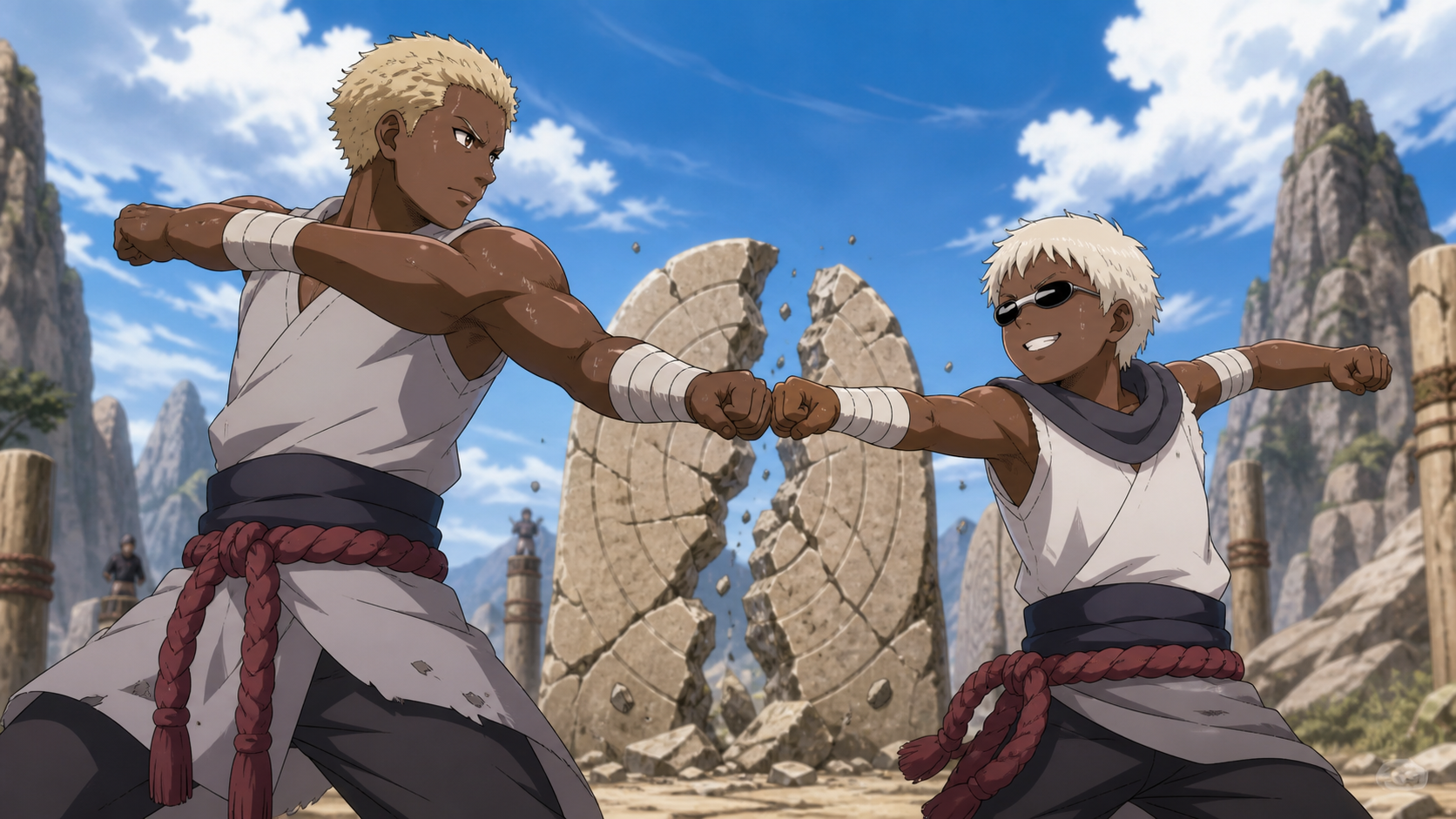
The Secret Origin of the Ultimate Tag Team!
A and B’s military pairing becomes chosen family, then fear tests whether the Fourth Raikage can still hear the adult brother standing before him.
Bottom line
“The Secret Origin of the Ultimate Tag Team!” explains why Killer B can stand between Naruto and the Fourth Raikage without reducing their bond to blood or rank. A chose B through a brutal partnership test, then spent years treating protection as control because losing another jinchūriki felt unbearable. B understands the fear and still refuses the order. Their fist bump becomes evidence that brotherhood should transmit truth in both directions. If A can no longer read B’s conviction, the problem is not B’s disloyalty. The problem is A’s grip.
Two Kage form the roadblock
Tsunade and the Fourth Raikage intercept Naruto and Killer B before they reach the battlefield. Their position carries legal and military authority. The alliance organized the war around keeping both jinchūriki away from Obito, and the Gedō Statue’s attack has already proved how catastrophic escalation can become. Naruto and B carry power and enormous risk. The confrontation begins because command believes no personal argument can outweigh the capture scenario.
The catalog needs the right episode number
The Naruto official site records this installment as overall animated episode 502 under `01_726`. Crunchyroll lists “The Secret Origin of the Ultimate Tag Team!” as Shippuden Episode 282, released October 4, 2012, with watch ID `GYZXQ4MD6`. Another official page labels an older Guardian Shinobi Twelve episode as Episode 282 in overall-series numbering. The URL and story summary prevent that numbering overlap from sending readers to Sora instead of the A/B confrontation.
A frames confinement as protection
The Raikage argues that the war exists to protect Naruto and B. The statement is true at one level. Obito needs their tailed beasts, and capture would endanger the world. Protection becomes controlling when A treats the protected people as cargo whose informed refusal has no weight. His fear narrows every possibility to obedience or death. The episode asks whether a leader can call somebody family while denying that person any authority over the life being protected.
B asks personally before he resists physically
Killer B does not begin by attacking his brother. He asks A to let Naruto pass and offers his own judgment as a guarantee. That choice matters. B recognizes the office, the danger, and the relationship before challenging the order. A’s refusal leaves him with a conflict between obedience and what he believes is necessary. The escalation is not teenage rebellion. A decorated adult jinchūriki reaches the limit of a command structure that still handles him like a containment vessel.
The A and B names were military roles
Kumogakure paired the future Raikage with candidates for the “B” position, seeking a partner capable of matching A’s strength and timing. The naming system turns people into a combat formation before brotherhood develops. A candidate succeeds by completing the Double Lariat in perfect unison. B earns the name through performance, but the relationship grows beyond the assignment. That growth is what makes later control feel like a betrayal of their shared history.
Choosing a brother can be real and institutional
A and B are not biological brothers. Their bond remains genuine. Chosen family does not become less meaningful because a village initiated the pairing for military reasons. The institutional origin still matters. Kumo needed a weaponized team and placed children inside that need. A and B built affection, trust, jokes, training, grief, and responsibility within a structure designed to produce combat output. Both truths belong in the biography.
The fist bump becomes their private language
Physical contact allows A and B to read one another’s force and intention beyond ordinary speech. The fist bump is greeting, emotional check, and proof of alignment. Repeated over years, the gesture carries shared missions and promises. B challenges A by asking whether his brother can still read his soul through the contact. The question exposes how fear can make a person stop receiving information even when the familiar signal remains clear.
A’s cousin understood the jinchūriki wound
Before B received Gyūki, A’s cousin spoke about the emptiness a jinchūriki must survive. Public strength, village status, and material support cannot fill the hole created by being treated as a container. A host needs a relationship strong enough to confirm personhood when everyone else sees the beast first. That insight influences A’s promise to B. The promise is compassionate and also places enormous responsibility on one brother to become the entire emotional answer to institutional isolation.
The funeral changes A’s protective instinct
Loss teaches A that strength does not guarantee survival. Standing beside B after his cousin’s death deepens the fear that another person close to him may be taken. Grief can make protection more urgent and less respectful. A wants B strong enough to survive, then later wants him controlled enough to avoid every risk. The same love supports both choices. The episode does not excuse coercion, but the history explains why A confuses stopping B with saving him.
B receives Gyūki and a different public life
Once Gyūki is sealed inside him, B’s relationship with the village changes. He becomes strategically essential and socially vulnerable. People can celebrate his power while distrusting the person carrying the beast. A remains his emotional anchor, but A also becomes part of the leadership managing him. Brother and commander occupy the same body. That overlap creates conflicts no fist bump can automatically solve.
Gyūki gives B another chosen relationship
B eventually forms a working partnership with the Eight-Tails, refusing the model where a host succeeds only by dominating the beast. Gyūki becomes adviser, combat partner, critic, and friend. That bond expands B’s support beyond A and challenges the village’s weapon logic. B’s judgment about Naruto carries weight because he knows what a jinchūriki partnership can become. He is not gambling on a theory from outside the seal.
Naruto stands inside someone else’s family argument
The roadblock concerns Naruto’s deployment, but the emotional core belongs to A and B. Naruto needs to avoid making their relationship another stage for his personal determination. B chooses to support him based on training, shared jinchūriki experience, and observation. Naruto benefits from that choice. Respect requires recognizing that B is risking conflict with his brother, not merely playing sidekick in Naruto’s escape.
Tsunade understands Naruto and still blocks him
Tsunade has repeatedly trusted Naruto with impossible tasks and defended his potential. As Hokage and alliance leader, she must also consider the consequence of capture. Her presence prevents the argument from becoming a simple contrast between a controlling Raikage and an understanding Leaf leader. Institutions can place caring adults in positions where they enforce choices that contradict personal trust. The answer requires judgment, not team loyalty.
A’s threat to kill Naruto reveals warped risk logic
If Naruto insists on going, A considers killing him to prevent Obito from taking the Nine-Tails. The reasoning follows an extreme denial strategy: destroy the asset before the enemy captures Naruto. Calling Naruto an asset is exactly the moral problem. A proposes death as protection from a worse outcome without granting Naruto any say. The threat shows how quickly strategic fear can reproduce the dehumanization leaders claim to oppose.
B refuses to let protection become execution
Killer B places himself between A and Naruto. The move protects Naruto physically and forces A to confront the brother he claims to protect. B’s resistance is not evidence that their bond failed. Resistance proves the bond has enough truth to survive disagreement. A brother who never says no becomes an extension of authority rather than family. B risks the relationship because preserving its honest meaning matters more than preserving surface obedience.
The Double Lariat measures equality
The signature combination requires A and B to coordinate speed, direction, and force. Neither partner can treat the other as baggage. Their history as the ultimate tag team therefore contradicts A’s current assumption that only his judgment should control the route. Combat taught them mutual dependence. Leadership tempted A to forget that dependence. B invokes the old formation to remind him that partnership means each person brings power and judgment to the decision.
Training that lariat required both brothers to report pain, timing errors, blind angles, and changing capacity without punishment for slowing the attempt. The final technique looks effortless because earlier failures were allowed to produce information. A cannot celebrate that synchronization in combat while refusing the same honest feedback when B disagrees with a wartime order.
Naruto’s Chakra Mode changes the physical argument
Naruto’s speed in Nine-Tails Chakra Mode gives him a chance to move past the Raikage’s famous lightning-enhanced reflexes. Physical ability does not settle the ethics, but the contest changes A’s practical assessment. Naruto is no longer the child A imagines sending toward capture. He has trained, gained sensory reach, and developed power the alliance urgently needs against White Zetsu. Updated capacity deserves an updated risk calculation.
Minato’s shadow enters the speed test
The Raikage remembers Minato as the shinobi who could surpass his speed and alter a battlefield instantly. Seeing Naruto approach that level connects inherited talent with personal training. The comparison may tempt the story to validate Naruto through his father. Naruto’s case should not depend on bloodline alone. He earns trust through choices, relationships, and demonstrated control. Minato’s memory explains A’s recognition without becoming the sole reason Naruto deserves agency.
Brotherhood needs room for changed people
A still protects the B he remembers receiving Gyūki and carrying village hostility. The current B has mastered partnership, survived Akatsuki capture attempts, trained Naruto, and formed an informed judgment about the war. Love becomes controlling when memory refuses to update. The fist bump should help A meet the present brother rather than enforce promises made around the younger one.
Strategic disagreement needs conditions, not ultimatums
The alliance could reduce risk through escort, communication, clone deployment, retreat thresholds, and continuous sensory reporting. None of those conditions eliminate danger. They treat Naruto and B as participants capable of following a negotiated plan. A’s roadblock offers only return or force. The episode moves toward trust because the binary becomes impossible to defend after B stakes his own judgment and Naruto proves new capacity.
The flashback earns its length
The episode pauses the forward war to explain A and B’s bond, but the history directly controls the present decision. The selected-child system, cousin’s insight, funeral, Gyūki sealing, training, and fist bumps establish why B’s refusal hurts and why A may finally listen. This is not filler memory placed beside the conflict. The flashback supplies the evidence each brother uses when deciding what their relationship requires now.
The B selection asks a child to audition for intimacy
Kumo needs a fighter whose timing can complete A’s technique, so candidates are tested as potential Bs. The village presents a combat requirement. A child experiences the possibility of being chosen by the person who may become brother, partner, protector, and commanding authority.
Performance and belonging arrive tangled together. B succeeds because he is skilled, but a child should not have to wonder whether one missed lariat also means losing a family. The bond becomes real later. The selection structure remains worth naming.
Chosen family can grow inside an arrangement without owing the arrangement gratitude
A and B build something genuine from a role Kumo created for military output. Their laughter, grief, private rhythm, and mutual recognition cannot be dismissed as propaganda. Neither should that love be used to declare the system benevolent.
People often make life inside structures that did not prioritize their freedom. The beauty belongs to what they gave each other. The village does not deserve ownership of the bond merely because officials placed the boys in the same trial.
A promises to fill a wound one person cannot fill alone
His cousin teaches A that a jinchūriki needs somebody whose love reaches beyond the beast. A takes the lesson seriously and becomes that person for B. The promise saves something. The promise also risks making A believe he is the sole keeper of B’s emotional survival.
B later forms relationships with Gyūki, friends, music, students, and his own sense of self. Brotherhood should support that widening world. Protection becomes possession when A treats every independent bond as a threat to his place.
Gyūki proves partnership can cross a seal without erasing difference
B and Gyūki are not one agreeable voice. They argue about lyrics, danger, judgment, and timing. Their cooperation matters because disagreement survives. The tailed beast is not reduced to obedient power, and B is not reduced to a container.
That living partnership gives B expertise A lacks. When B says Naruto is ready, he speaks as someone who understands both capture risk and what reciprocal jinchūriki strength feels like from inside.
The fist bump fails when one brother decides what the signal must say
A values the gesture as proof that their hearts remain connected. During the roadblock, he approaches contact already convinced B must agree. Any other message becomes noise.
The problem is not that the fist bump stopped working. A stopped listening. Ritual cannot guarantee understanding when authority permits only one acceptable answer. B has to push hard enough that the physical truth breaks through the conclusion his brother prepared in advance.
Grief explains control without turning control into care
A has buried people and watched jinchūriki become targets. His fear is not imaginary. That history makes the roadblock emotionally coherent, but understandable coercion remains coercion.
Love cannot be measured only by how desperately somebody prevents loss. Love also appears in whether the protected person can speak, change, assess danger, and choose. A must hold grief without making B live permanently inside the moment A first feared losing him.
B’s refusal protects the brotherhood from becoming command
Obedience would keep the surface peaceful and hollow out the relationship underneath. B says no because his judgment matters, Naruto’s life matters, and the battlefield has changed.
By standing against A, B insists their bond contains two adults. He risks anger to preserve honesty. A relationship that survives only when the lower-ranked brother agrees is not ultimate teamwork. It is hierarchy wearing family language.
Naruto should not inherit B’s sacrifice as entitlement
B chooses to oppose the Raikage for reasons rooted in his own ethics and experience. Naruto benefits, but support does not make B another instrument of Naruto’s destiny.
Naruto owes him attention, respect for retreat conditions, and recognition of what the conflict costs. The scene is not simply proof that everyone eventually joins the hero. It is B authoring a decision about war, jinchūriki agency, and his brother’s fear.
Tsunade’s change matters because institutional judgment can change
She begins at the roadblock as Hokage, not merely Naruto’s admirer. New evidence arrives through his control, B’s testimony, the battlefield crisis, and the moral failure inside A’s proposed solution.
Leadership that cannot update becomes ritualized fear. Tsunade’s task is to translate personal knowledge of Naruto into conditions the alliance can defend, rather than pretending affection alone settles strategic risk.
The Double Lariat remembers mutual force better than A does
The technique cannot work if one partner becomes cargo. Both bodies set timing, direction, and commitment. The formation itself contains a political lesson: synchronized power requires receiving another person’s contribution.
A celebrates the lariat as proof of their greatness while trying to remove B from the present decision. B returns to shared force because words have reached their limit. The body reminds the leader what the title ultimate tag team was supposed to mean.
Protection needs an exit from emergency logic
Temporary restrictions may be defensible when capture risk spikes and information is incomplete. The danger comes when emergency rules have no threshold for ending. B’s growth can never satisfy a policy designed around the possibility of catastrophe.
A responsible plan names evidence, review points, escorts, communication, and retreat conditions. Permanent confinement disguised as temporary safety leaves the jinchūriki protected from living while the enemy still controls the shape of his life.
The flashback gives B a history larger than comic relief
His rhymes and confidence can make pain look weightless. The childhood story reveals the labor beneath that ease: selection, sealing, public expectation, grief, training, and the need to keep a self inside roles other people chose.
The episode refuses the cruel idea that joy proves harm never happened. He built style, partnership, and freedom as responses to constraint. That makes his laughter stronger, not simpler.
RaeRae’s verdict
“The Secret Origin of the Ultimate Tag Team!” makes the A/B partnership stronger by allowing B to disobey. Their chosen brotherhood began inside a military system and became real through years of mutual trust. A’s grief turns protection into control, while B uses the fist bump to demand that his brother recognize the adult standing in front of him. Love does not lose meaning when B says no. Love finally has to prove that A can hear him. The episode lets disagreement become evidence of a living bond rather than proof that family loyalty failed.
RaeRae’s call
A and B became brothers inside a system that wanted a weaponized pair. Their love is real because they grew beyond the assignment. B’s refusal protects that truth: partnership needs two judgments, and a fist bump means nothing if only the stronger brother gets to decide what both hearts said.
Episode details and viewing routes
- Official episode reference: Naruto Official episode guide
- Licensed episode route: Crunchyroll licensed episode page
Next on the road
Episode 283, “Two Suns,” resolves the roadblock. Tsunade must decide whether to stand with A’s containment logic or Naruto’s demonstrated will, while B forces the Raikage to remember that a jinchūriki’s strength comes from the person who fills the heart’s emptiness, not the leader who closes every road.