
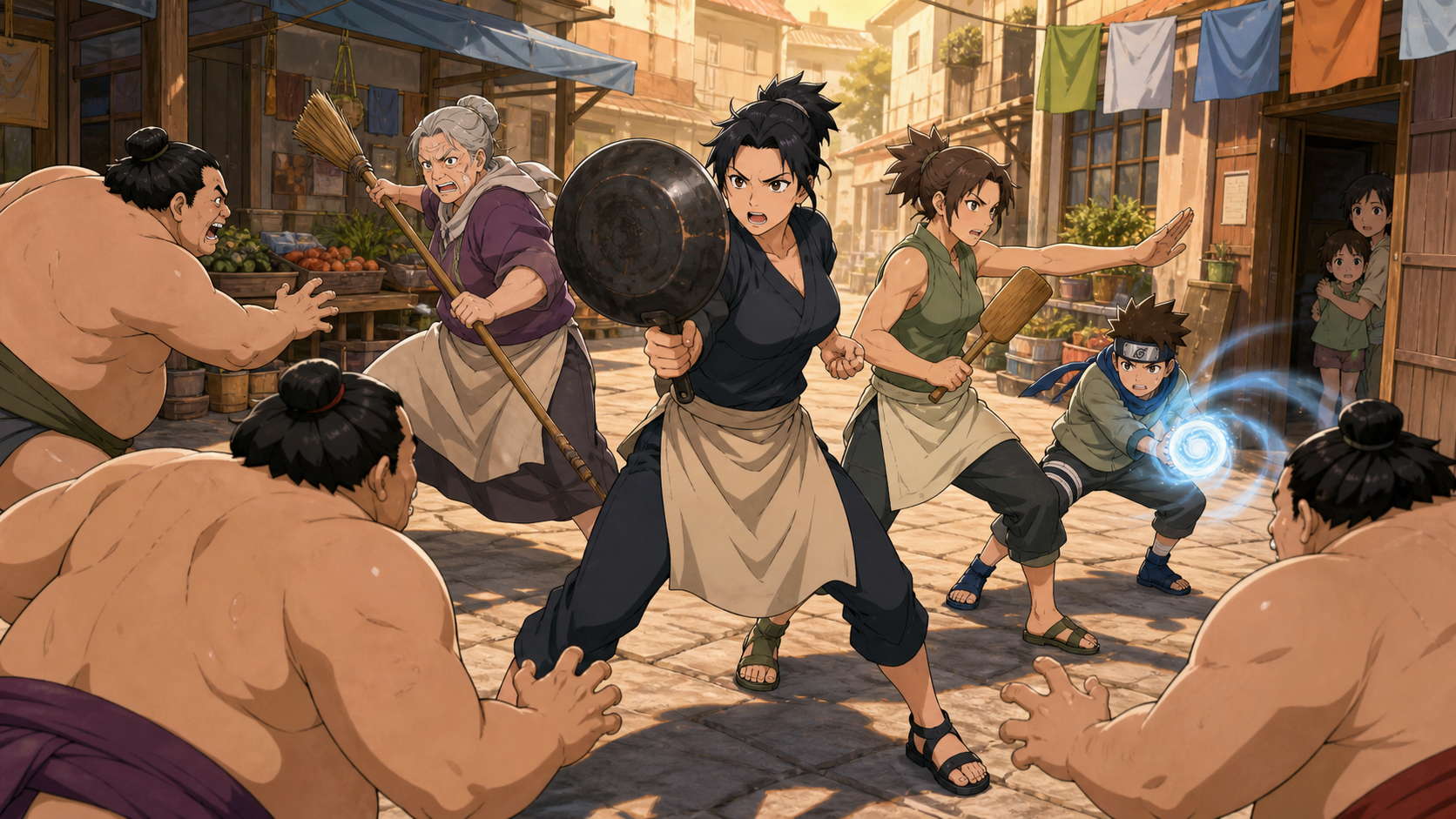
The Allied Mom Force!
Konoha’s home front survives because mothers and civilians already organize care, supplies, children, and neighborhood defense before any young hero arrives.
Bottom line
“The Allied Mom Force!” is broad comedy wrapped around a point Naruto rarely states plainly: sending most recognized fighters to war does not make everybody left at home passive. Mothers, shopkeepers, children, teachers, and other civilians already maintain the village while shinobi receive public credit for protecting the village. The episode gets silly with frying pans and sumo invaders, but the joke works best when the mothers’ competence is not treated as a surprise. Konoha survives because defense was always larger than uniforms.
The village looks empty because labor moved
Many shinobi have deployed with the Allied Forces, leaving Konoha without its normal concentration of trained defenders. The streets still need food, childcare, communication, fire response, medical access, and security. Those jobs do not vanish when combat personnel leave. Remaining residents absorb the work while also waiting for news from family members at the front. Home-front stability becomes another war resource, even when command reports rarely count that stability.
The records identify the comic detour
The Naruto official site catalogs “The Allied Mom Force” as overall animated episode 501 under record `01_725`. Crunchyroll lists the episode as Shippuden Episode 281, released September 27, 2012, under watch ID `GY2PW575Y`. The story is anime-original and does not advance the manga’s central war sequence. Viewers following only the main battle can skip. Viewers wanting Konoha home-front comedy and Konohamaru screen time have a clear reason to watch.
Konohamaru wants a job that looks heroic
Konohamaru is eager to guard the village because war has made protection feel urgent and public. Adults tell him to continue his ordinary routine, which sounds dismissive when he knows danger exists. His frustration reflects a real problem for young people during emergencies. They can recognize risk without having the authority, training, or information to choose a safe role. Telling them to “act normal” without explaining the plan can turn responsibility into unsupervised improvisation.
Ebisu treats preparation as adult work
Ebisu gathers the remaining personnel and thinks through the possibility of attack. His caution is reasonable. Konoha has survived invasions, destruction, and infiltration before. Assuming every enemy will ignore the village because the main armies are elsewhere would be careless. His mistake is underestimating what local residents already know and can do. Emergency planning works better when officials map available capacity instead of defining capacity as whoever holds a conventional combat assignment.
The mothers do not begin at zero
The Allied Mothers Force knows homes, streets, neighbors, supplies, children, and the practical rhythm of the village. Some members have direct combat knowledge; others possess strength built through daily labor and family defense. The episode exaggerates their readiness for comedy, but the baseline is credible. People who manage households during recurring shinobi crises are not waiting for a teenage boy to explain that danger exists.
Domestic tools become visible weapons
Frying pans and household objects turn into comic weapons during the confrontation. The gag lands because these tools normally represent labor viewers overlook. Cooking equipment feeds families, manages scarce supplies, and keeps a household moving. In an emergency, the same sturdy object can defend a doorway. The episode should not imply domestic labor matters only after becoming combat. The joke is stronger when viewers recognize that usefulness existed before anyone swung the pan.
Care work is already village defense
Protecting children, maintaining food, watching neighbors, tending injuries, and preserving routine reduce panic and keep trained responders free for other tasks. That is security work even without an enemy at the gate. The mothers’ alliance demonstrates a network that notices absence and responds quickly. Konoha’s formal command could learn from the same network rather than treating civilians as people to evacuate after professionals make every decision.
Children notice what adults dismiss
Konohamaru receives reports from other children about suspicious people near the forest. Some sightings may be harmless, but the information deserves a structured check. Children move through spaces adults ignore and may notice changes in routine first. Emergency systems should give them a safe reporting route without turning them into scouts. Adults need to verify the report while keeping the children away from direct contact.
The travelling circus complicates the alarm
Early suspicion appears to lead toward a harmless travelling group, making Konohamaru’s concern look excessive. False alarms are part of security work. A report that turns out harmless does not prove reporting was foolish. The correct response is proportionate verification. Mocking every mistaken concern teaches residents to stay quiet when the next observation matters. The episode uses the circus for comedy but leaves a useful lesson beneath the misunderstanding.
Sumo attackers keep the threat intentionally ridiculous
The eventual attackers are sumo wrestlers rather than Akatsuki infiltrators or a hidden elite unit. That choice keeps the story light and clearly separate from the war’s central stakes. The men still attempt violence against a village with reduced defenses. Comic scale does not make residents obligated to tolerate the intrusion. Home defense can be serious in purpose without pretending every threat deserves a tragic soundtrack.
The mothers act before a hero arrives
The Allied Mothers Force confronts the attackers directly. They do not wait for Konohamaru to become the male child savior who validates their competence. That order matters. Konohamaru contributes later, but the village was already defended by people who understood the danger and organized themselves. A story about mothers should not use them as a cheering crowd for a boy’s finishing move.
Konohamaru’s Rasengan still has a place
Konohamaru uses the Rasengan to finish the confrontation, demonstrating training inherited through Naruto’s example. The technique gives him a legitimate contribution. The moment works when treated as one part of the defense rather than the reason everyone else mattered. Adults contained the situation, residents shared information, and Konohamaru applied a tool at the right moment. Cooperation makes the Rasengan safer and more useful.
Wanting responsibility is not the same as being ready
Konohamaru’s courage deserves respect. Courage does not give him automatic command authority or complete situational awareness. A young shinobi can perform a strong technique while still needing adult coordination, boundaries, and debriefing. The episode balances those facts unevenly because comedy wants him to rush forward. A better home-defense plan would assign him a defined route, communication duty, and backup instead of alternating between dismissal and unsupervised combat.
Mothers should not be reduced to instinct
Stories often explain maternal competence through a magical protective instinct, which erases knowledge and labor. The mothers in Konoha know how to coordinate because they have years of experience managing people, resources, conflict, and emergencies. Love may motivate action. Skill determines whether action helps. Calling every successful choice “mother instinct” would make the work seem natural, effortless, and available without preparation.
The village owes home defenders resources
Publicly celebrating civilian bravery still cannot become an excuse to leave civilians under-equipped. Konoha’s leaders should maintain shelters, alarms, supply caches, medical points, evacuation maps, and trained local coordinators before deployment drains the village. Heroic mothers with frying pans make a funny episode. Real planning should not depend on improvised cookware as the first line of defense.
Neighborhood coordinators also need a simple signal chain: who confirms an alarm, who moves children, who checks isolated residents, and who reports to the remaining shinobi command. Clear roles keep courage from turning into a crowd of people running toward the same danger without knowing who protected the evacuation route.
Gendered comedy cuts both ways
The title makes motherhood the punch line and the source of power. Some jokes celebrate women nobody expected to fight. Others risk suggesting that anger, scolding, or domestic violence define mothers. RaeRae can enjoy the exaggerated takedowns without accepting every stereotype. The best joke is institutional: officials overlooked an organized defense network because the members were women associated with kitchens and children.
The home front carries uncertainty differently
Frontline fighters face visible enemies. Families in Konoha face waiting, incomplete reports, disrupted work, and the possibility that loved ones will not return. That stress does not produce dramatic jutsu exchanges, but the pressure lasts. Maintaining ordinary routines can protect children and can also hide adult fear. The episode’s cheerful surface leaves room to notice why the residents organize so quickly when a possible threat finally gives anxiety a concrete target.
The mothers’ alliance should outlast the joke
An emergency network created during deployment could remain useful after the war. Members know vulnerable residents, supply gaps, childcare needs, and neighborhood routes. Formal leaders should invite that knowledge into recovery planning rather than disband the group after trained shinobi return. Community defense becomes stronger when institutions remember who kept the village functioning during absence.
Returning shinobi will need the village they left
Frontline survival does not end the household consequences of war. Fighters may return injured, grieving, exhausted, or unable to resume old work immediately. Families will need food, accessible housing, childcare, medical follow-up, income, and honest information about people who never come home. The women organizing Konoha during deployment already know which households are strained and which resources disappeared. Their network could guide reintegration instead of forcing every family to solve the same problem alone. A village that celebrates returning heroes while ignoring the labor required to support them has misunderstood recovery. Home defense includes preparing a place where survivors can live after public attention moves to the next monument. That preparation deserves funding, authority, and a permanent seat in village planning.
Otherwise Konoha will praise resilience while quietly demanding that the same households absorb every future crisis for free, without recognition or decision-making power.
Anime-original filler can change the scale
The episode offers no major Akatsuki development, battlefield intelligence, or permanent power change. That is the point of the detour. Viewers see the war from people whose names will not appear on strategic maps. The low stakes can feel jarring after Deidara’s escape and White Zetsu infiltration. Clear filler labeling lets fans choose whether the change of scale feels refreshing or disruptive.
Konohamaru learns that protection is shared
His ambition often follows Naruto’s visible heroism. The mothers show another model: notice the neighborhood, organize available people, and respond without waiting for fame. Konohamaru still wants to become a great shinobi. The episode broadens what greatness needs to protect. A Hokage candidate must value the residents who keep Konoha alive between monuments, battles, and speeches.
The comedy works because the village is worth seeing
War arcs can turn home into an abstract place characters say they defend. “The Allied Mom Force!” spends time in streets, homes, shops, and family routines. The episode reminds viewers that the alliance fights for people who do not all carry weapons. The silliness protects that ordinary texture from becoming another grief montage. A village should contain embarrassing, noisy, capable life worth returning to.
The village did not become undefended when the men left
The episode flirts with the old joke that trained men depart and surprising women discover strength. Konoha’s mothers did not acquire competence during the opening credits. They were feeding households, moving supplies, settling disputes, tracking children, and surviving repeated attacks long before this patrol began.
What changes is visibility. The absence of formal forces makes labor that was always protective impossible to ignore. The emergency does not create their value. The emergency exposes how narrowly the village recorded value during ordinary days.
Calling the group mothers can honor and contain them
Motherhood explains relationships and some of the network’s urgency. The label also risks swallowing every other identity in the street. These women may be merchants, former shinobi, caregivers, organizers, widows, neighbors, and people with political opinions unrelated to their children.
A celebratory title can become another small box if the village only permits their authority during maternal emergencies. Their knowledge should matter when budgets, reconstruction, shelter placement, and deployment plans are decided too.
Domestic labor becomes funny only after combat notices
A frying pan receives applause when it blocks an attacker. The meals cooked in the same pan rarely earn a dramatic soundtrack, even though nutrition keeps children growing and soldiers able to deploy. Naruto inherits a familiar cultural hierarchy here: violence makes an object important while care remains background.
I can laugh at the swing and still reject that hierarchy. The weapon gag works because the audience already understands the tool carries years of labor, familiarity, and strength in the hand using it.
Konohamaru confuses visibility with responsibility
He wants a task that proves he belongs among the village’s defenders. Patrols, enemies, and Rasengan offer visible evidence. Staying with younger children, carrying messages, or checking elders feels smaller because nobody builds a legend around those jobs.
The mothers challenge that measurement. Responsibility is not whatever places Konohamaru closest to applause. Responsibility is doing the work the community needs, including work that keeps him away from the most exciting part of the emergency.
Adults owe children more than dismissal
Konohamaru’s eagerness does not authorize him to improvise a war role. Telling him nothing because he is young creates another danger. Children know the adults are frightened, see the missing shinobi, and hear pieces of news. Silence sends imagination to fill the gap.
A useful plan would explain the threat at an appropriate level, assign safe duties, name the adults in charge, and establish when a child must leave rather than investigate.
The neighborhood network knows who will be missed
Formal rosters identify personnel. Neighbors notice the shop that never opened, the child whose caregiver failed to arrive, the elder who did not collect medicine, and the household suddenly stretching one meal across too many people.
That knowledge can reveal harm earlier than a command report. The Allied Mom Force is powerful because members already observe the village relationally. Emergency planners should connect that local awareness to official response without extracting the information and excluding the women who gathered it.
Improvised defense should not become permanent policy
Bravery can rescue leaders from the immediate consequences of poor preparation. Konoha should not learn that mothers will always produce cookware and courage whenever deployments leave a gap.
The next plan needs stocked shelters, communications, trained ward coordinators, accessible evacuation routes, and enough remaining shinobi to support civilians. Celebration without resources is a polite way to schedule the same exploitation again.
The sumo invaders are ridiculous and the vulnerability is not
The threat is intentionally broad enough for comedy. Beneath the exaggeration sits a serious invitation: an enemy knows the military left. A weak attack can test response times, map civilian behavior, or create panic without defeating a single elite ninja.
Konoha cannot design home defense only for enemies important enough to receive ominous music. Theft, fire, misinformation, opportunistic violence, and interrupted supplies can damage a village already carrying wartime strain.
Konohamaru’s finishing move does not make him the author
The Rasengan resolves the loudest beat, so memory may hand him the whole victory. That framing would repeat the exact invisibility the episode briefly corrects. The women identify the danger, mobilize residents, hold space, and create conditions where his technique can land.
A finishing move is one contribution inside an operation. Konohamaru grows when he recognizes the network instead of treating everyone before him as setup for his heroic entrance.
Ebisu should be learning from the people he underestimated
His formal concern for village safety is not wrong. The blind spot appears when he imagines planning flows only from credentialed shinobi toward passive residents. The mothers possess capacity his plan failed to map.
A real debrief would ask what signals they used, how quickly they gathered, where supplies came from, and which residents required protection. Ebisu’s authority becomes stronger when he can revise the model, not when comedy merely lets him look surprised.
The home front deserves grief without becoming a grief montage
These families are waiting for people who may return injured or not return. The episode chooses laughter, and that choice can be merciful.
Comedy should not erase the pressure underneath. A mother organizing a patrol may also be calculating whether her child’s parent is alive. A shopkeeper keeping doors open may be extending credit to families whose income deployed. Their humor and anxiety can occupy the same street.
Recovery begins before the army comes home
Accessible housing, food reserves, childcare, medical follow-up, and work accommodations cannot be improvised after injured shinobi arrive. The neighborhood already knows which households have capacity and which are nearing collapse.
Giving the Allied Mom Force a seat in planning would convert emergency improvisation into recovery infrastructure. They protected the village’s continuity, and continuity is what returning fighters will need most.
RaeRae’s verdict
“The Allied Mom Force!” is disposable to the main war plot and still makes one point worth keeping: Konoha’s defense never belonged only to the shinobi whose names fill mission reports. The mothers are funny because officials underestimate them, not because women using strength is inherently absurd. Konohamaru gets his Rasengan moment, but in any honest accounting the episode belongs to the people who maintained the village before he noticed a chance to look heroic.
RaeRae’s call
The mothers are not funny because strength appeared where nobody expected strength to exist. Konoha is funny because its institutions overlooked the people already holding households, streets, supplies, and children together. Give Konohamaru his Rasengan. Give the women authority after the cheering stops.
Episode details and viewing routes
- Official episode reference: Naruto Official episode guide
- Licensed episode route: Crunchyroll licensed episode page
Next on the road
Episode 282, “The Secret Origin of the Ultimate Tag Team!,” returns to Killer B and the Fourth Raikage. Their history explains how a chosen “B” becomes a brother, a military partner, and a jinchūriki carrying village expectations long before Naruto asks the Raikage to trust him on the battlefield.