
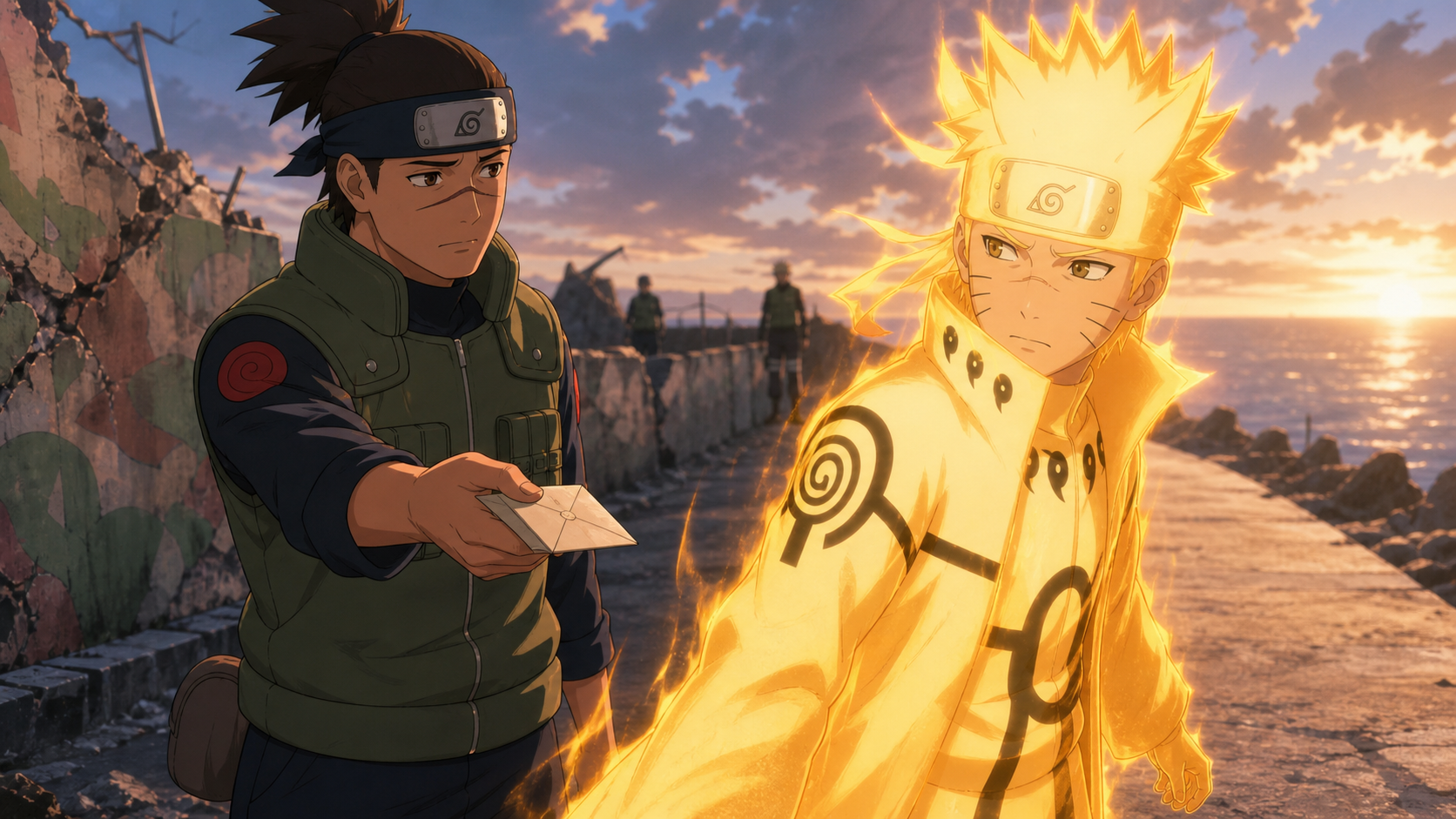
A Message from the Heart
Naruto senses the war through Kinkaku’s chakra, confronts the lie that kept him isolated, and leaves carrying Iruka’s fear, faith, and demand to return alive.
Bottom line
“A Message from the Heart” ends the alliance’s plan to protect Naruto through deception. Naruto senses Kinkaku’s Nine-Tails chakra, checks the story he was given, and realizes his friends entered a war while commanders kept him busy on an island. Iruka tries to stop him because Iruka genuinely wants him alive. Naruto leaves because love cannot require him to surrender every decision about his own life. The episode works because neither side becomes a villain. Protection and trust finally collide where a lie can no longer hold.
Kinkaku’s chakra reaches the island
Naruto’s Chakra Mode training gives him a sensitivity the alliance did not fully account for. Kinkaku carried Nine-Tails chakra after surviving inside Kurama, and that energy becomes a signal Naruto can recognize across the battlefield. The discovery is not random intuition. A specific chakra relationship pierces the isolation plan. The alliance built secrecy around physical distance and controlled information, but power changed Naruto’s access to evidence.
The official record confirms the break
The Naruto official site catalogs the story as overall animated episode 495. Crunchyroll lists “A Message from the Heart” as Shippuden Episode 275 and records an August 16, 2012 release. Both summaries begin with Naruto sensing Nine-Tails chakra from Kinkaku while training. That shared fact matters because Naruto does not abandon the island from boredom or ego. The containment story fails when the outside war produces evidence his own body can read.
The animal survey story was always fragile
Naruto was told that his island work involved an important ecological survey. The explanation depended on limiting who could speak, what Naruto could sense, and how long the war could remain outside his awareness. That is too many moving parts for a lie meant to contain one of the most observant emotional fighters in the alliance. Naruto may miss paperwork and political hints, but he notices fear, hesitation, and chakra. The cover story underestimated the kind of intelligence he actually uses.
Protection without consent becomes confinement
The alliance has a strong tactical reason to hide Naruto and Killer B. Akatsuki needs the Eight-Tails and Nine-Tails to complete the larger plan. Keeping both jinchūriki away from enemy hands protects entire nations. Tactical logic does not erase the personal cost. Naruto’s body, power, friendships, and political importance become resources managed by commanders who do not tell him the truth. Safety becomes confinement when the protected person receives no meaningful choice.
Naruto’s anger is not childish ingratitude
Naruto understands that people fear losing him. He also understands what happens when friends fight and die while he remains deliberately uninformed. His anger comes from exclusion and responsibility, not a simple desire for action. He spent his life demanding recognition as a village member. The alliance now recognizes his power so completely that leaders treat him as an asset too valuable to consult. That contradiction would infuriate anyone.
Iruka stands at the emotional checkpoint
Iruka is the right person to meet Naruto because their relationship began before Naruto had status, medals, or world-saving power. He knew the lonely child behind the village’s fear and became one of the first adults to affirm Naruto’s personhood. That history gives his request weight. Command cannot replace trust with a generic guard. Iruka can ask Naruto to stay because Naruto knows the request comes from love rather than contempt.
Love does not make Iruka’s order fair
Iruka’s motives are sincere. He wants Naruto alive and understands the catastrophic risk of capture. Sincerity does not automatically make the containment honest. Iruka participates in a plan that withholds information from someone directly affected by the decision. The episode lets his care remain real without turning care into moral permission. A trusted adult can make a controlling choice for understandable reasons and still owe the younger person the truth.
Naruto reads Iruka’s face before the explanation
Naruto has spent years studying how people behave around information they do not want to share. He recognizes pauses, guarded wording, and emotional strain. That social reading matters as much as chakra sensing. The boy dismissed as inattentive became an expert in belonging because exclusion forced him to notice every sign of acceptance or rejection. Iruka cannot sell the cover story once Naruto sees that his teacher is afraid of what the truth will make him do.
The forehead protector carries chosen belonging
Iruka’s earlier gift of recognition remains tied to the Leaf forehead protector and Naruto’s identity as a shinobi. The current conflict exposes the tension inside that belonging. The village cannot celebrate Naruto as a ninja when his power saves everyone, then reduce him to protected cargo when his judgment becomes inconvenient. Wearing the symbol means accepting obligations, but obligations should run both directions. The institution owes Naruto honest participation in decisions about his deployment.
A written message succeeds where an order fails
Iruka’s message communicates fear, faith, and a demand that Naruto return alive. Writing allows him to say what the checkpoint confrontation cannot hold cleanly. The message does not physically stop Naruto. The message travels with him and places survival beside duty. That difference respects agency. Iruka cannot choose Naruto’s route, but he can make sure Naruto carries the knowledge that somebody expects him to come home.
Naruto needs restraint more than permission theater
The episode does not argue that Naruto should charge into every danger because his heart feels strongly. He still needs information, allies, and a plan. The failure lies in replacing those supports with deception. If commanders believe Naruto’s judgment is incomplete, they should explain the risk and establish conditions for participation. Pretending he is collecting animal data avoids the difficult work of negotiating with a powerful young person who may disagree.
Killer B understands the jinchūriki problem
Killer B knows what happens when villages define a person through the tailed beast inside him. He also understands the strategic danger more deeply than ordinary guards because Akatsuki targeted him directly. His presence keeps Naruto’s decision from becoming a lonely escape. B can challenge, accompany, and help manage the risk while respecting Naruto as another jinchūriki. Peer support works differently from surveillance because both people share the burden commanders are trying to contain.
The barrier becomes a test of political trust
Island security is designed to prevent the jinchūriki from leaving unnoticed. Once Naruto knows about the war, every guard and barrier must answer a political question: does the alliance trust the person whose power anchors its survival? Physical restraint may delay him, but force would confirm that leaders value the Nine-Tails more than Naruto’s citizenship. The episode wisely keeps the conflict focused on relationships before turning the island into a prison break.
Naruto’s sensory growth changes command reality
Chakra Mode does more than raise Naruto’s combat numbers. Sensory reach makes information control harder. Command structures often rely on deciding who knows what and when. Naruto can now detect pieces of the battlefield without waiting for a report. That ability requires a new relationship with leadership. Secrecy strategies built for the earlier Naruto cannot survive the current Naruto. Institutions must update when the people inside them gain new knowledge and capacity.
Kurama’s chakra creates connection before partnership
Naruto and Kurama have not yet built the partnership they will later share. Naruto still uses chakra taken through force, and Kurama remains hostile. Even so, Nine-Tails chakra connects Naruto to Kinkaku’s battlefield presence. The same power feared as a source of isolation becomes evidence linking him to events beyond the island. That irony prepares the story for a broader change. Naruto cannot master the war through extraction alone, just as the alliance cannot protect him through control alone.
The alliance’s fear is justified and incomplete
If Naruto is captured, the cost could be catastrophic. Obito’s plan depends on the tailed beasts, and the enemy has already shown the ability to infiltrate, manipulate, and overwhelm major forces. Commanders are not inventing danger to assert authority. Their mistake is treating risk as the only fact that matters. Naruto’s relationships, combat ability, moral commitment, and right to understand the war also belong in the decision. Good policy must hold more than the worst-case scenario.
Iruka releases control without releasing concern
Iruka’s emotional success comes from changing the form of his protection. He cannot guarantee Naruto’s safety by keeping him ignorant. He can tell Naruto the truth, ask him to remember the people waiting, and trust the student he helped raise. Letting go does not mean caring less. Letting go means accepting that another person’s adulthood limits how much love may decide on that person’s behalf.
Naruto carries the village instead of obeying the village
Naruto’s idea of loyalty has never been simple obedience. He argues with leaders, breaks procedure, and pursues people institutions have written off. Those choices can be reckless, but they also define why others trust him. He carries the village as a network of people rather than a command chain. Learning that those people are fighting without him activates the same responsibility that once sent him after Sasuke, Gaara, and Pain.
A message from the heart still needs facts
Emotion gives the episode its title, but emotion does not replace information. Naruto’s decision becomes legitimate because he senses Kinkaku, identifies deception, confronts Iruka, and learns the war is real. Iruka’s letter matters because the factual conflict has already been exposed. A heartfelt message cannot repair manipulation while the lie continues. The episode earns sentiment by allowing truth to arrive first.
The departure changes the war’s center
Once Naruto leaves isolation, the alliance must reorganize around an active jinchūriki rather than a hidden objective. The enemy gains an opportunity, but the alliance gains Naruto’s clones, sensory reach, morale, and ability to identify hostile chakra. Command loses control and gains capacity at the same time. That tradeoff drives the next phase of the war. Naruto’s participation creates risk because meaningful participation always changes who can make decisions.
The episode makes adulthood a negotiation
Naruto is still young enough that Iruka’s protective instinct makes emotional sense, yet Naruto has carried responsibilities many adults avoided or could not survive. Age, power, experience, and legal authority do not line up neatly. The episode does not solve that mismatch through a birthday or rank. Naruto claims greater agency by gathering evidence, confronting the person he trusts, hearing the danger, and accepting responsibility for the choice to leave. Iruka recognizes adulthood by changing from jailer to witness. Their disagreement becomes a negotiation between people who love each other, not a test where one person must stop caring for the other person to become free.
The lie fails because Naruto’s body gains access to evidence
Naruto’s new sensory reach defeats a cover story designed for his earlier limits. Kinkaku’s chakra supplies evidence command cannot filter, and Naruto combines that signal with the fear around him. The body treated as secrecy’s justification becomes the instrument exposing the lie that confines it.
An ecological survey turns Naruto’s willingness to help against him
The cover story works only because Naruto accepts strange work when people say the work matters. His eagerness to contribute becomes a tool for keeping him occupied while everyone else enters danger.
That manipulation is easy to soften because the goal is survival. It remains manipulation. Leaders do not merely withhold a battlefield detail. They invent a civic duty and let Naruto perform it sincerely. Protection borrows his trust, spends it, and assumes the account can be settled after the war.
Strategic necessity does not erase the debt created by deception
Obito needs the jinchūriki. Hiding Naruto and B protects millions of lives. Those facts make the decision defensible under emergency conditions and make honest consultation harder, not irrelevant.
The alliance owes Naruto an explanation because his body, relationships, and citizenship are directly involved. A grave risk can justify temporary secrecy without turning secrecy into moral cleanliness. Once he discovers the truth, commanders must answer the betrayal as well as the strategy.
Naruto is valued as a savior and managed as cargo
Konoha celebrates his decisions when they save the village, then the alliance removes him from decision-making when the same independence threatens its plan. Recognition remains conditional on whether his agency produces the answer leaders already want.
That contradiction reaches back to childhood. The village feared the power inside Naruto while ignoring the child carrying it. Now leaders honor the person and still organize around the asset. Better intentions do not automatically prevent the old category from returning.
Iruka’s history makes the checkpoint honest and dangerous
Naruto cannot dismiss him as a guard following orders. Iruka knew him before reputation, believed him before victory, and became family through repeated ordinary attention. That history gives every request enormous weight.
It also creates the risk that love will be used as the final lock. If Naruto stays only because disappointing Iruka feels unbearable, the alliance has replaced a physical barrier with emotional leverage. Their bond deserves better than becoming the most effective restraint available.
Iruka can be loving and wrong in the same scene
His fear is earned. Naruto has a history of entering impossible danger and treating his own body as the price of keeping a promise. Asking him to remain safe is not cowardice or disrespect.
Participating in the lie is still wrong. The episode succeeds because correction does not require exposing a secret cruelty beneath Iruka’s care. Good people can make controlling choices when terror narrows their imagination. Love needs accountability precisely because sincerity can make overreach feel righteous.
The letter changes protection from prevention into accompaniment
Iruka cannot guarantee Naruto will remain on the island. The written message stops trying to control the route and begins shaping how Naruto carries it. Come back alive. Remember the people waiting. Do not confuse duty with disposability.
That form respects agency without pretending concern vanished. Iruka’s words travel beside Naruto rather than standing across the road. Protection becomes relationship: advice, expectation, and a claim on the future that Naruto remains free to answer through his own decisions.
Returning alive is the harder promise for Naruto
Charging toward friends fits every heroic instinct he has practiced. Accepting that those friends need him to survive asks for a different discipline. Naruto often proves sincerity through exhaustion, injury, and willingness to die.
Iruka’s message refuses death as the most convincing evidence of love. Saving people is not complete if Naruto treats himself as the one person nobody must save. Coming home places his body inside the community he wants to protect instead of offering it outside the count.
Killer B offers solidarity that surveillance cannot imitate
B understands the strategic danger and the humiliation of being defined through a tailed beast. He can disagree with Naruto without pretending the burden belongs only to headquarters.
Shared experience changes the power relationship. B accompanies rather than monitors. He has enough knowledge to warn and enough respect to let Naruto answer. Peer support does not make their departure safe. It makes the risk something discussed between participants instead of imposed on a protected object.
The alliance must update its plan when Naruto changes
New sensory reach, chakra control, clones, and battlefield judgment alter what hiding him costs and what deploying him offers. Continuing the old plan because it was once reasonable would turn strategy into attachment to authority.
Institutions often demand individuals prove growth while refusing to revise the category assigned to them. Naruto’s development forces command to confront that habit. A plan centered on his earlier limits cannot remain sound after those limits move.
Agency does not mean Naruto’s answer is automatically correct
Leaving the island could hand Obito the target he needs. Naruto’s right to participate does not guarantee every choice he makes will be wise. Consent is not a magical defense against consequences.
The point is that consequences cannot be evaluated honestly while he is denied facts. Agency creates responsibility rather than removing it. Naruto must listen, coordinate, accept limits, and carry the danger of his decision. Command must stop calling obedience the only evidence that he understands the stakes.
The message works because truth arrives before sentiment
A heartfelt letter cannot repair manipulation if the cover story continues. Naruto first recognizes the chakra, confronts the contradiction, and learns the war exists. Only then can Iruka’s emotion become relationship rather than distraction.
The sequence keeps the title honest. Feeling does not replace facts. The message matters because both people now know what they disagree about. Love survives the argument by speaking inside reality instead of asking Naruto to return to the comforting lie.
RaeRae’s verdict
“A Message from the Heart” understands that protection becomes unhealthy when love refuses to update its image of the protected person. Iruka sees the child he once saved and the shinobi now capable of changing the war. He wants to hold both, but only one can choose the next step. Naruto leaves with Iruka’s fear and faith instead of leaving against an empty order. That is not perfect military procedure. That is an honest relationship surviving disagreement.
RaeRae’s call
Iruka cannot keep Naruto safe by keeping him small. The letter matters because protection changes from confinement into accompaniment: tell the truth, name the fear, demand his return, and let the person loved choose the road.
Episode details and viewing routes
- Official episode reference: Naruto Official episode guide
- Licensed episode route: Crunchyroll licensed episode page
Next on the road
Episode 276, “Attack of the Gedō Statue,” shows why commanders feared escalation. Obito enters the battlefield, summons the massive statue tied to the tailed beasts, and turns an alliance advantage into immediate devastation. Naruto’s decision to join the war now sits beside proof that the enemy can change the scale of violence without warning.