
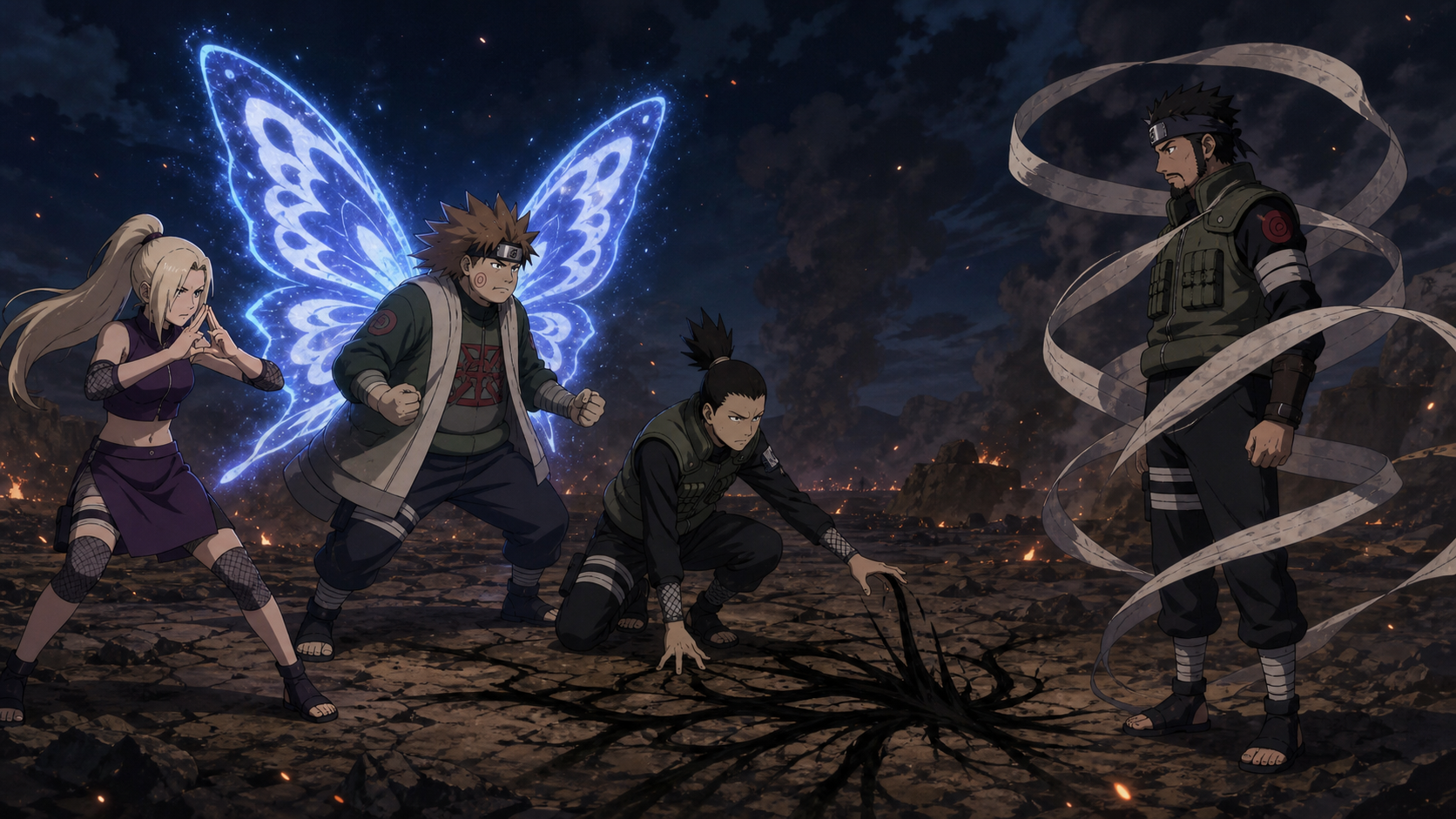
The Complete Ino-Shika-Chō Formation!
Chōji stops asking grief for permission, and Team 10 completes the formation Asuma trained them to use when the cost became personal.
Bottom line
“The Complete Ino-Shika-Chō Formation!” gives Chōji power only after the episode stops treating his kindness as a defect that needs to be beaten out of him. Chōza, Ino, Shikamaru, and Asuma all push him toward action, but the breakthrough comes when Chōji understands what his strength is for. He does not become useful by turning cruel. He becomes dangerous to Kabuto because compassion finally includes protecting the living, honoring Asuma’s consent, and accepting his own place in the formation.
Chōji begins where the last episode left him
Chōji still cannot strike Asuma. The delay matters because emotional understanding rarely becomes physical action on schedule. He knows the reanimated body is being controlled. He knows Ino and Shikamaru need him. His muscles continue obeying the older rule that hurting a loved person makes him bad. The episode lets that rule create consequences instead of resolving the crisis through one speech. Every second of hesitation makes the formation weaker and gives Kabuto more room to use Asuma’s techniques.
The official record names the missing piece
The Naruto official site catalogs the installment as overall animated episode 494, while Crunchyroll lists the same story as Shippuden Episode 274 and records an August 9, 2012 release. Both summaries identify Chōji’s paralysis and Ino and Shikamaru’s attempt to pull him back into the fight. The title promises a complete formation, which means the episode cannot settle for two teammates compensating forever. Chōji must choose to occupy the role that belongs to him.
Ino covers more than one body
Ino’s technique becomes a battlefield bridge while the team is incomplete. She watches Asuma, helps protect Chōji, and coordinates with Shikamaru under pressure. Her job requires attention to multiple people whose bodies and decisions do not move at the same speed. The episode makes that labor visible. Ino is not waiting for the boys to resolve the emotional plot. She actively keeps the formation alive long enough for Chōji to return.
Shikamaru cannot strategize around a permanent absence
Shikamaru improvises because improvisation is his gift, but the inherited formation was designed around three techniques. Shadow restraint can create an opening. Mind transfer can disrupt control. Neither technique supplies Chōji’s physical force or reach. Shikamaru’s frustration comes from tactical reality and personal trust. He believes Chōji can act because their entire childhood proved that Chōji will step forward when somebody he loves faces danger. The current freeze contradicts the friend Shikamaru knows, not merely the plan he drew.
Asuma attacks the excuse, not Chōji’s worth
Asuma uses sharp words because Kabuto is forcing the encounter forward and gentler time has run out. The risk is obvious. Chōji has always been vulnerable to insults about his body, and careless pressure could deepen the shame causing the paralysis. Asuma’s real message is more specific: Chōji already has the power and has chosen not to use that power. The teacher wants him to stop confusing avoidance with goodness.
Body shame is not a motivational tool
The series has often used Chōji’s weight as a joke or trigger. That history deserves criticism even when his anger produces spectacular strength. A person should not need humiliation to access courage. This episode works best when the word “fat” is understood as a sore point Asuma knows will break through the freeze, not as proof that cruelty was secretly healthy coaching. Chōji’s value comes from loyalty, judgment, technique, endurance, and care. His body is not a failed draft awaiting punishment.
Chōza arrives as a father and commander
Chōza understands the Akimichi techniques and the child using them. He does not promise that the fight can stay emotionally clean. He reminds Chōji that kindness without courage cannot protect anyone. The intervention carries family history because the Akimichi clan’s physical expansion has always made the body publicly visible. Chōza knows his son’s sensitivity and still expects responsibility. Loving Chōji means refusing to let fear define the limit of what Chōji can do.
The butterfly needs no pill this time
During the Sasuke retrieval mission, Chōji used the Akimichi clan’s Three Colored Pills to force power beyond his normal limit and nearly died from the cost. Here, butterfly chakra emerges without that chemical shortcut. The change shows technical growth and a different relationship with his own body. Chōji no longer needs self-destruction to prove commitment. Training, maturity, and emotional clarity let him access power that once demanded a lethal gamble.
Growth should reduce the cost of competence
Anime often treats greater sacrifice as automatic proof of greater feeling. Chōji’s progress offers a better model. His strongest commitment does not require repeating the damage from his childhood battle. Competence can mean learning how to produce the needed result with less harm to the user and the team. The butterfly form remains costly, but the absence of the pills matters. Chōji has not become serious by becoming disposable.
The wings make an internal choice visible
Chōji’s chakra wings are beautiful because the visual arrives after an ugly emotional struggle. The wings do not erase his fear. They show that fear no longer controls the next action. Butterfly imagery also suits a character whose body has been treated as fixed evidence of laziness or comic excess. Transformation does not make him worthy for the first time. Transformation makes visible the strength Asuma, Shikamaru, Ino, and Chōza already recognized.
Chōji’s size stops being the joke
When Chōji expands, the same body other characters mocked becomes protection, reach, and force. The episode does not need to claim that every insult secretly helped him. The stronger point is that the ridicule misunderstood him. Chōji’s body supports a clan technique built around controlled mass and converted calories. His skill requires knowledge, stamina, and timing. The battlefield finally frames that reality without reducing the result to appetite.
The formation is inherited, not copied
Ino-Shika-Chō has passed through their clans for generations. Inheritance can become empty performance if each generation merely repeats names and poses. The younger trio completes the formation by adapting their parents’ system to their own relationships. Shikamaru’s planning carries his personality. Ino’s attention carries hers. Chōji’s protective force carries his. Tradition survives because living people make decisions inside the structure, not because children disappear behind family labels.
Their answer also depends on trust built during ordinary missions, not only inherited clan technique. Each teammate moves before receiving a complete explanation because the other two have already proved how they think under pressure. Years of irritation, meals, mistakes, and recovery become coordination when hesitation carries a body count.
Shikamaru creates the opening
Shikamaru’s shadow technique controls Asuma’s movement long enough for the others to act. The restraint cannot finish the fight alone, and the episode does not pretend otherwise. Shikamaru’s contribution is timing and shape. He turns a dangerous opponent into a solvable position. That work may look less dramatic than chakra wings, but the final strike would fail without the restraint. A complete formation depends on the person whose technique makes another person’s power safe to use.
Ino crosses the most dangerous distance
Mind Body Switch asks Ino to send her consciousness toward a target while her own body becomes vulnerable. Against reanimated fighters and battlefield chaos, that exposure is not a decorative support move. She trusts Shikamaru and Chōji to protect the body she leaves behind and to act during the opening she creates. Ino’s courage is quiet because the animation cannot make a missing consciousness as visually large as butterfly wings. The risk remains real.
Chōji supplies force without owning the victory
Chōji’s transformed attack becomes the memorable image, but the episode title names the formation rather than one hero. Shikamaru restrains, Ino disrupts, Chōji strikes, alliance fighters contain the area, and sealing specialists prepare the final answer. No single person performs every job. That division of labor matches the strongest Naruto battles, where power matters most when somebody else creates the conditions that let power land without destroying the wrong people.
Asuma coaches through the forced fight
Asuma continues giving his students information and emotional direction even while Kabuto pushes his body against them. The choice is a form of resistance. He cannot stop every movement, so he reduces the harm by helping Team 10 predict and counter him. His pride becomes visible as the trio regains its shape. The teacher’s final evaluation is not based on whether his students protect him. He judges whether they can protect one another.
Sealing is the respectful ending
The alliance cannot kill an Edo Tensei body through ordinary damage. The goal is restraint and sealing, not revenge. That mechanic supports the episode’s emotional argument. Team 10 does not need to hate Asuma or destroy his worth to stop the danger. They need to separate his personhood from Kabuto’s access to his body. Sealing becomes a boundary that honors Asuma’s expressed wish while denying the controller further use.
Asuma gets to say goodbye without a repeat funeral
Team 10 already survived Asuma’s death and funeral. The reanimated encounter threatens to reopen mourning as though their earlier grief accomplished nothing. The episode avoids a complete reset by letting their growth shape the second farewell. Shikamaru, Ino, and Chōji are no longer the children who first heard Asuma’s last words. They can answer him through coordinated action. The pain returns, but the relationship has moved forward.
Chōji’s promise is too large and still meaningful
Chōji declares that he will help end the war. The promise sounds enormous after a fight where he could barely move. That scale reflects relief, confidence, and a young person’s urge to make the breakthrough permanent. He cannot end the war alone, and the episode should not be read as claiming otherwise. The useful part is his willingness to stop withholding strength from the collective effort. Confidence becomes accountable when that confidence returns him to the team rather than placing him above the team.
Kindness becomes an active skill
The two-episode conflict changes Chōji’s definition of kindness. Care includes noticing pain, refusing needless cruelty, and preserving another person’s dignity. Care also includes interrupting harm, respecting consent, and accepting that a necessary boundary may hurt. Chōji keeps his softness after learning that lesson. He does not become a colder fighter. He becomes a person whose gentleness can survive contact with responsibility.
The episode earns the transformation
Power-up episodes often rush emotional material because the new form is the product viewers remember. “The Complete Ino-Shika-Chō Formation!” spends enough time on Chōji’s paralysis that the wings feel connected to a choice rather than a merchandise reveal. The pacing may frustrate viewers who wanted immediate action, but the delay gives the transformation moral weight. Chōji must decide what kind of person will use the power before the episode lets him display that power.
The formation becomes complete when Chōji chooses his place
Clan inheritance can provide names, techniques, and an expected order. It cannot make the current Chōji participate. Ino and Shikamaru can cover his absence temporarily, but completion requires consent from the person carrying the Akimichi role.
That is why the breakthrough matters beyond power. Chōji stops treating his position as a burden other people assigned and claims it as work he wants to do for them. The inherited shape becomes his formation only when he decides what his strength protects.
Chōza refuses to confuse gentleness with fragility
A frightened parent might remove Chōji from the encounter or demand hardness as the price of staying. Chōza does neither. He knows his son’s softness is part of the person worth protecting and part of what makes the clan’s physical power safe in Chōji’s hands.
His challenge joins kindness to courage. Feeling another person’s pain cannot end the moral calculation when friends remain exposed. Chōza expects action because he respects Chōji’s heart, not because he wants that heart replaced by a more convenient fighter’s numbness.
The butterfly form rejects self-destruction as proof
During the retrieval mission, Chōji nearly died after using the Three Colored Pills. The sacrifice established commitment, but it also taught a child that his body might need to be spent before others believed his seriousness.
Accessing butterfly chakra without the pills changes the lesson. Training and maturity reduce the price. Chōji does not love his friends less because competence makes survival more likely. Growth should let people protect one another without repeatedly offering themselves as disposable evidence.
Transformation reveals strength without creating worth
The wings are beautiful, and the body once framed as a joke becomes the largest protective presence on the field. It would be easy to treat the image as the moment Chōji finally becomes worthy.
Asuma, Shikamaru, Ino, and Chōza recognized his value before the light appeared. The transformation corrects the audience’s judgment, not Chōji’s body.
Ino holds the emotional formation before the techniques align
She guards Chōji’s vulnerable body, watches Asuma, reads Shikamaru’s timing, and keeps speaking into a grief nobody can resolve for him. Her labor is tactical and relational at once.
The story often calls such work support, as though support happens after the real action. Without Ino, there is no stable interval in which Chōji can return. She protects the team’s physical survival and its ability to remain a team while one member temporarily cannot carry himself.
Shikamaru designs a plan that depends on other people’s excellence
His intelligence does not make teammates interchangeable pieces. The strategy works because he understands the precise range, timing, courage, and judgment of the two people beside him.
That dependence is not a weakness in the plan. It is the plan. Shikamaru creates the solvable position and trusts Ino and Chōji to complete actions he cannot perform. Genius becomes relational when it gives other people indispensable work instead of turning them into decoration around one mind.
Asuma’s instruction survives by becoming independent of Asuma
A teacher who needs students to obey his living voice forever has not prepared them for adulthood. Reanimation literalizes the problem by returning Asuma’s voice inside a body they must oppose.
Team 10 honors him when they use his lessons against his controlled movement. They can distinguish the principles he taught from the commands Kabuto forces through him. The education becomes complete when the students protect his purpose without protecting his authority from challenge.
Mind, shadow, and body share the risk in sequence
Shikamaru restricts movement, Ino crosses into consciousness, and Chōji supplies force. Each technique creates a vulnerability the other two must guard. No member becomes the safe observer of someone else’s courage.
The interlocking danger explains why years of ordinary trust matter. They move before complete reassurance because the window will close. Familiarity lets one person’s limit become another person’s cue rather than a reason to assign blame.
Sealing Asuma is a boundary drawn with love
Ordinary damage would regenerate. Revenge would misunderstand the person being hit. The sealing team offers a third meaning: stop Kabuto’s access and let Asuma’s soul leave the violence being committed through his body.
The boundary hurts because love remains. That pain does not make it cruel. Asuma has asked them to act, and the living remain in danger. Team 10 respects both truths by ending the use without pretending the body in front of them deserves hatred.
The second goodbye measures growth without canceling grief
Shikamaru, Ino, and Chōji already mourned at a funeral. Kabuto forces them into another farewell as though healing made the relationship available for reuse.
The pain returns, but the students do not return to their earlier selves. They coordinate, correct one another, and answer Asuma through decisions he no longer makes for them. Growth does not mean grief disappears. It means grief no longer erases every skill and relationship built since the first loss.
Chōji’s promise becomes credible only inside the team
Saying he will help end the war risks turning one breakthrough into heroic inflation. Chōji cannot carry every front, and confidence should not recreate the isolation he just escaped.
The promise works as a commitment to stop withholding himself from collective labor. His strength joins people with different limits and tasks. He does not become the whole answer because the wings are large. He becomes available to the answer the alliance is building together.
True kindness and complete formation name the same decision
Episode 273 asks whether care can draw a painful boundary. Episode 274 shows the boundary becoming coordinated action. Chōji keeps his gentleness and enters the strike; Ino and Shikamaru keep faith in him without pretending his delay caused no danger.
The formation completes when compassion, accountability, and technique stop competing. Nobody has to become cruel. Everyone has to accept that love carries obligations beyond preserving the feeling of being loving.
RaeRae’s verdict
“The Complete Ino-Shika-Chō Formation!” gives Chōji one of his strongest Shippuden moments because his victory does not require abandoning the trait people dismiss. He remains tender, easily hurt, loyal, and deeply concerned about causing pain. Chōza, Ino, Shikamaru, and Asuma help him recognize that those qualities need courage and boundaries. The butterfly form looks spectacular. The real growth is Chōji accepting that compassion can throw the punch Asuma asked him to throw.
RaeRae’s call
The butterfly form is not Chōji’s worth arriving. It is Chōji choosing how the worth his people already saw will act. Team 10 becomes complete because mind, shadow, and body accept dependence without asking kindness to disappear.
Episode details and viewing routes
- Official episode reference: Naruto Official episode guide
- Licensed episode route: Crunchyroll licensed episode page
Next on the road
Episode 275, “A Message from the Heart,” shifts back to Naruto’s isolation. Naruto senses Kinkaku’s Nine-Tails chakra beyond the island and begins testing the explanations meant to keep him away from the war. The alliance must decide whether protection still counts as protection after the protected person discovers the lie holding the plan together.