
The Artist Returns
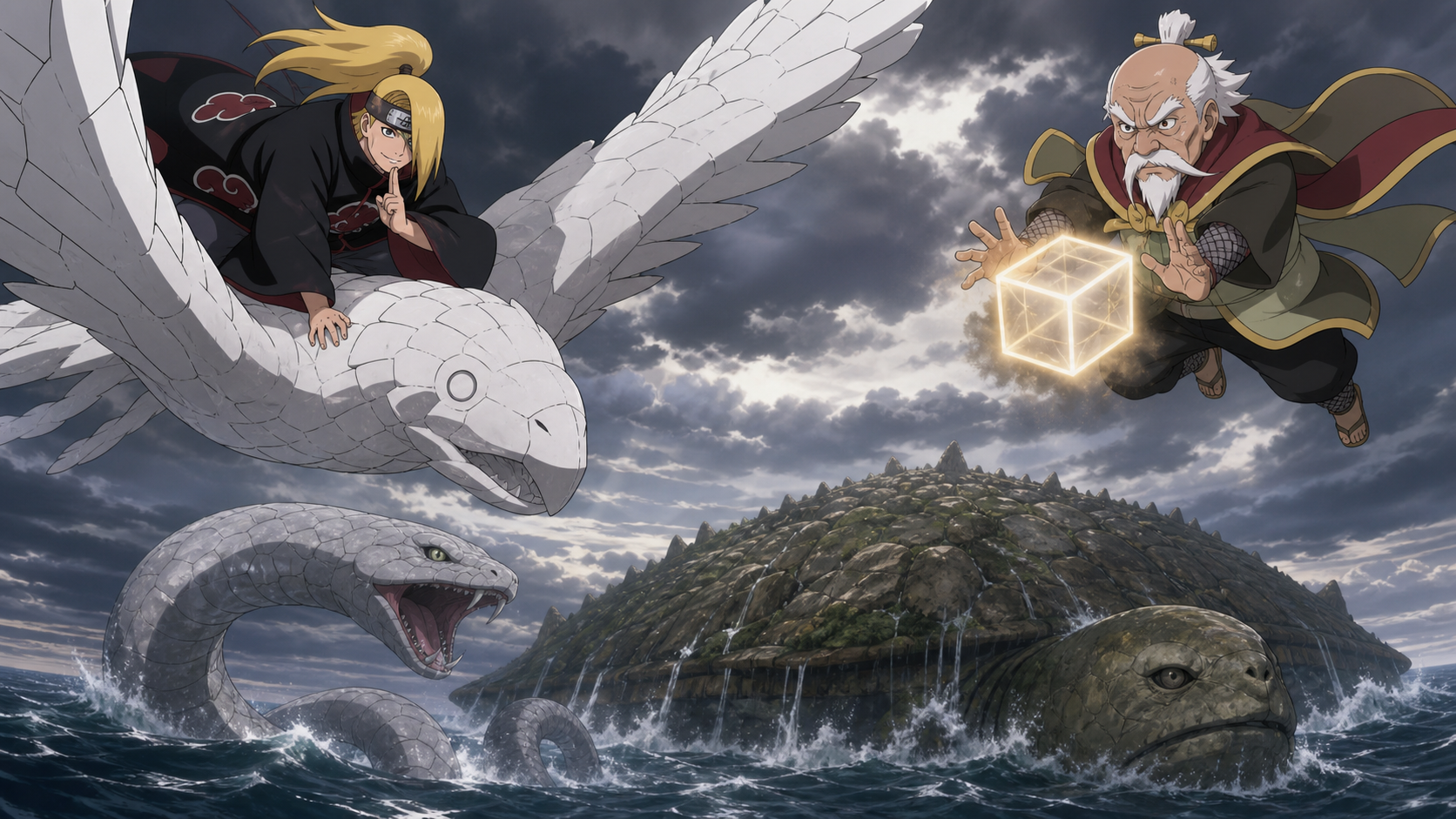
Deidara fights Onoki above the ocean while Kabuto attacks the living island below and turns Yamato into the mission’s real prize.
Bottom line
Naruto Shippuden Episode 255 turns Kabuto's attack on the living island into a demonstration of how thoroughly he treats bodies as tools. Deidara has his voice, memories, and ego, but Kabuto controls where the reanimated artist flies and when the fight ends. Manda II exists because Kabuto wanted a stronger replacement for a dead summon. Yamato survives his capture only because Kabuto believes Wood Release can make the White Zetsu army more useful.
The title promises Deidara's return, and the aerial fight with Ōnoki gives the episode spectacle. Kabuto remains the person directing the whole operation. He uses Deidara to hold the Tsuchikage's attention, sends Manda II beneath the ocean, flips an island that everyone thought was safely hidden, and leaves with a prisoner whose value becomes worse the longer anyone thinks about the coming war.
Naruto and Killer B remain protected, but the alliance still loses. Yamato is not a consolation prize. His knowledge, Wood Release, and connection to Hashirama's cells can strengthen an enemy army built from copied bodies. Episode 255 makes the rescue look successful for a moment, then reveals how cheaply Kabuto can redefine success.
Deidara returns without receiving his life back
Deidara arrives talking like Deidara. He still argues about art, resents Ōnoki, and wants control over the fight. Those familiar traits make his return entertaining, but they also make Impure World Reincarnation uglier. Kabuto did not restore a person. He restored a personality inside a body that must obey him.
The distinction becomes clearest when Deidara protests Kabuto's retreat order. Deidara wants to continue proving his explosive art against the Tsuchikage. Kabuto ends the confrontation because the distraction has served its purpose. Deidara's desire has no operational weight.
That loss of agency gives the episode more substance than a simple villain rematch. A dead man who once destroyed himself to control his final artistic statement now cannot decide whether his own battle continues.
Ōnoki knows exactly who he is facing
Ōnoki recognizes both Deidara's danger and the insult behind his return. Their shared history gives the aerial confrontation a personal charge before either man launches a major technique. Deidara did not appear from nowhere as another Akatsuki weapon. He came from the Hidden Stone, rejected its expectations, and built his identity around art that Ōnoki never respected.
Kurotsuchi's almost casual greeting makes the reunion even stranger. Her familiarity clashes with the fact that Deidara is dead and currently attacking them. Akatsuchi needs the explanation that Orochimaru's forbidden reincarnation technique has brought him back. The scene lets family-like village recognition sit beside immediate military danger.
Ōnoki responds with experience instead of disbelief. His rock clone absorbs Deidara's opening explosion while the real team remains clear. Age has not made the Tsuchikage passive. Ōnoki understands that surviving Deidara starts with refusing the obvious target.
The aerial duel is loud because Kabuto needs eyes pointed upward
Deidara's clay bird, explosive attacks, and argument with Ōnoki dominate the sky. The spectacle invites everyone on and around the island to treat the returning artist as the main threat. Kabuto benefits from that assumption.
The actual infiltration travels beneath the water. Manda II searches where aerial defenders cannot easily see, kills the giant squid guarding the island, and attacks the turtle directly. Kabuto uses vertical space as strategy: noise above, discovery below, and a target hidden inside a moving ecosystem.
The episode's direction sells the misdirection by cutting between the personal duel and the serpent's progress. Deidara does not need to defeat Ōnoki. He only needs to keep a Kage busy long enough for Kabuto to reach the island.
Manda II is another life engineered for somebody else's plan
Manda II resembles the original giant snake, but Kabuto describes the new summon as a genetically altered clone made stronger than the first. The upgrade sounds clinical. A living creature has been designed around usefulness, then sent into an ocean battle against another living creature.
The giant squid dies because the island's first defensive layer cannot match Kabuto's experiment. Manda II then bites the turtle and helps overturn the entire island. Scale becomes part of the horror. Kabuto can injure landscapes because the landscape itself has a body.
Manda II also extends the episode's concern with control. Deidara is a dead person forced into service. The serpent is a copied creature built for service. Yamato will soon become a captured person valued for what Kabuto can extract from his body.
Flipping the island destroys the illusion of a stable refuge
The alliance chose the living island because secrecy and mobility offered protection. Episode 254 showed leaders moving that refuge after Kisame's intelligence escaped. Episode 255 answers with an enemy capable of locating and physically overturning the refuge anyway.
Naruto's fake ecological mission becomes darkly funny again when the animals and terrain suddenly tumble. He believes the disruption belongs to the survey assignment rather than an enemy assault. The lie remains functional even while the hiding place is under direct attack.
The island's movement also reminds the audience that the setting is not ordinary ground. Every defensive decision affects a giant turtle and the many animals living on its shell. Shinobi strategy keeps treating the creature as a vehicle, base, and shield before treating the creature as a life placed in danger.
Naruto's protection depends on keeping him confused
Naruto remains committed to the fake mission while explosions and violent motion surround him. The alliance's deception survives because he trusts his assignment and assumes his allies would tell him if the danger concerned him.
That trust saves operational secrecy for another day. The same trust prevents Naruto from responding when Yamato is taken. Naruto has trained under Yamato, depended on Yamato's Wood Release to restrain Kurama's chakra, and shared dangerous missions with him. Nobody lets Naruto know that relationship is being used against both men.
The episode does not pause for Naruto to question the story yet. That delay is the point. Every minute of protection increases the number of choices other people make on his behalf.
Kurotsuchi nearly closes the trap
Kurotsuchi moves from the aerial confrontation to Kabuto with the confidence of someone who understands that the visible fight may not be the whole mission. Her quicklime technique creates a practical capture route rather than another contest of enormous destructive power.
Yamato follows with Wood Release, and the group appears to have Kabuto contained. The combination works because different villages and skill sets cooperate: Stone restrains movement, Leaf adds control, and the defenders close around the intruder.
For a brief moment, the alliance's structure works exactly as promised. The problem is Kabuto's body no longer obeys normal capture assumptions.
Kabuto turns escape into body horror
Kabuto sheds his outer body and slips from the restraint in serpent form. The escape carries Orochimaru's influence without reducing Kabuto to an imitation. He has taken the methods that once made his former master disturbing and rebuilt them around his own ambitions.
The maneuver also punishes defenders for treating a captured shape as a captured person. Kurotsuchi and Yamato secure what appears to be Kabuto's body. Kabuto abandons that surface, redirects Aoba into the trap, and reaches Yamato before the group can understand the switch.
The sequence is efficient and nasty. Kabuto does not overpower everyone through a longer fight. He exploits one moment of confidence and converts a successful restraint into an opening.
Yamato becomes the mission's real prize
Kabuto came for Naruto and Killer B, but he leaves with Yamato. Tobi initially treats that outcome as failure because neither jinchūriki was captured. Kabuto explains why the prisoner changes the calculation.
Yamato knows the alliance, Naruto, the island, and Leaf operations. More dangerously, his Wood Release comes from experimentation with Hashirama's cells. Kabuto believes that biological connection can strengthen the White Zetsu army.
The capture therefore threatens both intelligence security and military scale. Yamato is one person, but the enemy plans to turn what his body can do into power for thousands of manufactured soldiers.
Yamato's history makes the capture especially cruel
Yamato already survived being treated as research material. Orochimaru experimented on children with Hashirama's cells, and Yamato lived through a process that killed the other subjects. His Wood Release is a skill, a burden, and evidence of what adults did to his body before he could consent.
Kabuto now sees the result of that abuse as reusable infrastructure. The enemy does not need to repeat Yamato's exact childhood experiment. Kabuto can capture the survivor and extract military value from the traits forced upon him.
That history makes Yamato's loss more disturbing than the episode's pace initially allows. Capture returns him to a system descended from the same man who altered him.
Kabuto learned Orochimaru's methods and removed the remaining restraint
Orochimaru treated people as containers, experiments, and possible bodies. Kabuto inherited that worldview and added administrative precision. He manages reanimated fighters, engineered summons, stolen intelligence, biological upgrades, and negotiations with Tobi as parts of one campaign.
His confidence comes from having several acceptable outcomes. Naruto and B would be ideal captures. Yamato still gives him intelligence and a way to improve Zetsu. Deidara can be recalled and used again because death no longer ends the assignment.
That flexibility makes Kabuto dangerous before the formal war begins. Defenders must stop every route. Kabuto only needs one useful result.
Deidara and Ōnoki fight over art while Kabuto reduces both men to function
Deidara wants the duel to settle an old argument about artistic worth. Ōnoki wants to stop an enemy and confront the former Stone shinobi's destructive legacy. Both men bring history, pride, and personal meaning into the sky.
Kabuto cares about none of that. Deidara is a diversion. Ōnoki is an obstacle whose attention can be occupied. Their unresolved relationship gives the battle emotional heat, while Kabuto measures the same battle by how many minutes the exchange buys him.
The contrast explains why Deidara becomes furious when recalled. Kabuto has taken a confrontation Deidara considers art and classified the whole encounter as support work.
The Dust Release standoff shows how close the diversion comes to becoming disaster
Deidara prepares C4 while Ōnoki readies Dust Release. Both techniques can erase far more than the immediate opponent. The living island and nearby defenders make escalation especially reckless.
Kabuto ends the exchange before either side completes the worst possibility. His decision protects Deidara as a reusable asset and prevents the distraction from consuming the objective. The retreat is strategically correct even though Deidara hates the loss of control.
Ōnoki does not receive emotional closure or a clean victory. He protects the jinchūriki, but the enemy escapes with Yamato. The mission report has to hold both facts at once.
Tobi's complaint reveals how Akatsuki prices people
Tobi expects Naruto and B. When Kabuto returns with Yamato, the masked leader reacts as though a lesser item arrived. Kabuto responds by listing Yamato's uses: knowledge, guardianship of Naruto, Wood Release, and the ability to improve the White Zetsu army.
Neither man discusses Yamato as a person. The disagreement concerns value, not harm. Tobi wants the rarest weapons. Kabuto explains that this prisoner can increase the output of weapons they already possess.
Their exchange makes Akatsuki's internal alliance clear. Cooperation continues while each man can prove that his resources increase the other's chance of winning.
The White Zetsu army turns one kidnapping into mass consequence
Before Yamato's capture, the White Zetsu army already represents industrialized imitation. Thousands of near-identical bodies wait for war. Kabuto's plan to strengthen them with Yamato's Wood Release connects one prisoner's suffering to battlefield casualties across every village.
The consequence expands beyond rescuing a valued Leaf captain. Every allied shinobi may face a stronger enemy because Yamato was taken. His body becomes a supply line.
That scale also changes how the previous episode's secrecy should be judged. Protecting Naruto and B prevented a catastrophic capture. Keeping Naruto ignorant also meant one of his protectors faced the attack without Naruto's help. The story has not settled whether a different choice could have saved Yamato.
The Rinnegan reveal announces the next phase of Tobi's war
Tobi shows the Rinnegan taken from Nagato's body and says the eye is ready for war. The reveal follows Konan's death and confirms that her attempt to protect Nagato's remains failed in material terms. Tobi now wears another dead person's power.
The image fits an episode filled with stolen bodies and forced use. Deidara's corpse fights for Kabuto. Yamato's cells will serve Zetsu. Nagato's eye sits in Tobi's face. Power moves through possession, extraction, and control.
Tobi's new eye also raises the threat beyond Kabuto's successful raid. The enemy has gained a prisoner, an army upgrade, reanimated fighters, and one of the series' most dangerous visual powers before the alliance formally enters battle.
Deidara’s personality makes the captivity more visible
He sounds alive enough to argue, boast, resent Ōnoki, and demand completion of his artistic statement. Kabuto can end every one of those choices with a command. Memory and voice remain while self-determination does not.
That is worse than a silent corpse weapon. Deidara understands the indignity. A man who chose the timing and scale of his own death now has no authority over when a rematch begins, escalates, or stops.
Yamato’s capture repeats the logic of his childhood
Orochimaru’s experiment treated children as possible containers for Hashirama’s cells and discarded the many who died. Yamato survived, built a life, developed judgment, and used the imposed ability to protect other people. Kabuto looks at that entire survival story and sees an upgrade component.
The cruelty is not merely physical confinement. It is interpretive theft. Yamato turned abuse into a power he owns. Kabuto translates the same power back into laboratory inventory and plans to distribute its value through thousands of manufactured soldiers.
Kabuto wins because almost every outcome has value
Naruto and Bee are the ideal prizes. Yamato still provides intelligence, Hashirama-derived power, knowledge of Naruto, and access to the island’s defenses. Deidara can be recalled after serving as a diversion. Manda II remains useful if it survives.
Defenders must protect every person and route. Kabuto needs one extractable benefit. His strategy treats failure as salvage, which makes conventional victory dangerously comforting. The alliance keeps both jinchūriki and still loses a captain whose body can strengthen an army.
The title’s joke becomes meaner after the retreat. “The Artist Returns” suggests an encore, as if Deidara has come back because unfinished expression demanded another stage. In reality, Kabuto selected him from a catalog of dead specialists and assigned him a distraction slot. His art still explodes and his pride still fills the sky, but neither belongs fully to him while the reincarnation contract stands. Ōnoki sees a former student and village problem. Deidara sees the chance to prove his philosophy. Kabuto sees minutes purchased for an underwater raid. That reduction is the episode’s ugliest control. Edo Tensei does not erase personality because personality improves performance. It preserves enough self for talent to function, then denies that self authority over purpose. Deidara’s anger at being recalled is therefore not comic fussiness alone. It is the dead artist recognizing that his newest audience also owns the curtain and decides exactly when applause ends.
What landed
The episode handles simultaneous scale well. The aerial duel supplies personality and history. Manda II's attack makes the living island feel physically vulnerable. Kabuto's close-range escape keeps strategy from becoming only a contest between giant techniques.
Deidara's frustration with Kabuto adds an important limit to reincarnation. Familiar personality does not equal freedom. The revived artist can speak, argue, and remember, but those human signs make his captivity clearer.
Yamato's capture also creates a consequence that reaches backward and forward. His experimental childhood, role in Naruto's life, Wood Release, and connection to the Zetsu army all matter at once.
What did not fully land
Yamato's capture happens so quickly that the episode gives little space to his fear or the defenders' immediate guilt. The speed serves Kabuto's competence, but the emotional cost has to be carried by later episodes.
Manda II receives almost no identity beyond being a stronger clone. That may be the intended horror, yet the living creature functions mostly as equipment while the episode asks viewers to enjoy the enormous attack.
The Deidara and Ōnoki history also remains more suggested than explored. Their conflict has enough personal weight for a fuller conversation, but Kabuto recalls Deidara before the argument can develop.
Final reaction
Naruto Shippuden Episode 255 brings Deidara back, then refuses to pretend return means restoration. Kabuto controls the artist's body, timing, and exit. The same logic shapes every part of the attack: Manda II was engineered for strength, the living turtle becomes a movable fortress, Yamato becomes biological material, and Nagato's eye becomes Tobi's weapon.
Ōnoki prevents Kabuto from taking Naruto or Killer B, which matters. Kabuto still leaves with the person whose body can strengthen an army. The alliance protects its highest-priority targets while losing someone the enemy can multiply into battlefield power.
That trade makes the episode an effective opening to the war's next phase. Kabuto does not need a clean victory because his whole system runs on salvage. Dead enemies, failed experiments, copied creatures, stolen cells, and captured protectors all become inventory. Yamato's kidnapping proves that surviving somebody else's experiment does not stop powerful men from trying to use the survivor again.
RaeRae’s call
Deidara returns without freedom, Manda returns as an engineered replacement, and Yamato returns to the logic of the laboratory. Kabuto’s real art is turning every body into reusable inventory.
Episode details and viewing routes
- Official episode reference: Naruto Official episode guide
- Licensed episode route: Crunchyroll licensed episode page