
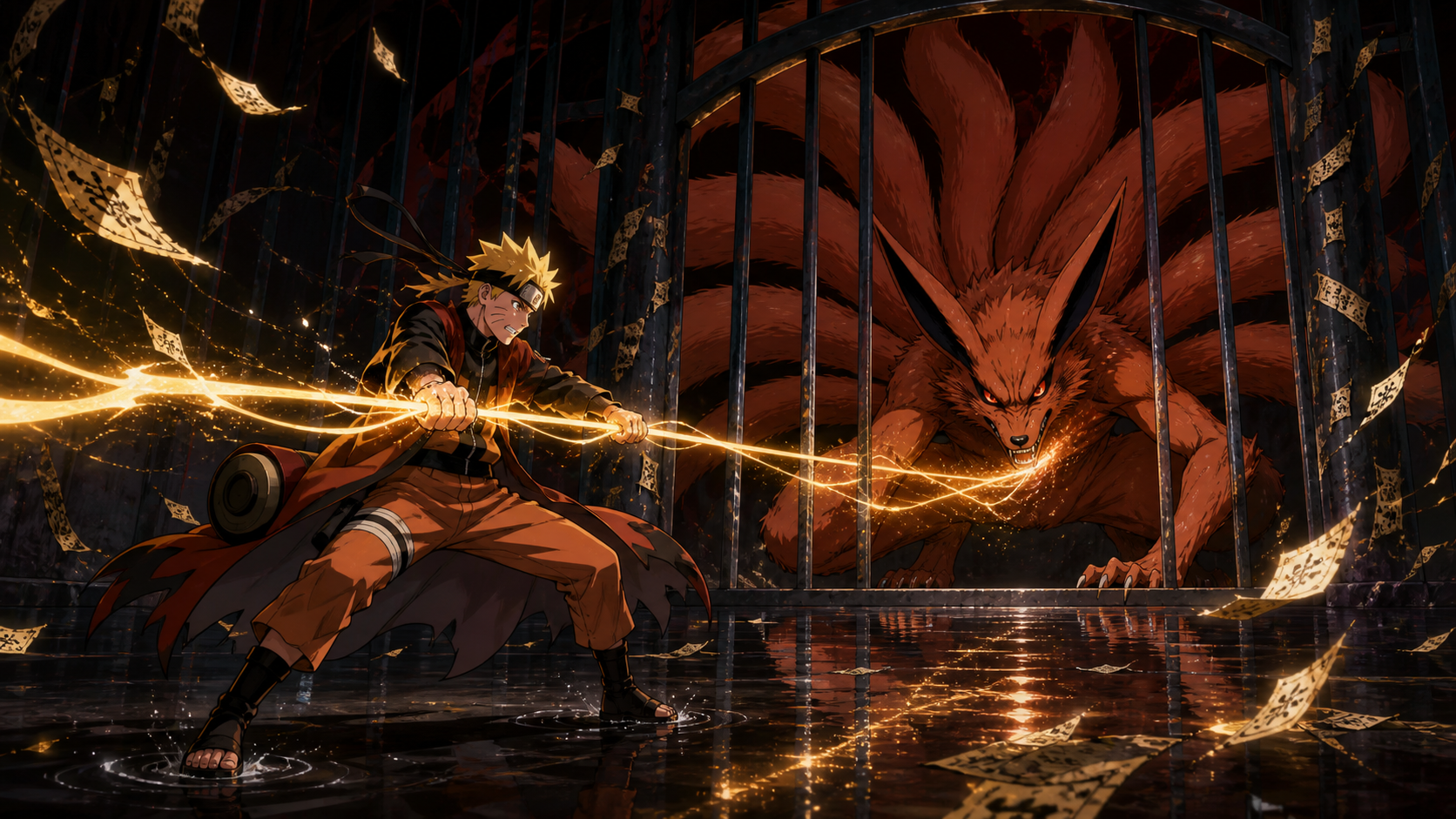
The Next Challenge! Naruto vs. Nine Tails!!
Naruto stops fighting his own anger, then opens Kurama’s gate and learns why accepting himself is only the entrance to controlling tailed-beast power.
Bottom line
Naruto Shippuden Episode 245 moves Naruto from fighting hatred to accepting why hatred protected him. At the Waterfall of Truth, he stops attacking Dark Naruto, thanks that part of himself for carrying years of rejection, and embraces him. The dark counterpart disappears because recognition removes the need to keep shouting from outside Naruto’s identity.
Killer Bee then leads Naruto into the sealed chamber where jinchūriki confront their tailed beasts. Naruto must open the Four Symbols Seal, fight Kurama directly, and pull the fox’s chakra into himself. Failure could release the Nine-Tails and cost Naruto his life. The episode makes emotional integration the entrance requirement, then reveals that the next stage still begins through coercive extraction rather than trust.
Returning to the waterfall requires a different strategy
Naruto approaches the Waterfall of Truth after hearing Motoi and Bee’s history. He no longer assumes the dark counterpart is an enemy created from nowhere. Resentment grew from experiences Naruto actually survived.
The first attempt failed because combat treated a part of himself as an invader. Every strike strengthened the claim that anger had no legitimate place inside the public hero Naruto wanted to become.
Dark Naruto tells the truth praise avoids
Dark Naruto remembers villagers who feared, ignored, and insulted the child jinchūriki. Those same people cheered after Naruto defeated Pain. The change was real, but timing matters.
Recognition arrived after extraordinary labor and sacrifice. Dark Naruto asks whether affection depends on usefulness. That question cannot be defeated through optimism because Konoha supplied the evidence behind the suspicion.
Naruto thanks the anger that kept him moving
Instead of denying resentment, Naruto acknowledges that anger helped him survive. Hurt created energy when loneliness offered little else. The dark counterpart protected memory when Naruto’s cheerful performance threatened to bury the cost.
Gratitude changes the relationship without celebrating every hostile impulse. Naruto can honor the survival function while refusing to let resentment interpret every present connection.
The embrace integrates rather than erases
Naruto hugs Dark Naruto. The gesture refuses the split between acceptable hero and unacceptable wounded child. Both belong to one life.
The counterpart fades because integration removes the separate role. Anger does not vanish from Naruto’s history. Naruto becomes capable of carrying anger without outsourcing anger to a shadow that must oppose him.
The village hero makes room for the rejected child
Naruto’s public identity changed after Pain. He became the person villagers thanked, children admired, and leaders expected to help save the shinobi world. That identity can become another form of pressure when everyone needs the hero to remain uncomplicated.
Dark Naruto carries the child who still remembers closed doors and hostile looks. The embrace lets the celebrated teenager stand beside that child rather than replacing him. Heroism no longer requires Naruto to prove the earlier loneliness stopped mattering.
This integration protects future relationships from hidden tests. If Naruto denies doubt, every disappointment can appear to confirm that Konoha’s acceptance was false. When he knows the doubt belongs to him, he can examine a present person’s actions without forcing that person to answer for the entire village.
Acceptance does not absolve Konoha
The waterfall resolution could be misread as Naruto deciding the village’s past behavior no longer matters. Acceptance concerns his internal relationship, not institutional innocence.
Konoha still failed a child. Present gratitude and earlier rejection coexist. Naruto’s growth should not become an excuse for adults to claim the harm produced a stronger hero and was therefore worthwhile.
Bee recognizes readiness through emotional change
Killer Bee sees that Naruto passed the waterfall and agrees to guide the next stage. He does not demand a perfect explanation or a performance matching his own history.
Readiness appears in Naruto’s changed relationship with himself. Bee understands that tailed-beast chakra amplifies emotional instability, making self-recognition a safety condition rather than a decorative lesson.
The temple hides behind the waterfall
Bee leads Naruto, Yamato, and Motoi into a temple concealed behind the Falls of Truth. Generations of jinchūriki used the site to confront their tailed beasts.
The architecture turns a private internal struggle into an institutional practice. Cloud has built knowledge around control, though the chamber’s lethal safeguards reveal how much that knowledge still treats hosts as dangerous containment problems.
The chamber makes failure terminal
Naruto will communicate with Kurama directly in a sealed room. If control collapses, the room can contain the Nine-Tails, but Naruto may die inside.
The design protects the outside world by placing nearly all risk on the jinchūriki. The village preserves the weapon and population through a process where the host’s life becomes the expendable boundary.
The room therefore represents both accumulated expertise and institutional failure. Cloud learned enough to create a repeatable path toward control, but the safest version for everyone outside remains lethal for the person inside. Jinchūriki knowledge developed within a system that values hosts and fears them at the same time.
Naruto enters willingly after being told the consequence. That consent distinguishes the attempt from his infant sealing, though the approaching war narrows the freedom behind the choice. Everyone needs his power quickly, and refusing training would leave friends exposed.
Yamato learns how little control he has
Yamato traveled because Wood Style could suppress Naruto’s tailed-beast transformations. Inside this training, his role is limited. Bee understands the process and Gyuki can intervene at the internal boundary.
Yamato’s concern highlights a transition. Naruto is moving beyond control borrowed from another person’s emergency technique. Greater autonomy requires facing danger without the safety system that defined earlier missions.
Bee’s joke tests fear and trust
Bee briefly gives Yamato an alarming false instruction about Naruto placing his head inside a statue’s mouth. The joke releases tension while reminding everyone that Bee controls access to knowledge they cannot independently verify.
Humor becomes part of his teaching style, but authority carries responsibility. Naruto and Yamato must learn when Bee is performing and when the danger is literal.
Naruto’s Four Symbols Seal matters
Bee examines Naruto’s seal and recognizes the Four Symbols design as more flexible than his own Iron Armour Seal. Minato built a system intended to let Nine-Tails chakra mix gradually with Naruto’s chakra.
That design created the possibility of control while also shaping every earlier leak. Naruto inherits both opportunity and danger from a decision made on the night of his birth.
Minato planned power before Naruto could consent
Naruto’s father believed his son would need Kurama’s strength against a future masked enemy. The seal converted a newborn into a long-term strategic answer.
Minato’s love and tactical reasoning do not erase the lack of consent. Naruto now chooses to continue a path created for him, turning inherited purpose into personal decision for the first time.
Opening the seal reverses years of survival training
For most of Naruto’s life, safety meant keeping the Nine-Tails contained. Jiraiya experimented with loosening the seal, while Yamato and others restored control when chakra overwhelmed him. Episode 245 asks Naruto to open the gate deliberately.
The act requires courage and caution. Growth does not mean barriers were always wrong. Earlier containment kept Naruto and others alive until he developed the skills and relationships needed for a controlled confrontation.
Kurama enters as an imprisoned person and a threat
The Nine-Tails has attacked, manipulated, and tried to seize Naruto’s body. Kurama is also a conscious being held behind bars since Naruto’s birth and used as village power before that.
Both realities shape the confrontation. Naruto has reasons to fear the fox, while Kurama has reasons to reject another human attempt at control. The chamber begins from a relationship built through mutual coercion.
Kurama’s earlier offers always carried conditions. He supplied chakra when Naruto’s rage aligned with escape and pressed against the seal whenever despair weakened resistance. Naruto learned to interpret help as danger because the fox often treated vulnerability as an opening.
Naruto now reverses that pattern by entering Kurama’s space and taking initiative. The reversal gives him agency but does not settle the ethical problem. A captive consciousness does not become an object simply because the host suffered from captivity too.
Power without will is the temporary objective
Bee teaches Naruto to separate Kurama’s chakra from Kurama’s intent. The strategy promises strength without the personality that previously tried to overwhelm him. In tactical terms, that separation solves the immediate safety problem.
Relationally, the method repeats the shinobi system’s oldest desire: keep the tailed beast’s power while silencing the being. Naruto needs the advantage for war, yet lasting control will require more than winning ownership of energy. The episode plants that limitation inside the training rather than pretending extraction equals peace.
Bee describes chakra extraction as control
The immediate goal is to separate Kurama’s chakra from the fox’s will and pull that power into Naruto. Victory would create a usable chakra reserve without surrendering consciousness.
This method is not yet friendship. Naruto seeks power through combat and extraction. The series will need to move beyond domination before genuine partnership becomes possible.
Sage Mode gives Naruto an earned advantage
Naruto uses Sage Mode because natural energy improves strength, perception, and durability without relying on Kurama. The choice brings an ability he earned through discipline into the confrontation with inherited power.
Sage training also taught stillness, balance, and the danger of taking in more energy than the body can integrate. Those lessons fit a chakra tug-of-war where excess can become transformation or death.
Shadow clones divide labor and risk
Naruto uses shadow clones to attack, restrain, and create openings. The technique that once expressed loneliness now becomes a disciplined tactical network.
Clones let Naruto multiply effort, but Kurama can drain his chakra while Naruto uses the fox’s power. The familiar advantage carries a new vulnerability inside the seal.
Gyuki helps from the boundary
Bee and Gyuki provide support without taking Naruto’s battle away. Gyuki can restrain Kurama briefly and offer knowledge from one tailed beast about another.
The assistance proves partnership already exists elsewhere, creating a model even while Naruto’s own encounter remains adversarial. He is not inventing an impossible relationship from nothing.
The chakra tug-of-war externalizes consent and control
Golden chakra stretches between Naruto and Kurama as each tries to determine who directs the power. The image makes their relationship physically visible.
Naruto is reclaiming power sealed inside his body, yet Kurama experiences the act as theft. Control and consent remain unresolved on both sides. Winning the contest will not automatically create trust.
Kurama attacks Naruto’s emotional openings
The Nine-Tails has spent years watching Naruto’s fear, rage, and loneliness. Physical strength is only one weapon. Kurama can tempt, provoke, and exploit the emotions that weakened the seal before.
Passing the Waterfall matters because Naruto has named the resentment Kurama would otherwise weaponize. Integration does not make him invulnerable, but hidden pain no longer offers the same secret entrance.
The episode stops before victory
Naruto opens the seal and begins the battle, but the outcome remains unresolved. The structure gives weight to the threshold rather than rushing into a new transformation.
Episode 245 is about readiness, method, and risk. The next episode will introduce the relationship capable of changing the fight, but Naruto first has to understand what direct control demands.
Thanking anger is not the same as worshipping it
Naruto recognizes that resentment kept a record when cheerful endurance became his public survival strategy. Anger insisted the rejection happened, that it mattered, and that late applause could not rewrite childhood. Thanking that function does not place every bitter conclusion in charge.
This distinction saves the waterfall scene from motivational mush. Naruto is not declaring every hostile thought correct. He is telling the wounded part that it no longer has to scream from exile to be heard. Acknowledgment makes choice possible where denial produced endless combat.
The embrace does not issue Konoha a pardon
The village failed Naruto long before he had language for the failure. Adults avoided him, children absorbed their fear, and institutions protected classified information more reliably than they protected a lonely boy. His ability to integrate that history cannot become evidence that the harm worked out fine.
I need that said plainly because heroic fandom loves retroactive purpose. Naruto became compassionate despite abandonment, not because abandonment was secretly excellent training. Present love can be genuine while the people offering it remain responsible for arriving painfully late.
Bee checks readiness without demanding emotional purity
Naruto emerges changed, not scrubbed clean. He still remembers resentment. He can now discuss it without treating the feeling as an external enemy or a shameful contaminant. Bee recognizes that shift because his own control grew from a self broad enough to hold contradiction.
A jinchūriki does not need to become permanently serene before touching dangerous chakra. That would be an impossible standard imposed on the person already carrying everyone else’s weapon. Readiness means knowing which emotions are present and refusing to let one hidden wound seize the controls.
The chamber exposes whose safety the system prioritizes
Cloud built a room capable of containing the tailed beast if the host loses. That sounds responsible until the cost is named: the jinchūriki may die inside while everyone outside remains protected. Expertise and disposability share the same architecture.
Naruto enters willingly, but his choice sits inside wartime pressure and a destiny designed by adults before he could speak. Consent is more real now than it was at birth. It is not magically free from every force pushing him toward the gate.
Minato’s plan gave Naruto an option and assigned him a burden
The Four Symbols Seal was built to mingle chakra over time. That design created the possibility Naruto is using now, and it also made his body the battlefield for a threat Minato expected his newborn son to confront one day.
Love and strategy occupy the same decision. Minato believed in Naruto, but belief from a parent can still become an assignment the child never requested. Naruto’s agency begins when he chooses what to do with the inherited plan rather than merely fulfilling it.
Kurama is dangerous and imprisoned at the same time
The fox manipulated Naruto’s despair, pushed chakra through weakness, and repeatedly sought control of his body. Naruto has every reason to approach the open gate as a survival fight. Kurama has also spent decades sealed, transferred, commanded, and valued primarily for power.
Reducing either side to pure victim or pure monster makes the relationship less honest. They have harmed each other from radically unequal positions inside one body. The coming victory can settle access to chakra. It cannot settle personhood, captivity, or trust.
Extraction repeats the shinobi world’s favorite compromise
Bee’s method separates power from will so Naruto can use Kurama without being consumed. Tactically, that is brilliant. Politically, it resembles every village dream about tailed beasts: keep the weapon, mute the consciousness, and call reliable output harmony.
The method is a necessary stage, not the moral destination. Naruto cannot leap from mutual hostility into partnership through good intentions. He first needs safety and leverage. The story must later admit that control stolen through force remains different from strength offered through relationship.
Sage Mode proves Naruto enters with power of his own
Naruto does not approach Kurama as an empty container begging for the fox’s strength. He brings natural energy, clone coordination, Rasengan mastery, and the discipline learned from teachers who treated him as a person. Those abilities keep the confrontation from becoming inherited power fighting itself.
Sage training also taught balance. Take too much energy without integration and the body changes disastrously. That lesson mirrors the entire jinchūriki problem. More power is never the same as better control, especially when another will exists inside what someone wants to take.
The episode’s smartest move is making self-acceptance a safety measure instead of a decorative speech before the real action. Kurama has always entered through fractures Naruto could not name quickly enough. The waterfall does not remove those fractures; it gives Naruto ownership of them. When the fox reaches for resentment now, Naruto knows whose voice he is hearing and why it exists. That knowledge cannot guarantee victory, but it changes the battlefield. A feeling recognized inside the self is harder for another consciousness to impersonate, inflate, and return as destiny.
What landed and what did not
The embrace with Dark Naruto is the strongest moment because Naruto stops treating anger as moral contamination. The temple and lethal chamber also reveal the institutional cost hidden beneath jinchūriki training.
The transition from self-acceptance to forcibly extracting Kurama’s chakra creates an unresolved contradiction. Bee’s jokes occasionally weaken the danger, and Kurama’s perspective receives less space than the power Naruto wants to take.
Final reaction
“The Next Challenge! Naruto vs. Nine Tails!!” makes acceptance a prerequisite for power. Naruto thanks the part of himself that remembered rejection, then enters a chamber designed around the possibility that he may die.
He opens the seal by choice and confronts Kurama with abilities he earned outside the fox. The battle begins as domination, not friendship. Naruto has integrated his own anger; now he must survive a relationship where the other consciousness has anger too.
RaeRae’s call
Naruto wins the right to enter this fight by welcoming his anger home. He does not absolve Konoha, purify himself, or solve Kurama. He becomes honest enough to open the gate without a hidden wound opening it for him.
Episode details and viewing routes
Naruto Shippuden Episode 245, “The Next Challenge! Naruto vs. Nine Tails!!,” first aired in Japan on January 19, 2012. The manga-adapted episode continues the Taming of the Nine-Tails and Fateful Encounters arc inside the Island Turtle’s jinchūriki training temple.
- Official episode reference: Naruto Official episode guide
- Licensed episode route: Crunchyroll licensed episode page