
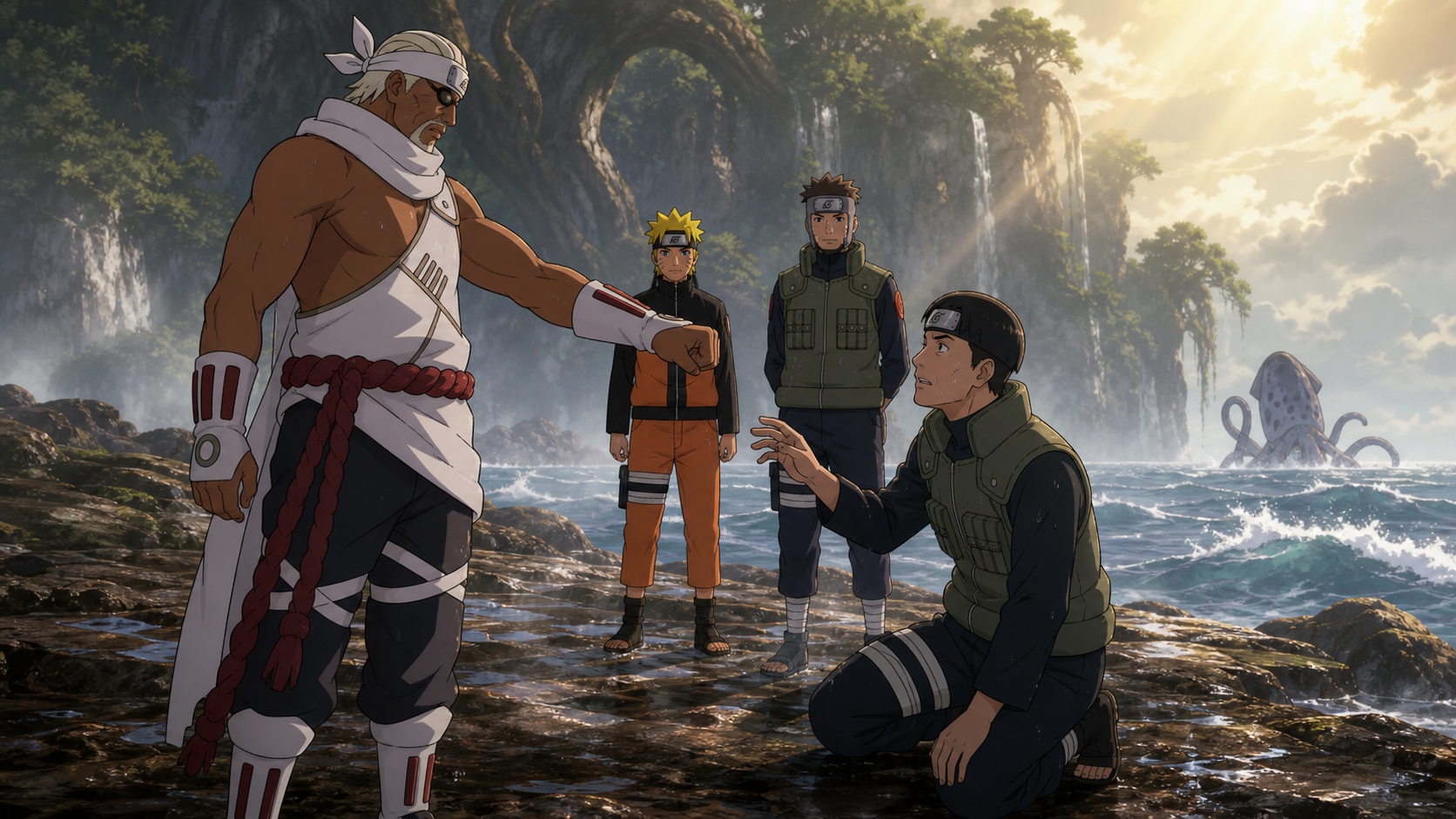
Killer Bee and Motoi
Motoi tried to kill Bee. Bee remembers their friendship, saves him anyway, and gives Naruto a living answer to the hatred waiting at the waterfall.
Bottom line
Naruto Shippuden Episode 244 explains why Killer Bee could face the Waterfall of Truth without being ruled by resentment. Motoi hated the Eight-Tails for killing his father, transferred that hatred to the child chosen as the next jinchūriki, and tried to stab Bee. Bee remembered the friendship rather than building his identity around the betrayal. Years later, he still saves Motoi from the giant squid without demanding an apology first.
The episode does not prove pain disappears when someone smiles. Bee survived public abuse, political use, and an attack from his closest friend. His strength comes from deciding who he will be in relation to those injuries. Naruto needs that distinction. Dark Naruto cannot be beaten by pretending hatred belongs to someone else. Bee shows that memory can include betrayal without letting betrayal become the only memory available.
Naruto cannot overpower his own reflection
Naruto returns from the Waterfall of Truth unable to defeat his dark counterpart. Every attack is matched because both sides carry the same experience, skill, and instincts. The problem is not insufficient force.
He asks Motoi how Bee passed the same trial. The question shows progress from demanding a technique. Naruto now wants history, personality, and the difference between their responses to pain.
Motoi initially treats shared status as enough context
Motoi tells Naruto that a fellow jinchūriki should understand what Bee endured. Naruto pushes back because shared classification does not grant access to another person’s private history.
Both positions contain truth. Naruto knows isolation, fear, and being treated as a container. He does not know Cloud’s Eight-Tails disasters, Bee’s family structure, or Motoi’s role in the harm. Similarity creates a reason to listen, not permission to assume.
World peace makes the story politically useful
Motoi agrees to speak partly because Naruto controlling the Nine-Tails could affect the war and world peace. Bee’s life becomes evidence for another village’s military need.
That framing is uncomfortable. Motoi is sharing history involving Bee’s trauma without Bee present. The episode recognizes his reluctance but ultimately prioritizes the stakes attached to Naruto. Valuable knowledge and personal privacy collide.
The Eight-Tails once meant recurring catastrophe
Before Bee achieved control, the Eight-Tails repeatedly escaped its hosts. Cloud shinobi had to suppress the rampages, and every containment carried casualties. The village experienced Gyuki as a recurring public disaster.
That history explains fear without making every response acceptable. People lost family members and learned to associate the beast with sudden death. The political system answered by sealing the same power into another child, transferring danger and community resentment together.
Motoi’s father died during containment
Motoi’s father was killed during one Eight-Tails rampage. The loss gave Motoi a direct reason to hate the beast. He was a child trying to place grief somewhere concrete.
The village’s sealing system blurred responsibility. Gyuki caused the immediate death, but leaders repeatedly treated hosts as replaceable containment. Motoi had no path to challenge that institution, so anger moved toward the most visible new host.
Bee was chosen after another host failed
The previous jinchūriki died when the Eight-Tails was extracted. Bee was selected as the next vessel and linked to the future Raikage through the A–B partnership. Adults framed the choice as duty and strategic necessity.
For Bee, selection meant carrying a beast associated with recent deaths and becoming the village’s new target for unresolved fear. He inherited power, blame, and expectations before developing any control over the arrangement.
The village punished the child for the seal
Cloud residents insulted Bee and threw eggs at him. Their fear attached the Eight-Tails’ violence to the boy’s identity even though Bee did not choose the sealing or the earlier rampage.
Public punishment served no safety function. Humiliation gave grieving people a target while isolating the person expected to protect them. The village demanded stability from Bee while making emotional stability harder to build.
Bee’s smile is not proof that nothing hurt
Motoi remembers Bee smiling through abuse. From the outside, the response looked effortless or indifferent. Naruto initially risks reading the same surface as natural confidence.
A smile can be resilience, performance, refusal, or protection for the people watching. Bee’s later strength does not prove the harassment lacked impact. The episode is strongest when the smile represents a decision rather than evidence of invulnerability.
Motoi transferred hatred from beast to host
Motoi could not attack the Eight-Tails directly. Bee became reachable. Hatred moved from the power that killed his father to the child carrying that power.
The transfer follows the same prejudice Naruto endured in Konoha. Villagers collapse the distinction between jinchūriki and tailed beast, then punish the host for violence that occurred before the host had control. Grief explains the movement without making the target fair.
Friendship made the resentment more complicated
Motoi and Bee had been close. Bee’s selection did not erase their shared childhood immediately. Motoi therefore carried affection and blame toward the same person.
That contradiction became unbearable. Treating Bee as only a monster simplified grief, while remembering him as a friend would require questioning where responsibility belonged. The attempted murder tried to force a single answer through violence.
Motoi tried to kill Bee from behind
Motoi approached Bee with a kunai and attacked. The betrayal was intimate because Bee recognized the person behind the weapon. A village insult is painful; a friend deciding your life should end reaches a different part of identity.
Bee disarmed him without retaliating. Restraint prevented Motoi’s grief from becoming a death neither boy could undo. The moment also gave Bee every reason to close the friendship permanently.
Silence preserved guilt rather than repairing trust
Motoi never found the courage to speak honestly with Bee after the attempt. Years passed, and guilt hardened around the memory. He built respect for Bee from a distance while assuming the betrayal defined what Bee remembered.
Avoidance protected Motoi from immediate rejection but denied Bee the chance to respond. Unspoken remorse can feel morally serious while still leaving the harmed person alone with the consequence.
Motoi’s admiration grew without honest contact
Motoi watched Bee become a powerful jinchūriki, the Raikage’s trusted brother, and the person capable of calming the island’s giant animals. Respect accumulated alongside shame. The greater Bee appeared, the harder Motoi found approaching him.
That distance let Motoi imagine Bee’s judgment without testing the assumption. Guilt often claims to center the harmed person while remaining preoccupied with the offender’s fear of rejection. Motoi’s silence spared him from hearing anger, disappointment, or forgiveness directly.
Naruto’s question forces the story into speech. Motoi tells someone else first, which remains ethically incomplete, but confession breaks the sealed version of history. Once the truth is spoken, his present relationship with Bee can no longer rest entirely on avoidance.
Naruto hears a version of his own village history
Bee’s childhood resembles Naruto’s experience: a child carries a tailed beast, adults project fear onto him, peers repeat the hostility, and recognition must be earned through extraordinary effort.
The differences matter too. Bee had A as a brother and a formal role inside Cloud’s power structure. Naruto had Iruka and later Team 7, but no comparable family protection early in life. Their paths show multiple ways villages fail jinchūriki.
Dark Naruto is not defeated by copying Bee’s smile
Naruto could hear the story and conclude that he should simply remain cheerful. That lesson would repeat the problem. Bee’s smile belongs to his choices and relationships, not a mask Naruto can borrow.
Naruto must acknowledge resentment toward Konoha before deciding how that resentment fits. Control requires integration, not replacing one performance with another.
The squid turns memory into a present test
After Motoi confesses, the giant squid attacks and captures him. The threat creates an immediate question: what will Bee do when the friend who tried to kill him needs rescue?
Bee does not pause to negotiate the past. He uses Gyuki’s power and saves Motoi. The response proves his values through action without claiming the betrayal never mattered.
Bee’s rescue is not automatic forgiveness
Saving Motoi means Bee refuses to let him die. The act does not erase the attempted murder or settle every year of silence. Rescue creates survival, which makes later accountability and reconciliation possible.
That distinction matters for Naruto’s training. Compassion can interrupt harm before every feeling is resolved. A person does not need perfect emotional closure to choose against revenge.
Gyuki helps Bee protect the person who blamed him
The rescue also involves Gyuki, the tailed beast Motoi originally blamed for his father’s death. Bee uses that same power to save Motoi from the squid. The image reverses the childhood association without pretending the earlier casualty never occurred.
For Motoi, the Eight-Tails can no longer remain only the force that took his father. Through Bee’s partnership, Gyuki becomes part of the action preserving his life. Contradictory evidence enters a story grief had kept fixed for years.
Bee’s control therefore changes more than combat. Partnership gives the village new experiences through which to understand the beast and host. Every rescue challenges the belief that sealing a tailed beast creates an inevitable monster, while every act of trust challenges the treatment that made hostility more likely.
Bee remembers the good without denying the attack
Bee indicates that his memories of Motoi focus on their friendship. He does not let the worst act consume the whole relationship. That choice explains how he approached the Waterfall of Truth with less divided resentment.
Remembering good moments is not the same as declaring the attack harmless. Bee controls which memory organizes his identity. Motoi’s betrayal remains part of the past without becoming the only definition of either person.
The fist bump restores a shared language
Bee extends a fist after the rescue. The gesture carries recognition, trust, and the possibility of returning to relationship. Motoi can answer without pretending words are unnecessary forever.
The fist bump also links Bee’s relationships. He uses the gesture with A, with Naruto, and with people granted access to his trust. Physical contact becomes a boundary and an invitation rather than a performance Naruto can demand.
Motoi’s guilt needs responsibility beyond gratitude
Being rescued may tempt Motoi to treat Bee’s generosity as complete absolution. The healthier next step would include direct apology, listening, and changed conduct. Bee’s strength should not carry all the labor of repair.
The episode stops near emotional recognition rather than exploring those obligations. Naruto receives the lesson he needs, while Motoi and Bee deserve more time for the relationship itself.
Bee’s mastery comes from chosen identity
Bee cannot control how Cloud treated him, how the Eight-Tails was sealed, or what Motoi attempted. He can decide which bonds, ambitions, and creative practices define his response.
Rap, combat, brotherhood, and partnership with Gyuki become expressions of a self larger than the village’s fear. The Waterfall of Truth could not expose a hidden half Bee refused to acknowledge because he had already built room for contradiction.
Naruto begins to understand acceptance differently
Naruto thought conquering Dark Naruto required victory over hatred. Bee’s story suggests he must recognize why hatred exists and then choose what receives authority.
Acceptance does not mean approving Konoha’s rejection or pretending praise repairs childhood. Acceptance means the resentful voice belongs to Naruto without being the only Naruto allowed to speak.
Motoi’s story makes the village’s failure structural
Cloud did not merely contain a dangerous beast. Its leaders kept repeating a system where one host died, another child inherited the seal, and grieving residents were left to aim fear at whoever carried it next. Bee became both protection and public target.
That arrangement is obscene. The village demanded emotional control from the person receiving its eggs, insults, suspicion, and military expectations. Bee’s later mastery does not vindicate the system. It proves he built a life larger than what the system prepared for him.
The episode asks too much of Bee’s smile
Everybody remembers that he smiled. Fine. Smiling can be defiance, self-protection, care for a frightened friend, or the face somebody wears because letting a hostile crowd see pain feels unsafe. It is not a medical scan proving the pain never entered.
I resist any reading that turns Bee into the magical unbothered victim. His achievement is not purity from anger. It is authorship. He decides what kind of man those injuries will meet, even when the people who caused them never earned such grace.
Motoi’s grief explains the target without cleansing the act
His father died during Gyuki’s rampage, and a child needed somewhere to put a loss too large for him. Bee was visible, reachable, and attached to the power Motoi feared. That is how prejudice often recruits grief: it offers a nearby person in place of a complicated institution.
The attempted stabbing remains attempted murder. Sympathy should make our judgment more accurate, not disappear it. Motoi deserves room to name his wound and responsibility for choosing a friend’s back as the place to answer it.
Confession to Naruto is movement, not repair
Motoi finally says what happened, but he first says it to somebody who cannot forgive him. Naruto needs the history for training. Bee needs the truth addressed inside their relationship. Those needs overlap without becoming identical.
The story uses Naruto as a witness who can understand the machinery of scapegoating. That witness breaks secrecy. It should not let Motoi treat shame as an apology delivered by proxy, especially when Bee carried the physical danger and the years of silence.
The rescue keeps mercy from becoming surrender
Bee does not debate whether Motoi deserves saving while the squid holds him. He acts because allowing a man to die would hand the old betrayal authority over his present values. Mercy belongs to Bee’s character before it becomes a reward for Motoi.
That distinction protects the scene from cheap absolution. Rescue says, “You will live.” It does not automatically say, “Nothing remains between us.” Survival creates the possibility of accountability, conversation, anger, and whatever relationship both men choose after the emergency.
Gyuki’s role rewrites Motoi’s oldest association
The Eight-Tails exists in Motoi’s memory as the force that killed his father. Now that same power, directed through cooperation with Bee, pulls him away from death. The contradiction cannot restore his family, but it destroys the simplicity hatred depended upon.
Gyuki is not suddenly harmless. Bee’s partnership shows that power and personhood change what enormous strength does in a given moment. Villages create danger when they treat tailed beasts and hosts as equipment, then act surprised when captivity produces rage.
Naruto needs integration, not Bee cosplay
Bee’s smile, rhymes, confidence, and fist bumps are visible results of choices Naruto did not live. Copying them would give Naruto another performance to place over resentment. The waterfall will keep producing the truth underneath because it is not grading charisma.
Naruto must tell the angry child inside him that the injury was real. Only then can he decide that Konoha’s later love is also real without using either truth to erase the other. Control starts when both voices belong to one person.
The fist bump opens a door that conversation must walk through
The restored gesture is beautiful because Bee remembers friendship without surrendering his entire history to its worst moment. Motoi can answer, but gratitude cannot become the last word. He owes Bee direct responsibility, patient listening, and behavior that no longer treats generosity as emotional cleanup.
The episode ends before doing that slower work. I believe the reconciliation because Bee chooses it. I do not believe one rescue completes it. A fandom story can love grace and still demand that the person receiving grace carry some weight.
The lesson is not that Bee forgave. It is that he refused to let either the village or Motoi write his identity. Their fear called him a monster. Motoi’s guilt could have made him a saint whose only purpose was absolving somebody else. Bee rejects both cages. He is vain, funny, disciplined, irritated, generous, musical, dangerous, and entitled to boundaries. Naruto cannot reach that freedom by defeating an evil version of himself. He reaches it by giving every wounded part a place without handing one part the microphone.
What landed and what did not
Motoi’s confession gives the Waterfall of Truth social context and prevents Bee’s mastery from looking effortless. The squid rescue provides a clean present-tense answer: Bee protects a betrayer because his values are not controlled by the betrayal.
The episode risks turning Bee’s smile into a superhuman absence of pain. Motoi’s attempted murder also resolves too quickly through rescue and a fist bump. Bee’s interior perspective deserves more than other people interpreting his expression.
Final reaction
“Killer Bee and Motoi” shows why Bee can teach Naruto without sharing the same emotional method. Bee remembers rejection and betrayal, but he refuses to let other people’s worst choices decide his entire inner life.
Motoi tried to kill him. Years later, Bee saves Motoi before asking what apology might follow. The rescue is not cheap forgiveness. Bee acts from the person he chose to become, which is exactly the control Naruto lacks at the Waterfall of Truth.
RaeRae’s call
Bee saves Motoi because betrayal does not own him. That is mercy, not amnesia. Motoi still owes repair, Cloud still owns the system that targeted a child, and Naruto still has to welcome his anger home.
Episode details and viewing routes
Naruto Shippuden Episode 244, “Killer Bee and Motoi,” first aired in Japan on January 12, 2012. The manga-adapted episode continues the Taming of the Nine-Tails and Fateful Encounters arc on the Island Turtle.
- Official episode reference: Naruto Official episode guide
- Licensed episode route: Crunchyroll licensed episode page