
Sai’s Day Off
Root taught Sai to erase attachment. A day off gives him room to draw the team he chose.
Bottom line
Naruto Shippuden Episode 238 gives Sai a day with no mission and discovers that rest can be harder than combat when Root trained every private desire out of him. He walks through rebuilding Konoha, draws because drawing is the one language that belonged to him before Team 7, and meets three children whose arguments remind him of Naruto and Sakura. Their simple question about the difference between a comrade and a friend exposes how much Sai has learned and how much he still cannot explain.
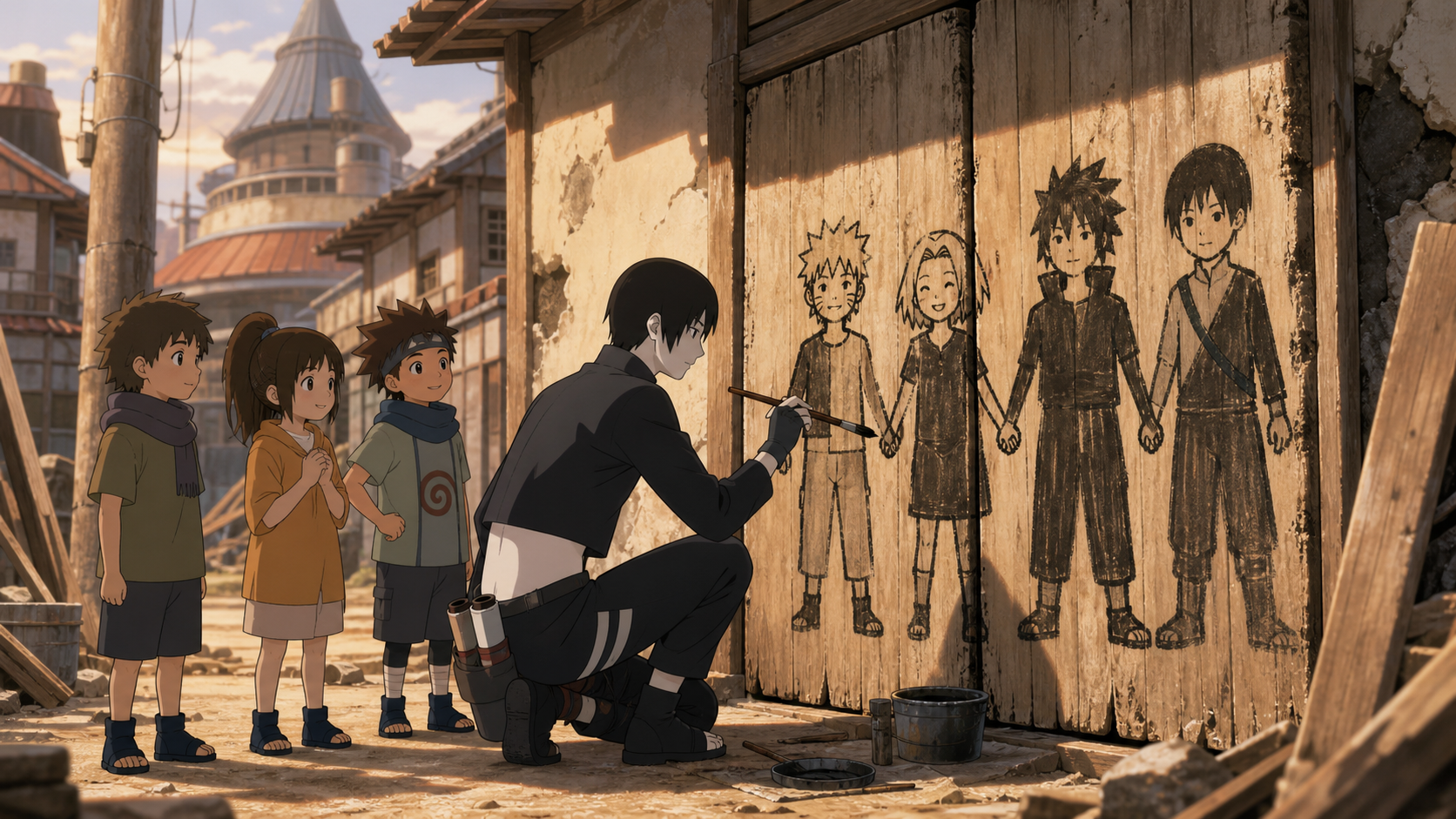
The final mural is his answer. Sai paints Naruto, Sakura, Sasuke, and himself holding hands across the doors of a ruined house. He includes Sasuke without erasing his own place. That choice is not naïve proof that Team 7 has been repaired. The image shows the team Sai wants, the bond Naruto refuses to abandon, and the family Root taught Sai never to need.
A day off is an unfamiliar assignment
Sai receives free time and walks through Konoha without a target, surveillance order, or coded objective. Root trained him to perform tasks and suppress attachment. Leisure asks a different question: what does Sai choose when nobody gives him a command?
He reaches for paper and ink. Drawing survived the conditioning that stripped names and emotions from his work. The habit lets him observe people without immediately knowing how to join them. His day off becomes a slow exercise in choosing attention.
Rebuilding Konoha makes the quiet episode matter
The village still carries damage from Pain’s assault. Repaired streets sit beside ruined houses, and ordinary residents continue working around broken structures. Sai’s wandering takes place inside recovery rather than a polished return to normal.
That setting reflects him. Konoha has survived, but survival did not restore every wall. Sai left Root and joined Team Kakashi, but joining did not automatically rebuild the emotional vocabulary Root removed. Both village and person are functional while reconstruction continues in public.
The children approach the strange artist first
Three children notice Sai drawing and ask questions. He struggles with their energy and directness because children do not follow Root’s controlled communication. They ask what they want to know and react without hiding the reaction.
Sai does not scare them away. His awkwardness creates curiosity rather than danger. Their willingness to stay gives him a social space with low stakes, something his earlier life rarely offered.
Naruto appears through noise before memory
One child’s loud confidence reminds Sai of Naruto. The resemblance does not require orange clothing or a ninja technique. The child takes up space, argues openly, and expects the relationship to survive the argument.
Sai first met Naruto as an obstacle to Root’s mission and a source of confusing loyalty to Sasuke. Over time, Naruto’s volume became evidence of emotional honesty. He says who matters and refuses to hide the cost.
Sakura appears through temper and care
Another child’s sharp response reminds Sai of Sakura. Sai’s early attempts at social language often provoked her because he treated insulting honesty as a shortcut to friendship. Sakura taught him that words have effects even when the speaker claims ignorance.
Her temper is not the whole memory. Sakura heals teammates, worries, carries guilt, and keeps working through emotional contradictions. Sai has learned to see care underneath reactions he once catalogued as unpredictable.
“Comrade” is the word Root could tolerate
The children ask about the difference between a comrade and a friend. Comrade fits the shinobi system. A comrade shares a unit, objective, chain of command, or battlefield responsibility. Root can recognize that relationship because the relationship serves a mission.
Friend introduces choice, pleasure, grief, memory, and attachment beyond orders. A friend matters when no task requires the bond. Sai understands the definition through experience before he can explain the word cleanly.
Root taught Sai that attachment creates weakness
Danzō’s Root removed names, histories, and emotional ties to produce obedient operatives. Sai’s bond with Shin was treated as a dangerous flaw. The organization did not simply discourage tears. Root tried to erase the inner structure that lets a person decide another life matters.
That conditioning makes a day off politically meaningful. Sai spends time on art that serves no superior and listens to children who offer no strategic value. Ordinary choice becomes resistance against the system that shaped him.
Team 7 did not welcome him cleanly
Naruto and Sakura initially saw Sai as an unwanted replacement for Sasuke. Sai entered with secret Root orders, insulting manners, and no reason to trust their obsession with a missing teammate. Their conflict was real.
The episode’s flashbacks matter because friendship did not arrive through instant warmth. Sai watched them argue, protect each other, fail, and keep returning. The bond became believable through repeated friction.
Naruto’s loyalty to Sasuke changes Sai’s mission
Sai was ordered to approach Orochimaru and deal with Sasuke under Root’s agenda. Naruto’s refusal to abandon Sasuke forced him to reconsider what a bond could demand. The loyalty looked irrational from Root’s framework because Sasuke offered no current operational benefit.
Naruto’s choice gave Sai a model for acting against assigned logic. Sai eventually chose Team Kakashi and the effort to retrieve Sasuke over Danzō’s control. Friendship became a reason to disobey.
Sai learns that emotions are actions before labels
Sai reads books about social behavior and often applies the advice badly. He can memorize the polite phrase and still miss timing, context, or the person receiving the words. Episode 238 shows a better route.
He watches what Naruto and Sakura do. They return, argue, worry, defend, apologize, and remember. Friendship becomes visible through patterns before Sai finds a definition that fits.
That distinction protects the episode from turning Sai into a joke about poor social skills. His confusion has a history. Root denied him the ordinary practice other children receive through family, school, play, and disagreement. A book can supply vocabulary, but vocabulary cannot replace years spent learning that affection survives a mistake. Naruto and Sakura give him those missing lessons in motion. They get angry with him, yet they do not discard him after every failed attempt.
Sai’s progress therefore appears in attention rather than fluency. He recognizes a familiar emotional rhythm in the children. He notices that irritation and loyalty can occupy the same relationship. Earlier Sai might have treated anger as proof that cooperation had failed. Now he understands that friends can clash because the bond matters enough to defend, repair, and continue.
Drawing lets him say what speech cannot
Sai once created art without titles because naming required emotional meaning. His ink techniques turned drawings into useful mission tools, but private art remained tied to the brother and feelings Root tried to suppress.
The mural lets image carry an answer that conversation cannot. Four people hold hands. The composition names belonging through position, distance, and touch. Sai can place himself in the group without delivering a speech he does not yet know how to make.
The ruined doors become the correct canvas
Sai paints on salvaged doors from a damaged house. The surface already carries loss. Turning that wood into a shared image does not hide the destruction. The cracks and wear remain behind the figures.
Team 7 has the same structure. Sasuke left, Naruto and Sakura were hurt, Kakashi and Yamato carried separate responsibilities, and Sai entered through a vacancy nobody wanted to acknowledge. The mural uses damaged material because a clean canvas would be less honest.
Doors also mark a boundary between private life and the street. By painting on them, Sai moves a feeling he normally keeps behind a controlled expression into public view. He does not sign a report or offer the picture to a superior for evaluation. He leaves a declaration of connection where neighbors and passing children can encounter the work. For someone trained to conceal every attachment, visibility carries its own courage.
The rebuilding village gives that gesture additional weight. Residents are deciding what to salvage, what to replace, and what can become useful in a different form. Sai makes the same decision about his past. Drawing began before Root fully closed around him, became a weapon under Root, and now returns as a way to choose people. The skill remains familiar while its purpose changes.
Including Sasuke is not the same as forgiving everything
Sai paints Sasuke holding hands with the team. The image does not erase Sasuke’s crimes, his attack on former allies, or the danger surrounding his choices. Sai knows those facts.
Including him records the bond Naruto and Sakura continue to carry. Sai has learned that understanding friends sometimes means recognizing attachments he would not choose for himself. He can represent their hope without pretending the reunion has already happened.
Sai includes himself without becoming “the replacement”
The mural could have shown the original Team 7 and left Sai outside. He places himself beside them. That is the quiet achievement of the episode.
Sai does not need Sasuke erased to belong. Teams can change shape, carry absences, and add relationships without making people interchangeable. His place comes from what he shared with Naruto and Sakura, not from occupying Sasuke’s empty chair.
The children give Sai a safer mirror
The three children repeat familiar dynamics without carrying Team 7’s war, betrayal, or grief. Sai can observe an argument, answer questions, and test connection without the stakes that usually overwhelm him.
They also admire his drawing directly. Root valued his art as a technique. The children value the image because the image is interesting and beautiful to them. Their response lets creativity exist outside utility.
Their number matters to the visual parallel. The children do not form an exact miniature Team 7, and the episode does not need them to. They create just enough resemblance for Sai to connect present behavior with accumulated memories. He can see Naruto’s insistence and Sakura’s force without reducing either teammate to a single trait. The children prompt recognition, while Sai supplies the deeper meaning from everything he has lived through since joining the team.
They also ask without demanding a perfect answer. Sai is allowed to pause, misunderstand, and respond through art. That patience is the opposite of Root’s performance standard, where uncertainty could threaten a mission. The encounter gives him room to learn in front of other people and remain accepted while learning.
The episode understands recovery as ordinary practice
Sai does not defeat an enemy or unlock a new jutsu. He spends a day noticing how people relate. That modest scale fits his development better than a sudden emotional breakthrough.
Learning attachment requires repetition in ordinary settings. Missions reveal loyalty under pressure, but free time reveals whether a relationship exists when survival does not demand cooperation. Sai uses the quiet to realize Team 7 follows him even when nobody else is present.
Leisure asks Sai to produce desire without an order
Root trained him to identify objectives, suppress private attachment, and measure success through completed assignments. A free day removes that external structure.
Choosing where to walk, what to notice, and whether to draw becomes difficult precisely because no superior can certify the correct answer.
Drawing survived because it held memory before it held utility
Root converted ink into reconnaissance and combat technique, but art began inside Sai’s bond with Shin. The practice carries a self the organization never fully erased.
Returning to private drawing allows the same hands to create meaning without converting the image into a weapon.
The rebuilding village gives recovery a public landscape
Konoha’s broken homes, salvaged material, and active repairs prevent healing from looking complete. People live beside evidence while deciding what can still serve another purpose.
Sai does the same with art and attachment. Survival preserves material; choice determines what the material becomes next.
Children offer relationship without strategic demand
They approach because they are curious, not because Sai can complete a mission. Their questions have no hidden Root objective and their appreciation of the drawing produces no tactical advantage.
Low-stakes contact lets Sai practice uncertainty while remaining welcome after an awkward answer.
Comradeship can exist through assignment
A comrade may share command, risk, and obligation because an institution placed two people together. That bond can be serious and honorable.
Friendship adds chosen continuation. The person matters after the report is filed and during hours when nobody requires contact.
Root feared attachment because attachment creates competing authority
A person who loves someone may refuse an order that endangers the bond. Memory, grief, and loyalty provide standards outside the organization’s control.
Erasing emotion was not merely preparation for difficult work. It was a political method for ensuring Danzō remained the only voice operatives could obey.
Sai’s awkward speech reflects deprivation, not emptiness
Other children learned timing, repair, teasing, and boundaries through years of ordinary interaction. Sai learned to conceal response and treat uncertainty as operational weakness.
Social books can name conventions. Naruto and Sakura teach him that relationships survive mistakes long enough for practice to become lived knowledge.
The mural answers through composition rather than definition
Holding hands communicates connection, while four distinct figures preserve separate identities. Sai does not need a perfect sentence when placement already reveals what he believes.
The answer feels earned because art is the language most deeply connected to the emotional life Root tried to remove.
Painting on doors moves attachment into public view
Doors ordinarily divide private feeling from the street. The salvaged panels no longer protect a home, so Sai gives them a new boundary to hold.
Displaying the team exposes a chosen attachment where neighbors and children can witness it. Visibility becomes resistance after a life built around secrecy.
Sasuke and Sai can occupy the same image without replacement
Sasuke’s absence shaped why Sai entered Team 7, but belonging does not require one person to be deleted so another can fit.
The mural allows the team to carry unresolved history and new connection simultaneously. Inclusion is not forgiveness, equivalence, or proof of reunion.
The mural keeps Team 7’s contradiction visible
The mural preserves contradiction instead of announcing repair. Sasuke remains dangerous and absent. Naruto and Sakura remain attached to him. Sai remains a teammate whose place grew inside the vacancy.
Putting all four together records desire, not current operational truth. Sai can acknowledge the family shape people want without falsifying the work still required.
Hope becomes credible because the damaged doors remain visible beneath the paint.
Sai chooses inclusion without asking anyone to disappear
Root trained identity through replacement, secrecy, and expendability. A new operative filled a role when another could no longer serve.
Sai rejects that logic when he paints himself beside Sasuke rather than over him. The image permits history and present belonging to coexist without treating people as interchangeable slots.
That is a sophisticated emotional answer from someone who still struggles to explain the word friend.
Shin belongs inside the emotional history even when absent from the mural
Sai’s first experience of brotherhood shaped his art long before Team 7. Root’s attempt to force him to kill Shin and suppress the bond made drawing inseparable from grief.
The episode could have connected the public mural more directly to the unfinished picture book and the smile Sai recovered through his brother’s memory.
Team 7 does not replace Shin. Their friendship gives the earlier love permission to remain part of a living future.
Recovery needs uneventful time
Missions reveal whether Sai will risk himself for teammates. A day off reveals whether he seeks connection when no danger, order, or evaluation demands it.
Choosing to observe children, remember friends, and finish art establishes continuity beyond crisis. Ordinary practice teaches his nervous system that attachment can exist without becoming immediate leverage.
Healing cannot depend only on heroic emergencies. It needs afternoons where nothing happens except choice.
RaeRae’s final word on Sai’s day off
Sai receives free time and discovers that having no orders may be the hardest assignment Root ever left him. Naturally, he solves it with ink.
The children ask for a definition. Sai paints one: four people holding hands on wood salvaged from a home that did not survive intact.
Sasuke is not forgiven. Sai is not a replacement. The village and team remain damaged. He chooses belonging in public anyway.
The picture becomes his chosen answer, not Root’s.
What landed and what did not
The final mural is a strong emotional image because Sai chooses every person and the damaged surface. The child interactions also make his awkwardness gentle without mocking the conditioning behind the problem.
The episode relies heavily on flashbacks, which can make the middle feel like a recap rather than new development. Sai also deserves more direct reflection on Shin and Root. The Team 7 memories show what he gained, but the episode only lightly touches what emotional survival cost before that gain.
Final reaction
“Sai’s Day Off” treats friendship as something Sai can draw before he can define. Comrades share missions. Friends remain in the picture when the mission ends, when somebody leaves, and when belonging feels complicated.
Sai paints the team he wants on the doors of a home that no longer stands. That choice is hopeful without being clean. Sasuke is absent. Konoha is damaged. Sai is still learning. He places all four hands together anyway, then leaves the image in public where other people can see what he chose.
RaeRae’s call
Sai’s day off is difficult because nobody assigns desire. He chooses art, friendship, public visibility, and a Team 7 image where Sasuke’s absence does not erase Sai’s belonging.
Episode details and viewing routes
Naruto Shippuden Episode 238, “Sai’s Day Off,” first aired in Japan on December 1, 2011. The anime-original episode belongs to the Paradise Life on a Boat stretch and remains in rebuilding Konoha while Naruto continues traveling.
- Official episode reference: Naruto Official episode guide
- Licensed episode route: Crunchyroll licensed episode page