
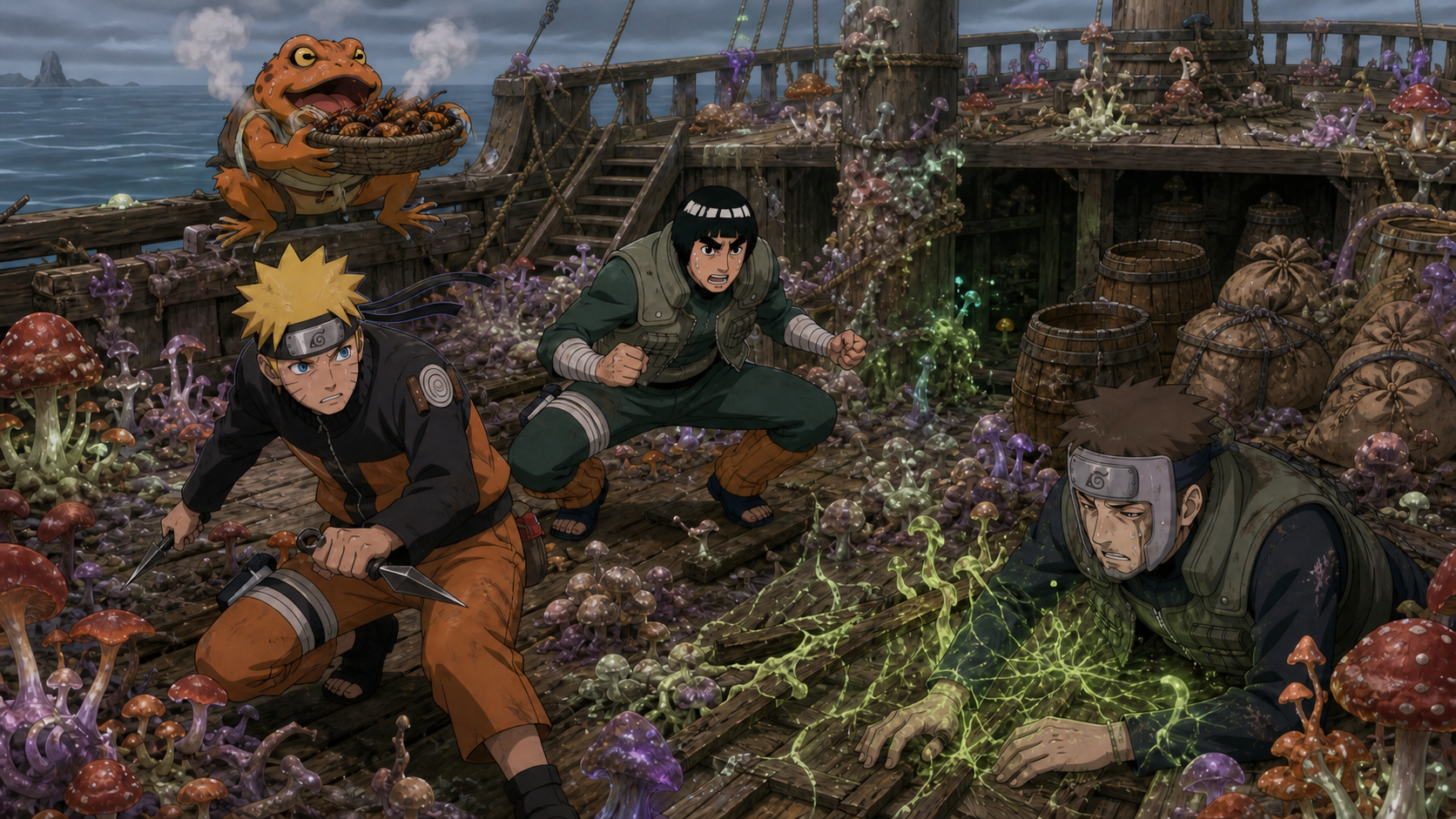
Eat or Die! Mushrooms from Hell!
One bad grocery purchase defeats the food, water, ship, and Yamato before Gamatatsu arrives with the meal nobody wanted.
Bottom line
Naruto Shippuden Episode 229 traps four elite ninja on a windless sea and nearly defeats them with one mushroom Naruto bought from a stranger. "Eat or Die! Mushrooms from Hell!" is gross, ridiculous survival filler with a solid scam underneath. Ubau sells sailors a fungus that destroys their supplies, waits for starvation to finish the job, then returns to loot the ship. Naruto makes the first mistake, but the crew survives because he finally asks Gamatatsu for help instead of pretending stubbornness counts as food.
The episode works because hunger changes the team's normal power hierarchy. Rasengan cannot restore clean water. Wood Release makes Yamato more vulnerable because the fungus feeds on his chakra through the ship. Guy's strength cannot create fish in a dead sea. Aoba's intelligence can identify the trap, but recognition arrives after their provisions are gone. The problem forces everyone to accept an answer they hate: Shima's insect cooking.
The Sea Route of Silence is a scammer's dream
Before entering the Sea Route of Silence, the crew stops at port to gather enough food and water for a two-week crossing. The route has no wind, no fish, and no easy place to resupply. A ship that loses provisions cannot sail faster, catch dinner, or turn toward a nearby harbor.
That geography creates the crime. Ubau does not need to overpower travelers at the dock. He only needs them to carry the weapon aboard. Distance removes witnesses and alternatives. By the time a crew understands what happened, currents and time have done most of his work.
The episode makes the still water feel threatening without inventing a sea monster. An empty horizon becomes a locked room. Every barrel matters. Every day consumes supplies. The lack of ordinary life around the ship also means nobody will notice when Ubau returns to strip the vessel.
Naruto buys the mushroom because the sales pitch targets fear
Ubau presents the Moulding Mushroom as emergency food that can keep sailors alive. Naruto knows the next route offers no natural food source, so the promise sounds responsible rather than reckless. The merchant turns preparation anxiety into a sale.
Naruto still deserves blame for adding an unapproved organism to the provisions. Yamato assigned a supply mission, not permission to buy magical fungus from the first smiling vegetable seller. A proper crew would inspect unusual food, isolate samples, and record the source before entering a two-week dead zone.
The mistake fits Naruto because he trusts direct solutions. A mushroom that prevents starvation sounds like a clean answer. He does not ask how the fungus multiplies, what the fungus eats, or why Ubau sells such a valuable survival tool at one convenient port. The missing questions become the whole episode.
The fungus attacks food, water, wood, and chakra
Once aboard, the mushroom spreads through the hold and consumes the provisions. The infestation reaches food and water, which removes both survival basics at once. The fungus also draws chakra from Yamato and the ship's wooden structure, leaving him weak and eventually unconscious.
Yamato's collapse raises the stakes beyond spoiled meals. His Wood Release has saved the crew from storms, cannon fire, and ship damage. Losing him means losing their most useful maritime specialist. The same ability that made the journey possible becomes a fuel source for the infestation.
The fungal spread also turns the ship against its passengers. Planks, ropes, barrels, and stored supplies become connected surfaces. Fire could destroy the mushrooms and the vessel together. Water offers no answer because the infestation has already contaminated drinking stores. The crew cannot solve the problem with a single dramatic attack.
Hunger strips away heroic dignity fast
Naruto, Guy, Aoba, and the sailors ration what remains, then run out. Hunger makes time feel longer and judgment weaker. The episode uses exaggerated bodies and desperate expressions for comedy, but the underlying problem stays serious. Two weeks without food is dangerous. Contaminated water makes the timeline worse.
Naruto and Guy resist eating the mushrooms until the choice feels impossible. Both men normally solve limits through effort. Hunger does not care how many push-ups Guy can perform or how loudly Naruto promises to endure. Their bodies need calories, water, and rest.
The loss of dignity is important. Ninja stories often treat deprivation as proof of toughness. Episode 229 shows toughness collapsing into confusion. Starvation does not make people morally pure or strategically sharp. Starvation makes two powerful men eat the organism that caused the crisis.
Eating the mushrooms turns survival into a fistfight
Naruto and Guy consume the fungus and become poisoned. Their awareness breaks down, and the two attack each other. The fight is funny because both men bring enormous combat ability to a completely stupid cause. The danger remains real because nobody aboard has enough strength to manage them easily.
Their blows eventually force the mushrooms back out of their bodies, creating a brief recovery. That solution belongs to anime logic, but the sequence reinforces a useful point: the fungus was never food. Desperation did not change the organism's nature.
The episode does not romanticize their choice. Eating the mushrooms buys no clean victory and almost creates another disaster. Naruto and Guy survive the poisoning through luck, resilience, and mutual violence. Nobody should add that method to the academy survival manual.
Naruto nearly looks at Gamatatsu and sees dinner
Naruto summons Gamatatsu when the crew has no food left. For one uncomfortable moment, the starving team considers the toad as a possible meal. The joke works because summoning relationships are supposed to be partnerships. Hunger pushes Naruto close to viewing a friend as meat.
Naruto stops before crossing the line and asks Gamatatsu to bring food from Mount Myoboku. The request leads to Shima's insect cooking, a cuisine Naruto already considers punishment under normal conditions. Scarcity changes the standard. Fried insects become a rescue package.
The moment also creates a sharp contrast with Episode 227. The forgotten-island researchers treated summoning animals as materials for shinobi demand. Naruto briefly faces the same temptation and rejects the result. He asks his summoned partner for help instead of consuming the partner.
Shima's cooking saves everyone because disgust is not danger
Shima's insect meals look awful to the Leaf crew, but the food is nutritious, available, and not actively trying to consume the ship. Naruto's disgust comes from preference and unfamiliarity. The mushrooms present poison and predation. Hunger finally teaches him the difference.
The episode gets an earned joke from the reversal. Naruto has complained about Mount Myoboku food before. During the Sea Route crisis, the same food restores enough strength for the crew to plan a counterattack. A meal does not need to look familiar to keep someone alive.
The survival lesson stays simple: reject pride before pride becomes another hazard. Naruto could have called for help earlier. Guy could have admitted weakness earlier. The crew waits until every acceptable option disappears, then discovers the unacceptable meal was safe all along.
Ubau returns because he expects a quiet corpse ship
Ubau and his gang approach after enough time has passed for the infestation to destroy the crew. Their plan depends on victims dying far from port, where evidence cannot reach anyone who might investigate. The merchant expects to board an empty vessel and collect goods without a fight.
The return confirms that Naruto's purchase was no accident. Ubau sells the fungus as a survival product while knowing the route will prevent escape. He profits from trust, isolation, and the assumption that a vegetable seller poses less danger than a pirate.
The crew uses the strength restored by Shima's food to ambush the thieves. Ubau loses because he mistakes silence for proof. He never checks whether the targets found outside food, contained the fungus, or remained capable of combat.
A supply check would have ended the episode in five minutes
The whole disaster exposes weak mission procedure. Naruto brings an unknown living product aboard. Nobody records the purchase, inspects the mushroom, or isolates the sample. The crew enters the most resource-poor stretch of the route before discovering the extra cargo. Yamato gives orders, but a captain cannot protect provisions nobody reports.
A simple quarantine container would have limited the spread. A manifest check could have found the mushroom before departure. Buying emergency supplies from multiple vendors would reduce the damage caused by one scammer. A shinobi escort should understand sabotage, especially while transporting the Nine-Tails jinchuriki toward a secret location.
The procedural failure does not erase Ubau's guilt. The merchant designed the trap. Good security still matters because villains do not need permission to exploit carelessness. Naruto learns the lesson through hunger instead of paperwork, which guarantees he will remember the mushroom longer than any supply lecture at the academy.
The punishment copies the crime too closely
Naruto's group defeats Ubau and places the criminals on a small boat heading back through the Sea Route of Silence with a Moulding Mushroom. The punishment gives the scammers the same danger they imposed on travelers.
The symmetry feels satisfying in a comedy, but the ethics are messy. The Leaf ninja know the fungus can destroy food and water, poison anyone who eats the growth, and trap a boat for days. Sending prisoners into that route risks execution by starvation without trial.
Stopping the gang and returning them to authorities would fit Naruto's usual values better. The episode wants a fairy-tale reversal, so the final image chooses poetic punishment over a careful legal answer. Funny does not automatically mean fair.
Ubau sells certainty where the route creates fear
His product promises a complete answer to the specific danger every sailor anticipates: running out of food where nothing can be caught. The pitch succeeds because it resembles responsible preparation.
A useful scam does not invent fear from nothing. It identifies a real vulnerability, offers relief faster than careful inspection, and makes caution feel like the less practical choice.
The mushroom is sabotage disguised as passenger cargo
Ubau never needs access to the ship after departure because Naruto carries the agent inside. The fungus spreads through connected supplies while distance prevents replacement.
That method turns trust into transportation. The victim performs the delivery, assumes ownership of the object, and may blame personal carelessness before recognizing an organized crime.
Supply discipline protects people more powerful than their provisions
Naruto, Guy, Yamato, and Aoba possess extraordinary combat ability. None can convert strength into uncontaminated calories and water after the stores are destroyed.
Logistics is not beneath heroic work. It defines how long heroes can remain conscious, make decisions, recover chakra, and protect everyone who cannot survive through anime determination.
Yamato’s Wood Release creates an unusual biological exposure
The ship is partly an extension of his chakra and technique, so the infestation reaches him through material that normally functions as protection. His greatest maritime advantage becomes an attack surface.
Security planning should account for abilities that connect a shinobi physically or energetically to infrastructure. A threat against the structure may also be a threat against its creator.
Starvation changes consent and judgment
Choices made after prolonged hunger are not equivalent to choices made with safe alternatives. Naruto and Guy eat a known dangerous fungus because their bodies and reasoning have been narrowed by deprivation.
The comedy works, but the condition should not become proof that they freely accepted the risk. Ubau engineered the scarcity that made a poisonous option feel available.
Gamatatsu arrives as a partner, not emergency meat
The brief thought of eating him exposes how quickly hunger can turn a relationship into resource calculation. Naruto stops before converting friendship into survival inventory.
Asking Gamatatsu to help preserves his agency. The toad can understand the emergency, return home, and bring food through a network Ubau never knew the victims possessed.
Shima’s insects expose preference as a luxury
Naruto’s earlier disgust treated unfamiliar food as nearly impossible to eat. On the silent route, nutrition, safety, and availability replace appearance as the important standards.
The lesson is not that people must enjoy every cuisine. It is that disgust should not be confused with evidence of danger, especially when familiar-looking food caused the crisis.
The crew survives through a relationship outside the ship
Ubau designs the trap around geographic isolation. Summoning breaks that model because Naruto’s social world extends to Mount Myōboku without depending on wind, fishing, or nearby ports.
The scammer calculates physical resources and misses relational resources. Naruto’s ability to ask for help becomes more decisive than his ability to attack.
Poetic reversal is not a responsible sentence
Sending Ubau through the same route with the same fungus mirrors his method, but it exposes prisoners to starvation and poisoning without custody, medical oversight, or trial.
Naruto can stop the crime without reproducing it. Turning perpetrators over to authorities would preserve accountability while refusing the idea that deserved suffering makes lethal abandonment acceptable.
The sailors deserve procedures after the joke ends
The crew now knows how one infected object can compromise every store. Future voyages need manifests, separated reserves, locked water, vendor records, and inspection before entering resource-poor routes.
A lesson remains useful only if it changes practice. Remembering the disgusting mushroom is not enough when another saboteur can choose a different organism.
The real reversal is dependence becoming strength
The episode’s most useful reversal is not mushroom against mushroom. Naruto begins by believing preparation means personally carrying the perfect answer. He survives by admitting the ship has no answer and reaching beyond it.
That request does not diminish his competence. Leadership includes recognizing when another person has access, knowledge, or resources the current team lacks. Gamatatsu becomes essential because the toad’s mobility between worlds defeats geographic isolation.
Ubau assumes victims are closed systems. Naruto’s relationships make that assumption false.
Water should remain the crisis nobody jokes away
Food dominates the title and comedy, but contaminated drinking water can incapacitate a crew faster than missing meals. Safe hydration affects consciousness, circulation, temperature control, and every attempt to recover chakra.
The episode compresses those consequences so the mushroom spectacle can continue. A more grounded survival plan would isolate remaining water first, establish ration authority, and use any summoning route to request containers before discussing dinner.
Shima’s meal restores energy, but food alone cannot repair dehydration. The omission is worth naming because viewers are being asked to take the supply trap seriously.
Ubau’s business depends on victims never returning to testify
The Sea Route of Silence destroys evidence as effectively as it destroys provisions. Empty vessels can be looted, bodies disappear, and families may blame weather or navigation rather than a merchant at the previous port.
Once Naruto’s crew survives, stopping Ubau is only the first accountability step. Port officials need his name, product description, sales location, accomplices, and a record connecting earlier disappearances to the same method.
Without that shared evidence, another seller can repeat the scam after changing the mushroom’s appearance.
RaeRae’s final word on the mushrooms from hell
Naruto buys apocalypse produce from a smiling stranger, Guy tries to out-stubborn starvation, and Yamato nearly gets eaten through his own boat. This crew needed a supply officer yesterday.
Gamatatsu saves them because friendship reaches where the ship cannot. Shima’s insects are safe, available, and apparently the price of Naruto learning that unfamiliar food is not the same as poisonous food.
Keep Ubau in custody. Keep the mushroom in quarantine. Keep the toad off the menu. Those are the three policies this voyage should write down immediately.
What works and what the episode stretches
The survival structure gives Episode 229 clear escalation. The crew enters a route with no resources, discovers contaminated provisions, loses Yamato, starves, makes a terrible food choice, accepts help, and traps the returning thieves. Each stage narrows options.
The visual comedy lands because mushrooms invade every ordinary part of the ship. Barrels, ropes, planks, and cargo become hostile. Guy and Naruto fighting while poisoned adds chaos without replacing the central threat. Gamatatsu arriving with insects provides the exact rescue the characters least want.
The episode stretches the starvation montage and avoids practical questions about water, medical treatment, and signaling for help. Ubau also remains a simple scammer rather than a developed villain. The concept carries more weight than his personality.
Filler status and watch value
"Eat or Die! Mushrooms from Hell!" is anime-original material in the "Paradise Life on a Boat" arc. Manga-only viewers can skip Episode 229 without losing a war development. Fans who enjoy survival comedy, Gamatatsu, or the travel team's group chemistry will find more value.
The episode also gives Yamato's Wood Release a rare vulnerability and reminds viewers that logistics can defeat powerful shinobi. Food, water, medical safety, and route planning matter even when the passengers can split mountains.
Final verdict: inspect the groceries and respect the toad
Episode 229 turns one bad purchase into a two-week survival trap. Naruto causes the crisis by trusting Ubau's pitch, then helps solve the crisis by asking Gamatatsu for help. Shima's insects restore the team because safe food beats familiar food. Ubau's scam fails because he assumes isolated victims have no relationships beyond the ship.
The final punishment goes too far, and the episode could handle starvation with more care. The fungal takeover still gives the boat arc one of its better self-contained problems. Naruto can fight pirates and monsters. The mushroom forces him to admit that preparation, inspection, and an orange toad carrying bugs can matter more than another Rasengan.
RaeRae’s call
Ubau nearly defeats elite shinobi through logistics, not combat. The crew survives when Naruto stops treating help as weakness, respects Gamatatsu as a partner, and accepts safe food over familiar pride.
Sources and watch routes
- Official episode reference: Naruto Official episode guide
- Licensed episode route: Crunchyroll licensed episode page