
The Young Man and the Sea
A revenge hunt becomes a rescue when Naruto finds the old war still lodged inside a summoned creature.
Bottom line
Naruto Shippuden Episode 223, "The Young Man and the Sea," begins a secret voyage by asking why an entire national port has tolerated one weaponized fish for fifteen years. The answer never fully survives common sense, but the episode finds a better story inside the shaky setup.
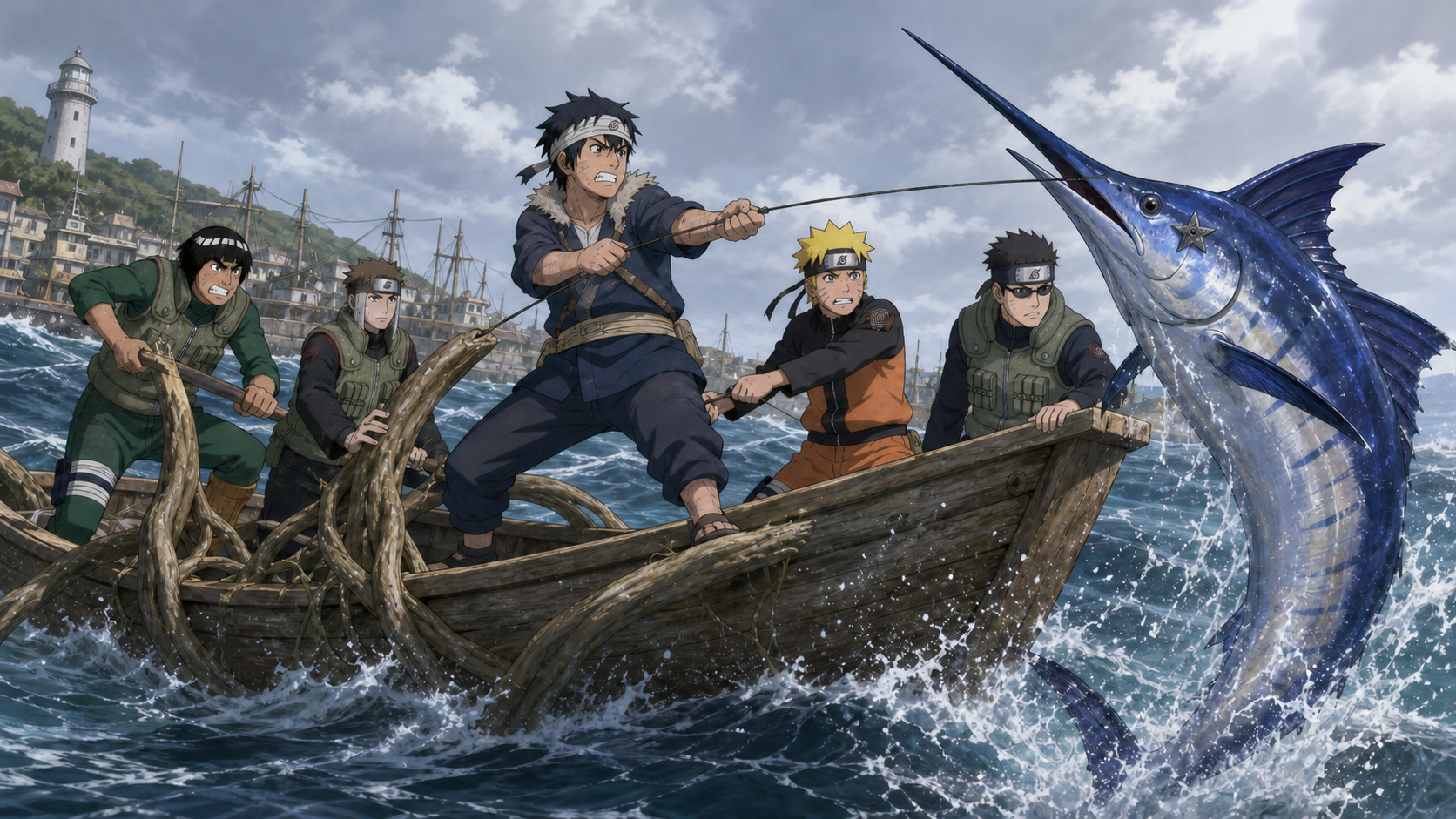
Yūsuke believes the giant marlin killed his father and has built his adulthood around catching that creature. Naruto, Yamato, Guy, and Aoba help him reach the fish. The final discovery changes the moral frame: a shinobi weapon remains embedded in the marlin's head, trapping a summoned animal far from home long after the Third Shinobi World War ended.
Yūsuke gets the confrontation he wanted. Naruto recognizes that the fish also needs rescue. Revenge and release become the same physical struggle only after somebody looks closely enough to see the old weapon.
Naruto leaves Konoha under a mission-shaped lie
Naruto believes Tsunade sent him on a top-secret S-rank mission connected to the octopus in the Great Lord Elder's prophecy. The assignment gives him urgency, status, and a reason to accept an unfamiliar route.
The real plan is concealment. The alliance wants Naruto and Killer B away from Akatsuki while war preparations continue.
That deception follows him onto the boat before the boat exists. Yamato, Guy, and Aoba know more about the assignment than Naruto does, which turns ordinary travel questions into a loyalty test for his escorts.
The escort team covers more than combat
Yamato provides leadership, construction, and Nine-Tails suppression. Guy provides overwhelming physical effort and battle experience. Aoba provides intelligence and observation. Three additional Leaf shinobi support the voyage and ship operations.
The team composition acknowledges that moving a jinchūriki across water is a logistical operation. Security alone cannot build a vessel, read a coast, manage supplies, or repair storm damage.
Naruto sees companions assigned to help complete a mission. The escorts see a protected target whose cooperation depends on maintaining the cover story.
One marlin closes the Land of Fire's usable port
Sailors refuse to leave because a sea monster attacks vessels passing through the harbor mouth. Naruto's team cannot continue until somebody solves the threat.
The premise raises a fair question: why did the Land of Fire allow a creature to interrupt shipping for fifteen years? Ports move food, medicine, passengers, military supplies, and taxes. A repeated attack would trigger organized response long before Naruto happened to arrive.
The episode never gives enough institutional explanation. Perhaps other routes remained open or attacks were intermittent, but the stated scale deserves more than frightened dockworkers and one grieving fisherman.
Local sailors make a rational choice
Refusing to sail is not cowardice when crews have watched ships attacked. A captain is responsible for workers, passengers, cargo, and families depending on everyone returning.
Shinobi can leap across water and survive impacts ordinary people cannot. Sailors do not owe Naruto's secret mission a suicidal departure.
The port delay therefore belongs to the state and the threat, not workers protecting themselves. Somebody with power should make the route safe before demanding labor resume.
Yūsuke has spent fifteen years living beside one death
Yūsuke identifies the marlin as the creature responsible for his father's death. The loss shaped his relationship with fishing, adulthood, and the sea.
His pursuit is personal rather than commercial. He does not want a valuable catch or a heroic reputation. He wants proof that the force dominating his family's history can be faced.
Fifteen years also means his memory contains a child's understanding of the event. Grief hardened around one visible creature because a fish is easier to hate than an old war, an unknown summoner, or a military system that abandoned its weapon.
Naruto recognizes stubborn grief immediately
Naruto understands what happens when one person organizes a life around a dead loved one and a target for revenge. Sasuke has followed that structure through Itachi, Danzō, and now Konoha.
Yūsuke's case is smaller, but the emotional mechanism is familiar. Naruto does not lecture him from the dock. He helps create a chance for direct knowledge.
That choice is compassionate and risky. Confrontation can produce truth, injury, or another death. Naruto supports Yūsuke while keeping enough strength nearby to prevent a private grudge from becoming a public disaster.
Yamato turns Wood Release into maritime infrastructure
Yamato builds a boat and fishing equipment because waiting for local resources would delay the mission. Wood Release becomes construction rather than battlefield restraint.
That practical use is one of the episode's best ideas. Shinobi techniques should affect agriculture, transport, disaster response, housing, and repair when wars are not consuming every specialist.
The improvised vessel also shows a limit. Fast construction creates a platform, but seamanship still matters. Wood Release cannot replace knowledge of current, balance, line tension, and how a large fish can overturn a boat.
Guy supplies an engine made of muscle and bad moderation
Guy rows hard enough to keep Yūsuke close to the marlin and draws on the Eight Gates for more power. The image is funny because Guy treats rowing as a duel with youth itself.
His effort also has a serious function. A hooked marlin can tow a small vessel, change direction suddenly, and exhaust the person holding the line. Guy gives Yūsuke a chance to fight the fish rather than simply be dragged.
Using the Gates for boat propulsion is excessive, which makes the choice perfectly Guy. The episode lets his comedy produce real labor instead of interrupting the crisis.
Aoba watches the problem other people are pulling against
Aoba brings the perspective of an intelligence shinobi. While Naruto, Yūsuke, and Guy focus on force, somebody needs to read movement, distance, and the creature's behavior.
Observation matters because the marlin is not attacking like a mindless natural predator. Fifteen years of territorial violence and the old weapon embedded near its head suggest an abnormal cause.
Aoba's role is less flashy than Guy's rowing, but survival often depends on the teammate who sees what strength is failing to explain.
The fishing struggle makes vengeance physical
Yūsuke cannot complete revenge through one dramatic strike. He must hold tension, manage fatigue, keep balance, and endure the marlin's power without letting anger waste the line.
The labor changes the emotional rhythm. Revenge fantasies skip toward impact. Fishing demands patience and response to another living body.
By the time the marlin tires, Yūsuke has encountered the creature as more than a childhood monster. He has felt fear, strength, resistance, and exhaustion traveling through the line.
The embedded weapon changes who caused the harm
Naruto finds an old shinobi throwing star embedded near the marlin's forehead. The weapon prevented the summoned creature from returning to its original home after the Third Shinobi World War.
That discovery moves responsibility away from animal evil and toward human warfare. A shinobi summoned the marlin, used the creature, injured the creature, and left the consequences in civilian waters.
Yūsuke's father still died. Understanding the cause does not erase that loss. The truth expands blame beyond the body directly in front of him.
A summon is a partner or a conscript depending on consent
Naruto's relationship with toads usually includes contracts, personalities, arguments, and mutual decisions. Gamabunta can refuse, complain, or demand respect.
The marlin's history suggests another form of summoning: a creature brought into war and stranded after serving a human purpose. The episode never identifies the summoner or explains the contract.
That uncertainty matters. Calling a being a summon does not automatically make every military use ethical. A contract can still hide coercion when one side controls transportation home.
Removing the shuriken turns capture into release
Naruto removes the old weapon so the marlin can finally leave. The action prevents Yūsuke's victory from ending as a trophy-kill.
Release offers a harder form of closure. Yūsuke cannot display the body or pretend killing one animal balanced his father's death. He can know he faced the creature, survived, and ended the condition keeping both lives tied to an old war.
The marlin's departure also protects the harbor. Mercy and public safety do not conflict once the real mechanism is understood.
Yūsuke completes the task without receiving a neat emotional cure
The episode presents his vengeance as complete, but grief does not vanish because a fish swims away. Fifteen years of identity cannot disappear at the same speed as one old weapon.
Yūsuke now has a different story about his father. The death came through consequences of war rather than a naturally malicious monster hunting his family.
That truth may ease hatred, create new anger, or leave him wondering which shinobi caused the disaster. Closure can mean the question changes, not that every feeling ends.
The Third Shinobi World War remains in civilian water
Most war stories count battles, famous deaths, and treaties. Episode 223 shows an abandoned military consequence disrupting work fifteen years later.
Dockworkers who never summoned the marlin lose income. Sailors accept danger. Yūsuke loses a father. The animal remains trapped away from home.
War does not end everywhere when leaders sign peace. Weapons, mines, displaced people, damaged land, and trained violence remain in ordinary communities long after official history moves forward.
The episode accidentally comments on the coming war
Naruto is traveling because another world war is about to begin. He encounters a creature abandoned by the previous war before reaching the alliance's protected island.
That timing should trouble the shinobi adults. The alliance is preparing new summons, weapons, deployments, and secret locations while old consequences still block a national harbor.
Winning against Akatsuki will not be enough if the alliance leaves another generation of civilians and creatures cleaning up military decisions nobody claims.
The Hemingway reference works best as a loose conversation
The title echoes Ernest Hemingway's The Old Man and the Sea, but Yūsuke's story is not a direct adaptation. The episode borrows the sea struggle, bodily endurance, and a fisherman's identity tied to one extraordinary catch.
Hemingway's old fisherman fights for dignity and returns with the remains of a catch consumed by sharks. Yūsuke fights through grief and releases the marlin after discovering human responsibility.
The differences matter more than a clever title. Naruto's version turns domination into rescue and places war beneath the apparent contest between human and fish.
Filler status does not excuse weak logic or erase useful ideas
Episode 223 belongs to an anime-original voyage arc. The episode does not adapt a manga chapter and should be labeled honestly.
Anime-original material can still develop themes, characters, and world consequences. The marlin's connection to an older war gives the voyage a relevant idea.
The fifteen-year port shutdown remains hard to believe. Viewers do not have to choose between noticing that flaw and appreciating the final act of release.
The Japanese performances balance strain and sincerity
Yūsuke's Japanese performance carries anger through physical effort rather than turning every line into a grief speech. The strain makes his fixation feel lived rather than decorative.
Naruto responds with immediate investment because another person's unresolved pain rarely remains somebody else's business around him. Guy's volume and rowing intensity provide comedy without mocking Yūsuke's father.
Yamato and Aoba ground the group through practical reactions, giving the improvised fishing mission enough adult supervision to remain believable inside the episode's larger absurdity.
The harbor accepted private grief as public infrastructure
Yūsuke’s fixation receives sympathy, but the town has also allowed his personal hunt to stand in for organized public safety. One fisherman should not carry responsibility for reopening a national route.
Officials, merchants, and shinobi authorities benefited from letting the danger become a local legend. The arrangement kept institutional failure invisible while sailors absorbed the cost.
Naruto’s team succeeds because nobody works outside their limits
Guy’s strength cannot identify the embedded weapon. Aoba’s observation cannot pull the marlin close. Yamato’s boat cannot settle Yūsuke’s grief. Naruto’s compassion needs everyone else to create the moment where rescue becomes possible.
The sequence is strongest when it treats teamwork as interdependence rather than five people waiting for the protagonist’s finishing move.
Yūsuke must surrender the ending he rehearsed for fifteen years
He prepared to catch and kill the creature that represented his father’s death. Learning the marlin was another casualty forces him to abandon the emotional script at the moment victory appears available.
That surrender is not weakness. It requires accepting that grief selected the wrong defendant because the actual guilty system was distant, anonymous, and protected by history.
The marlin carries evidence nobody bothered to examine
An old weapon remains embedded in a living body while the community repeats a monster story. The visible wound could have changed the explanation years earlier if anyone had approached the creature with curiosity instead of fear.
Evidence often exists before institutions are willing to read it. Naruto changes the outcome because he treats the target’s body as testimony.
Summoning contracts need an ethics beyond battlefield usefulness
The franchise usually makes summons memorable individuals with homes, tempers, and political relationships. Their personalities encourage viewers to understand service as negotiated partnership.
The stranded marlin exposes what happens when transportation and return remain under shinobi control. A creature can fulfill a command and still be abandoned inside consequences it never consented to carry.
Removing the weapon repairs more than one relationship
The extraction releases the marlin, reopens the port, ends Yūsuke’s hunt, and corrects the community’s account of the danger. One act works across personal, ecological, and economic harm because it addresses the mechanism rather than punishing the symptom.
Naruto’s gift is not merely mercy. He recognizes when apparently separate problems share one buried cause.
The voyage starts by warning what war leaves behind
The alliance plans troops and concealment while Naruto encounters a veteran nobody counted: a summoned animal carrying metal from the previous conflict. Its fifteen lost years are absent from every official casualty list.
If the new alliance wants to represent progress, it must eventually account for aftermath. Victory without cleanup simply transfers military cost to civilians, landscapes, and animals unable to send delegates to a summit.
Anime-original does not mean emotionally disposable
The episode’s port logic deserves criticism, yet its central image belongs beside the series’ larger arguments about inherited violence. A weapon from an old war remains inside a body until the next generation recognizes the injury.
Canon labels describe adaptation history. They do not decide whether an episode can ask a useful question or whether viewers are allowed to remember its answer.
Production choices make the marlin a character
Scale, speed, water impact, and the embedded weapon keep the marlin from reading as a generic boss. The creature can frighten sailors and still become visibly exhausted and trapped.
The boat sequence distributes action across specialized labor. Yūsuke holds the line, Guy powers pursuit, Yamato maintains the vessel, Aoba observes, and Naruto intervenes when the truth becomes visible.
That teamwork gives the resolution more weight than a single Rasengan ending the harbor problem.
A monster story lets every institution remain innocent
The village’s monster story protected comfortable distance. If the marlin was naturally evil, nobody needed to ask which shinobi summoned it, which battle displaced it, or why officials abandoned the harbor afterward.
That explanation also made Yūsuke’s revenge socially useful. His private determination offered the town a volunteer solution while everyone else waited behind the docks. Praising his courage cost less than building a coordinated response.
Closure arrives through a corrected story, not a conquered body
Yūsuke begins with a simple narrative: the fish killed his father, so killing the fish will settle the debt. The embedded weapon replaces simplicity with history. His father and the marlin were harmed by the same military aftermath from different sides.
He cannot recover the years already spent hunting. He can decide whether new knowledge changes the next action. Letting the creature leave keeps grief from demanding another victim merely because the victim is finally within reach.
Naruto practices the leadership the alliance still lacks
Naruto does not hold office, command the port, or know the entire history. He observes harm, listens to the person carrying grief, and revises the mission when evidence changes responsibility.
The Five Kage are building cooperation through command structures. Naruto demonstrates its moral requirement: the willingness to stop pursuing the agreed target when the target turns out to be another trapped participant.
The ridiculous setup cannot erase the humane resolution
I still need the Land of Fire to explain why one giant fish apparently defeated port administration for fifteen years. Somebody had budgets, shinobi contacts, and a reason to care about shipping before Naruto arrived.
The ending earns its tenderness anyway. Yūsuke confronts the object of his hatred and chooses release after receiving better information. That is more difficult than winning the fight he imagined.
RaeRae’s final word on The Young Man and the Sea
Guy using the Eight Gates to row a wooden boat is exactly the kind of nonsense filler should deliver. His commitment has no reasonable setting, and I respect the consistency.
Yūsuke’s grief is never ridiculous. He has spent most of his life believing one creature chose to take his father, then learns human warfare trapped that creature in the same tragedy.
Naruto does what institutions failed to do. He looks closely, finds the weapon, and understands that killing the visible target would preserve the real injustice.
The port reopens because mercy follows evidence. The marlin goes home, Yūsuke survives his confrontation, and an old war finally loses one piece of its grip on the present.
RaeRae’s call
The harbor premise is shaky, but the resolution lands. Naruto refuses the easy monster story, removes the weapon causing the harm, and gives both Yūsuke and the marlin a future beyond an abandoned war.