
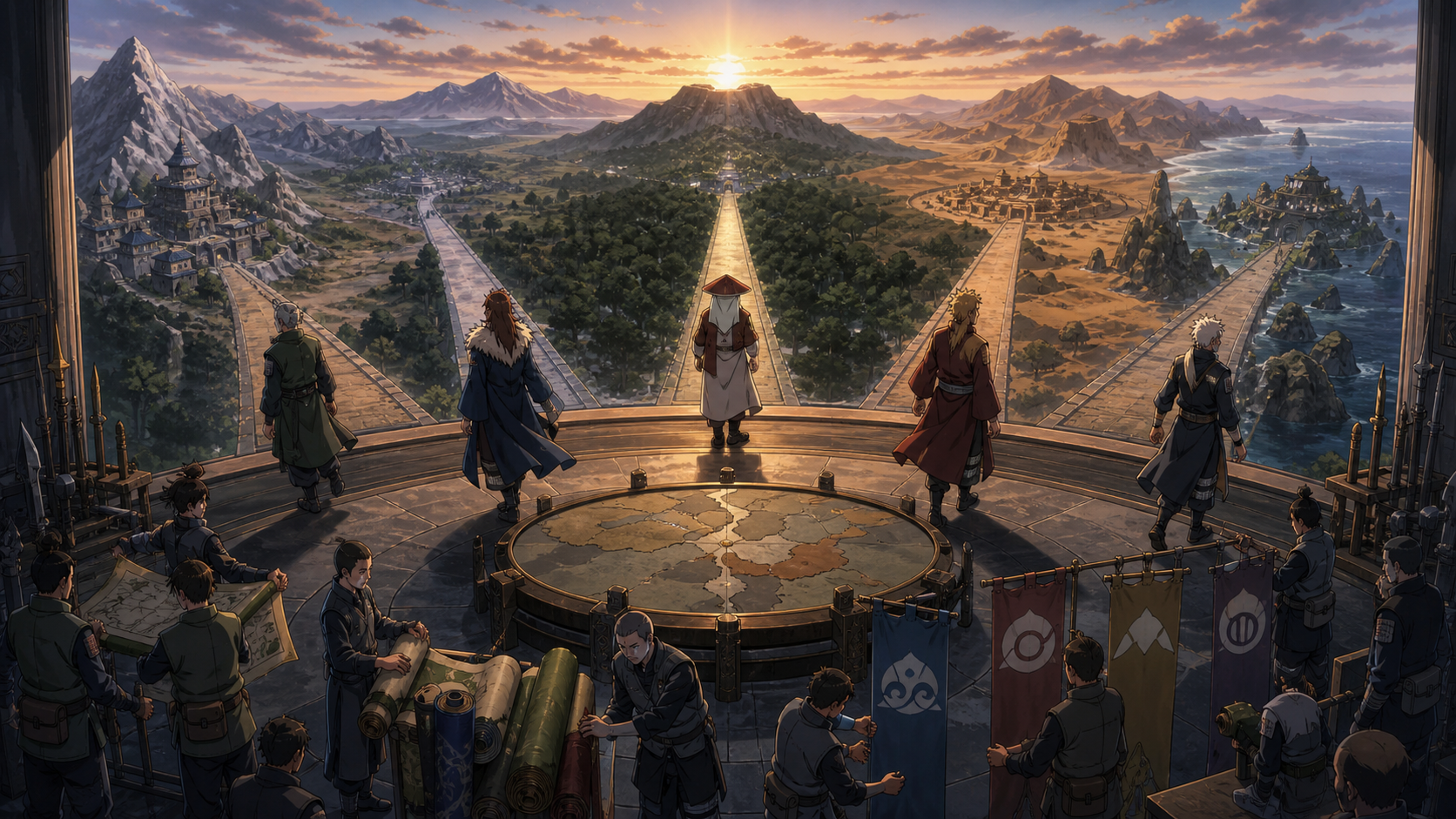
The Five Great Nations Mobilize
One ratified alliance becomes five local mobilizations as every village prepares to turn political agreement into a shared war effort.
Bottom line
Naruto Shippuden Episode 218, "The Five Great Nations Mobilize," turns the Five Kage Summit from an emergency meeting into a functioning military alliance. The five feudal lords approve the Allied Shinobi Forces through a remote conference, giving each Kage authority to return home and begin open preparation for war against Tobi and Akatsuki.
The political decision moves immediately into local consequences. Kakashi sends his ninken with news of Danzō's death. Gaara briefs the Sand Council, where distrust of Konoha collides with memories of Naruto saving their Kazekage. Naruto returns to a village still rebuilding after Pain and asks Shikamaru to gather their friends so he can explain his decision about Sasuke himself.
The episode is deliberately transitional. No army has entered the field, but every relationship begins changing shape around the coming war. Cooperation is no longer an inspiring proposal. Leaders, messengers, councils, and young shinobi must decide how alliance works when the participating villages still carry years of suspicion.
The feudal lords turn agreement into authority
The Kage can negotiate military cooperation, but the scale of the proposed alliance requires approval from the political rulers funding and authorizing their villages. The remote conference shows that the shinobi world has overlapping systems of power rather than a simple ladder ending with each Kage.
Ratification matters because war preparation consumes national resources. Troops must be moved, supplies organized, intelligence shared, and command structures accepted across borders. Personal trust among the Kage cannot authorize every consequence alone.
The conversation is brief because the threat has already removed the luxury of prolonged debate. Tobi declared war publicly and named the remaining jinchūriki as targets. The lords are not voting on an abstract reform. They are deciding whether fragmented defense can survive a coordinated enemy.
Approval also creates accountability. The alliance can no longer be treated as a private Kage experiment if losses mount or strategy fails. Civil authorities have accepted the risk and must support the resources required to make their decision real.
Technology makes the political scale visible
The teleconference allows five rulers to meet without gathering in another vulnerable summit chamber. Screens collapse geographical distance while preserving the formal separation of each nation.
That visual choice suits an alliance being created before emotional unity exists. The lords can reach one decision while remaining in distinct rooms, surrounded by their own advisers and priorities. Cooperation begins through a shared channel rather than a shared identity.
The system also demonstrates what wartime communication must accomplish. Information needs to cross borders faster than messengers can travel. The alliance will depend on networks, codes, and verification as much as battlefield strength.
The Kage return home carrying one decision into five histories
Ratification does not produce identical preparation. Each Kage returns to a village with its own losses, rivalries, military culture, and opinion of the other nations. The alliance must be translated into local orders that people are willing to follow.
Ōnoki carries the Stone's long memory and skepticism. Mei returns to a Mist still emerging from the Bloody Mist era. The Raikage brings the urgency of protecting Bee. Gaara faces a Sand council aware of both past conflict with Konoha and Naruto's role in saving their Kazekage.
The episode understands that international cooperation succeeds or fails in those local rooms. A summit declaration matters, but mobilization happens when village institutions accept unfamiliar partners as part of their own survival plan.
Kakashi's ninken turn private knowledge into allied intelligence
Kakashi sends his dogs to distribute news of Danzō's death. The update cannot wait for Team 7's full return because Danzō left the summit as acting Hokage and his status affects whether other villages trust Konoha's commitments.
The ninken are a fitting communication network for Kakashi. They can move quickly, identify recipients, and carry information through terrain where ordinary channels may be uncertain after the summit crisis.
This is the opposite of the secrecy that damaged Team 7. Kakashi recognizes a fact that must become shared operational knowledge and pushes the update outward. Alliance requires the villages to plan around the same reality.
The Sand Council does not forget Danzō's reputation
One Sand councillor questions cooperation with Konoha while Danzō holds the Hokage title. The concern is not irrational obstruction. Danzō built his career through hidden operations, manipulation, and policies that asked others to trust outcomes without seeing the methods.
An alliance demands intelligence sharing and coordinated command, precisely the areas where Danzō's reputation creates fear. The Sand cannot treat the title of Hokage as automatic proof of good faith.
News of his death changes the immediate political calculation, but the suspicion remains instructive. Institutions inherit reputations from the people who represent them. Konoha will need transparent action, not only a new leader, to rebuild international confidence.
Gaara makes Naruto relevant to military trust
Kankurō wonders how Naruto can save Sasuke after the missing-nin killed a Hokage and attacked the summit. The question extends beyond friendship. Sasuke has become part of the threat environment the alliance must address.
Temari answers through Gaara's history. Naruto reached their brother when the Sand siblings could not, then later fought to recover him from Akatsuki. Their family has direct evidence that Naruto can change a person whom violence and isolation appeared to have placed beyond help.
Gaara does not promise that Naruto will succeed with Sasuke. He recognizes Naruto's unusual power to reach people and leaves the choice with him. That confidence gives Naruto room without asking the Sand to ignore Sasuke's danger.
Naruto returns to a village still under construction
Konoha's gates do not open onto a restored home. Buildings, streets, and routines remain shaped by Pain's assault. Naruto smiles at the rebuilding because recovery proves the village did not end with destruction.
The image matters after the bridge confrontation. Sasuke wants to destroy Konoha as payment for the Uchiha massacre, while Naruto returns to people physically reconstructing the same village. Konoha is both the institution that produced terrible harm and a community full of people trying to live.
Naruto's decision about Sasuke must hold both truths. Protecting the village cannot require denying its history. Understanding Sasuke cannot require treating every resident as an acceptable target.
Shikamaru becomes the person Naruto asks to gather everyone
Naruto turns to Shikamaru because organization is one of Shikamaru's strengths and because their friends have already tried to make a collective decision about Sasuke. The request acknowledges that the group deserves a direct account.
Shikamaru had previously approached Naruto with the conclusion that Konoha might need to eliminate Sasuke. Naruto now returns after facing Sasuke himself and asks for a meeting rather than another private conversation.
That move represents overdue transparency. Naruto may still carry details he struggles to share, but gathering the group creates a forum where his decision can be heard, questioned, and placed beside the risks everyone else carries.
Konohamaru's newspaper request meets a changed Naruto
Konohamaru, Udon, and Moegi rush toward Naruto looking for another story for their newspaper. The interruption brings ordinary village life into an episode focused on war councils and international command.
Naruto postpones the interview because the meeting with his peers cannot wait. The choice shows a new sense of priority without making him cold toward the younger students. Public hero stories can come later; the people affected by his Sasuke decision need honesty first.
The newspaper also raises a smaller version of the episode's information question. Who receives news, who frames the story, and when does private knowledge become public? Mobilization will place those questions everywhere.
The alliance begins before trust is complete
The five nations do not erase their history through one vote. Stone, Cloud, Mist, Sand, and Leaf have fought, hired one another's enemies, competed for power, and interpreted security through different interests.
Akatsuki creates a common threat strong enough to force cooperation before reconciliation finishes. That order is uncomfortable but realistic. People sometimes have to build reliable procedures with partners they do not yet know how to forgive.
The episode frames alliance as work rather than emotion. Messages must arrive. Councils must be persuaded. Command must be clarified. Suspicion must be voiced without allowing suspicion to paralyze defense.
Danzō's death creates a leadership vacuum and an opening
Danzō's death removes the immediate obstacle troubling the Sand Council, but Konoha now lacks an active Hokage during the most dangerous military transition in generations. Tsunade remains unconscious, and Kakashi returns from the summit carrying expectations he did not seek.
The vacuum creates vulnerability because allied partners need to know who can commit Leaf forces and honor agreements. Internal succession is no longer only a village matter.
At the same time, Danzō's removal creates an opportunity for Konoha to participate without his hidden agenda shaping every exchange. The next leader inherits both the alliance and the obligation to prove that the Leaf can act transparently inside the alliance.
Mobilization exposes the labor beneath a war arc
Large battles often begin in stories with armies already assembled. Episode 218 pauses over the less glamorous work: authorization, travel, reports, briefings, council debate, and personnel coordination.
Those steps determine whether fighters arrive with supplies, accurate objectives, and a chain of command. Heroic strength cannot compensate for five armies receiving contradictory instructions.
The transition therefore earns its place. War is not only a collection of duels. War is a logistical system capable of turning political decisions into thousands of coordinated movements.
Those movements will include people who never attended the summit and may know former allies only as enemies from family stories. Preparation therefore requires more than distributing uniforms and formations. Leaders must explain why the shared threat changes old calculations without pretending old wounds never happened.
The Japanese performances keep politics connected to people
The feudal-lord conference carries formal urgency without making every ruler sound identical. Their different rhythms preserve the sense that five independent authorities are reaching one necessary conclusion.
Gaara's calm delivery gives the Sand discussion a moral center. Kankurō's doubt sounds grounded in what Sasuke has done, while Temari's answer carries family memory rather than blind optimism.
Naruto's return shifts the soundscape toward familiar village relationships. Shikamaru, Ino, Chōji, and Konohamaru remind viewers that international decisions will land on specific young people who grew up together.
Ratification separates emergency agreement from legitimate command
The Kage can recognize danger and design a response, but armies belong to nations whose resources, civilians, and political leaders will carry the consequences. Approval connects military urgency to public authority.
The process may be brief, yet its existence matters. An alliance opposing Tobi’s absolute control begins by accepting that powerful shinobi cannot authorize every cost alone.
Five screens preserve difference inside unity
The lords do not merge into one room, costume, or political voice. Technology allows agreement while each ruler remains visibly located inside a separate national context.
That image provides the coalition’s best argument against Infinite Tsukuyomi. Shared action does not require identical experience, memory, or perspective; people can coordinate without surrendering the boundaries that make consent meaningful.
Mobilization begins with translation
A summit decision must become local language for councils, commanders, supply officers, families, and shinobi who remember the other nations as enemies. Every Kage carries the same alliance into a different historical room.
Orders alone can move troops. Trust requires explaining why cooperation serves present survival without demanding that old injuries be forgotten or denied.
The Sand debate gives suspicion a legitimate place
Danzō manipulated the summit and built a reputation through secrecy. Questioning Konoha’s reliability is evidence of memory, not automatic obstruction.
Gaara does not silence that concern to perform unity. The alliance becomes more credible when doubt can be named, answered with updated facts, and carried forward as a demand for transparent conduct.
Naruto’s history becomes diplomatic evidence
Temari and Gaara remember that Naruto reached the lonely child their own family could not. His influence has already changed Sand leadership and helped recover its captured Kazekage.
That record does not guarantee he can save Sasuke. It explains why allowing Naruto room to choose is not merely Konoha sentiment imposed on allies endangered by Sasuke.
Konoha’s rebuilding prevents village from meaning one thing
Sasuke sees the institution that ordered his clan’s destruction and residents whose ordinary lives continued above the secret. Naruto returns to workers reconstructing homes after Pain.
Both realities occupy the village. Accountability cannot flatten Konoha into innocent community, and revenge cannot flatten every inhabitant into a willing beneficiary of classified violence.
Physical reconstruction becomes a political test
Walls and streets can be rebuilt faster than trust after Danzō, the massacre, and years of hidden policy. Alliance membership requires Konoha to repair both structures.
A new roof proves survival. Transparent leadership, shared intelligence, and honest history will determine whether the village rebuilds the system that created its vulnerabilities.
Naruto chooses a meeting after being excluded from one
The rookies decided Sasuke’s fate without him and sent Sakura with a false confession. Naruto returns with his own bridge decision and asks Shikamaru to gather everybody.
The method shows growth even before the conversation succeeds. He begins replacing private promises with a forum where friends can question the danger they will also be asked to carry.
Shikamaru provides structure rather than automatic agreement
He previously told Naruto why Konoha’s peers believed Sasuke needed to die. Gathering them does not mean endorsing Naruto’s answer or softening that judgment.
His organizational skill creates the room where conflict can become shared information. Relationships need procedure when emotion has repeatedly turned each person toward solitary action.
Konohamaru’s newspaper represents the civilian story forming nearby
Young reporters want the heroic version of Naruto’s journey while war preparation and Sasuke’s crisis remain unresolved. Their enthusiasm shows how public memory begins before leaders finish deciding what can be said.
Naruto postpones the interview because the affected people deserve direct truth first. Public narrative cannot responsibly substitute for conversation with those carrying immediate consequences.
Messengers are the connective tissue of alliance
Kakashi’s ninken turn Danzō’s death from private battlefield knowledge into information other villages can use. Speed matters because leadership assumptions change troop planning and diplomatic trust.
The dogs are less spectacular than Kage techniques and equally essential. A coalition only exists where accurate information can travel reliably between the decisions made at its edges.
Production choices map one decision across the world
The episode moves between screens, travel routes, council rooms, messenger paths, and rebuilding streets. Each location receives the same news at a different stage: proposal, approval, interpretation, or personal consequence.
That structure creates momentum without requiring combat. The world feels as though multiple gears have started turning at once. A message leaving Kakashi can change a Sand debate; a summit decision can reshape orders in every village.
The wide geography also prevents Konoha from remaining the only meaningful center. Naruto's choice matters, but the coming war belongs to nations with their own leaders and reasons for participating.
Logistics makes political values measurable
Claims of unity become real through food, medicine, transport, codes, command channels, and agreements about whose orders cross national lines. Every practical system contains a decision about trust.
War preparation therefore exposes whether leaders mean cooperation or merely want access to one another’s strength without reciprocal accountability.
The enemy inside the Cloud makes mobilization immediately incomplete
While nations authorize visible armies, Kisame listens from Samehada beside one of the two people those armies exist to protect. Scale cannot compensate for an intelligence breach.
The alliance needs verification practices as urgently as troop numbers. Otherwise coordinated movement simply gives the infiltrator a clearer map of everybody’s plan.
Coalition does not erase local responsibility
Each village must bring its history, leadership failures, and treatment of jinchūriki into the alliance rather than using the common enemy to postpone self-examination.
Akatsuki exploited fragmentation, but unity without accountability could reproduce the same conditions under a larger banner. Cooperation must change how power is exercised at home.
Mobilization asks ordinary people to trust unfinished politics
Most mobilized shinobi never heard Tobi explain Infinite Tsukuyomi. Many will know allied uniforms through border conflict, inherited stories, and missions where cooperation would once have been treason. Leaders must turn urgency into enough shared understanding that obedience does not depend on hiding the past.
That work cannot promise emotional unity before deployment. It can establish rules for command, medical care, prisoners, intelligence, supplies, and disputes so former enemies know what conduct the alliance will protect. Procedure becomes a temporary bridge while relationship develops through action.
The same lesson applies to Naruto’s meeting. His friends may reject his decision about Sasuke, and disagreement does not make the gathering a failure. Speaking directly allows them to plan around the truth rather than another performance of consensus. Five nations and one damaged team are attempting the same difficult move: remain distinct, tell enough truth to coordinate, and choose shared responsibility before trust feels complete.
RaeRae’s final word on the Five Great Nations mobilizing
This episode understands that declaring an alliance is the glamorous sentence and mobilization is the paragraph full of budgets, dogs, councils, roads, and people asking whether former enemies are serious.
I appreciate that the Sand is allowed to distrust Danzō. Unity that requires amnesia is another control scheme wearing a nicer uniform.
Naruto returning to unfinished Konoha keeps the politics human. He must protect residents, confront the village’s guilt, and explain Sasuke to friends who were done being excluded several lies ago.
Five nations are moving, and Kisame is already inside one of them. Please inspect the sentient sword before printing the matching alliance headbands.
RaeRae’s call
The alliance becomes credible through ratification, local debate, verified messages, and logistical work. Cooperation preserves difference; secrecy and unchecked trust remain the vulnerabilities Akatsuki is prepared to exploit.