
High-Level Shinobi
Naruto and Sasuke understand each other through their clash, then choose opposite answers to the bond neither has managed to sever.
Bottom line
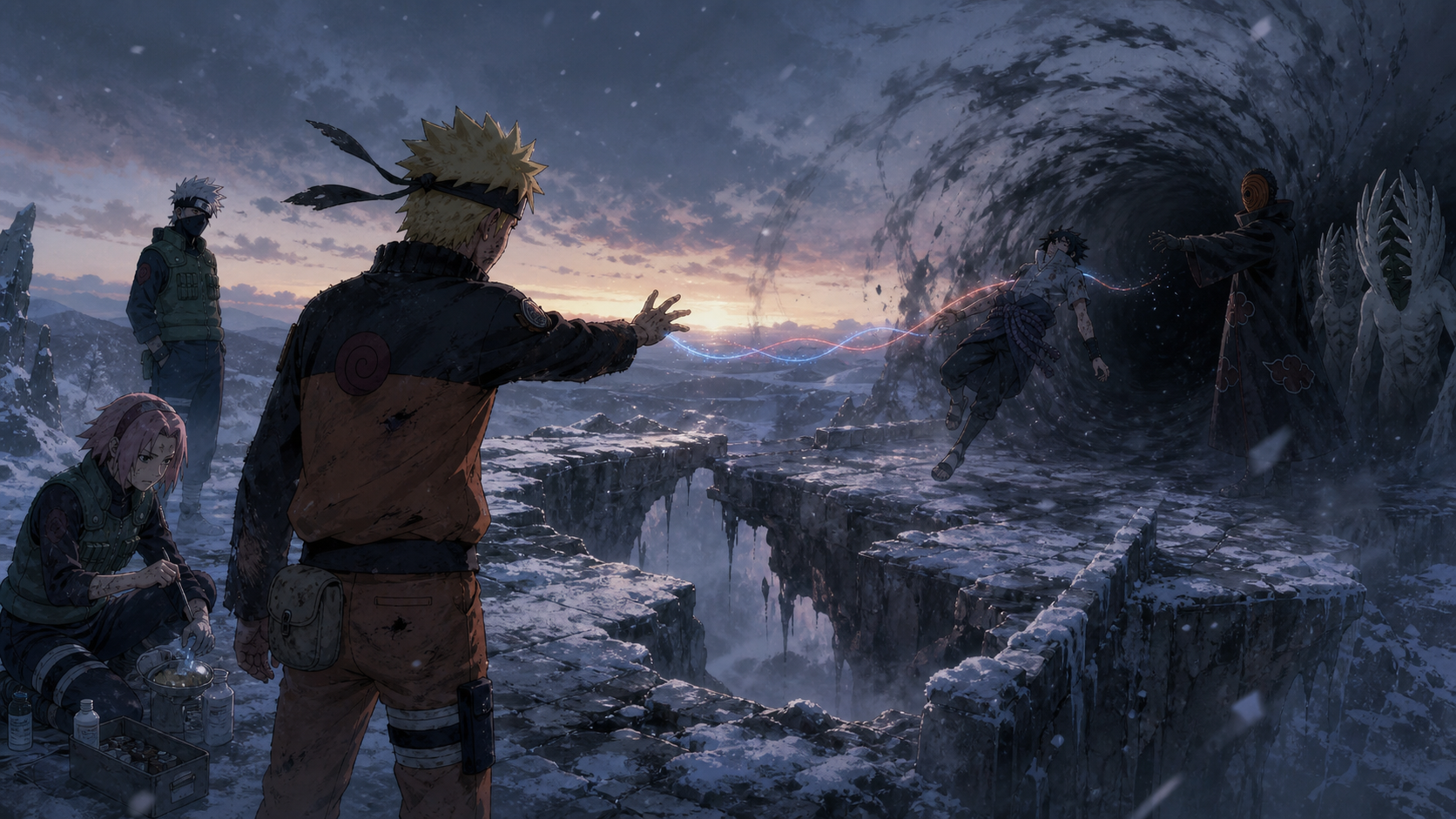
Naruto Shippuden Episode 216, "High-Level Shinobi," completes the confrontation at the Samurai Bridge. Naruto and Sasuke collide with Rasengan and Chidori, and the exchange confirms something Sasuke said years earlier: skilled shinobi can understand one another through traded blows. Naruto finally feels the full weight of Sasuke's hatred, while Sasuke recognizes that Naruto's promise cannot be dismissed as childish noise.
Naruto tells Sasuke that another full battle will kill them both. He does not offer mutual death as punishment or romance. He names the cost he is willing to carry rather than hand Sasuke's fate to Sakura, Kakashi, or the villages preparing for war. Tobi and White Zetsu remove Sasuke before the confrontation can continue. Naruto later collapses from the poison on Sakura's kunai, Kakashi takes Karin into Leaf custody, and Sasuke asks Tobi to transplant Itachi's eyes.
The episode closes one phase of Naruto's pursuit and begins another. He no longer imagines that a speech or retrieval order can restore the old Team 7. Sasuke leaves knowing Naruto understands him. Naruto remains committed to meeting him again with enough strength to carry both their lives through the final clash.
Their clash completes the sentence from the Valley of the End
Years earlier, Sasuke told Naruto that high-level shinobi could read one another through exchanged blows. At the time, the statement helped Sasuke defend distance. Combat seemed cleaner than confession, especially for a boy who treated vulnerability as another weakness an enemy could exploit.
Episode 216 returns that idea to him. Rasengan and Chidori become more than opposing techniques. The impact carries intent without allowing either boy to hide behind insult, strategy, or remembered grievance. Naruto feels how completely Sasuke has organized his future around revenge. Sasuke feels that Naruto has accepted the danger without abandoning the bond.
The exchange does not create agreement. Understanding another person does not require approving his conclusion. Naruto understands and refuses. Sasuke understands and leaves. Their new clarity makes the conflict harder because neither can pretend the other simply lacks information.
Naruto names a fate rather than winning an argument
Naruto has spent years promising to bring Sasuke home, but Episode 216 changes the language of that promise. Homecoming is no longer presented as a straightforward return to the village or the restoration of childhood Team 7. Sasuke has attacked allies, abandoned Karin, killed Danzō, and declared Konoha his target. Naruto knows the scale of the damage.
His answer is not a persuasive slogan. He tells Sasuke what will happen if both continue toward their strongest confrontation: neither will survive. Naruto accepts personal responsibility for meeting that future instead of asking someone else to kill Sasuke first.
The declaration frightens Sakura because Naruto places his life inside the solution. Kakashi also hears a student taking on a burden the teacher tried to reserve for himself. Naruto is not asking permission. He is establishing that every plan concerning Sasuke must account for the person Sasuke has never managed to erase.
Sasuke cannot dismiss recognition as ignorance
Sasuke has repeatedly argued that Naruto cannot understand Uchiha loss. Naruto did not know parents, siblings, or a clan whose murder became village policy. Those differences remain real. Episode 216 does not flatten their childhoods into identical loneliness.
Naruto reaches Sasuke through another route. He has learned the truth about Itachi, witnessed Sasuke's choices, and felt the hatred carried inside their clash. His refusal now comes after knowledge rather than before knowledge. Hope survives contact with the worst available evidence.
That change matters to Sasuke. He can reject Naruto's plan, but he cannot reduce Naruto to someone speaking from innocence. The one person who has pursued him across every transformation has finally understood enough to state the cost without retreating.
Kakashi's solution fails because Team 7 is not only his burden
Kakashi tries to take responsibility as Sasuke's former teacher. He sees a dangerous missing-nin, remembers the student he trained, and concludes that ending the threat should be his duty. The choice is loving and controlling at the same time. Kakashi hopes to protect Naruto and Sakura by excluding them from the final consequence.
Naruto's shadow clone physically restrains that plan. The student refuses a version of protection that leaves Kakashi alone with the killing. Team 7's history belongs to all four members, even though each person carries a different share of blame, love, and grief.
Kakashi cannot repair the team through rank. An order cannot make Naruto stop caring, make Sakura forget what happened, or make Sasuke recognize village authority. Professional duty remains necessary, but the episode exposes the limits of procedure when a criminal crisis grew from a family-shaped wound.
Sakura's poison reaches the person she wanted to protect
Sakura prepared poison for Sasuke and concealed her plan from the friends who followed her. During the struggle, Naruto receives the cut from her kunai. The weapon meant to release him from a promise enters his body instead.
The consequence is painfully direct. Sakura tried to contain every risk through secrecy: lie to Naruto, disable her companions, approach Sasuke alone, and carry the guilt of killing him. None of those choices protected the people she loved. Naruto saves her, then collapses because her private solution remained active on the blade.
Sakura immediately uses the antidote, returning to the medical role grounded in knowledge rather than despair. Healing Naruto does not erase the failed assassination. Her response does show that accountability can begin through honest repair instead of another attempt to control the entire outcome alone.
Karin becomes a witness instead of discarded evidence
Karin watched Sasuke sacrifice her body to strike Danzō and then abandon her when she became inconvenient. Her presence records how far his pursuit of revenge has already traveled. Sasuke's claims about loyalty or purification cannot erase the person left bleeding beside the bridge.
Kakashi decides to bring Karin back to Konoha. The choice serves an intelligence purpose because she witnessed the summit aftermath and Sasuke's actions, but custody also removes her from the immediate reach of the people who treated her as expendable.
Karin is not asked to validate Team 7's grief. Her injury stands on its own. The episode keeps her in the aftermath as proof that Sasuke's darkness has consequences beyond the childhood bonds dominating the conversation.
Tobi preserves Sasuke for the war he is building
Tobi interrupts before Naruto and Sasuke can test the promised outcome. His intervention is strategic, not compassionate. Sasuke remains valuable as an Uchiha, a weapon, and a person whose pain can be directed toward Tobi's larger design.
White Zetsu assists the withdrawal while Kakashi's Kamui offers no simple answer against Tobi's space-time technique. The escape reminds Team 7 that their private crisis now belongs to a conflict extending far beyond the bridge.
Tobi benefits whenever grief becomes isolation. Sasuke's refusal of Naruto, Sakura, Kakashi, and Karin leaves him increasingly dependent on the one man offering power without moral restraint. Removing Sasuke from the bridge preserves that dependence before recognition can become reconsideration.
The request for Itachi's eyes is Sasuke's answer
After leaving Naruto, Sasuke asks for Itachi's eyes to be transplanted. His own vision has deteriorated after repeated Mangekyō use, and the Eternal Mangekyō Sharingan offers the power needed for the path ahead.
The request is emotionally brutal. Sasuke once defined himself through killing Itachi, then learned that his brother protected him at an unbearable cost. Now he chooses to carry Itachi's eyes inside his own body. Love, grief, inheritance, and weaponization collapse into one decision.
Sasuke says he needs greater power to kill Naruto. That explanation confirms how seriously he received the bridge encounter. Naruto is no longer an irritating pursuer who can be ignored. Sasuke prepares his body for the opponent who understands him and still refuses his destination.
High-level skill means perception plus responsibility
The title could refer only to combat ability. Naruto and Sasuke are powerful enough to communicate through a collision that would destroy weaker fighters. The episode asks what each person does with that perception afterward.
Sasuke uses understanding to sharpen preparation. He accepts Itachi's eyes and commits to greater destructive power. Naruto uses understanding to accept responsibility. He refuses to outsource the confrontation and begins measuring the strength required to survive a bond that may otherwise kill them both.
Skill therefore does not guarantee wisdom. Reading another person's heart creates a moral choice; the reader may answer with care, fear, manipulation, or escalation. Naruto and Sasuke leave the same exchange with opposing responses.
Team 7 reunites without pretending to be restored
All four original members occupy the bridge, but the arrangement is fractured. Sakura tried to kill Sasuke. Sasuke tried to kill Sakura. Kakashi prepared to kill his student. Naruto restrained his teacher and collided with the teammate he still calls a friend.
The scene refuses nostalgia as a substitute for repair. Their shared history matters, yet history cannot make the present safe. Any future reunion will require accountability, changed choices, and strength capable of surviving the truth.
That honesty makes the Team 7 material more affecting. Naruto is not trying to recover a photograph. He is protecting the possibility that people damaged by the shinobi world can choose something beyond mutual destruction, even after every easy version of that hope has disappeared.
The Japanese performances keep certainty from sounding simple
Junko Takeuchi gives Naruto's declaration weight rather than triumph. His certainty carries exhaustion because Naruto understands that the answer frightens Sakura and may demand his life. The performance avoids turning devotion into a cheerful boast.
Noriaki Sugiyama gives Sasuke a colder surface with recognition moving underneath. Sasuke does not become gentle, but his attention changes after the clash. Naruto has entered the small group of people whose words require an answer.
Kazuhiko Inoue holds Kakashi between authority and helplessness, while Chie Nakamura lets Sakura's shock carry the collapse of her private plan. Kanako Tōjō gives Karin an injured presence that prevents the bridge from becoming only an argument among former teammates.
Understanding creates obligation rather than automatic forgiveness
Naruto feels Sasuke’s hatred and no longer needs outsiders to translate its scale. The contact makes the wound undeniable while leaving every attempted murder equally real.
Empathy becomes morally useful only if it enlarges responsibility toward everyone involved. Feeling Sasuke clearly cannot require Naruto to stop seeing Karin, Sakura, the summit, or the village Sasuke plans to destroy.
Sasuke receives recognition as a threat to isolation
He built his current identity around the belief that nobody understands and therefore nobody has standing to interrupt revenge. Naruto’s answer removes that defense.
Being understood does not soothe him because recognition reopens a relationship he needs to classify as weakness. Naruto becomes more dangerous to the plan after comprehension, not before it.
Naruto’s promise places cost on himself without solving the ethics
He refuses to volunteer Sakura, Kakashi, or another village for the final act and tells Sasuke his own life belongs inside the consequence. That equality reaches someone who expects sacrifice to flow outward.
Mutual death still leaves friends, victims, and villages carrying the aftermath. Personal willingness makes the promise honest, but honesty is the foundation of an answer rather than the finished answer.
The poison demonstrates how consequences ignore intention
Sakura prepared the blade to stop Sasuke and believed secrecy would spare Naruto. Naruto receives the wound because he enters the exact danger her plan tried to keep away from him.
The toxin does not care why it was mixed. Good motive cannot control where a concealed weapon lands once relationships begin moving around it.
The antidote returns Sakura from total solution to concrete repair
She cannot restore Team Seven, settle Sasuke’s fate, or undo the attempted assassination in one action. She can identify what entered Naruto’s body and use medical knowledge to keep him alive.
That smaller responsibility is not lesser. Repair becomes possible when Sakura responds honestly to present harm instead of privately designing everybody’s emotional future.
Karin enters custody with knowledge and injury
Konoha needs her intelligence about Sasuke, Taka, and the summit. She also arrives as someone betrayed by the person Team Seven continues discussing through childhood memory.
Treating her only as a source would repeat Sasuke’s reduction of relationships to function. Her testimony matters because a living person endured the choices being evaluated.
Tobi ends the conversation before recognition can develop
He transports Sasuke away once the clash has delivered information useful to both boys. Continued presence might allow questions, hesitation, or Team Seven’s combined influence to become unpredictable.
Extraction preserves the emotional result while restoring Tobi’s control over the next environment. Manipulation often depends less on preventing contact than deciding when contact must end.
White Zetsu turns escape into another managed service
Sasuke has rejected teammates and claims independence, yet departure requires Akatsuki bodies, knowledge, and space-time power. His solitary path remains supported by infrastructure another man owns.
Every severed alternative makes that dependence harder to perceive. Tobi can frame assistance as respect because nobody else remains close enough to dispute the terms.
Itachi’s eyes become grief accepted as armament
Sasuke once defined strength through defeating his brother. Learning the truth transforms Itachi from hated obstacle into the dead person whose power Sasuke now requests inside his body.
The transplant is intimate, strategic, and deeply unresolved. Carrying Itachi’s sight can express love while turning the brother’s remains into equipment for killing Naruto and attacking Konoha.
The Eternal Mangekyō answers deterioration with deeper inheritance
Sasuke’s fading vision proves current power cannot sustain the future he chose. Rather than reconsider the destination, he changes the body so the same path can continue.
Inherited strength prevents blindness while binding him more completely to the brother whose actual wish opposed Konoha’s destruction. Sasuke accepts the eyes and rejects the intention behind them.
Kakashi cannot rank his students out of the family crisis
Authority gives him responsibility for a dangerous missing-nin but no ability to erase Naruto’s bond or Sakura’s grief. His attempt to own the killing fails because the others remain participants.
Leadership now means coordinating truths he cannot command into agreement. Kakashi must protect the village, recognize its guilt, oppose Sasuke, and keep his students from privately sacrificing themselves.
Production choices make memory part of the battlefield
The Rasengan and Chidori collision repeats an image associated with the Valley of the End, but the repetition measures change. Their younger selves fought over departure. Their older selves clash after state violence, Akatsuki manipulation, multiple attempted murders, and years of pursuit have transformed the stakes.
Flashbacks do not pause the battle. Memory becomes part of what the techniques communicate. Earlier missions, rivalry, loneliness, and the first valley fight gather inside the impact until Sasuke's old statement about high-level shinobi finally receives proof.
The bridge remains an ideal location for this exchange. Bridges connect separated ground, but the structure beneath Team 7 is damaged and surrounded by cold emptiness. Connection is possible. Safe passage is not guaranteed.
High-level perception does not guarantee a humane answer
Naruto and Sasuke read one another through force with extraordinary clarity. Sasuke responds by preparing stronger eyes; Naruto responds by accepting shared responsibility.
Skill provides access to another person’s intent. Character determines whether that access produces care, escalation, control, or a different question.
The bridge closes with every burden redistributed
Naruto carries poison Sakura intended for Sasuke. Sakura carries awareness that her secret plan injured Naruto. Kakashi carries Karin and information back toward Konoha. Sasuke carries Itachi’s eyes forward.
No consequence remains with the person who tried to contain it. Relationships move burdens across bodies regardless of the private boundaries each character attempted to draw.
Naruto’s next task is imagining survival beyond equality in death
Promising to die together proves he will not value his life above Sasuke’s or demand that another person absorb the cost. Sasuke finally believes the commitment.
Breaking the inherited cycle requires more than equal destruction. Naruto must become strong enough to preserve accountability, relationship, and both lives through a clash neither boy currently expects to survive.
Recognition cannot remain private knowledge
The clash gives them certainty while others carry consequences they never freely chose. Sakura needs to answer for secrecy. Kakashi must answer as teacher and village leader. Karin needs care beyond the intelligence she can provide. Konoha must face the policy that shaped Sasuke’s grievance, and Sasuke must face every person harmed after that grievance became permission.
Naruto cannot transform understanding into a sacred exception for one friend. His promise becomes worthy only if recognition expands outward, preserving Sasuke’s humanity without reducing anybody else to scenery. The same bond that keeps Naruto from abandoning him must become strong enough to demand truth, restraint, repair, and survival. Otherwise mutual death would prove devotion while leaving the cycle fully intact for everyone still alive.
RaeRae’s final word on High-Level Shinobi
Naruto and Sasuke finally understand each other, and the result is not a hug, apology, or convenient return to Team Seven. Understanding makes every choice more deliberate.
Sakura’s poison reaching Naruto is the meanest possible receipt for a plan designed to protect him through secrecy. Intention did not control the blade after everyone else began moving.
Karin leaves as evidence Sasuke cannot explain away. She made his victory possible and became disposable when loyalty obstructed the target.
Sasuke asks for Itachi’s eyes because Naruto reached him deeply enough to become a future he must prepare to kill. Recognition survives. Sasuke chooses escalation anyway.
Naruto’s promise is honest because he puts himself inside the cost. The next growth must be refusing the belief that equality can only be achieved through dying together.
RaeRae’s call
High-level shinobi can read one another through impact, but perception only creates the next moral choice. Naruto accepts responsibility; Sasuke accepts Itachi’s eyes and sharpens the isolation Tobi needs.