
The Burden
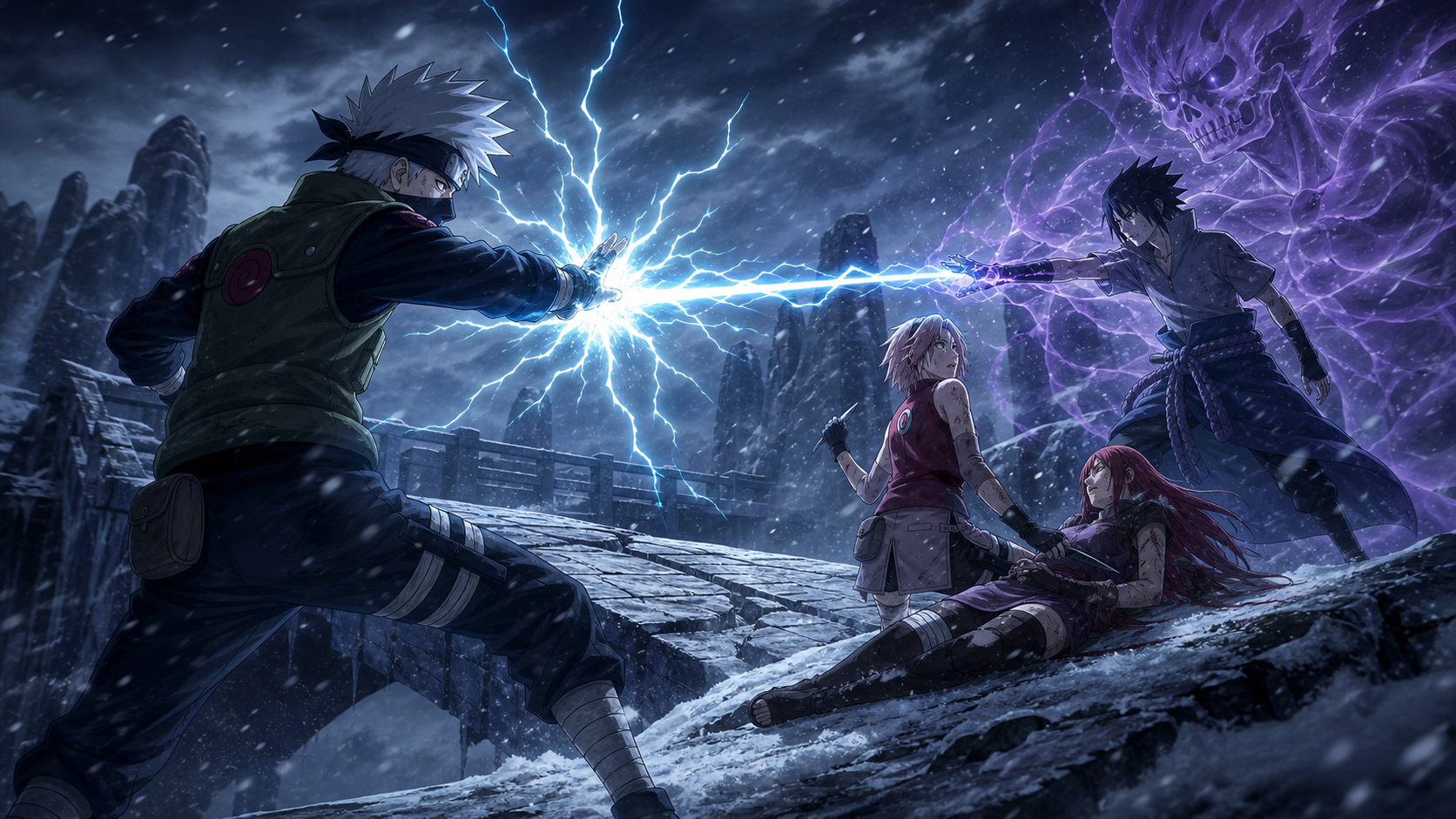
Sasuke tests Sakura with Karin’s life, and Kakashi steps between his former students to accept the responsibility he believes belongs to their teacher.
Quick reaction
“The Burden” turns Team 7’s private grief into an open fight. Sakura reaches Sasuke with a lie, Sasuke answers with a test designed to make her betray an injured woman, and Kakashi arrives just in time to block the killing strike Sasuke intended for his former teammate. Nobody can pretend this is still a simple retrieval mission. Sasuke is willing to murder Sakura, and Kakashi finally accepts that stopping him may require the same terrible choice the Third Hokage once faced with Orochimaru.
The episode’s title belongs to all three of them. Sakura believes Sasuke’s death is hers to carry. Kakashi believes Sasuke’s fall is his failure as a teacher. Sasuke treats every human connection as weight to discard. Each version of burden produces isolation, and the bridge becomes the place where those choices collide.
Sasuke tests Sakura’s lie
Sakura tells Sasuke she is ready to abandon Konoha and join him. The claim is desperate, but Sasuke does not dismiss her offer immediately. He explains that his new goal is the destruction of the Hidden Leaf, then offers Sakura a way to prove her loyalty: kill Karin.
The test is vicious because Karin is already wounded and helpless. She supported Sasuke throughout the summit, healed him, and was used as part of his attack on Danzō. Sasuke now speaks of replacing her as though loyalty were a tool that could be exchanged when damaged. By asking Sakura to finish the job, he makes cruelty the entry price for standing beside him.
Sakura approaches Karin with a kunai, but her hesitation exposes the truth. She came prepared to kill Sasuke, not execute someone who cannot defend herself. Sasuke reads that hesitation and forms Chidori behind her. There is no conflicted pause on his side. The boy who once protected Sakura during the Chūnin Exams is prepared to strike her through the back.
Kakashi catches the killing blow
Kakashi finds Kiba, Lee, Sai, and Akamaru unconscious in the forest and gets the direction he needs before continuing to the bridge. He arrives at the exact moment Sasuke attacks, intercepting the lightning and placing himself between his former students.
His shock matters. Kakashi knew Sasuke had attacked the summit and joined Akatsuki, but seeing him attempt to murder Sakura makes that information personal. This is no report from another village. Kakashi sees Sasuke aiming his teacher’s signature technique at a teammate he once risked his life to protect.
Kakashi tells Sakura to move Karin away and heal her. The order restores the role Sakura abandoned when she chose to work alone: she is a medic, a Leaf shinobi, and part of a team. Karin is also valuable for intelligence, but the scene is about more than interrogation. Kakashi refuses Sasuke’s claim that an injured ally has become disposable.
The teacher’s responsibility
Kakashi then claims the confrontation as his burden. He trained Sasuke, taught him Chidori, and believed that Team 7’s bonds could redirect the anger driving him toward Orochimaru. Standing on the bridge, he admits that belief did not prevent this outcome.
His thoughts return to the Third Hokage and Orochimaru. Kakashi once wondered why Hiruzen could not separate duty from affection for a former student who had become a threat. Now he understands. A teacher does not stop remembering the child simply because the adult has committed unforgivable acts. That memory makes the necessary response harder, not less necessary.
Kakashi’s willingness to kill Sasuke is therefore not coldness. Kakashi sees killing Sasuke as the darkest form of accountability available. He will not ask Sakura or Naruto to do what he believes their teacher should have prevented. Yet this becomes another Team 7 member deciding to suffer alone. The pattern survives even when the motive is responsibility.
Sakura cannot make the strike
After tending to Karin, Sakura approaches Sasuke from behind. The opportunity she wanted is finally there. Sasuke is focused on Kakashi, and Sakura has the kunai in her hand. She only needs to complete the decision that brought her into the forest.
Instead, memories stop her. The bell test, Team 7’s early days, and the night Sasuke left the village return at once. Sakura is not merely hesitating over a target. She stands behind the person who shaped her childhood, trying to force years of love, anger, grief, and guilt into one physical movement.
Her failure is dangerous, but the hesitation is honest. Sakura’s plan depended on believing she could turn feeling off at the decisive moment. Sasuke has practiced doing exactly that, and the episode shows what such practice has made of him. Sakura cannot imitate his emptiness because she is not empty.
Sasuke turns, seizes her, and takes control of the kunai. Kakashi is weakened after using his Mangekyō and cannot reach them in time. Sakura’s second attempt to carry everything alone leaves her exposed to the same person she came to kill.
Naruto arrives
Naruto enters at the final instant and pulls Sakura out of danger. His arrival pays off the decision in “Lost Bonds.” Yamato’s orders, physical exhaustion, and the risk of meeting Sasuke again could not keep him away. He refused to let Sakura and Kakashi decide this ending without him, and that refusal saves Sakura’s life.
The rescue does not solve the larger problem. Sasuke has attacked Sakura twice, Karin lies wounded, Kakashi is preparing to fight a student he still loves, and Naruto has arrived carrying his own answer about their bond. What changes is that Team 7 is finally in the same place. Their conflicting burdens can no longer remain private plans moving through separate forests.
Karin is the evidence nobody can explain away
Karin’s body makes Sasuke’s moral collapse visible before Team 7 begins debating his future. She is not an enemy casualty caught in a chaotic battle. She followed Sasuke, tracked targets for him, restored his chakra, and believed membership in Taka meant belonging somewhere. Sasuke rewarded that loyalty by driving Chidori through her to reach Danzō, then leaving her wounded on the bridge.
Sakura’s arrival gives Karin a painful mirror. Both women have organized part of their emotional lives around Sasuke, and both now face the distance between the boy they remember and the man willing to use their devotion. The episode does not flatten them into romantic rivals. Karin warns Sakura because immediate survival matters more than competition, while Sakura turns medical training toward the woman Sasuke discarded.
That care quietly opposes Sasuke’s entire worldview. He treats relationships as equipment that can be replaced after damage. Sakura stabilizes the person he declared useless. Kakashi protects the student Sasuke tries to kill. Naruto races toward people who tried to exclude him from the decision. Team 7 remains painfully dysfunctional, but their instinct to preserve human beings still separates them from Sasuke’s pursuit of purified isolation.
Chidori becomes an accusation against the teacher
Kakashi created Chidori as a young shinobi who believed speed and power could compensate for vulnerability. Minato warned him that tunnel vision made the technique dangerous without the Sharingan. Years later, Kakashi taught the attack to Sasuke because Gaara posed a lethal threat and because Sasuke possessed the eye needed to control the charge.
On the bridge, every safeguard has been stripped away except visual precision. Sasuke sees Sakura clearly and chooses to strike. The technique no longer represents a student meeting a dangerous opponent with his teacher’s trust behind him. Chidori has become a straight line from Kakashi’s hand to the attempted murder of another student.
Kakashi blocking the lightning therefore carries more than combat utility. He physically interrupts the legacy of his own instruction. The scene refuses the comforting claim that a teacher has no responsibility for how power travels after a lesson ends. Kakashi did not create Sasuke’s hatred, yet his knowledge helped give that hatred a weapon. Accountability cannot reverse the teaching. Accountability can still stand between the weapon and the next victim.
Sakura’s failure deserves honesty rather than ridicule
Sakura’s hesitation often gets reduced to proof that she is weak, but that reading ignores the trap she built around herself. She entered the forest after lying to Naruto, drugging her allies, separating from Sai, and deciding that killing Sasuke would repair everyone else’s pain. Success required Sakura to become emotionally numb on command while facing the central wound of her adolescence.
The plan is bad. The failure is predictable. Neither fact makes her grief fake. Sakura has enough strength to approach Sasuke and enough skill to prepare a lethal weapon, but power cannot substitute for an honest reckoning with motive. She wants to protect Naruto, punish Sasuke, honor the village, end her guilt, and preserve the memory of Team 7 at the same time. No single knife thrust can satisfy those conflicting desires.
Her most useful action begins only after Kakashi gives her a concrete responsibility: heal Karin. Medical work returns Sakura to choices grounded in the person directly before her. The contrast is not subtle. An abstract mission to solve everybody’s burden leads her into deception; attending to one wounded woman restores clarity.
The Japanese cast lets the old team haunt every line
Chie Nakamura gives Sakura’s false offer a brittle steadiness. The words aim for conviction, but pauses and breath keep revealing the history Sakura cannot erase. When the killing opportunity arrives, Nakamura does not play hesitation as simple fear. Memory crowds the performance until decision becomes physically impossible.
Noriaki Sugiyama gives Sasuke an unnerving lightness after Danzō’s death. His cruelty toward Karin and Sakura does not sound like a sudden explosion. The calm makes the danger worse because murder has become compatible with ordinary conversation. Kazuhiko Inoue answers with Kakashi’s controlled grief, keeping the teacher’s voice level while every remembered failure presses underneath.
Junko Takeuchi enters late, but Naruto’s arrival changes the sound of the scene before he explains anything. The energy is familiar without becoming cheerful. Naruto brings motion, urgency, and refusal into a confrontation that had narrowed toward execution. Team 7 sounds whole for a moment, though nothing about the reunion feels healed.
Direction turns the bridge into a failed reunion room
The bridge offers no private corner and no comforting landmark. Open snow, damaged stone, and cold air leave every character visible while Tobi’s larger war waits beyond the immediate conflict. Team 7 reunites in a place built for crossing, yet each member has arrived with a different plan for ending the road.
Blocking carries the argument. Sasuke repeatedly places another person between himself and danger, first Karin during the fight with Danzō and then Sakura as a target whose trust creates an opening. Kakashi places his own body between Sasuke and Sakura. Naruto repeats that protective movement at the episode’s final instant. Sasuke uses proximity as leverage; his former teammates use proximity as responsibility.
The episode ends before debate can make the danger feel manageable. Naruto’s rescue is not a triumphant entrance that resets Team 7. The shot preserves Sasuke’s intent, Sakura’s shock, Kakashi’s exhaustion, and Karin’s injury. Everybody is finally present, which means nobody can keep pretending the burden belongs to one person.
Sasuke makes cruelty the proof of belonging
He does not ask Sakura for information, strategy, or loyalty demonstrated through risk to herself. He asks her to kill the injured teammate he has decided no longer matters.
The test creates a community where entry requires accepting his definition of expendability. Sakura cannot join without proving she will treat another person exactly as Sasuke treated Karin.
Karin’s body interrupts every abstract argument about Sasuke
His pain, Danzō’s guilt, Konoha’s secrecy, and Tobi’s manipulation remain true. Karin lies wounded because Sasuke deliberately attacked through someone who helped him survive.
Her presence prevents empathy from becoming erasure. Understanding why Sasuke changed must occur beside evidence of what that change now permits him to do.
Sakura’s hesitation preserves a moral boundary her plan denied
She entered believing resolve could convert love, guilt, and duty into one lethal movement. Faced with Karin, she discovers she cannot begin by executing a helpless person to gain access.
The failure exposes her deception and saves something essential. Sakura’s conscience interrupts the mission before determination can make cruelty feel procedural.
Sasuke’s Chidori removes nostalgia from the danger
The technique once carried Kakashi’s investment in a student preparing to survive Gaara. On the bridge, Sasuke aims it at Sakura’s back with full knowledge of who she is.
No confusion or distant report softens the choice. Team Seven’s shared history remains present, and Sasuke decides the history gives her no protection from becoming an obstacle.
Kakashi blocks more than the attack he taught
His hand interrupts Chidori while his body stands between two former students. The image connects technical instruction to responsibility for what knowledge becomes after leaving the teacher.
Kakashi did not create the massacre or Sasuke’s revenge. He still refuses the comforting claim that teaching ends every obligation once a student chooses badly.
Claiming the burden alone repeats the team’s central wound
Kakashi wants to spare Sakura and Naruto from killing Sasuke. The intention is loving and reproduces the same isolation that made Sakura drug her allies.
Every member keeps trying to protect the others by privately owning the irreversible choice. Their family needs shared truth more than another volunteer for solitary suffering.
Healing Karin restores Sakura to immediate reality
The mission to solve Team Seven requires Sakura to manage years of memory, international danger, Naruto’s pain, and Sasuke’s future in one strike. Treating Karin narrows responsibility to the person bleeding before her.
Medical care does not settle the larger conflict. It gives Sakura an ethical action grounded in another person’s present need rather than an imagined ending for everybody.
Naruto arrives because exclusion has already failed
Sakura’s lie did not release him. Yamato’s confinement did not keep him away. Kakashi’s decision to own the confrontation did not remove the bond Naruto chose.
His rescue proves that people denied a voice remain part of the consequence. Team Seven finally shares one location because every separate plan collapsed into the same bridge.
The burden includes victims outside the original family
Karin joined later and carries evidence of Sasuke’s present choices. Samurai and summit attendants remain absent from the reunion but equally present in the accountability Naruto and Kakashi must demand.
Team Seven cannot repair itself by treating outsiders as collateral in a private tragedy. Any future bond must include responsibility toward people who never consented to its damage.
What this episode changes
“The Burden” removes any comfortable ambiguity about Sasuke’s current state. He is not simply harsh or unreachable. He is willing to kill Karin after using her and willing to murder Sakura when her deception becomes obvious. His goal has expanded from revenge against Danzō to destruction of the village itself.
The episode also exposes the limits of solitary sacrifice. Sakura cannot end Sasuke alone. Kakashi cannot erase his students’ involvement by claiming all responsibility. Naruto cannot preserve the bond by refusing to acknowledge the harm Sasuke has caused. The next confrontation will demand a truth none of them can carry on another person’s behalf.
Kakashi’s role is especially strong here. He does not excuse Sasuke, and he does not stop caring about him. The pain comes from holding both realities at once. Hiruzen carried that burden with Orochimaru, and Kakashi must now discover what the same weight demands.
Sakura and Sasuke reveal opposite failures of feeling
Sakura cannot erase emotion long enough to kill. Sasuke appears able to erase obligation while memory remains. One failure ruins a mission; the other ruins the relationships that once made survival meaningful.
The episode refuses to call emotional numbness strength. Hesitation can preserve humanity even when hesitation places the person in immediate danger.
Kakashi understands Hiruzen without receiving his answer
He now knows why a teacher remembers the child inside a dangerous adult and why duty becomes harder when affection survives. Recognition does not tell him whether killing is the only ethical outcome.
Hiruzen’s failure with Orochimaru is a warning, not a script. Kakashi must respond to Sasuke’s specific history, victims, and remaining choices.
The bridge makes everybody’s private plan public
Sakura’s assassination attempt, Kakashi’s lethal responsibility, Sasuke’s disposability, and Naruto’s refusal to be excluded can no longer travel through separate rooms and forests.
Presence does not create agreement. It removes the secrecy that allowed each person to imagine one sacrifice could decide the family’s future alone.
The episode’s hardest truth is that Kakashi cannot protect his students by becoming the only person allowed to decide their fate. Sakura cannot protect them by removing their choices. Naruto cannot protect Sasuke by denying his victims, and Sasuke cannot protect himself by destroying everyone who remembers him. Burden becomes honest only when it is shared with the people who carry its consequences, not claimed as private proof of love, duty, strength, or pain alone.
RaeRae’s final word on The Burden
Sasuke tells Sakura to prove devotion by killing Karin, because apparently his new membership form comes with attempted murder and no refund policy.
Karin is not a prop in their reunion. Her wound is the truth on the bridge, and Sakura becomes clearest when she stops solving everybody and treats the person Sasuke discarded.
Kakashi blocking Chidori hurts because he recognizes his own teaching inside the attack. Responsibility means standing there, but it does not mean he gets to carry the ending alone.
Naruto arrives before another private sacrifice becomes permanent. Team Seven is finally together, and every comforting lie about what Sasuke might do has already been removed.
RaeRae’s call
Everybody claims the burden to spare someone else, then excludes the people who must live with the result. Karin’s care and Naruto’s arrival return the conflict to shared human reality.