
RaeRae Reacts · One Piece Episode 99
Camu’s Rebel Heart
One Piece Episode 99 tests whether Camu’s fake rebels will genuinely protect Ido while examining deception, courage, and community accountability.
Quick reaction
One Piece Episode 99 introduces fake rebels in a country where the real rebellion is already close to civil war, and the joke lands with more weight than the disguises suggest. Camu and his companions enjoy the status attached to a dangerous name without carrying the work, discipline, or consequences behind that name. Vivi spots the fraud quickly. Her response, however, creates a second problem when the Straw Hats stage an attack to see whether these men will finally protect Ido.
Camu does stand. That choice matters because courage can begin before competence catches up. His decision does not erase the deception, repay the village, or transform his group into authorized rebels. Episode 99 works because the title calls him a rebel of the heart instead of handing him a rank he did not earn. He reaches the first honest decision of the episode when danger appears and running away would be easier.
RaeRae’s problem sits with the test. I understand why Vivi wants proof. Alabasta is running out of time, false identities can bring retaliation onto innocent people, and speeches from men who already lied are worth very little. A surprise assault around civilians and a scarce well creates real fear even when the attackers know the violence is staged. Camu’s courage deserves recognition. The villagers should never have become unwilling props in his character exam.
Ido’s water makes every performance more dangerous
Barbarossa directs the travelers toward Ido because the settlement still has water. That fact changes the value of every road, rumor, and introduction. A functioning well in drought-stricken Alabasta is not background scenery. The well keeps people alive, attracts desperate travelers, and gives armed groups a reason to claim authority nearby.
Ace reaches Ido before the others and receives water and food. The hospitality feels generous because viewers understand how little the village may have to spare. Ace can survive conditions that would stop most travelers, but fire powers do not make dehydration imaginary. His arrival also reminds us that ordinary communities keep absorbing the cost of larger adventures. Pirates, rebels, royal forces, and criminals all need supplies. Villagers still need enough water tomorrow.
The Straw Hats’ reunion with Ace brings relief, but the well remains the center of the episode’s politics. Camu’s group gains influence by presenting themselves as part of the rebellion. That claim may persuade residents to share food, shelter, information, or water they would otherwise protect. A false uniform can extract resources without a weapon ever leaving its sheath.
Crocodile’s wider plan depends on the same basic trick at a national scale. Baroque Works repeatedly uses borrowed identities, staged evidence, and controlled scarcity to make people act on a false story. Camu is nowhere near Crocodile’s level of harm, but the parallel matters. Alabasta has become so unstable that pretending to belong to a powerful group feels like a survival strategy.
Camu borrows the rebellion’s danger and its respect
Camu and his companions are not convincing because they possess overwhelming strength. They are convincing because villagers know a rebellion exists and do not have a reliable way to verify every stranger’s role. The group steps into that information gap. Residents may fear them, admire them, or simply decide that challenging armed men would be foolish.
The deception gives Camu social weight he has not earned. He can speak as though other people stand behind him. He can turn personal preference into an implied political order. He can also expose Ido to punishment if royal soldiers or actual rebels believe the village is sheltering an unauthorized unit. False affiliation sends consequences toward people who never agreed to the performance.
Fear may explain why the men chose the disguise. A village without dependable protection creates demand for somebody who looks organized and dangerous. Camu may also enjoy the attention. Mixed motives are normal. The useful question asks what he did with the role once residents believed him. Did he protect the well, reduce danger, share resources, and tell the truth when truth became costly? The episode does not let the costume answer for him.
Political legitimacy cannot come from a scarf, a rumor, or the ability to sound confident while weaker people listen. Consent, service, honesty, and sustained responsibility build authority. Camu has not completed that work by the time Vivi arrives. His later stand shows that he may finally be willing to begin.
Vivi recognizes a lie because she knows the real stakes
Vivi has lived inside Alabasta’s political crisis from several angles. She knows the royal family, infiltrated Baroque Works, traveled with pirates, and understands enough about the rebellion to hear when a local story does not fit. Her suspicion carries more evidence than a stranger’s guess. She also knows how much damage a fake rebel unit could cause.
Recognition does not automatically produce a safe response. Calling Camu out in public could force frightened villagers to choose sides before anyone has secured the well or established what the men have taken. A false accusation would be dangerous too, which is why verification still matters even when Vivi’s reading proves correct. Private questions, local testimony, and observed conduct could expose the fraud without turning the settlement into a stage.
Vivi wants to know whether Camu’s group contains any real commitment beneath the lie. That question fits her larger mission. She needs allies who care about Alabasta more than a uniform, and she has already watched official titles fail to predict moral behavior. A person outside the recognized rebellion may still protect a community. A person inside a royal institution may still betray one.
Her impatience also makes sense. Every delay brings the country closer to mass violence. Vivi cannot spend weeks auditing men who may disappear as soon as danger arrives. The pressure explains her decision to force an answer. Explanation does not make the method harmless.
The staged assault turns courage into a public experiment
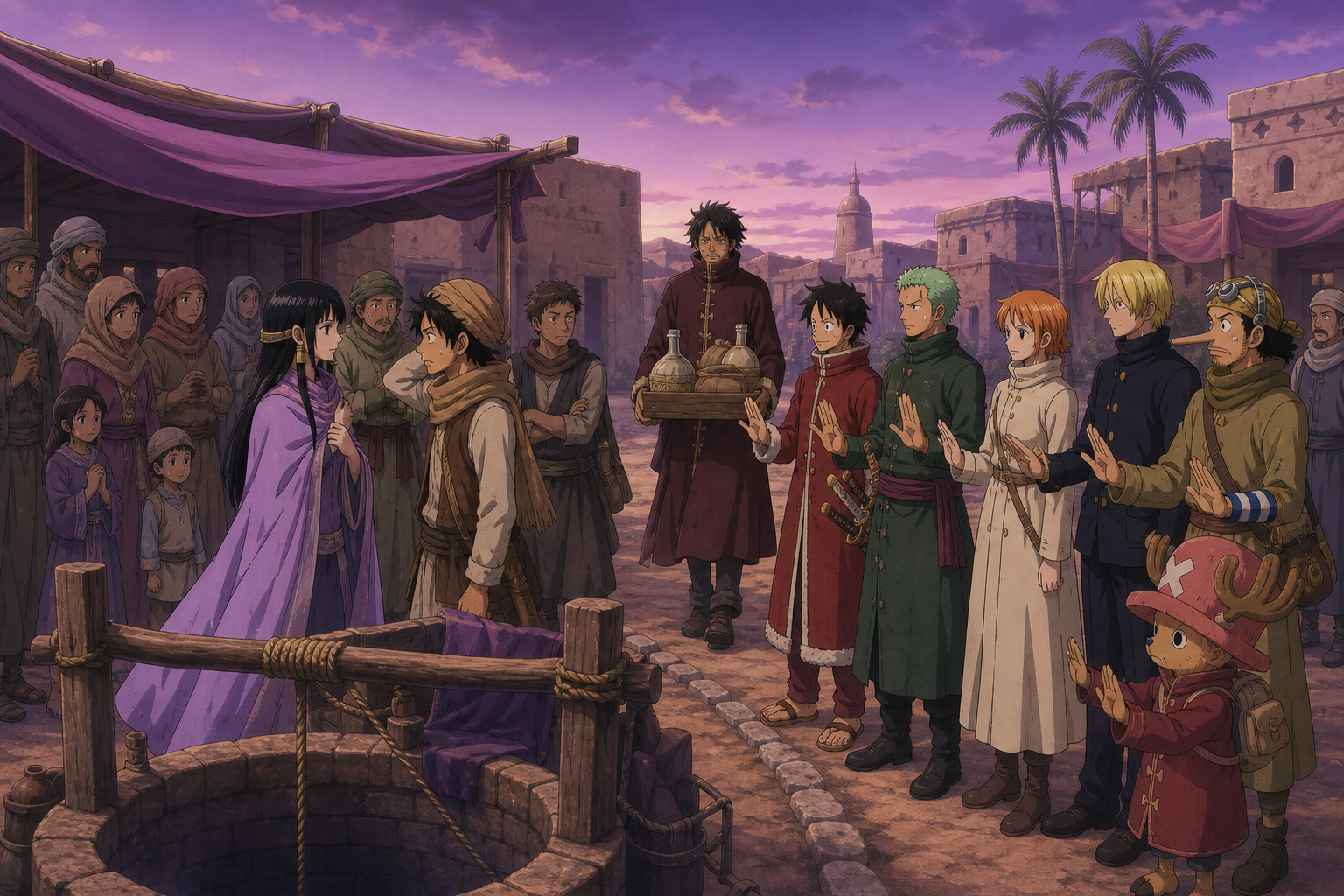
Vivi uses the Straw Hats as apparent attackers and waits to see whether Camu will defend Ido. The plan creates a clean dramatic question: will the fake rebel run, or will he accept risk for the people who believed him? Television loves a test with an immediate answer. Real communities rarely receive that kind of controlled environment.
The Straw Hats know the attack is staged. Vivi knows. Camu and the villagers do not. People guarding scarce water may panic, flee, hide children, draw weapons, or make choices that cannot be reversed after somebody announces the truth. A person can fall during an evacuation. A defensive strike can land. Trauma does not become fake because the aggressor planned to stop before serious injury.
Luffy’s crew also brings too much power for an unannounced exercise. Zoro, Sanji, Ace, and Luffy could overwhelm local defenders before anyone understands a boundary. Usopp and Nami understand fear well enough to recognize what a convincing threat can do. Chopper may end up treating residents for consequences created by his own side’s performance.
Vivi needed proof, but the village deserved consent. A bounded drill could still test organization if local leaders knew the purpose, agreed on safety rules, protected the well, and kept vulnerable residents outside the exercise area. Camu might perform differently after receiving warning, yet the community’s safety matters more than producing a perfect reveal for one man’s conscience.
Camu finally makes one choice without hiding behind a name
Camu’s decision to stand is the episode’s emotional payoff. The borrowed rebel identity stops doing the work for him once a stronger force appears. He cannot bluff the Straw Hats into retreat. He has to choose whether the people around him matter more than his own safety.
He chooses the village. That decision deserves credit because fear and fraud do not cancel every better impulse a person may have. Camu can be dishonest, underprepared, and genuinely unwilling to abandon people at the same time. One Piece often finds its most human characters inside that kind of contradiction.
The title’s wording protects the distinction between moral courage and official status. Camu becomes a rebel in his heart because he resists fear for somebody else’s sake. He does not suddenly become part of Koza’s command structure. The episode recognizes the internal change without pretending one brave moment settles every external responsibility.
His stand also changes what accountability can accomplish. Punishment alone may remove the costumes and leave Ido with the same protection gap that made the disguise useful. Camu has shown a willingness to serve. The village can decide whether that willingness becomes honest work, supervised defense, restitution, or a request for him to leave.
Repair begins after the heroic moment
Camu’s group needs to tell the truth about the false affiliation and document what they received because of the claim. Food, water, shelter, money, information, and social authority all count. Exact repayment may be impossible in a poor settlement, so residents should help decide what useful repair looks like.
Ordinary work may prove more meaningful than another dramatic confrontation. Guarding the well, maintaining warning routes, carrying water for people who cannot travel, repairing damage, and reporting real threats can rebuild trust over time. Camu should not control the terms merely because he performed well during Vivi’s test.
The villagers also need a way to verify future political claims. That does not mean publishing a list that exposes rebel contacts or turns every newcomer into a target. Trusted messengers, agreed signs, and private confirmation routes could reduce fraud without feeding Crocodile’s intelligence network.
Vivi and the Straw Hats owe the community an explanation for the staged assault. Good intentions do not remove that duty. Residents should hear what happened, why Vivi chose the test, which safeguards failed, and what support is available after the fear they experienced. Accountability loses credibility when only the weaker liar has to answer for his methods.
The production team balances comedy with political unease
Junki Takegami’s script gives a comic impostor plot a place inside Alabasta’s larger information war. Camu’s group can look ridiculous while still creating real risk. The episode keeps asking whether the feeling behind a title matters more than official membership, then refuses to make feeling the only requirement.
Munehisa Sakai’s episode direction has to move between reunion, suspicion, performance, and the moment Camu commits. The false rebels need enough comedy to fit the crew’s desert detour without making the villagers’ vulnerability look foolish. The staged attack then works as a tonal trap. Viewers know more than Camu, but the fear on his side remains genuine.
Eisaku Inoue’s animation direction gives courage a physical form through hesitation, posture, and the decision to remain in place. Camu cannot look fearless from the beginning or the test loses meaning. His body needs to reveal the distance between the man he pretended to be and the man he is trying to become.
Miyuki Sato’s art keeps Ido’s well and settlement present around the performance. The location matters because Camu is not defending an abstract idea. He is standing near the water, homes, and people affected by his lie. The background turns his choice into community action rather than a private duel for pride.
What Episode 99 changes
Ace has rejoined the group, which closes one immediate desert separation while reminding everyone how easily travel plans break in Alabasta. Vivi also receives another lesson in the difference between official identity and actual commitment. Camu’s group lacks legitimacy, yet one member can still choose protection when tested.
The episode prepares viewers for Koza by separating rebellion as an institution from rebellion as a moral impulse. Koza leads a real movement with political demands and thousands of lives attached. Camu wears the name because the name carries power. Their situations are not equal, but both force Vivi to ask what people believe they are protecting.
Crocodile remains the unseen winner whenever Alabasta’s people cannot verify information. Fake rebels, false royal orders, manufactured rain evidence, and staged attacks all thrive in the same environment. Trust becomes another scarce resource. Vivi will need more than correct instincts when she reaches the people making national decisions.
Camu’s stand offers a small hopeful answer. People can choose better after cowardice and deception. The choice only becomes durable when honesty, restitution, and ordinary service follow the brave moment.
Episode details
Japanese title: Nisemono no Iji! Kokoro no Hanrangun Kamyu!
English title: The Fake Rebels’ Pride! Camu, Rebel of the Heart
Japanese broadcast: February 3, 2002
Saga: Alabasta
Script: Junki Takegami
Episode direction: Munehisa Sakai
Animation direction: Eisaku Inoue
Art: Miyuki Sato
The official One Piece episode guide supplies the broadcast and production record. RaeRae’s analysis distinguishes Camu’s internal change from official rebel status and treats the staged assault, scarce water, and community repair as consequences visible within the episode’s setup.
Final verdict
Episode 99 gives Camu the chance to become honest at the exact moment his lie stops protecting him. He stands for Ido when escape would be easier, and that choice reveals a better man than the costume did. The episode earns its hopeful title because the change begins with action.
Vivi’s test still sends the bill to civilians who never agreed to participate. Her urgency explains the plan, and Camu’s response gives her the answer she wanted. Neither fact erases the fear created around a village and its water supply. The strongest version of this ending includes accountability on both sides.
RaeRae rating: 8.8/10. Give Camu credit for standing up. Make him drop the borrowed name, repay what he took, and prove his courage through ordinary service after the Straw Hats leave. Then let Vivi explain why she turned Ido into an exam before anybody calls the lesson complete.