
RaeRae Reacts · One Piece Episode 97
Desert Monsters
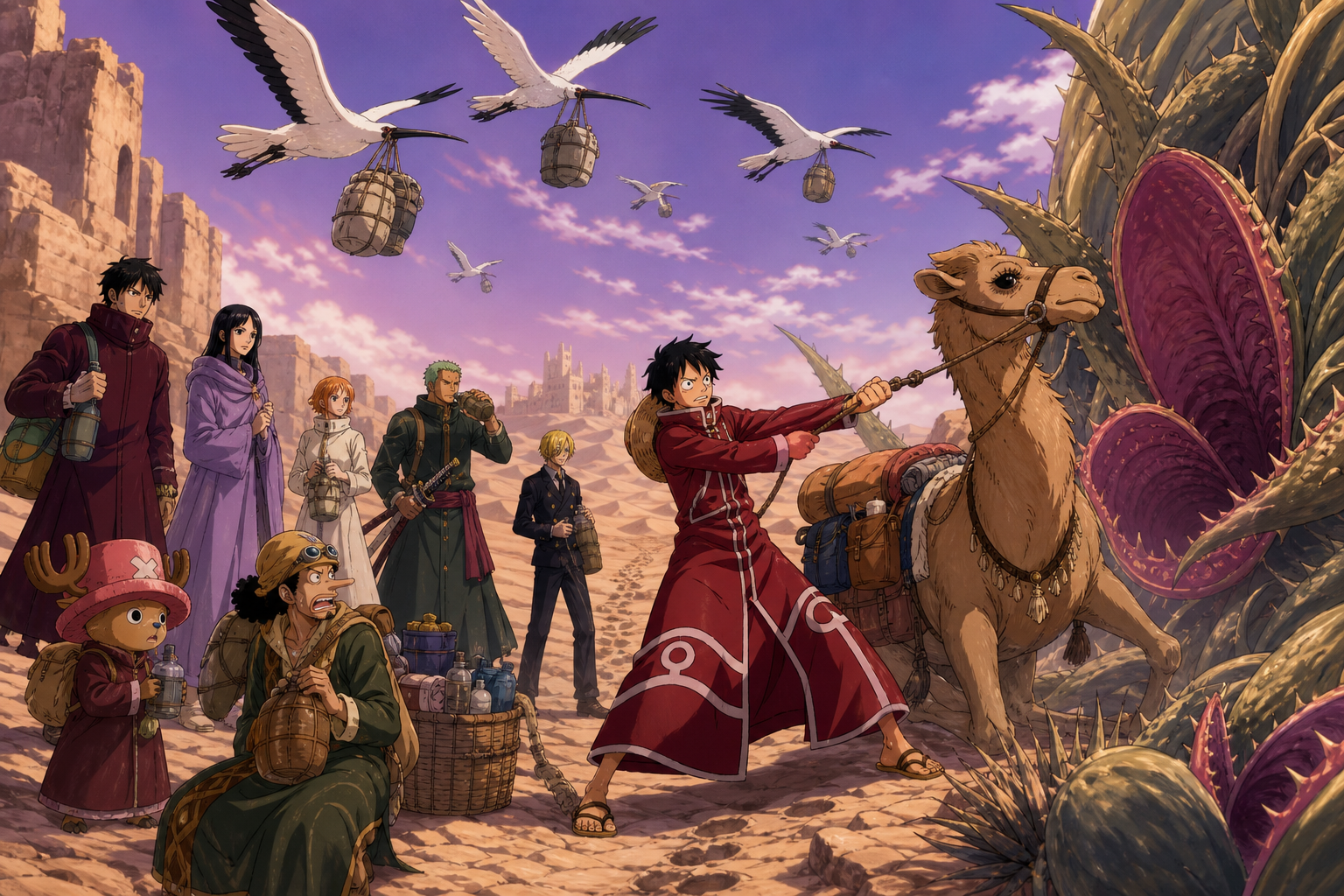
One Piece Episode 97 strands the group after Warusagi steal three days of supplies, then has Luffy rescue the camel later named Eyelashes.
Quick reaction
One Piece Episode 97 sends the Straw Hats into Alabasta’s open desert and immediately charges them for treating three days of supplies like one convenient bundle. The Warusagi trick Luffy, steal the provisions, and expose a planning failure bigger than his gullibility. If one successful theft can erase the group’s entire reserve, the packing system was already waiting to fail.
The episode balances that loss with Luffy rescuing the camel who helped Chopper in Katorea. Nami names him Eyelashes, the men learn he has opinions about who gets to ride, and the group gains a local animal companion who understands the terrain better than any pirate. Saving him does not purchase permanent transport. His cooperation matters because he chooses how close these people get.
RaeRae’s bottom line: Luffy’s trust creates trouble and saves a life in the same episode. The crew needs to stop treating those outcomes as proof that planning is unnecessary. Keep the compassion. Divide the supplies, count the travelers, respect Eyelashes, and let Ace and Vivi’s conversation show why Luffy’s best qualities still need a crew capable of catching the consequences.
The road to Yuba turns logistics into story
The group begins walking toward Yuba across exposed land. Every mile now depends on water, shade, pace, navigation, and the ability to keep people together. The Merry gave them a home base, stored supplies, and a route shaped by sea travel. The desert removes that structure and makes every person carry part of the voyage.
Three days of food and water sound like preparation until all three days sit inside a load that one flock can steal. Each traveler should carry a personal reserve while shared containers remain divided among several reliable carriers. Nami can coordinate the inventory without becoming the only person who knows how much remains.
Heat also changes what counts as a reasonable response. Chasing flying animals across hot sand may waste more water than the stolen food can justify. A smart group marks the location, protects what remains, checks every member, and calculates the nearest reliable source before pride turns theft into a missing-person emergency.
Alabasta keeps making survival work visible. The crew cannot punch thirst, charm a compass, or improvise safe water after symptoms begin. Their adventure depends on planning that rarely receives a victory pose.
The Warusagi weaponize Luffy’s best instinct
The Warusagi use deceptive distress to lower Luffy’s guard. He sees apparent need and responds before asking whether the scene makes sense. That instinct is one reason strangers trust him. The same instinct makes him easy to manipulate when nobody secures the packs first.
The birds are adapting to a harsh environment rather than committing human political fraud. They have learned which behavior draws travelers close enough to rob. The Straw Hats need to protect their supplies without turning one theft into permission to destroy an entire species.
Luffy still bears responsibility for abandoning the load, but permanent shame would teach the wrong lesson. The system should expect that any member can become distracted, injured, deceived, or separated. Redundancy protects everyone from one person’s worst minute.
Recovery also requires restraint. Intact sealed containers may remain usable if found nearby and cleaned. Food torn open by beaks may not. Climbing unstable rock or entering nesting areas could trade a supply loss for injury. The crew should know when retrieval costs more than turning back.
Losing food is serious, but losing water decides the route
The provisions force an immediate recalculation. How far is the last safe source? Where is the next verified well? Which path provides shade? What reserve remains if someone develops heat illness? Those questions should be answered before the group continues toward Yuba.
Rationing cannot become deliberate dehydration. Reducing exertion and traveling during cooler hours often saves more water than pushing harder while drinking too little. Chopper needs to watch for headache, cramps, nausea, weakness, confusion, and changes in coordination because a person in trouble may not recognize the decline.
Ace’s presence adds strength, but his fire cannot solve the supply problem. Flames near dry terrain, frightened wildlife, or airborne birds could create a larger disaster. His most useful contribution may be carrying weight, scouting within clear limits, and making sure nobody disappears while everyone watches Luffy.
The episode treats the theft as comic momentum, yet the loss explains why later food, water, and hospitality matter so much. Alabasta’s scarcity is not a decorative filter over the adventure. Scarcity shapes every relationship on the road.
A carnivorous plant turns Eyelashes into more than a callback
The crew encounters a camel trapped by a giant desert plant. They recognize the same animal who helped Chopper escape in Katorea. That earlier choice creates familiarity, but the immediate problem is physical: free him without pulling his body through teeth, thorns, or closing plant tissue.
Luffy’s elastic reach lets him intervene from a distance. The rescue works best when force supports the camel’s body instead of yanking his neck or harness. Somebody else needs to clear the landing area so a frightened animal does not escape one danger and run into another.
Ace should not reach for fire simply because flame is available. Dry wind, plant matter, and the trapped camel turn an obvious attack into a risk. The least destructive opening that frees the animal is the better choice.
Afterward, Chopper should check breathing, eyes, mouth, skin, legs, hydration, and any contact with sap or spines. Delayed irritation can appear after the dramatic rescue is over. Eyelashes needs shade and water before the group asks him for movement or transport.
Nami gives Eyelashes a name, not an employment contract
Nami names the camel Eyelashes, and the nickname fits the crew’s habit of turning encounters into relationships quickly. A name makes communication easier. The rescue and name still do not convert a free animal into equipment.
Eyelashes has preferences, including a refusal to carry the men. The joke gives him agency inside a story where animals often become convenient mounts. The crew can dislike his terms, but cooperation should remain voluntary and physically safe.
A camel can improve the group’s chances by reading terrain, enduring heat, and carrying limited loads. Overloading him would defeat that advantage. Chopper should monitor gait, breathing, rubbing from tack, and willingness to continue. Food and water belong to his care whether he offers a ride or not.
Luffy’s rescue matters because compassion should not become a purchase. He saves Eyelashes because the animal is in danger. Any help that follows is a relationship, not repayment imposed by the rescuer.
The desert monsters belong to a living system
The title calls attention to creatures that make Alabasta’s scorching land feel hostile. The Warusagi steal. The plant traps large animals. Both survive through behaviors adapted to conditions the Straw Hats barely understand.
Danger does not require extermination. Travelers can map plant reach, recognize deceptive bird behavior, secure provisions, and route around nesting or feeding areas. Destroying every threat may damage soil, insects, prey relationships, and the survival knowledge local people have built around those species.
The crew should share warnings through trusted local routes rather than publishing exact locations for trophy hunters. A useful map identifies hazards, safe distances, water points, and seasons. The goal is safer travel, not turning the desert into a cleared road designed for outsiders.
One Piece often gives animals strong personalities, but Episode 97 also shows how human categories fail. A thief can be wildlife following learned survival behavior. A monster can be a plant doing what its species does. A camel can be a rescuer with boundaries.
Ace and Vivi compare the Luffy they know
The walk gives Ace and Vivi time to talk about Luffy from two different positions. Ace knew him as a younger brother long before the Straw Hat flag. Vivi knows him as the captain who crashed into her political crisis, challenged her instinct to carry everything alone, and repeatedly made dangerous plans harder to control.
Ace can offer childhood history without pretending that family knowledge explains the adult captain completely. Vivi’s experience matters equally because she has watched Luffy lead people Ace barely knows. Their accounts should complicate each other rather than compete for authority.
Vivi can speak honestly about both help and risk. Luffy protects people, identifies cruelty quickly, and acts when institutions fail. He also loses supplies, breaks plans, and forces his crew to build structure around impulses he treats as obvious truth.
Ace may want reassurance that his brother is safe with these people. Vivi cannot promise safety in Alabasta. She can show that Luffy’s crew understands him well enough to disagree, repair, and remain beside him without becoming an audience for every reckless decision.
The production team makes survival funny without making survival easy
Junki Takegami’s script uses the Warusagi theft and Eyelashes rescue to reveal two sides of Luffy’s openness. He trusts a false distress display and loses supplies. He responds to real distress and saves an animal. The difference cannot be solved by telling him to stop caring.
Harume Kosaka’s episode direction moves between travel comedy, escalating loss, creature danger, and a quieter conversation about Luffy. The pacing needs the desert to feel large enough that missing supplies matter while keeping the crew’s reactions energetic.
Kazuya Hisada’s animation direction gives the creatures readable intent without making them human. The Warusagi need enough performance to deceive Luffy. Eyelashes needs enough physical reaction for viewers to understand fear, relief, and refusal.
Miyuki Sato’s art holds the episode together through heat, open distance, unusual plant life, and the crew’s small position inside the landscape. The desert should look beautiful enough to invite movement and dangerous enough to punish careless packing.
What Episode 97 changes
The group loses three days of provisions and must continue with a weaker margin for error. That shortage carries directly into the next episode, where food, water, unknown plants, and outside help become central.
Eyelashes joins the journey on his own terms. His presence can improve movement and connects Chopper’s Katorea experience back to the larger crew. The camel also brings another personality into the group’s already chaotic travel system.
Ace and Vivi gain a more personal understanding of each other through Luffy. Their conversation helps integrate Ace into the Alabasta road instead of leaving him as a powerful guest waiting for the next fight.
The episode proves that compassion and logistics belong together. Luffy should keep answering distress. His crew should keep the supplies secure while he does.
Chopper becomes especially important because Eyelashes cannot explain pain in the crew’s language and overheated travelers may minimize their own symptoms. His medical judgment connects animal welfare, human heat risk, and the decision about when the group can safely move again. The youngest Straw Hat carries responsibility that strength alone cannot replace.
Episode details
Japanese title: Suna no Kuni no Bouken! Ennetsu no Daichi ni Sumu Mamono
English title: Adventure in the Country of Sand! The Monsters That Live in the Scorching Land
Japanese broadcast: January 20, 2002
Saga: Alabasta
Script: Junki Takegami
Episode direction: Harume Kosaka
Animation direction: Kazuya Hisada
Art: Miyuki Sato
The official One Piece episode guide supplies the title, broadcast record, and production credits. RaeRae’s analysis treats the stolen provisions, Eyelashes rescue, wildlife behavior, desert logistics, and Ace-Vivi conversation as connected parts of the crew’s first sustained crossing toward Yuba.
Final verdict
Episode 97 makes Luffy’s open heart both the problem and the answer. He falls for the Warusagi performance and loses the group’s reserves. He sees Eyelashes in real danger and acts quickly enough to save him. The crew needs his compassion and a supply plan built for the possibility that compassion will distract him again.
Eyelashes earns his place by having boundaries. He helped Chopper before, accepts rescue now, and decides who gets to ride. The relationship feels more like One Piece because the animal is allowed to be inconvenient.
RaeRae rating: 8.7/10. Save the camel, respect his answer, and split the water across several packs. Trust is one of Luffy’s greatest strengths. Redundancy is how everybody else survives the days when that strength follows the wrong bird.