
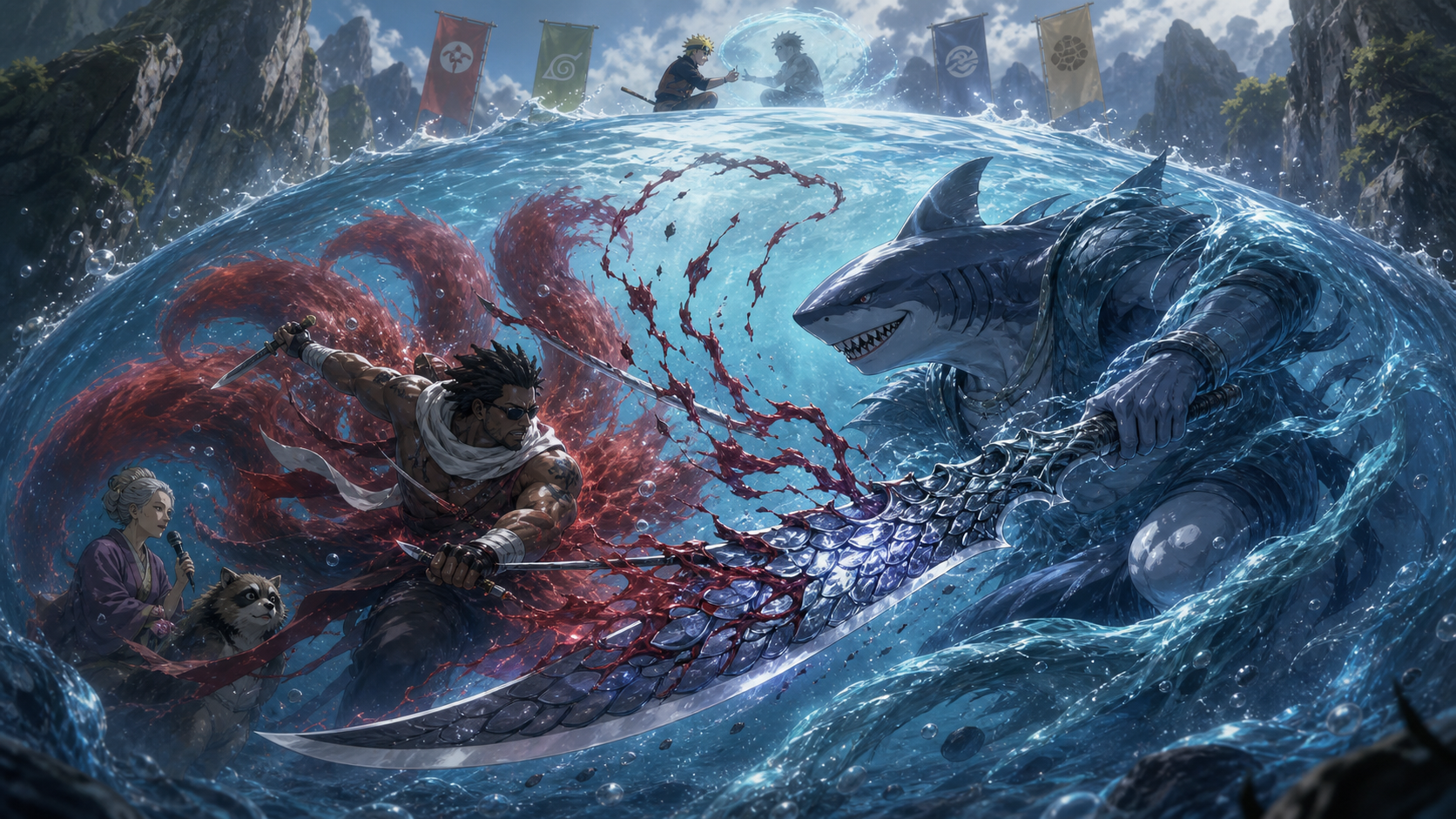
The Tailed Beast vs. The Tailless Tailed Beast
Samehada turns Killer B’s enormous chakra into Kisame’s fuel while a moving ocean traps the jinchūriki inside the predator’s rules.
Bottom line
Naruto Shippuden Episode 207, “The Tailed Beast vs. The Tailless Tailed Beast,” gives Killer B and Kisame the battlefield while Naruto learns the truth Sakura tried to hide.
Kisame reveals that Samehada consumes an opponent’s chakra and transfers the stolen energy to him. Killer B enters a seven-tailed chakra cloak, but one sweep of the living sword strips away most of that power. B shifts tactics, uses a stronger transformation, and tears open Kisame’s body, only for Samehada to restore him with the chakra the sword stole.
Kisame then fuses with Samehada and creates an enormous moving water dome that follows him, forcing B to fight underwater while protecting Sabu and Ponta. In the Land of Iron, Sai’s ink clone tells Naruto that the Konoha rookies have agreed to stop Sasuke and that Sakura intends to kill him herself.
Samehada makes Killer B’s greatest strength into food
Killer B controls the Eight-Tails more completely than any jinchūriki the audience has met. Ordinarily, releasing more chakra increases his options and overwhelms the opponent.
Samehada reverses that logic. The richer B’s cloak becomes, the more chakra the sword can consume. A seven-tailed charge that would terrify most enemies turns into a meal.
The ability forces B to treat his own power as a resource that can be stolen. Mastery of a tailed beast remains extraordinary, but this matchup punishes him for relying on the form that usually guarantees dominance.
Kisame earns the title of tailless tailed beast
Kisame carries chakra reserves so large that allies compare him to a jinchūriki despite having no beast sealed inside him. Samehada expands that reserve by feeding him chakra taken from others.
The title is more than hype. Kisame can generate an ocean, reshape his body for aquatic combat, sense movement through water, and recover from catastrophic damage. He reproduces the scale and endurance associated with tailed beasts through his own body and sword partnership.
That makes the fight less like ninja against ninja and more like two ecosystems colliding.
The water dome is a battlefield designed to move with the predator
Kisame’s dome does not remain centered on the place where the technique was created. The water follows him. Because he can swim faster than his opponents, anyone trying to escape moves the prison along with its captor.
Inside, B must manage breath, protect two companions, and fight someone whose fused body is built for the environment. Kisame converts open terrain into the bottom of his own ocean.
The technique shows strategic intelligence behind the spectacle. Kisame does not simply create more water; he creates a rule set in which every advantage belongs to him.
Killer B’s responsibility changes how he can fight
B is not alone. Sabu and Ponta are trapped inside the dome, and their survival limits his choices.
He cannot simply unleash the Eight-Tails at full scale without considering what happens to them. He must carry air, redirect attacks, and remain close enough to protect people who cannot match Kisame underwater.
That burden is not a weakness in B’s character. His protection of Sabu and Ponta proves that independence has not made him indifferent. The same man who escaped his guards for personal freedom now risks himself to preserve someone else’s.
Kisame and Samehada function as a predatory partnership
Samehada is alive enough to have appetite, preference, and a physical reaction to chakra the sword enjoys. Kisame treats that appetite as part of his fighting style.
The sword strips B’s cloak, feeds Kisame, and merges with him. Their partnership appears almost perfectly adapted to hunting jinchūriki: the target supplies both the threat and the fuel used for the defeat.
Yet Samehada’s pleasure in B’s chakra introduces uncertainty. A weapon with preferences is never entirely owned, no matter how long someone has wielded the blade.
B’s transformed strike proves raw power still matters
After Samehada neutralizes his first cloak, B compresses more dangerous power into a faster attack. The impact opens Kisame’s torso and would end an ordinary fight immediately.
For a moment, B’s mastery breaks through the matchup problem. He identifies that prolonged contact favors Samehada and delivers damage faster than the sword can absorb the attack itself.
Kisame survives because stolen chakra allows regeneration. The exchange does not diminish B’s strength; the recovery reveals how many layers of advantage Kisame brought specifically for him.
Sai’s clone gives Naruto the truth Sakura withheld
Sakura came to the Land of Iron with a confession designed to make Naruto release Sasuke. Sai’s ink clone tells Naruto the rest: the Konoha rookies have decided Sasuke must be stopped, and Sakura plans to handle the killing herself.
The disclosure confirms why her words felt false. She was not beginning a new relationship; she was trying to close Naruto out of a decision she believed would protect him.
Sai chooses honesty because Naruto cannot meaningfully respond to the crisis while everyone else controls his information.
The rookies’ decision recognizes consequences Konoha delayed
Sasuke has attacked Killer B, joined Akatsuki, invaded the summit, and brought retaliation closer to the Leaf. His former classmates can no longer treat retrieval as the only possible mission.
Their decision is painful because strangers did not make the choice. These are people who trained beside Sasuke and remember the boy before revenge consumed his life.
Taking responsibility does not mean they have stopped caring. They believe affection cannot indefinitely shield him from consequences that other villages are already paying.
Sakura’s plan isolates her in the name of ending isolation
Sakura believes killing Sasuke herself will free Naruto from his promise and prevent their friends from carrying the burden. The plan asks her to absorb every consequence alone.
That resembles Naruto’s worst habit. He repeatedly treats suffering as a personal debt he can pay on behalf of everyone else. Sakura objects to that pattern, then builds her own version of the same mistake.
Both characters are trying to protect the group by denying the group a full voice in what happens next.
Naruto now has two impossible truths at once
Tobi has told Naruto why Sasuke turned against Konoha. Sai has told him that Sakura and the rookies intend to kill Sasuke. Neither piece of information cancels the other.
Sasuke was shaped by institutional betrayal, and he is currently choosing actions that endanger innocent people. His friends love him, and some of them believe love now requires stopping him permanently.
Naruto cannot resolve that contradiction with the old promise to bring Sasuke home. He needs an answer that acknowledges both the wound and the harm.
Killer B’s freedom includes people he refuses to abandon
B escaped his Cloud escorts because surveillance had reduced even protection to confinement. That choice could make him look irresponsibly committed to personal freedom. The water dome proves his independence never meant indifference.
Sabu and Ponta limit the transformations B can safely use, consume precious air, and slow his escape. He never treats them as tactical mistakes whose lives can be traded for a cleaner fight. Their presence changes his decisions because relationship creates responsibility.
That distinction matters beside the Naruto story. Sakura and the rookies are also acting from responsibility, but secrecy turns their care into control. B protects companions who remain visibly part of the problem. Sakura tries to protect friends by removing their voice.
Samehada is a partner whose appetite can become disloyalty
Kisame’s bond with Samehada looks perfectly matched at first. He supplies direction and extraordinary chakra; the sword consumes opponents, expands, and returns stolen energy. Their fusion makes the partnership bodily rather than merely instrumental.
The sword’s delight in Eight-Tails chakra complicates that harmony. Samehada reacts to flavor, volume, and preference. Kisame may understand the appetite better than anyone, but understanding does not equal ownership.
The detail quietly prepares a fault line inside his greatest advantage. A hunter who relies on another living appetite must keep that appetite satisfied. Killer B is not only prey. His chakra is attractive enough to alter the relationship between weapon and wielder.
The moving dome weaponizes rescue itself
Most prisons give escape a direction. Kisame’s water dome removes that logic because the center follows his body. Swimming away from him cannot create distance from the boundary fast enough when he is the superior swimmer.
B also has to move toward Sabu and Ponta whenever their air becomes critical. Kisame can read motion inside the water and exploit every rescue attempt. Care becomes predictable movement, and predictable movement becomes a hunting route.
The technique is frightening because Kisame designs more than an environment favorable to himself. He creates a system where his opponent’s best quality, refusal to abandon companions, produces openings.
Sai’s clone restores consent through information
Sai cannot stop Sakura physically from the Land of Iron, but his ink clone can end the information imbalance she created. Naruto finally learns that the confession was connected to a plan to kill Sasuke and that their peers agreed on the decision.
Truth does not make Naruto safer or calmer. The disclosure gives him agency. He can now respond to the actual crisis rather than to the emotional fiction Sakura designed for him.
Sai’s choice is especially meaningful given Root’s training. Danzō’s system treated withheld information and controlled feeling as signs of discipline. Sai has learned that loyalty sometimes requires breaking the approved silence so another person can choose with open eyes.
The episode pairs chakra extraction with emotional exclusion
Kisame constructs a battlefield that drains B’s power and narrows his choices. Sakura and the rookies have constructed a decision around Naruto that removes information and narrows his choices. The stakes differ, but both plots ask what remains of agency after somebody else controls the conditions.
B can analyze the dome, ration air, and adjust his transformation. Naruto cannot begin adjusting until Sai tells him what has been hidden. In both stories, raw power is insufficient. Knowledge of the system becomes the first requirement for resistance.
The pairing also prevents the emotional plot from feeling like an interruption to the battle. Extraction is the episode’s shared language. Samehada takes chakra; secrecy takes Naruto’s ability to answer.
The Japanese performances distinguish panic from urgency
Hisao Egawa gives Killer B confidence without making the danger sound trivial. His rhythm changes as the water dome turns protection into a calculation, allowing responsibility to press through the bravado. Tomoyuki Dan gives Kisame an almost delighted certainty once the battlefield belongs to him.
Satoshi Hino makes Sai’s disclosure direct rather than theatrical. The clone is delivering information Naruto should already have received, so restraint serves the betrayal better than outrage. Junko Takeuchi lets Naruto absorb each sentence before emotion finds language.
The performances keep both halves of the episode connected. B and Naruto are not weak because other people have narrowed their options. Their next choices matter precisely because freedom must be rebuilt inside conditions they did not design.
Kisame studies abundance as a vulnerability
B’s enormous chakra reserve normally gives him endurance, explosive transformations, and freedom to overwhelm a matchup. Kisame arrives with a living blade that interprets the same abundance as available supply.
The fight becomes dangerous before either man runs out of power. B must decide how much strength he can reveal without feeding the opponent enough energy to erase the advantage.
Samehada makes extraction feel intimate
The sword does not drain chakra through a distant mechanism. It presses against the cloak, grows from the meal, and carries stolen energy directly into Kisame’s damaged body.
That intimacy turns B’s own power against him twice: first as loss, then as the resource that repairs the wound he successfully inflicted. Victory becomes nourishment for the person he nearly defeated.
The title compares ecosystems instead of simple reserves
B shares power with the Eight-Tails through a relationship built across years of hostility, negotiation, and mastery. Kisame shares power with Samehada through appetite, compatibility, and mutual usefulness.
Both partnerships enlarge a human fighter beyond ordinary limits. The moral and emotional difference lies in whether power circulates through consent or through consuming whoever enters reach.
Sabu and Ponta make B’s strength relational
The easiest version of the battle would let B transform without regard for the terrain. Their presence requires him to ration air, interrupt attacks, and measure every movement against two lives he brought into danger.
Kisame reads protection as exploitable restraint. B keeps protecting them anyway, proving that mastery means more than releasing the largest form available.
The dome turns pursuit into false escape
A captive naturally swims toward an edge, but Kisame remains the moving center. Because he is faster underwater, the boundary follows before B can reach it.
The technique weaponizes ordinary spatial logic. Every desperate attempt to flee feels active while preserving the captor’s chosen distance, an aquatic version of control disguised as open movement.
Samehada introduces desire inside the weapon relationship
Kisame depends on the sword as though long familiarity guarantees allegiance. B’s chakra produces a visible pleasure strong enough to reveal that Samehada evaluates its wielder as well as its meals.
A living weapon can prefer another source. The hint matters because Kisame’s perfect counterstrategy rests on a partner whose appetite may eventually choose satisfaction over loyalty.
Sai repairs the information boundary Root trained him to violate
Root taught him that withholding emotion and following controlled information protected the mission. His clone now breaks Sakura’s plan because Naruto cannot consent to a decision he has been deliberately prevented from understanding.
The disclosure may cause pain and disrupt the group’s strategy. Sai chooses that risk over helping friends manufacture a safer reality around someone they claim to protect.
The rookies have moved from retrieval to accountability
Their conclusion is not evidence that friendship disappeared. Sasuke’s attack on B, Akatsuki association, summit invasion, and escalating harm make indefinite waiting a choice with victims outside Konoha.
They believe stopping him has become their responsibility because they knew him. The tragedy is that collective accountability still produces a plan built through Naruto’s exclusion and Sakura’s solitary sacrifice.
RaeRae’s reaction to The Tailed Beast vs. The Tailless Tailed Beast
Samehada took one taste of Eight-Tails chakra and turned this fight into an all-you-can-eat buffet. Killer B finally meets an opponent where “release more power” is not automatically the smart answer, because the sword is standing there with a fork.
Kisame is terrifying here. The water dome is not just huge and pretty. The dome moves with the fastest swimmer, which means escape itself carries the prison along. Add two people B refuses to abandon, and every choice gets narrower.
Then Sai’s clone arrives to make Naruto’s emotional situation just as claustrophobic. Sakura tried to protect him with a lie. The rookies made a decision without him. Sasuke is still moving toward Danzō. Everybody is acting because they think waiting is dangerous, and nobody agrees on what saving a friend means anymore.
This episode pairs the fights perfectly. Kisame drains B’s power until the battlefield belongs to him. Secrets have been draining Naruto’s ability to choose until Sai finally returns the missing truth. Both men now have to fight inside conditions somebody else designed.
Both battles begin when hidden conditions become visible
B cannot fight wisely until he understands that Samehada converts chakra into recovery. Naruto cannot respond wisely until Sai reveals that Sakura’s confession concealed a plan to kill Sasuke.
Strength follows knowledge in both stories. The person controlling the conditions gains power by keeping the system unreadable, whether the hidden mechanism is absorption or secrecy.
Protection becomes dangerous when the protected person disappears
B protects Sabu and Ponta while continuing to respond to their physical needs. Sakura protects Naruto by replacing his knowledge with a story designed to produce compliance.
Care remains ethical when the other person stays present as a chooser. Once protection requires their inner life to become irrelevant, love begins reproducing the control it meant to resist.
Naruto must hold Sasuke’s wound beside Sasuke’s harm
Tobi gave him the institutional history that shaped Sasuke. Sai gives him the decision formed by friends watching Sasuke endanger other nations. Neither truth deserves deletion.
Naruto’s next answer cannot be a promise preserved from childhood. It must address the person he loves, the people already hurt, and the systems that made revenge feel like Sasuke’s only honest inheritance.
Kisame wins control by turning every advantage B brings into part of the trap. Chakra becomes food, companionship becomes predictable rescue, and open water becomes a boundary that moves with its captor. Yet B never accepts Kisame’s definition of strength. He protects people who slow him down because power without that responsibility would leave only appetite. The deeper contest asks what each man believes his power ultimately serves.
RaeRae’s final word on the tailed and tailless beasts
Samehada tasted Eight-Tails chakra and immediately made B’s greatest flex look like catering. The sword eats the attack, heals Kisame, and then helps turn the entire landscape into an aquarium owned by the shark.
B is still thinking about Sabu and Ponta while losing air and chakra. That responsibility limits him, but abandoning them would mean Kisame had already decided what his power was for.
Sai’s clone brings the same argument into Naruto’s room. Sakura wanted to spare him by hiding the real mission. Sai recognizes that pain with truth is still more respectful than safety built through deception.
Both men are trapped inside systems somebody else designed. Their first act of resistance is finally seeing the rules.
RaeRae’s call
Kisame extracts chakra while Sakura’s secrecy extracts choice. B and Naruto cannot resist through power alone; each needs an honest view of the conditions narrowing his next move.