
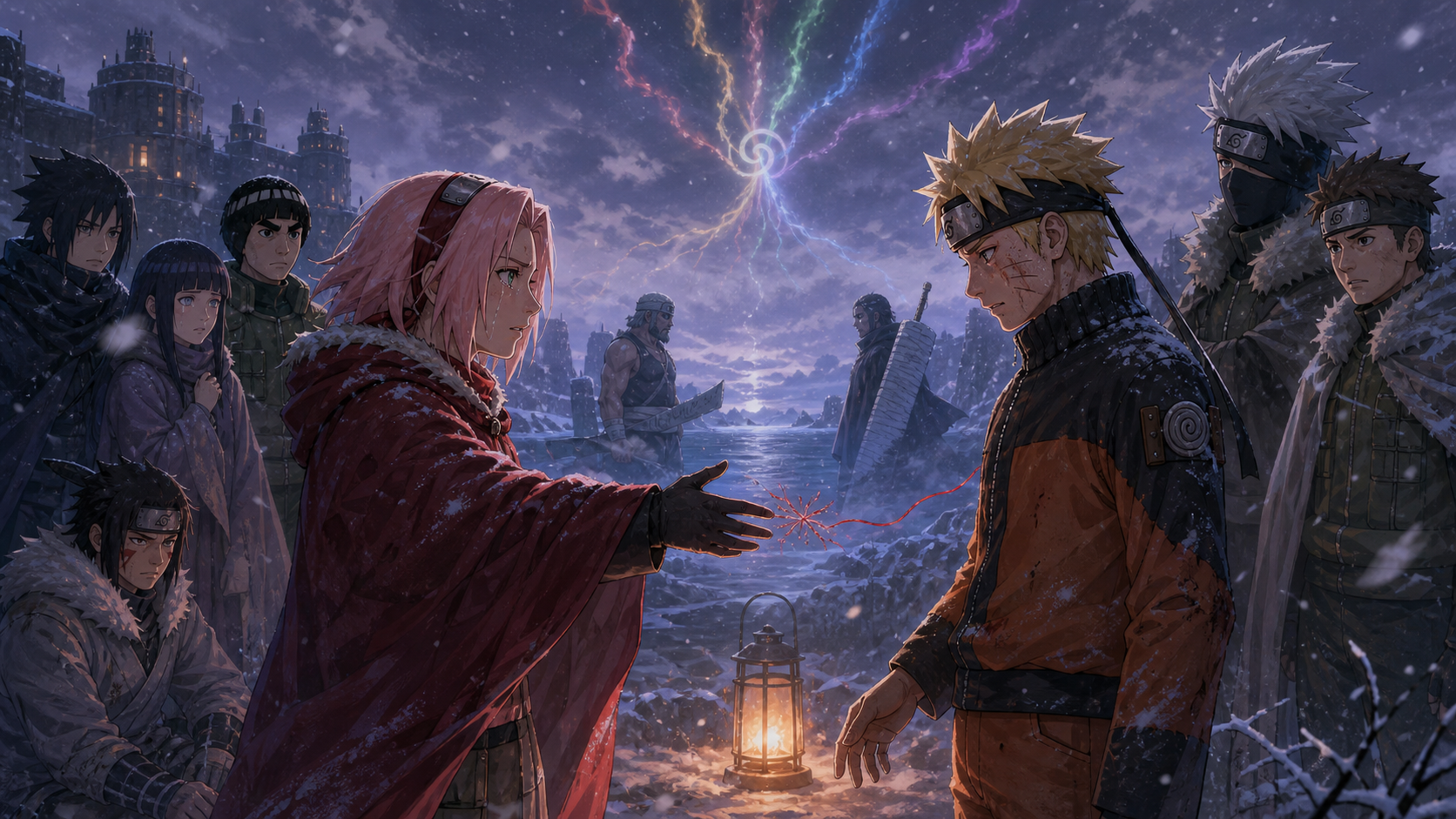
Sakura’s Feelings
Sakura offers Naruto the words he once wanted, but he refuses a confession designed to manage his bond with Sasuke.
Bottom line
Naruto Shippuden Episode 206, “Sakura’s Feelings,” follows the immediate consequences of Tobi’s declaration of war while bringing Sakura’s private plan into Naruto’s room.
The Kage agree to form the Allied Shinobi Forces and choose the Fourth Raikage as supreme commander. Gaara asks the villages to protect Naruto and Killer B rather than use them as ordinary battlefield weapons. Danzō’s flight leaves Konoha’s authority uncertain, and the other leaders recognize Kakashi as the more trustworthy representative.
Far away, Killer B encounters Kisame and Samehada. In the Land of Iron, Sakura tells Naruto that she loves him, claims she no longer cares about Sasuke, and asks him to abandon his promise. Naruto immediately recognizes that she is not telling him the truth.
The alliance begins with distrust still in the room
The villages do not suddenly forget old wars, stolen techniques, broken treaties, or Danzō’s manipulation. They agree because Tobi’s plan threatens every nation at once.
That makes the alliance fragile, but not meaningless. Cooperation often begins before trust is complete. The leaders now have to build structures that make shared action possible while knowing each member has reasons to protect information from the others.
The Fourth Raikage becomes commander because he has the strength, resources, and military credibility to organize the response. His temper remains a concern, but his commitment to opposing Akatsuki is not in doubt.
Gaara insists that jinchūriki are not disposable weapons
Naruto and Killer B are essential to preventing the Ten-Tails’ return. The simplest military answer would be to hide them, control their movements, and discuss them only as strategic assets.
Gaara understands the danger of that language. He spent childhood treated as a weapon whose value belonged to the village. Naruto reached him by recognizing the lonely person inside that role.
Protecting the remaining hosts must therefore mean more than guarding containers. The alliance will need their power, but the coalition cannot defend freedom by denying freedom to the two people at its center.
Kakashi earns trust while Danzō loses the authority he manipulated
Danzō tried to secure command by influencing Mifune with Shisui’s eye. Once exposed, he fled the summit while other villages handled Sasuke and Tobi.
The Kage cannot treat him as a reliable alliance partner. Kakashi has no formal Hokage appointment yet, but his record across village lines makes him a credible alternative.
This contrast matters. Danzō pursued authority through hidden control. Kakashi acquires influence through accumulated trust, including relationships he never created for political gain.
Sakura comes to release Naruto from a promise he no longer follows for her
Sakura believes Naruto’s pursuit of Sasuke is tied to the promise he made her years ago. Sai’s anger convinced her that the promise has become a source of suffering.
Her goal contains real care. She wants Naruto to stop accepting punishment for a burden she believes she placed on him. The mistake is assuming she can remove that burden by changing the stated terms.
Naruto’s bond with Sasuke exists independently of Sakura. He would still pursue Sasuke if she had never asked, because Sasuke is part of Naruto’s own understanding of family, failure, and responsibility.
The confession fails because Naruto knows Sakura too well
Sakura tells Naruto she loves him and has moved beyond Sasuke. Naruto does not accept the words simply because they offer something he once wanted.
He recognizes the gap between her statement and her feelings. That recognition is painful and also evidence of maturity. Younger Naruto might have seized the fantasy. This Naruto refuses affection offered as a tool.
His response protects both of them from a lie that would become harder to maintain. Love cannot repair manipulation when the person receiving the confession is asked to pretend he does not see what is happening.
Sakura’s intention does not erase Naruto’s right to honesty
Sakura is not trying to humiliate Naruto. She is frightened by Sasuke’s actions, guilty about Naruto’s suffering, and preparing to take responsibility in a way she believes will free him.
Those motives explain the confession without making the deception fair. Naruto deserves the truth about why she traveled to the Land of Iron and what their friends have decided.
By trying to manage his feelings, Sakura repeats a smaller version of the shinobi world’s larger habit: deciding that another person cannot handle reality, then choosing for them in the name of protection.
Naruto refuses to let Sakura simplify her own heart
Naruto knows Sakura still loves Sasuke. He may not understand every contradiction inside that love, but he refuses to accept her claim that the feeling vanished because Sasuke became a criminal.
The refusal is not an endorsement of Sasuke’s behavior. Naruto insists that feelings do not become honest merely because they are more convenient for a mission.
Sakura wants a clean statement that can close the old promise and allow her next decision. Naruto will not give her that clean exit when the escape requires both of them to lie.
Sai’s information creates action without creating understanding
Sai correctly saw that Naruto was suffering. He correctly challenged Sakura to understand the weight of the promise. Yet the information he provided led Sakura toward a solution that treats Naruto’s bond as an obligation she can cancel.
This is part of Sai’s growth too. He has learned to recognize emotion, but recognition does not guarantee that he can predict how people will use the insight.
The group arrives with a plan built from care, guilt, and incomplete communication. Every ingredient is sincere; the result is still damaging.
Killer B’s freedom brings him directly to Kisame
While the alliance discusses protecting him, Killer B is outside the village pursuing his own adventure. That freedom exposes him to Kisame, one of Akatsuki’s most dangerous hunters.
Samehada’s appetite for chakra makes the pairing especially threatening. B’s strength and tailed-beast power are precisely what the living blade wants to consume.
The contrast with Naruto is sharp. Naruto is surrounded by people trying to decide what his bonds mean. B is physically free, but the enemy waiting for him may turn that freedom into isolation.
The episode asks whether protection without truth can work
The Kage plan to protect Naruto and B without immediately involving them in every decision. Sakura tries to protect Naruto by concealing the real purpose of her visit. Danzō claimed he manipulated others to protect the shinobi world.
These situations are not morally equal, but they share a question: when does care become control?
The episode’s strongest answer comes from Naruto. He does not reject Sakura’s concern. He rejects the false reality she wants him to accept on its behalf.
Sakura is trying to turn guilt into a clean transaction
Sai’s accusation lands because Sakura knows Naruto has suffered while carrying the promise to retrieve Sasuke. Her confession attempts to reverse the transaction: if she withdraws her love for Sasuke and offers love to Naruto, the old debt should disappear.
Human attachment does not balance like a mission ledger. Naruto’s pursuit stopped being a service performed for Sakura years ago. Sasuke became part of Naruto’s own identity, failure, and idea of family. Sakura cannot cancel another person’s chosen bond by changing the stated reward.
The plan also asks Sakura to convert guilt into romantic certainty. She cares deeply about Naruto, but care does not become the kind of love she claims simply because that declaration would make the next step easier. Her motive is compassionate; the transaction remains false.
Naruto’s refusal protects Sakura’s inner life
Naruto could accept the confession and gain the fantasy his younger self wanted. Instead, he believes Sakura’s actual feelings over the convenient statement placed before him. That choice recognizes her as a person whose contradictions deserve truth.
His response is blunt because the lie is dangerous. Accepting would help Sakura pretend that killing Sasuke carries no conflict and would let Naruto pretend his own bond could be dismissed as an obligation. Both fantasies would collapse as soon as the mission produced real consequences.
Respect here does not sound gentle. Naruto challenges her, names Sasuke, and refuses the offered emotional shortcut. The refusal protects the version of Sakura who will have to live after whatever happens next.
Gaara changes the alliance’s language about hosts
Military strategy naturally identifies Naruto and Killer B as the final resources Akatsuki needs. Gaara interrupts the slide from people to inventory because he knows what being discussed as a village weapon does to a child.
His argument also carries operational wisdom. A jinchūriki treated only as cargo has little reason to trust the people setting restrictions. Naruto and B developed their strength through relationships, self-knowledge, and degrees of autonomy, not through tighter cages.
The alliance will still hide them and limit their battlefield access, so Gaara has not solved the contradiction. He has forced the leaders to acknowledge that protection creates duties toward the protected person, not merely toward the power sealed inside them.
Kakashi’s credibility was built before anyone needed his vote
The other Kage consider Kakashi a workable Konoha representative because his relationships cross borders and precede this emergency. The Sand knows his role beside Team 7. The Leaf recognizes his service. His reputation does not depend on a genjutsu changing Mifune’s judgment.
Danzō wanted the authority first and planned to manufacture trust afterward. Kakashi accumulated trust without treating every bond as political capital. The contrast explains why an uncertain appointment can feel more stable than Danzō’s official claim.
Trust does not make Kakashi innocent of Konoha’s failures, especially regarding Sasuke. The alliance scene shows a different foundation for leadership: credibility that other people can verify rather than control they cannot detect.
Killer B exposes the gap between policy and lived reality
The Kage agree that B should be protected while B is already beyond the guards assigned to him. His encounter with Kisame makes the timing almost cruel. Policy recognizes his value after personal isolation has placed him directly before an Akatsuki hunter.
B’s decision to leave was not senseless. Constant surveillance denied him ordinary movement, and freedom matters to someone whose body has served village strategy since childhood. The danger does not erase that grievance.
The episode therefore refuses an easy lesson about obedience. B needed protection, and the system offering protection gave him reasons to escape. A better alliance must address both truths.
The Japanese cast lets the lie fail before Naruto answers
Chie Nakamura gives Sakura’s confession determination without emotional ease. The speech sounds prepared, but preparation cannot make the claimed indifference toward Sasuke feel lived. Pauses and pressure reveal the mission underneath the romance.
Junko Takeuchi answers with suspicion rather than flustered excitement. Naruto listens as someone who knows Sakura, not as the child who once wanted any sign of attention. His voice hardens because accepting the performance would participate in the lie.
Satoshi Hino’s Sai remains important even outside the central exchange. His earlier bluntness helped produce Sakura’s plan, showing that truthful information can still cause harm when emotional understanding remains incomplete. The cast makes sincerity, honesty, and accuracy sound like three different things.
Sakura confuses ending a promise with ending Naruto’s choice
The promise matters because Naruto made it in response to her grief, but years of pursuit changed its meaning. Sasuke became Naruto’s own failure, family bond, and measure of whether connection can survive hatred.
Sakura can release him from a request she made. She cannot release him from a responsibility he has since claimed for himself, and pretending otherwise leaves his inner life out of her solution.
The confession uses romance as mission equipment
Sakura needs Naruto to stop pursuing Sasuke before she attempts the decision forming behind her words. Declaring love becomes a tool designed to redirect him, close the old promise, and clear her path.
That use does not make her care false. It makes the form unfair. Naruto is asked to receive intimacy while being denied the information required to understand what the intimacy is trying to accomplish.
Naruto rejects reward without humiliating the person offering it
He could celebrate, test the confession, or punish Sakura for saying what he knows she does not mean. Instead, he identifies the lie and refuses to participate.
The anger in his answer protects a boundary. His affection cannot become a lever when guilt demands one.
Sakura’s guilt makes control feel like responsibility
Sai tells her Naruto is suffering, and Sakura hears a debt she must personally cancel. That framing gives her an urgent task and shields her from the harder truth that Naruto’s pain has causes beyond her power.
Taking responsibility should mean honest participation in what happens next. Guilt instead tempts her to decide everyone’s role privately, then present the decision as emotional closure.
The friends behind Sakura turn consensus into pressure
Kiba, Lee, and Sai accompany a mission shaped by the Konoha group’s fear of Sasuke’s escalating danger. Their concern is legitimate, but Naruto meets a conclusion already negotiated without him.
The group treats his bond as the obstacle that must be managed before action can proceed. Protection begins to resemble exclusion when the person most affected receives the plan only through a false confession.
Gaara and Sakura offer opposite forms of care
Gaara tells the Kage why Naruto’s personhood must remain visible inside military planning. Sakura hides her plan because she believes Naruto’s feelings will prevent the necessary choice.
Both want to protect him. Gaara expands the room in which Naruto counts as a participant; Sakura narrows that room because urgency makes his independent answer feel dangerous.
Kakashi’s trust shows what honesty accumulates over time
No single speech makes the other Kage accept him. His credibility comes from years of observable choices, cross-village relationships, and conduct that can be compared against Danzō’s exposed manipulation.
The contrast reaches the personal story. Sakura wants one powerful statement to manufacture a safe conclusion. Trust resists shortcuts because the listener remembers the whole relationship around the words.
B’s encounter proves autonomy and safety need each other
Constant restriction gave him a reason to escape, and escape placed him before the exact hunter the restriction was meant to prevent. Choosing only control or only freedom reproduces the same danger from different directions.
The alliance needs protection built with Naruto and B as adults capable of judgment. Otherwise every security measure teaches them that being valued still means being owned.
RaeRae’s reaction to Sakura’s Feelings
This scene makes me want to put everyone in separate rooms with paper and ask them to write what they actually mean. Sakura is trying to save Naruto from pain. Naruto is trying to save Sasuke from hatred. Sai is trying to save both of them from a bond he only recently learned how to name. Nobody is lying because they enjoy cruelty, and everybody is making the conversation worse.
Naruto refusing the confession is one of his most emotionally intelligent moments. He wanted Sakura’s attention for years, but he will not accept love that asks him to betray what he knows about her. That is not romantic victory. The refusal is respect with teeth.
I also understand why Sakura reaches for the wrong solution. She has just learned how much Naruto suffered, and she is preparing to do something terrible about Sasuke. She wants one sentence to cut every knot before she goes. Feelings do not cooperate with mission planning like that.
Meanwhile, the new alliance is promising to protect two jinchūriki while one of them is already standing across from Kisame. The war has officially begun, and communication remains everyone’s most dangerous missing skill.
Truthful feelings can remain contradictory
Sakura may love Sasuke, fear him, condemn his choices, and believe stopping him is necessary. She may care deeply for Naruto without that care becoming the romantic certainty she announces.
The episode respects emotional conflict by refusing a tidy replacement. Honest adulthood means carrying incompatible feelings without inventing a simpler heart for tactical convenience.
Naruto’s answer separates love from possession
He believes Sakura’s enduring feeling for Sasuke even though that truth gives Naruto nothing he once wanted. His response does not demand that her heart reward his loyalty.
What he demands is honesty. Refusing the confession allows Sakura’s actual feelings to remain hers while protecting his own bond from being rewritten as a favor performed for payment.
The episode pairs political alliance with emotional misalignment
Five villages begin cooperating while trust remains incomplete. Five friends approach Naruto with sincere care while withholding the decision that brought them. One group admits its uncertainty; the other tries to conceal it.
The comparison makes imperfect honesty look stronger than polished agreement. A relationship can survive conflict more readily than a conclusion built on words nobody believes.
RaeRae’s final word on Sakura’s Feelings
Sakura came into the snow carrying guilt, fear, a secret mission, and the romantic confession she hoped would somehow organize all four. Feelings do not obey mission charts, and Naruto knows her too well to pretend.
His refusal is not cruelty. He declines the dream without making her pay for offering it, because accepting would turn both of them into actors inside a lie.
I understand why Sakura wants one clean sentence before doing something irreversible about Sasuke. I also understand why Naruto refuses to let her erase her own heart to manage his.
Meanwhile B has escaped protection straight into Kisame’s path. Everybody is trying to keep a jinchūriki safe, and nobody has mastered how to protect someone without deciding who they are allowed to be.
RaeRae’s call
Sakura’s care is real, but the confession turns affection into control. Naruto’s refusal honors both of their actual feelings and demands the truth before anyone makes another permanent choice.