
RaeRae Reacts · One Piece Episode 93
Into the Desert Kingdom
One Piece Episode 93 brings the crew to Nanohana, prepares the desert crossing, and connects Chopper's heat illness to an unexpected rebel encounter.
Quick reaction
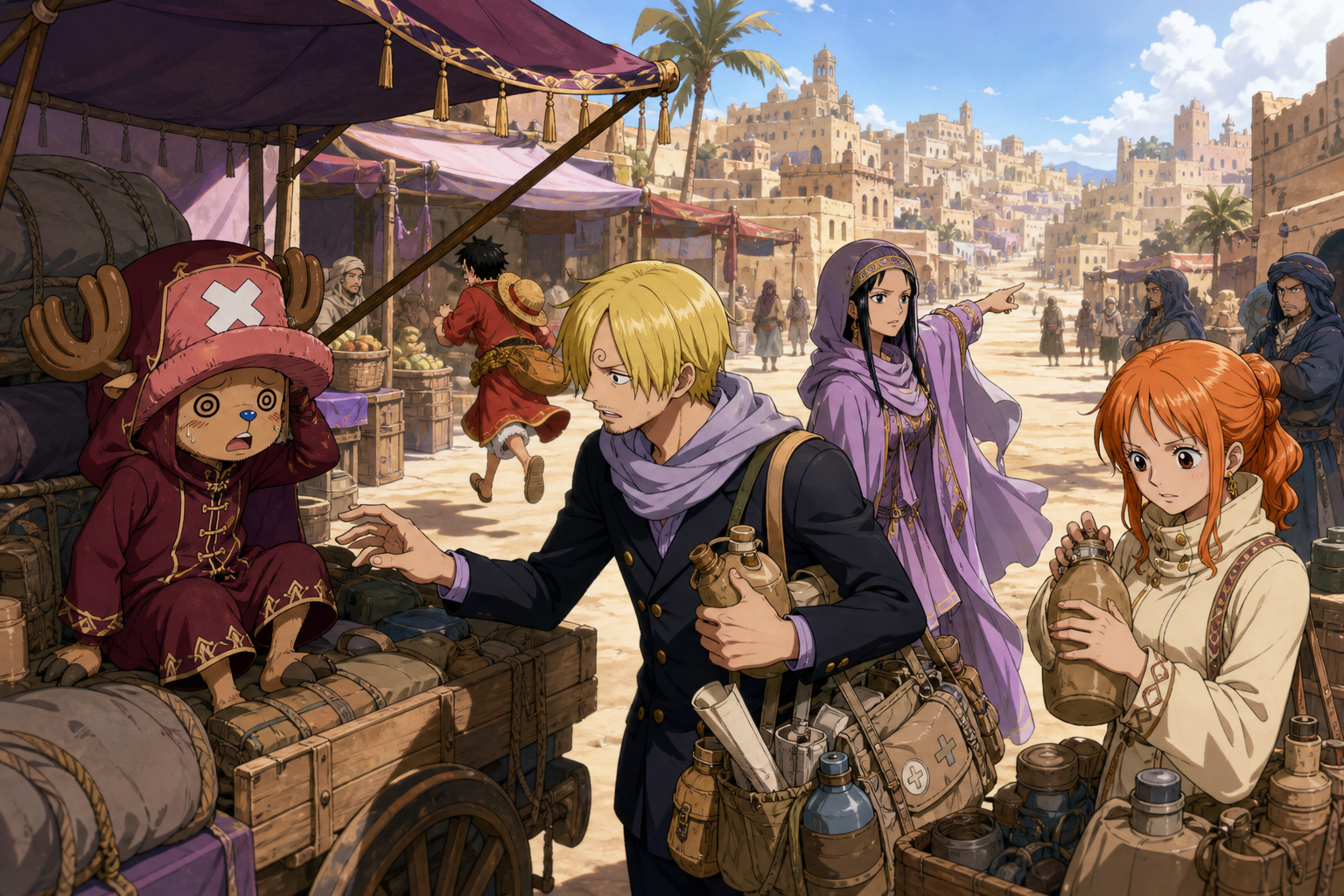
One Piece Episode 93 brings the Straw Hats into Alabasta and immediately proves that reaching the kingdom is not the same as understanding the crisis. Nanohana looks busy, hot, and functional, but drought pressure shapes every purchase, route, rumor, and political conversation. Vivi wants Yuba. Luffy wants food. Sanji wants supplies. Chopper wants relief from heat and perfume before a rebel cart carries him away.
The episode makes preparation feel like story rather than delay. Water, shade, medicine, transportation, and secrecy will determine whether the crew can cross the desert without becoming another rescue problem for the people they came to help. Alabasta’s political emergency lives inside bodies and daily work long before Crocodile steps into the center.
RaeRae’s bottom line: Vivi has returned home, but home no longer follows the map she remembers. Yuba may have changed, rebels have their own reasons for distrust, and Dance Powder has turned weather into evidence of betrayal. The crew needs more than loyalty to the princess. They need planning, humility, and enough water to survive their own good intentions.
Nanohana welcomes the crew with heat, hunger, and surveillance risk
The port gives the Straw Hats their first direct contact with Alabasta’s climate and public mood. Heat presses against movement while the market continues serving residents, travelers, soldiers, and people carrying political anxiety. The city cannot become a cheerful supply stop detached from the drought affecting the rest of the kingdom.
Luffy runs toward food almost immediately. Nobody watching him could mistake that choice for unusual behavior, but Nanohana is not an anonymous island where chaos disappears after lunch. Marines and Baroque Works agents may recognize him, and anyone following the captain can trace the crew back toward Vivi.
The safest plan gives Luffy a budget, a meeting point, a deadline, and at least one partner willing to keep sight of him. Food matters before a desert crossing, but speed-eating in an unfamiliar restaurant should not outrank awareness of exits, local conflict, or the people searching for a wanted pirate.
Vivi’s route to Yuba carries hope that the country may no longer support
Vivi wants to reach Yuba and speak with the rebel army before civil war becomes unavoidable. The goal depends on Koza and other leaders listening long enough for her to explain Baroque Works, Dance Powder, and Crocodile’s manipulation. Childhood trust may open a door. Childhood trust cannot substitute for proof.
The crew needs current information about roads, wells, checkpoints, rebel movement, and whether Yuba remains inhabited. Drought changes travel faster than old maps can record. A route that once supported caravans may now contain dry wells, abandoned shelter, displaced families, or armed patrols expecting royal deception.
Vivi also needs a message designed for people who believe Cobra harmed them. Beginning with royal innocence would sound like dismissal. She should acknowledge visible suffering, explain what she directly observed, distinguish evidence from suspicion, and offer verification that does not demand immediate obedience to the palace.
Protecting Vivi means refusing to advertise who needs protection
Nanohana creates a dangerous contradiction. Vivi knows the country and should guide decisions, but every public deference can reveal her identity. If the entire crew circles her, waits for her approval, or calls her by title, observers do not need an official portrait to understand that she matters.
Nami can repeat route decisions so leadership appears distributed. Sanji and Chopper can buy supplies without announcing the royal mission. Zoro and Usopp can watch separate approaches rather than forming a visible guard. Protection works best when the formation does not tell enemies where to aim.
The crew also needs a cover story simple enough for everybody to remember. Complicated lies collapse under casual questions. Ordinary travelers buying desert supplies attract less attention than a loud group explaining why they need enough water and medicine to reach a rebel stronghold.
Karoo needs the same operational care. His speed makes him useful, but a familiar royal animal can identify Vivi as quickly as her name. Rest, water, shade, and a route away from crowded observation protect both his body and the mission. Nobody should treat loyalty as permission to push him past safe limits.
Desert supplies are survival equipment, not shopping scenery
Sanji and Chopper take responsibility for purchasing supplies while the group prepares to travel inland. Water comes first, but quantity alone does not create safety. The crew needs sealed containers distributed across different packs so one leak, theft, or damaged cart cannot remove the entire reserve.
Food should support hydration and sustained movement rather than create extra thirst. Electrolytes matter during heavy sweating. Shade cloth, head coverings, and planned rest periods reduce exposure before symptoms begin. Emergency water should remain separate from the amount expected for ordinary travel.
Chopper’s medicine needs protection from heat, contamination, and crushing. He should identify which treatments require the coolest storage and which supplies must remain immediately reachable. A medical kit buried beneath trade goods may technically exist while being useless during collapse.
Chopper’s sensory overload deserves care before comedy
Perfume in the market overwhelms Chopper while heat already strains his body. His stronger sense of smell changes the exposure. A scent that seems merely heavy to Sanji can become painful, disorienting, or nauseating for someone whose nose processes far more information.
Telling him to endure would ignore both physiology and the mission. Sanji should move him toward shade and clean air, pause the shopping task, offer measured water, and check for headache, confusion, weakness, or vomiting. Heat illness can progress while the affected person tries to keep working.
Chopper is the doctor, but medical knowledge does not prevent him from becoming the patient. The crew needs to notice when competence hides vulnerability. Caring for him is not a detour from saving Alabasta. A dehydrated doctor cannot safely guide anybody else through the desert.
The wrong cart turns one overwhelmed crewmate into a political encounter
Chopper climbs onto the wrong cart while trying to escape the sensory pressure and heat. The mistake separates him from Sanji and places him among people connected to the rebellion. What looks like a small travel gag could expose Vivi’s party, lose critical medicine, or place Chopper in a group that reasonably distrusts strangers.
His first job is not explaining the entire royal crisis. He should identify his immediate medical condition, state that he boarded by mistake, and avoid sudden movement that could look threatening. The rebels are not one mind. Some may help, some may interrogate, and some may assume a spy has entered their transport.
Sanji needs a lost-person protocol rather than a frantic citywide search. He should return to the last confirmed location, notify Nami, describe the cart, and check its direction. Vivi may recognize rebel supply patterns, but using that knowledge publicly could reveal more than the rescue requires.
The rebel army exists because suffering made royal explanations inadequate
Vivi knows Koza and believes the rebellion can still be stopped through truth. The people around him have lived through failed rain, economic loss, displacement, and the visible concentration of water near the capital. Their anger does not disappear because the audience knows Crocodile arranged the evidence.
Calling the rebels mistaken would miss the political reality. They drew a conclusion from conditions designed to support that conclusion. Crocodile did not invent pain from nothing. He redirected real scarcity, amplified distrust, and built a story that made the palace look responsible.
A peace effort has to respect those reasons without accepting violence as inevitable. Vivi needs witnesses, records, samples, and a plan for protecting people who pause military action. Asking rebels to trust Cobra may expose them to retaliation from factions that believe negotiation equals betrayal.
Dance Powder turns environmental harm into a manufactured accusation
The explanation of Dance Powder gives the drought a mechanism. Forcing rain in one location deprives another area, so relief at the capital can coexist with disaster elsewhere. That unequal transfer makes Cobra appear willing to save his own center by sacrificing distant communities.
Crocodile benefits from both sides. The kingdom weakens as water disappears, public faith collapses, and the man presenting himself as Alabasta’s hero gains importance. Scarcity becomes a political weapon because citizens can see the results without seeing who arranged the cause.
Stopping the powder is not enough. Samples, storage sites, shipment records, purchase chains, and testimony need preservation. Destroying every container may end immediate use while leaving Vivi unable to prove that somebody framed her father.
The crew must communicate uncertainty without surrendering urgency
Vivi has strong evidence that Baroque Works engineered the conflict, but she cannot know every current rebel position, every compromised official, or every remaining powder stockpile. Honest uncertainty protects credibility. Promising details she cannot verify would give Crocodile an easy way to discredit the entire warning.
The same principle applies to the route. Yuba may still hold people willing to listen, or drought may have scattered the community. The crew should prepare alternate contacts and gathering points rather than placing the whole mission on one remembered destination.
Humanitarian help should remain separate from royal messaging. Water, medical care, and safe transport cannot become rewards for accepting Cobra’s innocence. People deserve survival support before they agree with the palace. That boundary gives Vivi’s peace effort moral weight beyond family loyalty.
The production team turns errands into political groundwork
Junki Takegami’s script connects Luffy’s appetite, Vivi’s plan, desert purchases, Chopper’s sensory distress, rebel movement, and Dance Powder without treating any thread as disposable filler. The ordinary errands explain how a national crisis reaches bodies, shops, carts, and travel decisions.
Konosuke Uda’s direction makes arrival unstable from the beginning. The crew has reached land, but everybody pulls toward a different need. That dispersal creates comedy and risk at the same time. Nanohana never offers the false comfort of a safe starting line.
Eisaku Inoue’s animation direction gives heat physical consequence through posture, pace, and Chopper’s distress. Tomoko Yoshida’s art keeps the port lived-in rather than emptying the streets for the protagonists. Alabasta already belongs to people whose routines continue around the arriving pirates.
What Episode 93 changes
The Straw Hats enter Alabasta and commit to reaching Yuba, moving Vivi’s mission from preparation at sea into the country Crocodile has destabilized. Every future choice now happens under drought, surveillance, and the possibility that local information has changed.
Dance Powder gives the crew a clearer account of how environmental manipulation produced political blame. Cobra’s reputation cannot be repaired through denial alone because citizens experienced real harm that appears connected to the capital.
Chopper’s accidental ride creates direct contact with people connected to the rebellion. His separation also exposes weaknesses in the crew’s roster and shopping plan. Before the desert crossing begins, the group has already learned that climate and politics can divide them without a formal battle.
Episode details
Japanese title: Sabaku no Kuni e! Ame o Yobu Kona to Hanrangun
English title: Off to the Desert Kingdom! The Rain-Summoning Powder and the Rebel Army
Japanese broadcast: December 16, 2001
Saga: Alabasta
Script: Junki Takegami
Episode direction: Konosuke Uda
Animation direction: Eisaku Inoue
Art: Tomoko Yoshida
The official One Piece episode guide supplies the title, broadcast record, and production credits. RaeRae’s analysis connects Nanohana’s market, desert logistics, Chopper’s sensory and heat distress, rebel distrust, Dance Powder, and Vivi’s route to Yuba to the episode’s wider argument about preparation and political credibility.
Final verdict
Episode 93 knows that entering Alabasta should make the mission more complicated, not less. Vivi’s memories offer direction, but drought and rebellion have changed the country while she was away. The crew cannot cross that gap with optimism and a few water jugs.
Chopper’s wrong-cart problem captures the whole episode in miniature. One overlooked physical need creates separation, security risk, and an unexpected encounter with the people the mission hopes to reach. Careful preparation would not remove every surprise, but careful preparation would keep a surprise from becoming abandonment.
RaeRae rating: 9.0/10. Protect Vivi without advertising her, plan water conservatively, treat Chopper’s distress, preserve Dance Powder evidence, and approach the rebels as people with reasons rather than obstacles waiting for a royal explanation.