
RaeRae Reacts · One Piece Episode 87
Wapol Attacks the Castle
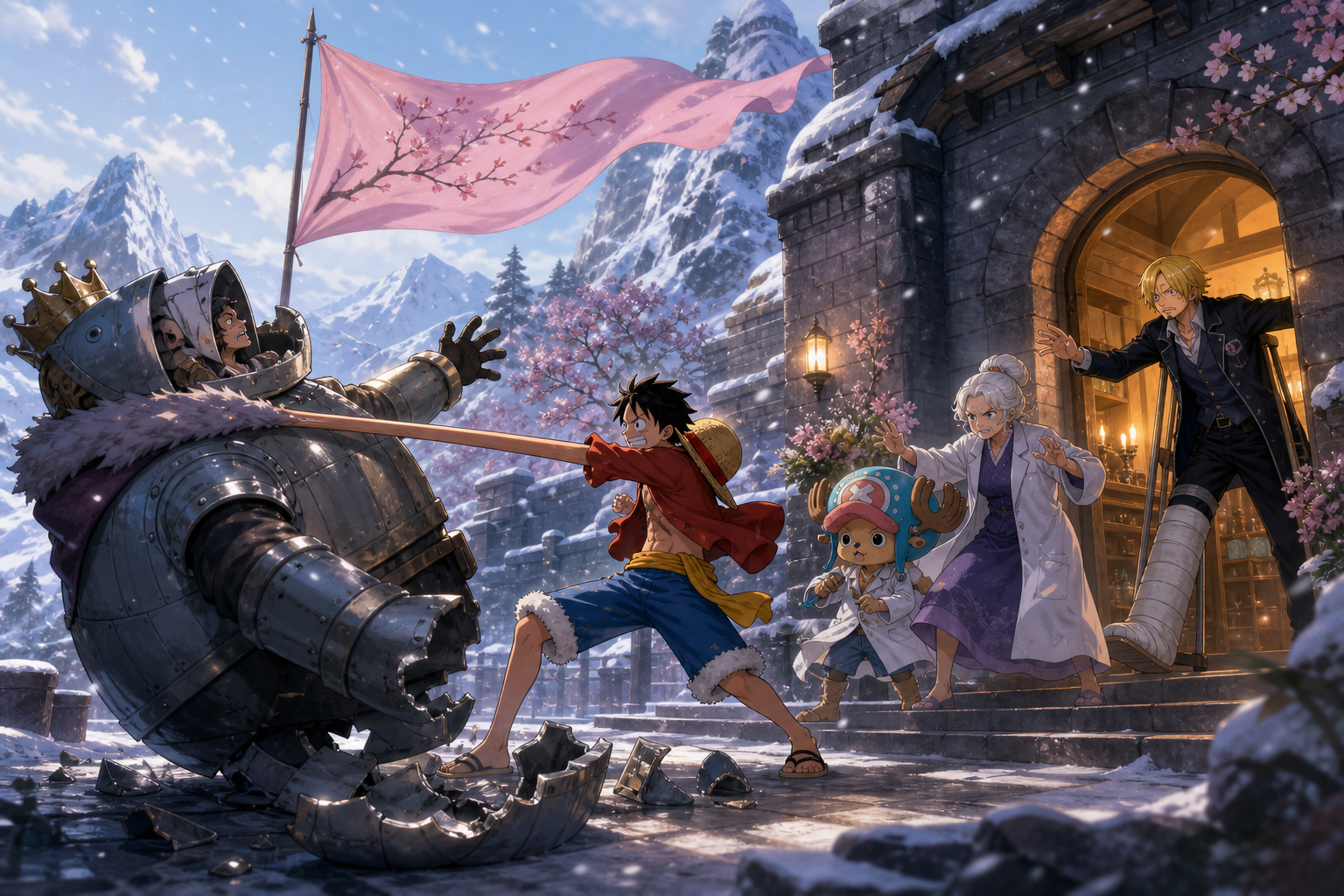
One Piece Episode 87 turns Hiriluk's memorial castle into a clinic under attack as Luffy confronts Wapol and Chopper faces the Munch-Munch Fruit's danger.
Quick reaction
One Piece Episode 87 turns the castle into three things at once: Kureha’s clinic, Hiriluk’s memorial, and the seat Wapol assumes he can reclaim by arriving with force. Luffy fights the invasion, but Chopper carries the sharpest danger when Wapol’s Munch-Munch Fruit makes his body something the former king believes he can swallow and use.
The power is grotesque because Wapol’s politics already work through consumption. He took doctors from the public, absorbed national resources into royal privilege, and treated Drum as property that existed for him. His Devil Fruit simply makes that worldview physical.
RaeRae’s bottom line: protecting Hiriluk’s flag matters, but living patients come first. Nami is still recovering, Sanji has a fracture, Chopper becomes a direct target, and Kureha cannot run a clinic while every room turns into combat space. Defending memory should protect the people who keep that memory alive.
Wapol reaches a castle that no longer recognizes his ownership
Wapol returns expecting walls, weapons, doctors, and authority to wait exactly where he left them. His claim depends on the belief that abandonment did not end his right to rule. He fled when Blackbeard attacked, then came back after other people endured the consequences.
Kureha confronts that claim through continued presence. She used the castle as a clinic, treated patients, trained Chopper, and kept medicine alive outside Wapol’s monopoly. Her occupancy is not conquest. Her work exposes how little legitimacy his title retains.
The confrontation should be documented by witnesses because Wapol may later describe the clinic as stolen royal property. Records of abandonment, medical use, patient care, and his armed return will matter when Drum decides who controls the site after the battle.
The clinic needs lockdown before Luffy’s strength becomes the only plan
Luffy intercepts Wapol, but one fighter cannot secure every entrance, patient room, medicine cabinet, record shelf, and fire hazard. Kureha needs a lockdown plan that divides the castle into treatment, evacuation, combat, and restricted storage zones.
Nami remains a patient recovering from infection. Sanji’s cast limits safe movement and balance. Neither should be expected to defend the clinic because they can still speak or argue. Their room needs cover, warmth, medication, and a route that avoids stairs or exposed terraces.
A relief defender should take over whenever Luffy leaves the main boundary. Chopper, Kureha, and patients cannot become unprotected because the strongest person follows a personal impulse or retrieves clothing.
Hiriluk’s memorial banner carries Chopper’s wish, not Wapol’s permission
The pink cherry-blossom flag represents Hiriluk’s dream and Chopper’s decision to keep that dream visible. Wapol sees a challenge to his authority because symbols can organize loyalty outside government control.
Protecting the banner matters, but the banner should not convert the clinic into a sacrificial battlefield. If moving the memorial keeps patients safe, careful relocation does not betray Hiriluk. The belief survives through people, not through forcing bodies to stand beneath incoming weapons.
Future preservation should include Chopper, Kureha, residents, and people affected by Hiriluk’s work. A memorial becomes propaganda when one institution controls the story and removes every contradiction.
The Munch-Munch Fruit turns containment into a moving problem
Wapol can consume objects, weapons, structures, and living targets, then use what he swallowed. Ordinary disarmament fails when loose material becomes ammunition or armor inside his body. The defenders need clear space rather than a terrace full of tools and debris.
Nobody should stand directly in front of his mouth. Attacks should come from angles that protect escape routes and avoid driving him toward patient rooms. Restraints must account for changing body shape rather than assuming one set of dimensions.
The castle’s armory, kitchen, fuel, and medical stores become strategic hazards. Wapol can turn public resources into personal force. Securing those areas protects both the fight and the evidence of what Drum owned before he tried to consume the inventory.
Doors alone will not hold him if he can eat the barrier. Defenders need distance, observation, and routes that lead him away from critical stores. Containment should use the mountain’s open space without driving him toward residents below.
Luffy’s jacket decision makes cold safety collide with combat duty
Luffy leaving to retrieve his jacket is not completely ridiculous. Cold exposure matters, especially after climbing the mountain and taking damage. Wet skin, wind, and prolonged inactivity can reduce judgment and strength.
The problem is timing and handoff. He leaves while Wapol threatens a clinic and Chopper lacks equivalent protection. A responsible choice would announce the movement, assign a defender, and retrieve necessary gear without opening the entire boundary.
After the fight, Luffy needs warming, dry clothing, food, and assessment for blast or impact injury. Treating cold prevention as comedy should not erase the physical reason his body needs protection.
Wapol swallowing Chopper turns a running joke into bodily terror
When Wapol consumes Chopper, the danger reaches beyond ordinary restraint. Chopper loses space, air, visibility, and control over how another body may use or transform him. The crew cannot strike blindly without understanding where he is.
Time needs tracking from the moment of ingestion. Watch Wapol’s breathing, shape, speech, and movement for evidence of Chopper’s position. Prevent further consumption so the situation does not become more complex with weapons or additional people inside.
Chopper may transform to create space, but that decision belongs to him if he remains conscious. Expanding inside an unknown internal structure could injure him as well as Wapol. Rescue planning should support his choices rather than assuming his body is the safest tool.
No one should attempt an untested chemical or heat response while he remains inside. Wapol’s body may react unpredictably, and Chopper would absorb the same exposure without a clear exit. Rescue discipline means rejecting the dramatic idea when the dramatic idea multiplies unknown harm.
The crew’s earlier jokes sharpen the trauma instead of disappearing
Luffy and Sanji previously joked about Chopper as emergency food. Wapol’s attack gives those words a horrifying physical context. Chopper already knows what being hunted and treated as an animal feels like. A powerful enemy literally swallowing him can reactivate that fear.
The crew did not intend the joke as a threat, but intent does not control impact. After release, they should acknowledge the connection without demanding that Chopper reassure them. An apology works best when behavior changes and food jokes stop.
Chopper may need quiet, choice about touch, and information about what happened while he was trapped. Kureha can help identify signs of shock, breathing injury, or pain while keeping him in control of the examination.
Sanji redirects Luffy because communication must survive shock
Luffy’s anger can narrow his attention toward hitting Wapol harder. Sanji understands that a blind attack could harm Chopper and redirects the response. His intervention shows why the crew needs more than raw strength during hostage danger.
Sanji should still respect his fracture. Giving tactical information does not require joining physical combat. Nami can support situational tracking from cover, including timing, doors, medicine locations, and changes in Wapol’s shape.
Kureha knows Wapol’s habits and castle layout. Her information should guide containment even if Luffy delivers the strike. Expertise remains valuable when the expert is not the strongest fighter.
Post-release care must treat airway, body, and memory
Once Chopper exits Wapol, the first checks should cover breathing, aspiration, crushing injury, chemical exposure, circulation, and orientation. Visible movement does not prove internal safety.
Warmth and privacy matter because he returns to a cold combat zone in front of people watching. Someone should move him away from Wapol’s reach before asking for a full account. Safety comes before intelligence gathering.
Psychological care should avoid forcing a lesson onto the experience. Chopper does not need to become braver because somebody swallowed him. He needs control, honest answers, and freedom to decide when or whether he discusses the fear.
The crew should also repair the earlier relational harm. A direct apology, a promise to stop consumption jokes, and consistent respect around food can help restore safety. Chopper may laugh later, but laughter should follow his comfort rather than serve as proof that everyone else can forget the event.
Kureha must protect medicine and records from consumption
Wapol’s ability makes every cabinet a potential weapon source. Medicines should move behind a defended boundary, especially controlled substances, fragile containers, and supplies needed for Nami and Sanji.
Patient records require separate protection. Losing diagnoses, allergies, dosages, or histories can harm people long after the battle. Records also document the medical monopoly Wapol created and may support future accountability.
Fire risk rises when fuel, alcohol, chemicals, and damaged heating systems share a combat zone. The clinic needs extinguishing tools, ventilation, and someone assigned to watch hazards rather than every person focusing on Wapol.
Someone must maintain an evacuation roster as rooms clear. A castle with multiple levels can hide a patient, worker, or defender after smoke blocks familiar routes. Names and destinations keep rescue teams from searching the same room while another person remains unaccounted for.
Wapol’s forces need accountability without collective retaliation
Soldiers who surrender should be disarmed, separated from patients, documented, and protected from revenge. Some may have committed serious harm, while others served under coercion or lacked a safe route out.
Individual investigation prevents two failures: letting powerful offenders disappear inside the group and punishing every low-level person as though responsibility were identical. Drum needs evidence more than a victory crowd needs targets.
Chopper should decide whether he participates in treating captured forces after his own safety is restored. Medical ethics support care, but nobody should force a traumatized doctor to treat the person who just attacked him when other clinicians are available.
The production team makes absence consequential
Michiru Shimada’s script makes every departure from position matter. Luffy leaving the boundary exposes Chopper. Sanji’s injury limits intervention. Nami’s illness shapes what support she can give. The episode refuses to pretend fighters exist without bodies or assigned roles.
Junji Shimizu’s direction frames the castle as clinic, memorial, arsenal, and contested seat of power. Movement across rooms changes the stakes because each space holds different people and resources.
Takeo Ide’s animation direction gives the Munch-Munch Fruit boundaries viewers can follow while preserving the bodily horror. Yuri Sanami’s art contrasts Hiriluk’s pink memorial with Wapol’s metal, snow, and possessive architecture.
What Episode 87 changes
Wapol reaches the castle and directly attacks the clinic, forcing Luffy, Chopper, Kureha, Nami, and Sanji into the same defense. His claim to ownership becomes active violence rather than distant history.
Chopper faces the Munch-Munch Fruit and survives consumption, deepening the danger behind Wapol’s ability and exposing the trauma beneath earlier food jokes. His choices in the fight belong to him rather than serving as a recruitment test.
The castle’s memorial, medicines, records, weapons, and patients become inseparable from Drum’s political future. Defeating Wapol now means protecting evidence and public resources as well as stopping his body.
Episode details
Japanese title: VS Wapol Gundan! Baku Baku no Mi no Nouryoku!
English title: Versus Wapol’s Army! The Power of the Munch-Munch Fruit
Japanese broadcast: November 11, 2001
Saga: Alabasta
Script: Michiru Shimada
Episode direction: Junji Shimizu
Animation direction: Takeo Ide
Art: Yuri Sanami
The official One Piece episode guide supplies the title, broadcast record, and production credits. RaeRae’s analysis connects Wapol’s ownership claim, clinic lockdown, Hiriluk’s memorial, the Munch-Munch Fruit, Chopper’s consumption and trauma, and protection of medical resources to the episode’s wider argument about coercion and bodily control.
Final verdict
Episode 87 makes Wapol frightening because his power and politics speak the same language. He consumes whatever he can reach and assumes possession follows. Chopper’s body, Kureha’s clinic, Hiriluk’s flag, and Drum itself all become objects inside that claim.
Luffy’s job is stopping the attack. The crew’s responsibility is broader: protect patients, hear Chopper, preserve medicine and records, and refuse to make his survival another joke.
Drum’s residents will inherit the castle after the noise ends. Their safety, testimony, and access to care should shape every decision made during the final minutes of defense.
RaeRae rating: 9.1/10. Lock down the clinic, cover Luffy’s position, keep weapons away from Wapol’s mouth, track Chopper’s time, assess him after release, and remember that protecting a flag begins with protecting the living person beneath the symbol.