
RaeRae Reacts · One Piece Episode 84
Chopper's Secret
One Piece Episode 84 reveals the Kestia bite behind Nami's fever, Chopper's medical skill and Human-Human Fruit, and the urgent effort to revive Dalton.
Quick reaction
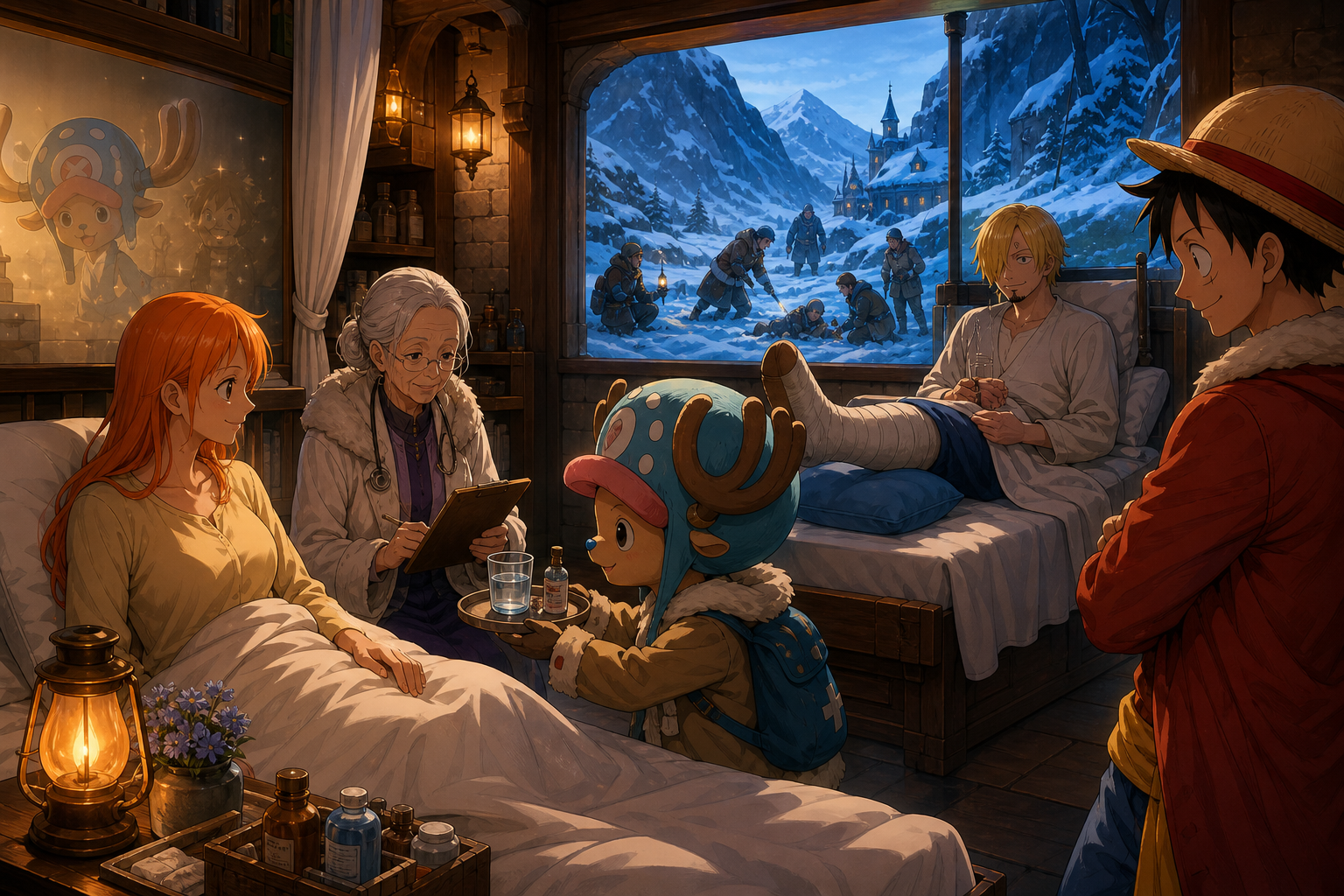
One Piece Episode 84 introduces Chopper through care before biography. Nami wakes because Kureha and Chopper identified the Kestia bite, treated the infection, and monitored her through the fever. Sanji has a fracture because carrying people up a winter mountain leaves real consequences. Dalton may still be alive because extreme cold changes what a rescuer should assume.
Then Luffy and Sanji chase Chopper while calling him food. The comedy may come from hunger and ignorance, but Chopper has already been hunted, rejected, and treated as an animal. Intent cannot decide whether the chase feels safe to the person running.
RaeRae’s bottom line: Chopper’s secret is not that a blue-nosed reindeer ate the Human-Human Fruit. His secret is that the frightened figure hiding behind the door already helped save Nami. Identity should deepen respect for his care, not turn his body into a curiosity show.
Nami wakes in a clinic with an answer the voyage needed earlier
Kureha explains that a Kestia bite caused Nami’s illness. The diagnosis gives the fever a route: vector exposure happened before the crew reached Drum, symptoms worsened at sea, and delayed expert care allowed the infection to become life-threatening.
The crew should have checked for bites, rashes, wounds, travel exposures, water sources, and insect contact as soon as fever began. They lacked a doctor, but a structured history could still have preserved useful information for the person who eventually treated her.
Nami needs an explanation of the diagnosis, treatment, expected recovery, warning signs, medication schedule, and whether complications remain possible. Waking up is a major improvement, not an automatic discharge.
Tick removal and vector care require technique
If a tick remains attached, removal should use appropriate tools close to the skin without crushing the body or leaving mouthparts behind. Oils, burning, or rough pulling can increase injury or pathogen exposure.
The site needs cleaning, documentation, and monitoring. Kureha should record likely exposure time, symptoms, fever course, treatment response, and any medicine reactions. That history may matter if Nami becomes ill again in another climate.
The crew also needs prevention for future islands: clothing, skin checks, bedding inspection, repellents when appropriate, and early reporting. A navigator cannot protect the route if everybody treats small bites as irrelevant until fever appears.
Vivi can add local knowledge without presenting herself as a physician. Travel history, climate, known insects, and recent stops help narrow exposure. The crew should record those details while memory remains fresh instead of rebuilding the timeline after another person becomes sick.
Recovery continues after the fever falls
Nami may experience weakness, dehydration, appetite changes, dizziness, or cognitive fatigue after severe infection. She should return to navigation work gradually rather than proving recovery through immediate command.
Monitoring needs temperature, hydration, sleep, medication adherence, and any returning symptoms. The crew can rotate navigation support under her direction while she regains strength.
Privacy still applies. Nami decides which medical details the crew receives beyond information necessary for safety and travel. Gratitude toward the doctors does not make her body public.
Discharge timing should account for the next environment. Leaving a heated clinic for a ship and then a desert crossing creates two rapid climate changes. Kureha should state which conditions make travel unsafe and what supplies must remain within reach during the transition.
Nami meets Chopper as a participant in care
Chopper approaches with supplies and knowledge while still hiding physically. His behavior shows clinical attention before anyone learns his full history. He is already part of the treatment team.
Kureha should credit him directly for observations, preparation, and assistance. Trainees deserve recognition that identifies their real contribution without exaggerating independent authority.
Nami can thank him without forcing closeness. Chopper may need distance, a doorway, or limited eye contact to feel safe. Respecting that boundary tells him more about the crew than excited questions could.
Sanji’s fracture remains active treatment
Sanji’s climb helped save Nami, but his leg paid for the effort. A fracture needs imaging or careful assessment, alignment, immobilization, circulation and sensation checks, pain control, and follow-up.
Surgical or reduction decisions require explanation and consent whenever capacity allows. A heroic rescue does not authorize surprise procedures or joking dismissal of pain.
The cast must stay dry and protected, while swelling, numbness, color change, odor, increased pain, or fever require review. Sanji should remain non-weight-bearing until Kureha clears movement.
Kitchen work also needs modification. Standing for long periods, carrying pots, and balancing on a moving deck can delay healing or cause a fall. The crew must share food preparation instead of rewarding Sanji for hiding pain behind service.
The clinic needs clean procedure space and visitor rules
Nami and Sanji occupy a working medical environment, not a reunion lounge. Hand cleaning, organized instruments, clean bedding, controlled food, and limited traffic reduce infection and distraction.
Visitors should ask before entering, keep noise down, and leave when Kureha or Chopper needs privacy. Luffy’s hunger cannot override patient meals or clinical supplies.
One update point can keep the crew informed without sending everybody through the room. The rule also protects Chopper from being surrounded while he works.
Food brought into the clinic should follow Kureha’s instructions. Patient diets, medication timing, allergies, and infection control matter more than the crew’s urge to celebrate recovery with one giant meal.
Luffy and Sanji turn hunger into a chase Chopper cannot read as harmless
They wake, see Chopper, and pursue him as possible food. The joke follows their hunger and ignorance, but Chopper does not know them well enough to trust the performance. His history gives every reason to believe humans may hunt him.
Intent does not erase impact. The chase should stop immediately, followed by space, a direct apology, and a promise that nobody will touch or eat him. Laughing harder would make repair more difficult.
Sanji’s fracture makes pursuit medically reckless too. Luffy can find food without targeting a person, while Sanji should stay off the injured leg. Comedy should not require reopening his injury.
Kureha should protect her trainee from guests who ignore boundaries
Chopper is helping in her clinic. Kureha has responsibility to stop the chase, protect his work area, and make visitors follow consent rules. His unusual appearance does not reduce his right to safety.
Touching antlers, fur, hooves, nose, or transformed body requires permission. Clinical curiosity does not create an exception. Chopper decides which questions he answers and how he describes himself.
Accountability includes repair. The crew can replace damaged supplies, clean disrupted rooms, and change behavior rather than treating one apology as the complete response.
Kureha should make the rule explicit before anyone asks Chopper to return. The burden cannot sit on the frightened person to negotiate while being chased. Adults who control a space must enforce safety without waiting for the target to prove distress.
The Human-Human Fruit explains transformation without defining identity
Chopper is a reindeer who ate the Human-Human Fruit and developed multiple forms. That history explains capability, not a simple answer to whether he is human, animal, both, or something else.
Ask Chopper what language he prefers. His blue nose is not a defect to diagnose or a clue that he belongs nowhere. Difference becomes a problem when other people turn appearance into exclusion.
Identity is not a medical curiosity show. The crew should not request transformations for entertainment, test his speech, or ask invasive questions about anatomy before establishing trust.
Names matter too. Calling him monster, pet, emergency food, or specimen frames the relationship before he can answer. Use Chopper unless he offers another name. Basic language can either reopen exclusion or create the first ordinary place he has known.
Dalton remains buried while the castle begins to feel safe
Below the clinic, rescuers find Dalton under snow with severe trauma and an embedded arrow. The contrast matters: warmth has returned for Nami while another patient remains in the cold.
No detectable pulse in severe hypothermia requires careful judgment. Cold can slow heart rate and breathing until signs become difficult to find. Rescuers should assess longer than usual while protecting the neck and avoiding rough movement.
Snow removal needs coordination so tools do not strike his body. Mark his position, clear the airway area first, and create enough space for controlled extraction and insulation.
Resuscitation must coordinate cold injury and the arrow
CPR, airway support, bleeding control, and transport need one plan. The arrow should remain stabilized unless removal is necessary for resuscitation and qualified care can manage the bleeding that may follow.
Rewarming should focus on the core with insulation, warmed air or fluids when available, and protection from wind. Rapid heating of limbs can shift cold blood toward the heart and worsen instability.
Kureha needs notice early so the clinic can prepare equipment, space, and staff. Chopper cannot cover Nami, Sanji, Dalton, and a chaotic crew alone.
Transport should include continuous monitoring because a pulse or breathing pattern can change during movement. One rescuer records time and observations while another maintains warmth and airway access. The team needs a direct route rather than stopping for public updates along the way.
Information can help Nami without turning recovery into labor
Nami may remember route conditions, timing, or resources that support Dalton’s rescue. She can share information from bed without being made coordinator for an emergency she cannot physically join.
Sanji can describe the mountain climb and weather while respecting non-weight-bearing restrictions. Luffy can carry equipment or clear paths if Kureha assigns a safe task.
The crew should learn that usefulness during recovery does not require ignoring medical limits. Patients can contribute and still remain patients.
That lesson will matter across the voyage. Nami and Sanji both define themselves through work, so rest can feel like failure. Chopper’s medical authority should help the crew separate temporary limits from loss of identity or belonging.
The production team places identity beside care
Michiru Shimada’s script reveals Chopper through what he does in the clinic, then complicates the introduction through fear and pursuit. Skill and vulnerability arrive together.
Daisuke Nishio’s direction balances warm recovery rooms with dread surrounding Dalton under snow. The episode refuses to let one successful treatment erase another emergency.
Kazuya Hisada’s animation direction makes clinical movement precise while giving Chopper’s hiding and flight emotional clarity. Miyuki Sato’s art makes the castle feel functional rather than a generic royal interior.
What Episode 84 changes
Nami’s illness receives a confirmed cause and successful treatment, while her recovery remains active. Sanji’s fracture becomes a separate care plan rather than a temporary visual gag.
Chopper is revealed as Kureha’s medical trainee and a reindeer transformed by the Human-Human Fruit. His competence becomes clear before the crew understands his identity.
Dalton’s apparent death becomes a cold-weather resuscitation emergency. Drum now holds multiple patients whose survival depends on coordinated care rather than one miraculous doctor.
Episode details
Japanese title: Tonakai wa Aopana! Chopper no Himitsu
English title: Blue-Nosed Reindeer! Chopper’s Secret
Japanese broadcast: October 21, 2001
Saga: Alabasta
Script: Michiru Shimada
Episode direction: Daisuke Nishio
Animation direction: Kazuya Hisada
Art: Miyuki Sato
The official One Piece episode guide supplies the title, broadcast record, and production credits. RaeRae’s analysis connects the Kestia diagnosis, Nami’s follow-up, Sanji’s fracture, Chopper’s clinical work and identity, the harmful chase, and Dalton’s cold-weather resuscitation to the episode’s wider argument about care and consent.
Final verdict
Episode 84 introduces Chopper in the right order: doctor, frightened stranger, transformed reindeer, and potential friend. His body explains why others stare. His care explains why the audience should stop staring and listen.
The Straw Hats need to repair their first approach before asking him for anything. A person who has spent a life being hunted will not learn safety from people who call the hunt a joke.
Dalton’s rescue carries the same standard in another direction: do not confuse silence or stillness with permission to stop trying. Care begins by questioning the easy assumption when a vulnerable body cannot speak.
RaeRae rating: 9.2/10. Explain Nami’s treatment, protect Sanji’s fracture, credit Chopper, stop the chase, ask about identity, and treat Dalton as potentially recoverable until careful cold-weather assessment proves otherwise.