
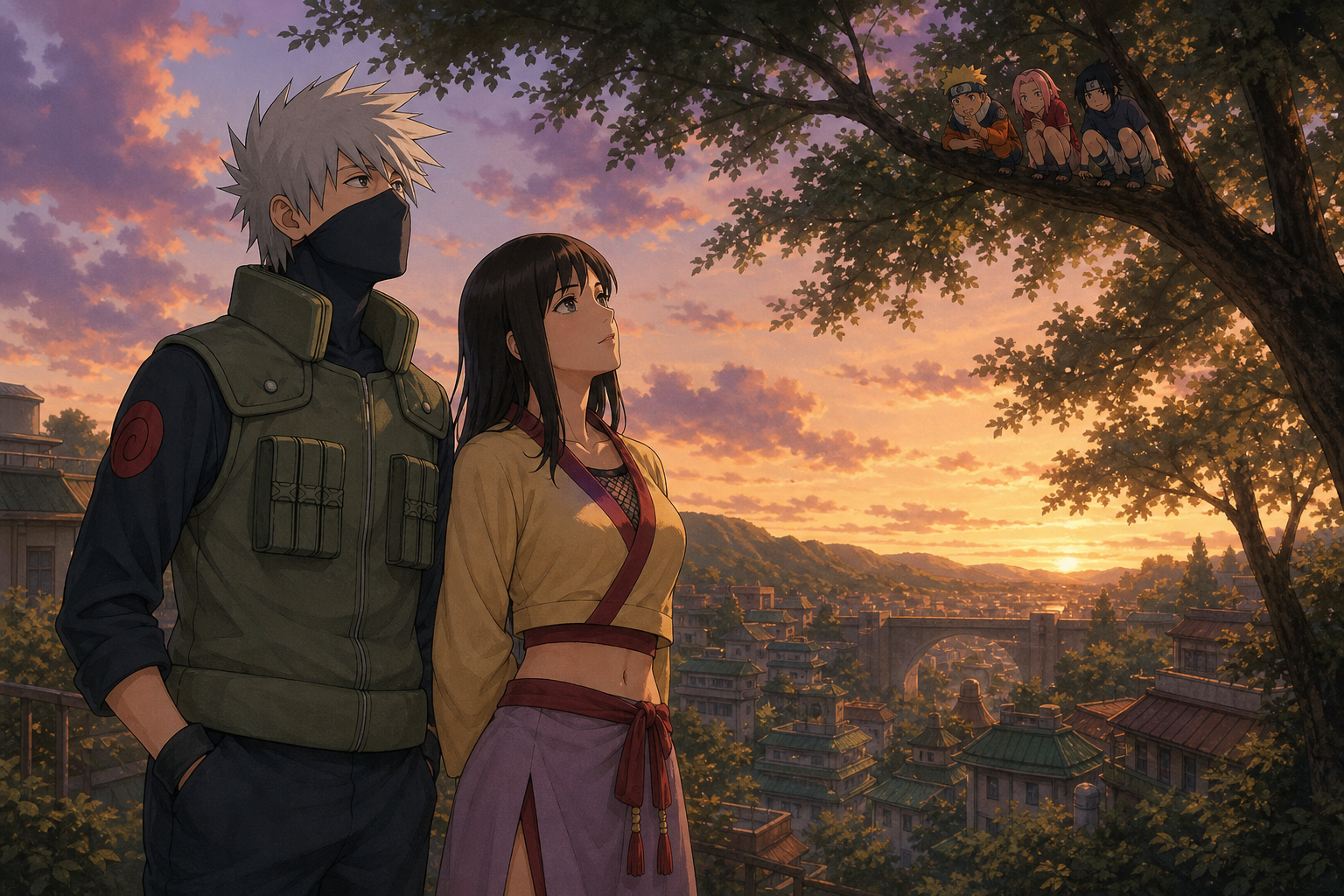
Kakashi Love Song
A captured spy remembers Kakashi’s childhood kindness, giving two guarded people one quiet afternoon before their villages pull them apart again.
Bottom line
Naruto Shippuden Episode 191, "Kakashi Love Song," begins during Konoha's reconstruction. A traveling musician reminds Kakashi of Hanare, a spy from the Hidden Lock Village whom the Leaf once captured near its gates.
Ibiki cannot extract useful information from Hanare, so Inoichi enters her mind. Hanare's Eye Mind Reading turns the technique back on him, but he sees one unexpected memory: she met Kakashi as a lonely child. Kakashi is assigned to escort her through the village and encourage her to talk.
Young Naruto, Sakura, and Sasuke conclude that their teacher is on a date and follow from the trees. Kakashi and Hanare speak about their childhood encounter and watch the clouds together. Team 7 tumbles from its hiding place, knocking Kakashi into Hanare for an accidental kiss.
The comedy gives way to a prisoner exchange after the Hidden Lock captures Leaf shinobi Riichi. Kakashi distrusts the arrangement and disrupts the bridge once Riichi is safe. During the pursuit, Hanare reveals that she erased the intelligence she gathered because she wants to choose a different life. Kakashi lets her escape, keeping her decision from becoming another weapon between villages.
Episode 191 works best as a story about recognition rather than a completed romance. Hanare remembers kindness from a lonely boy before Kakashi became famous for grief and emotional distance. Kakashi, in turn, recognizes the person beneath an enemy assignment. Their connection gives him enough reason to protect her act of conscience without claiming control over whatever comes next.
Kakashi remembers someone who met him before the mask hardened
Hanare's importance is not that she becomes a secret great love. She remembers Kakashi from a moment when both of them were isolated children, before his adult habits made emotional distance look effortless.
Young Kakashi offered guidance without knowing whether they would meet again. Hanare carried that kindness because her own village treated her less like a child than an intelligence asset. When they meet as adults, she is technically his prisoner, yet their shared history prevents him from seeing only the job attached to her name.
Kakashi is used to memories arriving as grief. Hanare brings back evidence that he once mattered to someone in a gentler way.
That gentleness matters because Kakashi rarely receives proof of his positive effect on people who survived. So many memories point toward someone he could not save. Hanare carries a different record: a brief encounter that helped a lost child keep moving. She does not remove his grief, but she reveals that his past contains more than failure and funerals.
Hanare's eye technique makes interrogation reciprocal
Inoichi enters Hanare's mind expecting access to flow in one direction. Her Eye Mind Reading reverses the arrangement, allowing her to gather from the person searching her. The technique is a perfect expression of espionage: even capture can become an opportunity to collect information.
The reversal also makes consent impossible to ignore. The Leaf has reasons to interrogate a suspected spy, but the scene refuses to present mental access as neutral. Both people cross into private material, and both leave with knowledge the other did not offer.
The memory of Kakashi becomes the human detail the intelligence process cannot classify. The memory is not a map, password, or troop count. Instead, the unexpected image gives the Leaf a reason to reconsider who Hanare might be beyond her assignment.
Inoichi's technique normally promises institutional access to a hidden truth. Hanare's counter-technique disrupts that confidence. Knowledge moves both ways, and the interrogator becomes visible to the person being searched. The scene suits an episode concerned with whether people are subjects with private lives or containers that villages may open for useful information.
Team 7 treats privacy like a group mission
Naruto, Sakura, and Sasuke spying on Kakashi is wonderfully on brand. They have spent so long trying to learn anything personal about their masked teacher that one walk with a woman becomes an emergency reconnaissance operation.
Sakura reads romance into every pause. Naruto lacks volume control even while hiding. Sasuke, who would insist he is above the entire situation, remains in the tree with them. Their curiosity reveals how little Kakashi shares and how invested all three students are in the idea that he might have a life beyond training them.
The accidental kiss is slapstick, not a grand romantic payoff. The collision breaks the tension precisely because Kakashi and Hanare were having a sincere conversation the children could not leave alone.
Their ridiculous surveillance also adds warmth to Team 7's history. The children violate every boundary, but the curiosity comes from attachment. Kakashi has become important enough that evidence of a private life feels like a revelation. Even Sasuke's presence betrays investment that his detached performance would never admit aloud.
The cloud-watching scene gives them a neutral sky
Kakashi belongs to the Leaf. Hanare belongs to the Hidden Lock. Every street and uniform asks them to stand on opposite sides. Looking at clouds gives them something neither village owns.
The quiet works because both characters are trained to conceal. They do not need a long confession to understand that loneliness shaped the other person. Their conversation carries the possibility of another life without pretending either person can simply walk away from obligation.
For Kakashi, stillness is rare. He often arrives late because he is visiting a memorial, and he hides inside books when company becomes too direct. Beside Hanare, silence is briefly shared instead of defended.
Clouds offer a fitting image because their movement ignores the borders controlling both shinobi. Kakashi and Hanare cannot erase allegiance by looking upward, but they can inhabit a short interval in which neither uniform defines the whole person. The scene earns intimacy through the absence of interrogation.
Hiruzen chooses exchange before punishment
The Third Hokage agrees to trade Hanare for Riichi because a captured Leaf shinobi's life matters more than possessing an enemy agent. The exchange is a pragmatic choice that protects his person without confusing custody with victory.
Kakashi still distrusts the other village. Once Riichi crosses to safety, he destroys the bridge and prevents the exchange from settling into a clean transfer of assets. The action looks like refusal to release Hanare, but the disruption also denies the Hidden Lock immediate control over someone whose loyalty is changing.
The bridge becomes a literal line between institutional claims. Kakashi breaks the crossing because neither side has earned the simple ending each village wants.
Hiruzen and Kakashi make different decisions at different scales. Hiruzen protects a captured Leaf shinobi through an official exchange. Kakashi responds to what he learns about Hanare after the exchange begins. Neither choice treats the prisoner as disposable, although Kakashi goes further by recognizing that returning her safely to her handlers may not protect her at all.
Hanare erases the intelligence herself
Hanare's decisive act happens before Kakashi frees her. She removes the Leaf secrets from her own mind, surrendering the value her village trained her to provide. That choice is costly because espionage has defined her usefulness since childhood.
Erasing the information does not erase her skill or the harm involved in collecting the secrets. Her decision changes what she will allow that skill to serve. She is trying to make herself a person rather than a container passed across a bridge.
Kakashi believes her because he recognizes the difference between desertion for convenience and a painful refusal of one's assigned role. He has spent his life negotiating the space between village duty and personal conscience.
Hanare makes the decisive moral move before Kakashi grants freedom. That sequence protects her agency. She does not promise reform after receiving mercy; she destroys the intelligence while escape remains uncertain and while the choice may leave her unwanted by both sides. Kakashi responds to courage already demonstrated.
Kakashi lets her go without claiming her
The episode avoids turning mercy into possession. Kakashi does not free Hanare on the condition that she stay with him, join the Leaf, or provide something in return. He lets her disappear because her attempt to change deserves room outside both villages' immediate reach.
That restraint makes the connection more affecting. Kakashi cares, but caring does not give him ownership over her future. Their bond remains unfinished, shaped by timing and duty rather than a promise the story cannot honestly support.
When a musician later recalls Hanare to him, the memory is bittersweet because he does not know where the choice led. He can only know that he gave her the chance to choose.
Kakashi's restraint is the most romantic part of the episode. He protects the possibility of Hanare's future without demanding a place inside that future. A less careful story could treat release as a debt she must repay with affection. Here, care means refusing to turn another person's freedom into his reward.
The episode finds romance in recognition, not certainty
“Love Song” sounds larger than what Kakashi and Hanare actually share. There is no settled relationship, domestic future, or declaration. There is recognition between two lonely people who remember one another across years of training and violence.
For Kakashi, that may be the most believable romance available at this stage of his life. He has lost too many people to treat attachment casually, and he is too practiced at distance to build intimacy in an afternoon. Hanare does not demand that he become suddenly open. She understands the coded version because she speaks the same emotional language.
Their connection matters even while remaining a single unresolved verse.
Both villages try to turn people into assets
The prisoner exchange is humane in immediate purpose because Riichi needs rescue, but the language of exchange still reveals a larger problem. Each side measures a person through intelligence value and institutional ownership. Hanare crosses the bridge as though allegiance fully defines her.
Her erased memories break that calculation. The Hidden Lock expects an operative carrying Leaf secrets, while the Leaf sees a dangerous collector of classified information. Hanare chooses to become neither description. Her decision does not erase her history, but the decision prevents both villages from completing the transaction they imagined.
Kakashi recognizes the pattern because shinobi culture has repeatedly priced people by usefulness. Letting Hanare leave is a small refusal of that accounting. He cannot dismantle the system during one exchange, but he can decline to deliver a person back into a role she has consciously rejected.
The accidental kiss is not the emotional climax
Team 7's fall from the tree supplies the episode's most obvious romantic comedy, yet the kiss happens without choice and resolves nothing. The real intimacy lies elsewhere: remembered kindness, shared quiet, and Kakashi believing Hanare's costly decision.
That emphasis keeps the story from confusing physical proximity with emotional commitment. Naruto, Sakura, and Sasuke see a date because they are children hunting for a simple explanation. The adults understand that affection exists inside surveillance, imprisonment, duty, and uncertain futures.
The comedy remains welcome because Kakashi is so rarely allowed embarrassment without catastrophe. Still, the episode wisely bases his final mercy on Hanare's agency rather than on the accident that made his students scream from the bushes.
Kakashi protects a possibility he may never witness
Hanare says she wants another life, but the episode offers no guarantee that freedom will be easy or safe. Her village may hunt her. The Leaf may continue to regard her as a threat. Years of training cannot be discarded as quickly as gathered intelligence.
Kakashi releases her despite that uncertainty. He does not require proof of a successful transformation before allowing the attempt. The choice resembles the childhood kindness Hanare remembers: guidance offered without ownership of the destination.
The musician's later appearance preserves the unresolved quality. Kakashi receives memory instead of closure. For someone whose life is crowded with graves, knowing that he once opened a route rather than arriving too late carries quiet significance.
Hanare remembers a Kakashi untouched by her assignment
She met him before adult allegiance converted every encounter into intelligence. The lonely boy offered direction because another child was lost, not because kindness served the Leaf.
That memory gives her one relationship her handlers did not design. When they meet again, recognition interrupts the easy classification of prisoner and escort.
Kakashi receives evidence that he once helped somebody survive
His memories usually return with accusation. Obito, Rin, Minato, and Sakumo all carry versions of what he could not prevent or repair.
Hanare brings a rarer record. Something small he did mattered, continued beyond his sight, and reached adulthood inside another person. The proof cannot erase grief, but it expands his past beyond failure.
Mind reading makes institutional entitlement visible
Inoichi enters looking for intelligence because Konoha considers access justified. Hanare’s reversal forces the searcher to become searchable, exposing how invasive the process is when knowledge stops moving in only one direction.
The useful discovery is not a military secret. It is a private memory that complicates the category assigned to her.
Team 7’s surveillance is invasive and deeply affectionate
Naruto and Sakura would follow immediately. Sasuke remaining in the tree completes the joke. Every student wants proof that Kakashi has a life beyond lateness, training, and orange books.
Their behavior is terrible. Their investment is tender. Curiosity becomes the language children use when an emotionally guarded adult never offers context voluntarily.
The bridge turns people into exchange values
Trading Hanare for Riichi protects a Leaf life, yet the structure treats both prisoners as assets whose institutional ownership can be negotiated.
Hanare’s erased intelligence destroys that calculation. She refuses to arrive as the useful package her village expects, making personhood interfere with a transaction designed around utility.
Kakashi’s mercy responds to a choice already made
Hanare removes the secrets before freedom is guaranteed. She risks becoming unwanted by the Hidden Lock while remaining distrusted by Konoha.
Kakashi does not invent her redemption or demand it as payment. He recognizes courage that occurred without his permission and protects the space it needs next.
Letting go becomes the episode’s most intimate act
He asks for no loyalty, residence, information, or future meeting. Care does not become a new claim on Hanare after she escapes the old one.
That restraint is more convincing than the accidental kiss. Kakashi protects her ability to choose a life even if that life never includes him.
RaeRae's reaction to Kakashi Love Song
Team 7 falling out of the tree is hilarious because Sasuke is there. Naruto spying on Kakashi makes perfect sense. Sakura joining him makes sense. Sasuke deciding the mission is worth his time tells me all three children were starving for evidence that their teacher was a human being with embarrassing feelings.
The episode is strongest during the quiet scenes. Kakashi and Hanare watching clouds works because neither character tries to turn the moment into a speech. They recognize loneliness in each other and allow the silence to be less lonely for a minute.
Hanare deleting the intelligence is the part that earns Kakashi's choice for me. He is not freeing an unchanged spy because she is beautiful or because they kissed by accident. He is responding to an act that makes her less useful to the system that controlled her.
I do not need this connection to become Kakashi's lost epic romance. I prefer something smaller and sadder: a person from his past reappears, proves she remembers his kindness, and leaves with one more kindness that may help her build a life neither of them can see yet.
The cloud scene stays with me because neither person asks for an impossible promise. They share recognition while every institution around them demands information, allegiance, and utility. For a few minutes, being understood is enough. Kakashi's later choice ensures Hanare has a chance to decide what enough might mean next.
The song remains unfinished because freedom is unfinished
The musician prompts memory, not closure. Kakashi does not know whether Hanare found safety, belonging, or another way to use her abilities. He only knows he opened a route instead of returning her to control.
For someone haunted by arriving too late, that uncertain possibility carries unusual grace. Not every meaningful bond needs possession, certainty, or a grave to prove it existed.
Hanare also gives Kakashi a rare memory in which separation does not mean death. She leaves because he created room for choice, not because tragedy removed choice forever. That distinction cannot promise happiness, but it lets tenderness exist without becoming another funeral within his already crowded personal history.
RaeRae’s final word on Kakashi Love Song
Sasuke hiding in that tree with Naruto and Sakura tells me everything. All three children are starving for evidence that Kakashi has embarrassing human feelings, and apparently covert surveillance is how Team 7 expresses concern.
The accidental kiss is funny. The cloud scene is intimate. Hanare erasing the intelligence is what gives the ending moral weight.
Kakashi does not free her because a collision created romance. He responds to a woman who has already sacrificed the value her village demanded from her in order to choose another life.
I prefer that the episode refuses to make this an epic lost relationship. Hanare remembers kindness from a lonely boy. Kakashi learns that one gentle act survived somewhere outside his grief.
Then he lets her leave without turning freedom into a debt. He may never know what she builds afterward. Protecting that unwitnessed possibility is the closest thing this guarded man offers to a love song.
RaeRae’s call
Kakashi and Hanare do not need a promised future to matter. Recognition, conscience, and one freedom given without conditions make their unfinished connection more honest than the accidental kiss ever could.