
RaeRae Reacts · One Piece Episode 82
Dalton Faces Wapol
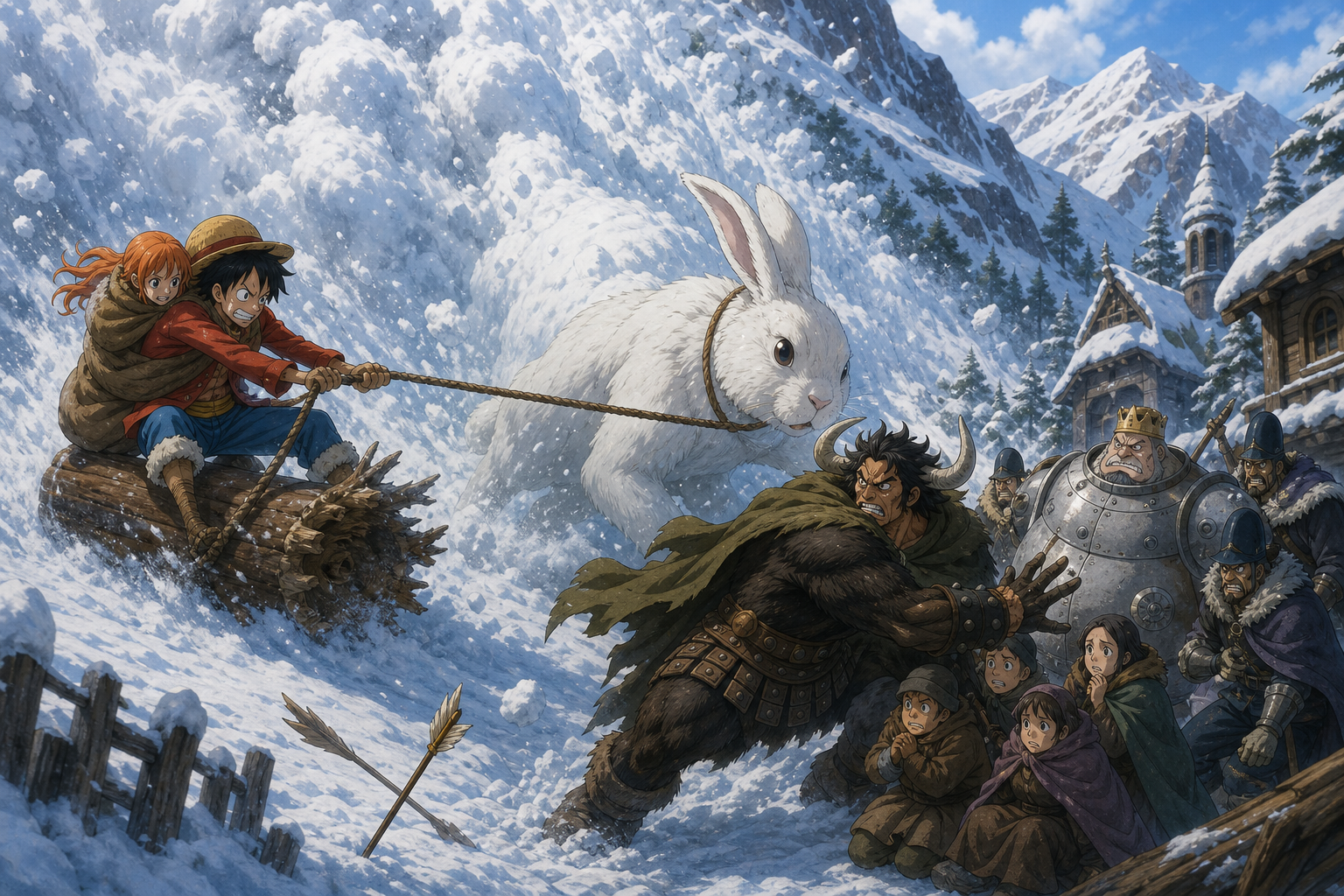
One Piece Episode 82 pairs Dalton's stand against Wapol with Luffy's rescue of a parent Lapahn as an avalanche overwhelms Drum's mountain and village.
Quick reaction
One Piece Episode 82 splits Drum’s crisis across the mountain and Big Horn, then lets an avalanche force every priority into the same emergency. Luffy must keep Nami moving while choosing whether to help an injured parent Lapahn. Dalton must confront the ruler who abandoned the kingdom while protecting residents who never consented to Wapol’s return.
The choices mirror each other. Luffy helps without bargaining for loyalty. Dalton stands between violence and civilians without claiming that courage automatically makes him the next king. Both acts matter because protection does not become ownership.
RaeRae’s bottom line: the avalanche does not pause politics, and politics does not pause triage. Nami, the Lapahn, Dalton, villagers, attackers, and separated crewmates all become part of one rescue field. Life safety comes first; evidence and accountability follow close behind.
The Lapahn conflict triggers a danger nobody can fight directly
Movement, impact, noise, and unstable snow combine until the slope releases. The avalanche turns a localized animal encounter into a mountain-wide threat whose force ignores intent.
Warning signs include cracking, collapsing snow, recent heavy accumulation, wind loading, and a hollow response beneath weight. Once release begins, distance and route selection matter more than defeating whatever started the conflict.
The group should move across the slide path when possible rather than racing straight downhill beneath the flow. Every person needs face protection and a plan to create breathing space if buried.
Heavy movement and shouting can worsen instability when the slope has not fully released. The crew should limit unnecessary impact, watch the terrain above, and avoid gathering in one runout zone. The mountain remains dangerous after the first wall of snow passes.
Nami remains the transport priority
Her fever continues worsening, so every detour carries medical cost. Luffy cannot abandon her to fight or investigate while the only known doctor remains ahead.
A tree becomes an improvised sled, which may reduce the physical burden but creates steering, impact, and exposure risks. Speed means nothing if the sled overturns or drives Nami into debris.
She needs insulation from wood and snow, secure support that does not restrict breathing, and monitoring for responsiveness. Snow inhalation and cold can worsen an infection even when the sled keeps moving.
A person should travel beside or just behind her whenever terrain allows. That position makes airway changes, vomiting, strap failure, and loss of coverings visible. A patient tied safely at the start can become unsafe after one collision or turn.
Sanji needs visual contact and a defined rescue role
Sanji follows the route while protecting the patient and watching Luffy’s decisions. He should remain close enough to see the sled without standing directly behind falling debris.
His best role is stabilization, route observation, and warning rather than independent pursuit. If Luffy changes direction, Sanji needs a signal and a known reunion point.
Food and warming supplies should stay accessible because both rescuer and patient will lose energy quickly. Sanji’s care work matters most when he preserves capacity for the climb still ahead.
He should also document Nami’s changes in simple terms: responsiveness, breathing, skin temperature, and any new symptom. Kureha will need a timeline, and memory under cold stress becomes unreliable. Observation is part of transport care.
The parent Lapahn creates a real ethical conflict
Luffy sees an adult animal endangered while the avalanche threatens Nami’s route. Helping risks delay; refusing may leave young Lapahn without their parent and damage the relationship formed moments earlier.
Wildlife rescue needs boundaries. Do not separate young from adults, force contact, or carry an animal toward human settlement without necessity. Create space for self-rescue first.
Luffy’s intervention changes how the Lapahn interpret him because he helps a vulnerable member without asking for submission. Reciprocity may follow, but the animals remain autonomous.
Reassessing after the slide is part of rescue
Once immediate movement slows, the team should count people, inspect Nami’s position, check Sanji and Luffy for injury, and identify whether supplies were lost.
Adrenaline can hide sprains, impact pain, frost injury, or confusion. A brief checkpoint may save time by preventing a collapse during the vertical climb.
The route also needs reevaluation because the avalanche can erase landmarks, expose new ice, block passes, or destabilize a second slope. The original plan no longer describes the mountain.
Lost equipment must be counted before the team assumes every supply remains attached. Water, coverings, medicine, ropes, and food each change the safety margin. A missing item should alter the plan instead of becoming a surprise higher on the route.
Big Horn faces occupation disguised as royal return
Wapol enters the village expecting old titles to restore authority. He abandoned Drum during Blackbeard’s attack, leaving residents to survive the vacuum. Returning with armed followers is not public consent.
Civilians should move away from confrontation, especially children, injured residents, and people without winter shelter. Strong buildings need assessment because avalanche pressure may make familiar rooms unsafe.
Witnesses should record Wapol’s words, orders, weapons, damage, and the timing of his return. A future claim of lawful restoration must face the testimony of people he left.
Residents also need one trusted source for public instructions. Conflicting rumors about the king, avalanche, or shelter safety can send people into exposed streets. Clear updates should identify immediate actions without demanding political allegiance during rescue.
Dalton confronts Wapol through duty rather than succession
Dalton stands against the former king because residents face immediate danger. His Zoan transformation gives strength and visibility, but a larger body also becomes an easier target in an open village.
Defensive positioning should keep him between attackers and evacuation routes without drawing fire toward civilians. Cover and movement matter more than a symbolic face-to-face stand.
His courage does not settle Drum’s future government. Protecting people may earn trust, but citizens still deserve a process for choosing leadership and limiting power.
Dalton should name another coordinator before confronting Wapol. Leadership that exists only in one brave body collapses the moment that body falls. Shared authority protects the village and demonstrates a different political model from Wapol’s personal rule.
Chess targets the islanders and turns resistance into collective punishment
Firing toward residents punishes the community for Dalton’s refusal to submit. The tactic reveals Wapol’s political model: harm ordinary people until the protector becomes responsible for surrender.
Evacuation should use multiple routes so one attack cannot trap everyone. Residents who can move should help children, older neighbors, and injured people without forming one dense target.
Vivi can support de-escalation and communication from cover. Her royal experience may help identify tactics, but she should not stand exposed or claim authority over Drum’s citizens.
Dalton takes the arrow and becomes a trauma patient
The embedded arrow may limit visible bleeding by remaining in place. Pulling the object out in the field could open damaged vessels and worsen the injury.
Stabilize the shaft, control bleeding around the wound, protect the airway, monitor responsiveness, and move him only when the route is ready. His transformed anatomy may complicate assessment and transport.
Someone else must assume evacuation coordination. A village cannot let every safety decision stop because one respected leader falls.
The avalanche reaches Big Horn and merges both emergencies
Snow overwhelms streets already under attack. People should leave weak walls, roof edges, narrow alleys, and terrain channels where moving snow concentrates force.
If burial occurs, protect the airway and conserve movement. Search teams need a structured grid, last-seen points, probes, listening, and marks showing cleared areas.
Secondary slides remain possible. Rescuers should work in teams, maintain contact, and avoid adding more missing people through uncoordinated bravery.
Search order should prioritize visible air pockets, last-seen locations, and places where structures may have created survivable space. Rescuers need warming rotations because cold hands and fatigue reduce the precision required around buried people.
Attackers also receive emergency care after life safety is secured
Wapol’s forces may become buried or injured alongside residents. Rescue should follow medical need while maintaining security through disarmament, supervision, and separation.
Care does not erase accountability. Names, uniforms, weapons, orders, and witness accounts should be preserved after breathing and bleeding are addressed.
Weapons collected during rescue need tagging and secure storage away from patients. Handling should preserve fingerprints, damage, and ownership records where possible. Casual redistribution would create new danger and weaken any later investigation into who fired on residents.
Collective revenge would reproduce Wapol’s disregard for bodies. Individual investigation can distinguish coercion, active abuse, surrender, and command responsibility.
The mountain team and village need one communication chain
Luffy, Sanji, and Nami may be unaware that Big Horn has been struck. The village may not know their condition or route. Signals, runners, and agreed checkpoints can reduce dangerous duplication.
Kureha may become the only advanced trauma resource for multiple zones. She needs patient counts, injury types, transport times, and supplies before deciding who moves toward the castle.
Multiple care zones can provide warming, triage, and stabilization below while the most critical patients travel. One distant clinic cannot safely absorb the entire disaster at once.
Each zone needs a patient register so families and teams know who moved where. Names, condition, treatment, destination, and transport time prevent people from vanishing inside a well-intentioned response. Records become especially important when political violence and natural disaster overlap.
Vivi, Zoro, Usopp, and Karoo need roles matched to capacity
Vivi can organize information, shelter lists, and communication without exhausting herself in heavy rescue. Her leadership works best when she delegates rather than becoming the center of every action.
Zoro can move debris under structural direction. Usopp can build signals, map search zones, and support ropes without entering unstable spaces alone.
Karoo should remain clear of avalanche debris and overloaded transport. His speed can carry messages across safe routes, but loyalty does not make his body expendable.
Vivi should confirm water, rest, footing, and a return threshold before assigning him a run. A message delivered after collapse helps nobody. Animal partnership requires the same contingency planning the crew would expect for a human courier.
The production team joins personal and public rescue
Michiru Shimada’s script connects Luffy’s choice about one animal and one patient with Dalton’s choice about a whole village. Care moves across scale without losing individual bodies.
Harume Kosaka’s direction sends mountain and village motion toward the same avalanche, making convergence feel inevitable rather than convenient.
Kenji Yokoyama’s animation direction gives snow mass, speed, and consequence. Kunihiro Senda frames Drum as a country under environmental and political pressure at the same time.
What Episode 82 changes
Luffy protects the parent Lapahn while maintaining Nami’s route, deepening the animals’ willingness to help without turning their support into ownership.
Wapol lands in Drum and attempts to reclaim authority through armed force. Dalton openly resists and receives a severe arrow injury while shielding residents.
The avalanche reaches Big Horn, merging the mountain rescue, village occupation, wildlife harm, and separated crew into one incident that will require coordinated triage.
Episode details
Japanese title: Dalton no Kakugo! Wapol Gundan Shima ni Jouriku
English title: Dalton’s Resolve! Wapol’s Army Lands on the Island
Japanese broadcast: October 7, 2001
Saga: Alabasta
Script: Michiru Shimada
Episode direction: Harume Kosaka
Animation direction: Kenji Yokoyama
Art: Kunihiro Senda
The official One Piece episode guide supplies the title, broadcast record, and production credits. RaeRae’s analysis connects the Lapahn rescue, Nami’s sled transport, Wapol’s armed return, Dalton’s stand and injury, avalanche triage, and the divided crew to the episode’s wider argument about protection without ownership.
Final verdict
Episode 82 places moral choices inside motion. Luffy cannot wait for perfect safety before helping the parent Lapahn. Dalton cannot wait for a constitutional process before shielding residents. Both can act without claiming the lives they protect.
The avalanche exposes how quickly separate failures combine. Medical scarcity, political abandonment, wildlife conflict, severe weather, and fragmented communication all arrive in one field.
A credible recovery has to address each cause instead of celebrating the strongest survivor. Rescue may end tonight, but prevention belongs to the government, clinics, villages, and mountain routes that remain.
RaeRae rating: 9.3/10. Keep Nami moving safely, help the Lapahn without owning them, stabilize Dalton’s arrow, evacuate Big Horn, search systematically, treat attackers under guard, and document Wapol’s return after every breathing person is found.