
RaeRae Reacts · One Piece Episode 81
Kureha and Chopper Appear
One Piece Episode 81 introduces Kureha and Chopper as Nami’s transport team faces Lapahn, Wapol approaches Drum, and Dalton explains why the island lost its doctors.
Episode information
Japanese title: Happy Kai? Majo to Yobareta Isha!
English title: Are You Happy? The Doctor Called a Witch!
Japanese broadcast: September 16, 2001
Saga: Alabasta
Script: Michiru Shimada
Episode direction: Konosuke Uda
Animation direction: Hideaki Maniwa
Art: Tomoko Yoshida
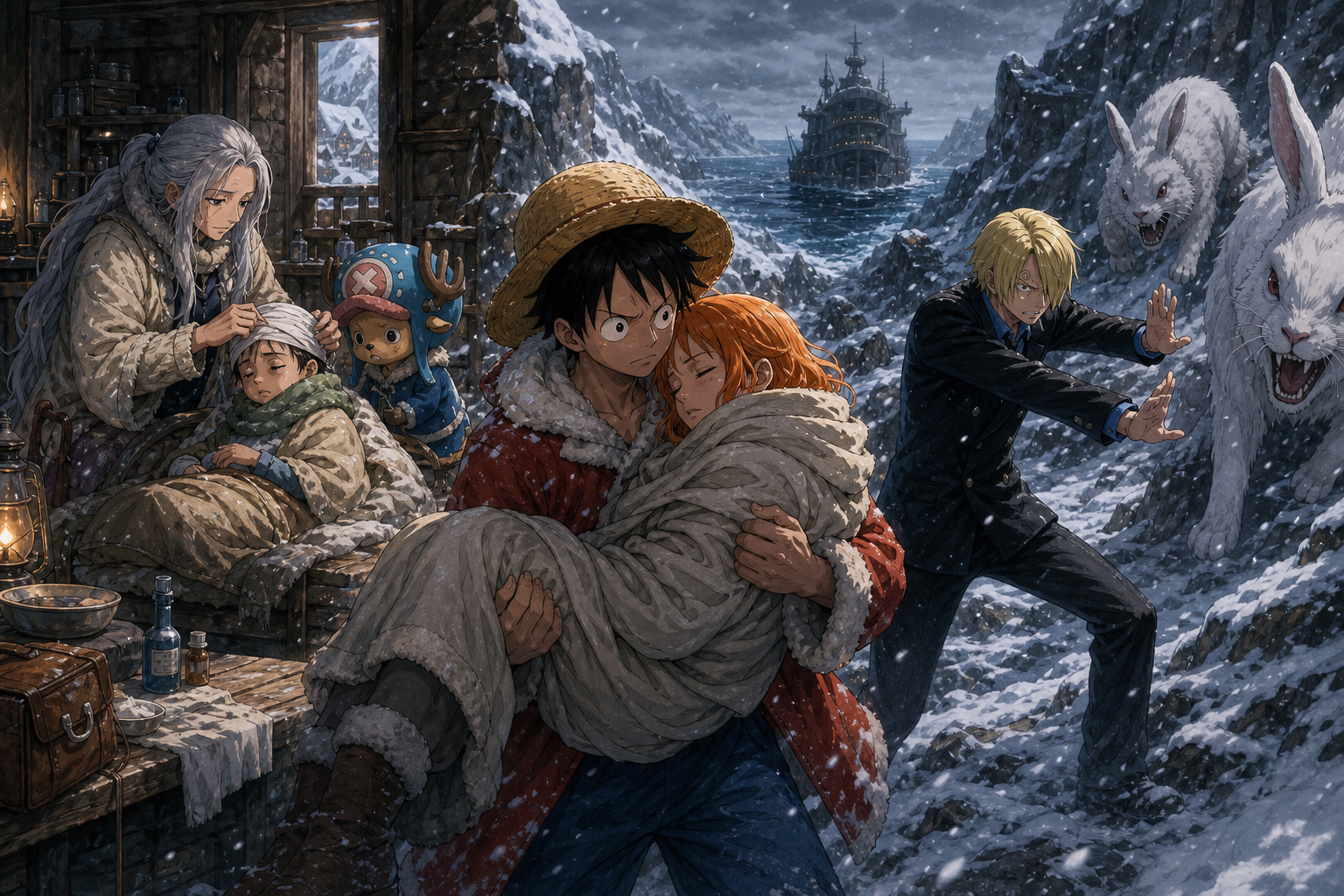
Episode 81 keeps Nami’s fever at the center while Drum Island expands around her. Luffy and Sanji are climbing toward a doctor, Wapol is moving toward the island he abandoned, and Dr. Kureha is already working among the people. Chopper appears beside her without fanfare, which makes his presence feel less like a grand entrance and more like the first glimpse of a life already in motion.
A rescue climb with no room for ego
Luffy has Nami secured against his back, and every step up the mountain now carries two lives. The cold is brutal, the route is nearly vertical, and Sanji cannot solve the danger by kicking the landscape into submission. Their usual strengths still matter, but strength has to become restraint. Luffy must keep his footing steady. Sanji must watch the path, the patient, and the man carrying her. Neither gets the luxury of treating pain as a private inconvenience.
That shift gives the climb real weight. One Piece often lets determination look spectacular. Here, determination looks slow, awkward, and responsible. Luffy cannot race ahead because speed would jolt Nami. Sanji cannot turn every obstruction into a dramatic fight because any shock could worsen her condition. The mission asks both men to become careful in ways their personalities rarely encourage, and their care for Nami makes that discipline believable.
The Lapahn are not disposable obstacles
The giant rabbits arrive as a threat, yet the episode never needs them to become villains. The Straw Hats are crossing their territory during desperate weather. From the Lapahn’s perspective, unfamiliar creatures have entered the mountain carrying noise, heat, and aggression. That context matters because danger does not automatically create malice. An animal defending space can still cause catastrophic harm, but moral judgment should not replace an honest reading of behavior.
Luffy and Sanji need passage, not victory. A clean response would create distance, use terrain as a barrier, and avoid separating adults from young. Pursuit would be pointless. Cruelty would be worse. The most revealing choice comes when immediate force is available but the crew’s actual goal demands control. One Piece understands that courage is not always measured by how hard somebody hits. Sometimes courage is the ability to leave a frightened creature alive while continuing through fear.
Nami changes the meaning of every impact
A normal Luffy confrontation can absorb slapstick punishment. This one cannot. Nami is feverish, barely responsive, and dependent on a carrier moving across ice. A stumble could compromise her breathing. A sudden strike could loosen her support. A fall could turn a treatable illness into trauma before any doctor sees her. The episode gains tension because familiar action language has been stripped of its usual safety.
Sanji’s role becomes essential. He is not merely backup muscle. He is the second set of eyes checking Luffy’s balance and Nami’s position while reading threats ahead. After any evasive movement, somebody should check her airway, responsiveness, blanket placement, and circulation. That level of attention may sound clinical, but care is made from details. Devotion without observation can still injure the person everybody is trying to save.
Wapol returns to a country he deserted
While the rescue team climbs, Wapol discovers Drum Island and turns toward home as though ownership survived abandonment. That assumption is outrageous. A ruler who fled during crisis cannot stroll back once danger seems manageable and expect the country to remain an object waiting for him. Drum’s people lived through the consequences of his choices. Their survival does not erase his responsibility; their survival proves how little his authority protected them.
His approach creates a divided emergency. The strongest visitors are away from the village, the ship has limited protection, and residents are living with a broken medical system. Wapol’s timing threatens more than a political confrontation. He could disrupt the network trying to get Nami treated. The episode connects personal illness to public power. A sick traveler and an abandoned nation are both suffering because access to care was treated as something a ruler could control.
Kureha is already doing the work
The reveal that Dr. Kureha has come down to Cocoa Weed is both frustrating and reassuring. Luffy is carrying Nami toward the castle while the doctor is elsewhere, which proves how dangerous bad information can become. At the same time, Kureha is not hiding in comfort. She is treating a child in town. Her work continues even when rumor turns her into a witch and geography makes every visit difficult.
The scene establishes competence before the audience receives biography. Kureha examines, decides, and acts. The title attached to her by frightened neighbors does not define the quality of her care. A community can resent a difficult personality and still depend on professional knowledge that nobody else was allowed to keep. That contradiction is one of Drum’s deepest wounds. People need medicine, but years of coercion have taught them to associate medical authority with fear, scarcity, and humiliation.
Chopper enters as a person, not a mascot
Chopper’s first presence beside Kureha could easily be reduced to visual novelty. He is small, expressive, and unlike anyone the Straw Hats have met. The better reading begins with his role. Chopper is part of a medical household. He observes care, carries knowledge, and belongs to a relationship whose history has not yet been explained. Cute design does not cancel personhood, and curiosity from outsiders does not create permission to touch, chase, or mock him.
This matters because One Piece frequently introduces characters through assumptions other people make about their bodies. Chopper will be vulnerable to every lazy category: animal, monster, pet, mascot. Episode 81 gives viewers a chance to refuse those categories before the story fully names him. Watch how he responds to Kureha, how he reads the room, and how the room responds to him. His choices are already more informative than anybody’s first label.
Drum’s doctor shortage was manufactured
Dalton’s explanation makes the island’s suffering legible. The lack of doctors is not bad luck. Wapol concentrated medical access around himself and drove independent practitioners away. That decision turned health into leverage. When only the ruler controls treatment, every fever becomes an opportunity for obedience and every injury becomes a reminder of political dependence.
Residents should not be blamed for superstition or desperation after living inside that system. Scarcity changes behavior. People delay seeking help, rely on rumors, distrust unfamiliar providers, and accept dangerous journeys because safer routes no longer exist. Kureha’s survival as an independent doctor represents resistance, but one doctor cannot replace a public network. Drum needs records, training, supplies, accessible clinics, and a structure that cannot be captured by the next person who wants power.
Dalton is carrying testimony and responsibility
Dalton knows what Wapol did because he stood close enough to the regime to witness the machinery. That position gives him useful knowledge and painful responsibility. Regret matters, but regret cannot become the final form of accountability. He needs to preserve testimony, name the officials and systems involved, help protect residents from retaliation, and support a medical structure that belongs to the public.
The episode does not need to resolve his moral position yet. The value comes from watching him choose what to do with knowledge after obedience becomes indefensible. Dalton can no longer pretend that serving the office and serving the country are the same act. Wapol’s return will force that distinction into the open. When a former ruler demands loyalty, Dalton’s answer must be measured by the safety of people who had no power to flee.
Zoro and Karoo turn cold into consequence
Zoro entering freezing water is funny only until the physical risk registers. Cold shock can steal breath, numb limbs, and destroy coordination before confidence has time to catch up. His endurance does not make his body exempt from temperature. Karoo following him adds another layer because an animal companion cannot be treated as a prop in somebody else’s training routine.
The responsible response is immediate warming, dry covering, observation, and no second round for pride. Karoo needs the same seriousness. The crew’s comedy works best when affection remains visible beneath the chaos. Laughing at a reckless decision is different from ignoring the consequences. Drum Island keeps making that distinction unavoidable: toughness does not eliminate the need for care, and loyalty does not mean silently following a friend into preventable danger.
The Merry needs a plan while the crew is divided
With Luffy, Sanji, and Nami on the mountain, everyone below needs a clear response to Wapol’s approach. The ship cannot become an undefended symbol waiting for the strongest fighter to return. Watch rotations, evacuation routes, signals, and civilian shelter matter. Nobody should call Luffy away from Nami unless the climbing route itself becomes impossible. Splitting the rescue team again would multiply risk without guaranteeing protection below.
This is where the Straw Hats’ loose style meets the demands of a larger crisis. Friendship creates willingness, but coordination turns willingness into protection. Vivi understands political stakes, Dalton understands the island, and the remaining crew understands the Merry. Those forms of knowledge should work together. A crisis does not require one hero to occupy every location. A good plan lets several people defend what they know best.
The castle may not contain the answer
The cruelest possibility is simple: Luffy could complete the climb and find an empty castle. That does not make the effort foolish. The team acted on the best location available while Nami’s condition demanded movement. Still, the episode shows why information must travel alongside rescue. A local messenger who knows Kureha’s route could save hours. A signal from the village could redirect the doctor. A sheltered meeting point could reduce the distance carried by both sides.
Medical emergencies often expose failures that began long before the patient became sick. Drum lacks reliable communication because Wapol hollowed out public systems. The mountain journey is heroic, but nobody should need heroism to reach basic care. Every dangerous step argues for a future where clinicians, transport, supplies, and residents are connected before the next fever arrives.
Direction lets care and threat share the frame
Michiru Shimada’s script moves between the climb, the village, Kureha, and Wapol without letting those strands feel unrelated. Each scene asks who receives protection and who controls access. Konosuke Uda’s direction keeps the mountain imposing while allowing quieter medical details to land. Hideaki Maniwa’s animation gives bodies weight against snow, which prevents Nami’s transport from becoming an abstract adventure beat. Tomoko Yoshida’s art separates the exposed mountain from the occupied town and distant castle, making geography part of the conflict.
The result is an episode built from convergence. Luffy is moving toward a doctor who is moving among patients. Wapol is moving toward a country that survived him. Dalton is moving from explanation toward decision. Chopper appears at the meeting point between rumor and reality. Nobody has arrived at the final confrontation, yet every route now carries moral meaning.
RaeRae’s real-time reaction
First, Luffy carrying Nami up that mountain has my entire heart and also my blood pressure in active rebellion. Baby, slow down. Sanji, keep watching her head. Both of you can be brave without turning this rescue into an avalanche audition. Then the Lapahn show up, enormous and furious, because apparently the mountain needed security guards with paws. I understand the danger, but I am not calling animals evil for defending home.
Meanwhile, Wapol sees Drum and starts heading back like the island is a coat he left on a chair. Sir, no. You abandoned people after destroying their access to doctors. You do not get a triumphant return. Then Kureha appears, already treating a child, and Chopper is standing there looking like the story just opened a door into something tender and complicated. Nobody better call that baby a pet. I already see intelligence, caution, and a whole history waiting behind those eyes.
What Episode 81 leaves behind
The episode advances the plot without rushing past the systems underneath the danger. Nami needs treatment, but her illness is unfolding inside a country where medicine was weaponized. Luffy and Sanji need strength, but their mission demands restraint more than spectacle. Kureha carries a frightening reputation, but her actions show a working doctor. Chopper looks unusual, but his place beside her asks the audience to recognize a person before accepting anybody else’s label.
The next move should bring reliable information to both sides of the mountain, protect the Merry and Drum’s residents from Wapol, and keep Nami’s transport stable. Longer term, Drum needs public medical access that cannot be owned by a ruler. Episode 81 makes the case through snow, distance, and divided people. Care should never depend on pleasing power, and survival should never be confused with proof that the harm was acceptable.