
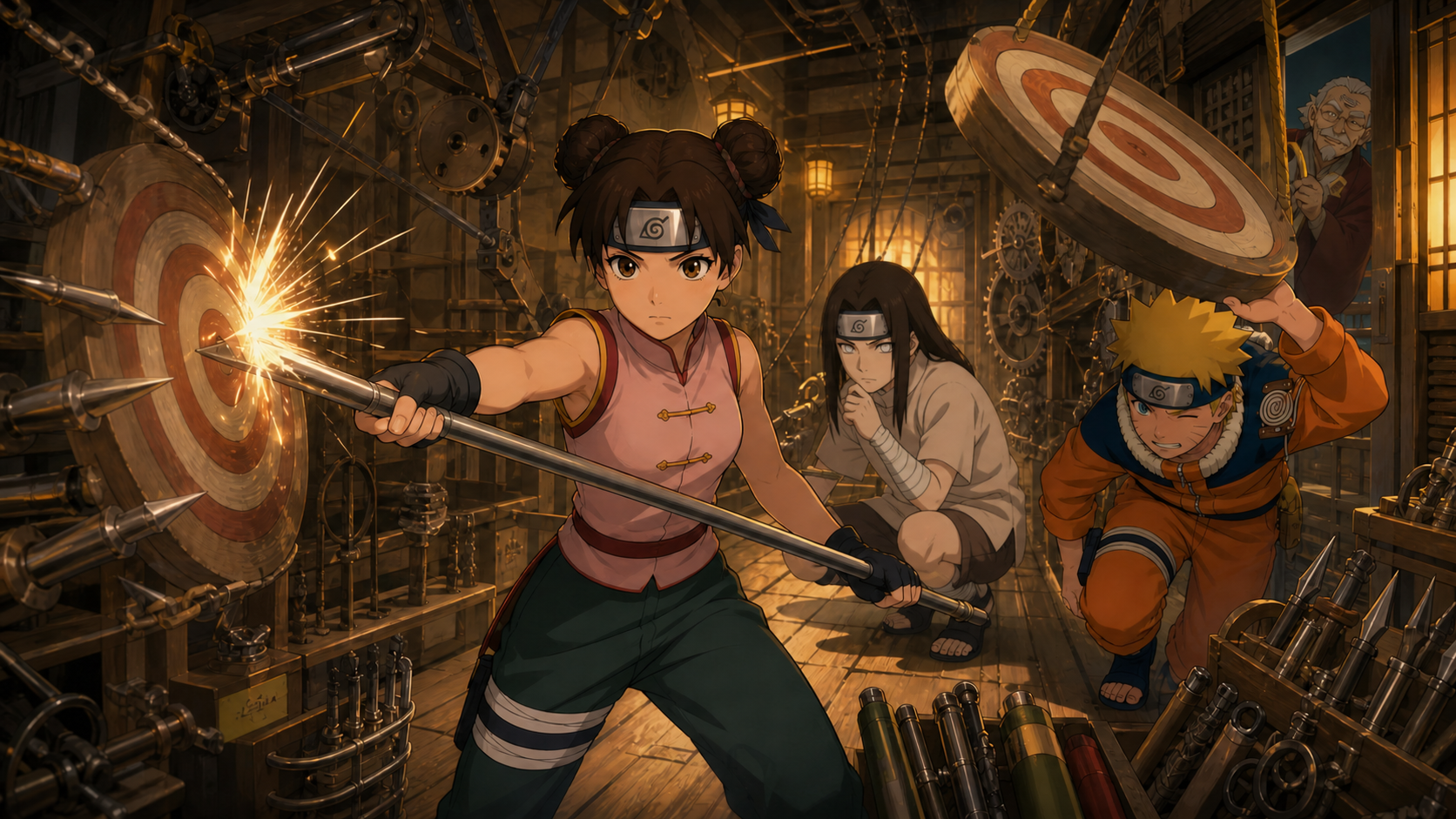
Deploy! Team Tenten
A routine supply order becomes Tenten’s leadership test inside an inventor’s workshop full of traps, prototypes, and thieves.
What happens in Naruto Shippuden Episode 184?
Naruto Shippuden Episode 184, "Deploy! Team Tenten," begins with a practical reconstruction problem. The Leaf needs ninja tools, so Tenten and Neji travel to the detached office of the Konoha Ninja Tool Research Facility. The visit reminds Tenten of an earlier mission when Konoha's military stock was depleted after the invasion and she received her first chance to lead.
With Rock Lee injured, Guy assigns Naruto to join Neji and Tenten. Their order sounds simple: collect one thousand kunai and one thousand shuriken from the craftsman Iō. Instead, the inventor proudly demonstrates experimental devices that solve problems no shinobi asked him to solve.
Reconstruction depends on equipment as much as heroic power
The present-day request grounds the episode in logistics. Pain's assault destroyed buildings, but rebuilding also consumes tools, wire, seals, fasteners, and defensive equipment. A village cannot recover through spectacular jutsu alone.
Tenten belongs at the center of this problem. She understands weapons as systems: how they are stored, deployed, maintained, and selected for a task. The assignment values expertise that is often invisible beside bloodline abilities or massive chakra reserves.
Her trip with Neji also shows institutional memory. They know where specialized supplies are made because a previous mission connected the field team to the workshop.
Guy gives Tenten authority instead of a ceremonial spotlight
In the flashback, Tenten is named team captain. The decision changes the episode's structure. Neji has the famous dōjutsu, Naruto supplies unpredictable power, and Guy is the senior instructor. Tenten still receives responsibility for the mission outcome.
Leadership is not presented as being the strongest person in the room. It is matching skills to the assignment. The mission concerns ninja tools, inventory, and an eccentric craftsman. Tenten has the best knowledge for judging whether Iō's workshop can meet Konoha's need.
She also has to manage two difficult teammates. Neji is disciplined but skeptical, while Naruto is enthusiastic enough to activate anything with a handle. Tenten's command must turn their strengths into support rather than distraction.
Iō invents from fascination instead of requirements
The order is precise: standard kunai and shuriken in large quantities. Iō responds by displaying strange prototypes. His creativity is genuine, but he is solving for novelty rather than the village's stated need.
This conflict is familiar to anyone who has worked with a brilliant maker. An invention can be technically impressive and operationally useless. A field unit needs reliability, predictable handling, repairable parts, and enough copies for training.
Tenten appreciates craftsmanship without surrendering the specification. Her expertise lets her separate admiration from acceptance. She can enjoy a mechanism and still say it will not equip Konoha's forces.
The snack break reveals a hidden emergency
When the team returns from food, Iō is gone. His workshop contains a concealed passage protected by traps. What looked like eccentric clutter becomes a layered security system.
Tenten takes control because the obstacles speak her language. Wires, launch angles, trigger plates, and weapon trajectories are not random hazards. They are mechanical decisions she can read.
Neji's Byakugan helps identify structures and hidden mechanisms. Naruto provides speed, clones, and the willingness to test a path. The episode allows both abilities to matter while keeping Tenten responsible for the solution.
The trap corridor turns tool knowledge into action
Tenten advances through swinging targets, projectile arrays, sealed mechanisms, and moving walls. The sequence demonstrates that weapon mastery is not simply throwing more steel than an opponent.
She predicts trajectories, chooses when to deflect rather than dodge, and recognizes how one mechanism feeds the next. Her calm prevents Naruto's energy from triggering a cascade and gives Neji clean moments to inspect deeper layers.
This is the episode's best argument for her as captain. The room is designed by a tool specialist, and another tool specialist defeats it by understanding intent.
Iō's hidden collection explains his strange priorities
Behind the defenses is a room holding Iō's most ambitious weapons. The collection represents years of experiments, including devices too dangerous or impractical for ordinary issue.
His secrecy is understandable. Powerful tools attract buyers who care more about advantage than responsible use. At the same time, hiding behind traps has isolated him from the people who could help establish safeguards.
Tenten sees more than treasure. She sees design choices, possible applications, and risks. Her response is professional curiosity rather than greed, which distinguishes her from the thieves approaching the lab.
Gameru and Kusune treat invention as loot
Gameru and Kusune arrive to steal the weapons. They have no interest in how the devices work safely or why Iō kept them hidden. The collection is valuable because it can be sold or used to overpower others.
Their attack clarifies the mission's stakes. Konoha did not merely need a shipment. It needed to protect the person and knowledge capable of producing future equipment.
The thieves also validate Iō's caution without proving every trap was wise. Security is necessary. Security that prevents trusted allies from understanding the danger can create its own failures.
Tenten leads the defense through coordination
Tenten assigns tasks based on what the team can do. Neji reads attacks and closes precision gaps. Naruto creates numbers, absorbs confusion, and keeps pressure away from Iō. Tenten controls the weapons and battlefield rhythm.
The fight is satisfying because her leadership is visible in decisions, not a title repeated by dialogue. She does not imitate Guy or compete with Neji's reputation. She builds a plan around the actual room and the actual people available.
That is the practical definition of command. Authority becomes credible when it helps everyone perform better.
Standard tools remain valuable after the spectacular prototypes
Iō's hidden inventions are memorable, but Konoha still asked for one thousand kunai and one thousand shuriken. The episode never needs to argue that ordinary equipment is obsolete.
Standardization is a strength. Familiar tools can be distributed quickly, used by many skill levels, and replaced without specialized training. Experimental weapons may solve rare problems, but armies and reconstruction crews survive on dependable basics.
Tenten's appreciation for both categories makes her more than a collector. She understands the difference between an exceptional artifact and a functioning supply system.
Tenten gets an episode built around what she knows
This should not feel remarkable, yet it does. The story does not borrow Tenten for somebody else’s emotional lesson. It begins with a supply problem, enters a weapons laboratory, and makes technical judgment the skill that keeps everyone alive.
Her expertise shapes the mission from the first order to the last fight. Naruto and Neji remain capable, but neither can replace the person who understands how tools behave as a system.
Reconstruction makes logistics visible
Pain’s destruction invites stories about grief, leadership, and spectacular rebuilding jutsu. This episode looks lower and notices the missing equipment. Shinobi still need blades, wire, fasteners, storage, replacement parts, and reliable supply routes.
A village is not restored when the skyline looks familiar. It is restored when ordinary workers can find the ordinary things that let institutions function again.
One thousand kunai are a statement about scale
The order sounds repetitive because repetition is the point. Konoha does not need one legendary weapon. It needs enough dependable tools for many people to train, patrol, repair, and respond without waiting for a specialist.
Standardization lacks glamour, but it distributes capacity. Tenten understands that a tool everybody can use may serve the village better than a brilliant invention nobody can maintain.
Guy recognizes the right kind of leadership
Neji has rank, pedigree, and the Byakugan. Naruto has enormous reserves and improvisational force. Guy still places Tenten in command because the assignment belongs to her knowledge.
That choice treats leadership as contextual rather than permanent. The best captain is not automatically the strongest fighter. It is the person most able to read the problem, assign resources, and protect the mission’s purpose.
Tenten must lead peers who can easily eclipse her
Naruto turns curiosity into action before anyone finishes a warning. Neji can identify hidden mechanisms so quickly that others may defer to him automatically. Tenten has to use both abilities without surrendering the decision-making role.
Her authority stays practical. She does not imitate Guy’s volume or demand ceremonial obedience. She keeps returning everyone to the actual task.
Iō hears an order and answers a fantasy
Konoha asks for proven basics. Iō unveils mechanisms designed to impress, surprise, and solve problems nobody placed in the specification. His delight is sincere enough to be charming and disruptive enough to endanger delivery.
Creative people can confuse possibility with usefulness. Tenten respects invention while protecting the difference between an exciting demonstration and equipment ready for public service.
Admiration does not require approval
Tenten can see the craft in Iō’s prototypes without pretending each device belongs in a standard kit. That separation is a mature form of expertise.
She is neither the skeptic who rejects novelty nor the collector blinded by rarity. She asks whether a tool is safe, repeatable, teachable, and appropriate for the people who must use it.
The snack break exposes a communication gap
The team leaves briefly and returns to an absent inventor plus a suspicious workshop. Iō’s private security turns his disappearance into a puzzle that trusted allies must solve without instructions.
His caution has reasons, but secrecy makes every emergency harder. Protection that excludes the people expected to help can become another hazard.
The corridor is written in Tenten’s language
Trigger plates, projectile angles, wires, moving walls, and chained mechanisms form sentences she can read. Where Naruto sees obstacles and Neji sees internal structure, Tenten sees design intent.
That distinction keeps her central. Information matters because she can convert it into timing, safe movement, and commands that prevent one mistake from activating everything else.
Weapon mastery is more than throwing accurately
Tenten predicts paths, identifies sequences, chooses deflection over evasion, and considers what the mechanism will do after the first contact. Her discipline is analytical before it becomes athletic.
The episode expands her skill beyond an arsenal gag. She understands tools as extensions of decisions, which is exactly what an inventor’s trap course demands.
Naruto’s enthusiasm needs a useful boundary
He wants to touch, test, and celebrate every strange machine. That openness keeps the workshop lively, but it can turn one unstable prototype into an emergency before Iō explains the handle.
Tenten’s command does not extinguish Naruto’s energy. She gives it a lane. Good leadership preserves a teammate’s strength while reducing the damage caused by its least patient expression.
Neji supports without claiming the center
The Byakugan reveals concealed pathways and mechanisms, yet Neji allows Tenten to interpret what the team should do. His cooperation matters because expertise often gets undermined by the most prestigious person in the room.
Here, perception serves judgment. Neji’s eyes become better tools because they feed the captain who understands the system surrounding them.
The hidden collection carries responsibility with its wonder
Iō’s private room is thrilling because it holds years of imagination made physical. It is frightening for the same reason. Experimental weapons can outgrow the safeguards of the person who created them.
Tenten looks with professional curiosity rather than ownership hunger. She recognizes capability and consequence together, which is the difference between stewardship and collecting power.
Gameru and Kusune erase every question except value
The thieves see devices they can sell or use. They do not care why the collection was hidden, who can operate it safely, or what happens when unstable designs enter circulation.
Their greed simplifies invention into loot. That makes them perfect opposites for Tenten, who keeps asking what each object is for and who carries the risk.
Iō’s paranoia is validated without becoming flawless
Actual thieves prove he needed security. They do not prove that isolating himself behind unexplained traps was the only responsible design. A safeguard can answer one danger while creating another.
The better solution is controlled trust: people with the knowledge and character to protect the work without exploiting it. Tenten demonstrates why that circle must exist.
The fight makes command visible
Tenten places Neji where precision and sight matter, uses Naruto’s numbers to disrupt the attackers, and controls access to the weapons. Her leadership appears through distribution of attention.
Nobody needs to announce that she is doing well. The room becomes survivable because her decisions let each teammate contribute without losing the mission to spectacle.
Captaincy changes how Tenten sees herself
Being assigned authority is not merely praise from Guy. It gives her evidence that specialized knowledge can organize stronger or more celebrated teammates. Competence becomes something she can name rather than quietly provide.
The mission offers a first rehearsal for trusting her own judgment under pressure. That confidence lasts longer than the immediate delivery.
RaeRae's reaction to Deploy! Team Tenten
I love that Tenten gets a mission where her knowledge is not decoration. The workshop is built to reward the person who understands mechanisms, inventory, and trajectories. Naruto's power and Neji's eyes support her instead of taking over the episode.
Iō is also an affectionate portrait of an inventor who desperately wants someone to admire the prototypes. His problem is not a lack of talent. It is forgetting that a request for two thousand standard tools is not an invitation to demonstrate every device in the basement.
The trap corridor gives Tenten the clearest leadership proof. She reads the room, limits risk, and uses her teammates well. Nothing about that requires a secret bloodline or a giant finishing move.
In the present, returning to the lab during reconstruction closes the loop. The strange mission created a durable relationship between Konoha's tool specialist and its research facility. When the village needs practical help, Tenten knows exactly where to go.
The present proves the mission built infrastructure
Tenten and Neji can return after Pain because the earlier assignment created knowledge, trust, and a route to specialized production. Relationships are part of logistics. Knowing who can make something, how they work, and what they need saves time during crisis.
The flashback is therefore not a detached adventure. It explains why Tenten can answer a reconstruction problem immediately while the village is still improvising around enormous loss.
Ordinary tools carry extraordinary continuity
Kunai and shuriken appear everywhere in Naruto, which makes them easy to stop seeing. This episode asks what happens when the supply disappears. Training stalls, standard tactics become harder, and every replacement suddenly represents labor.
Tenten’s attention restores value to familiar objects. Reliability is not boring when a damaged community depends on it.
Specialization deserves narrative space
Naruto’s world often rewards abilities that announce themselves through enormous effects. Tenten’s knowledge is quieter. She notices balance, range, trigger logic, storage, and whether a device can survive ordinary use.
They make essential work possible. A functioning village depends on specialists whose victories look like shortages prevented, accidents avoided, and tools arriving where they belong.
The assignment respects competence over reputation
Neji enters with a clan name everyone recognizes. Naruto already carries the disruptive importance of a future hero. Tenten receives command because fame is irrelevant to the question in front of them.
That decision offers a healthier model of teamwork than ranking every person on one ladder. Different problems create different centers. Letting expertise move authority toward the right person makes the whole group stronger.
Security improves when stewardship becomes shared
Iō’s traps can delay thieves, but they cannot make ethical decisions after somebody reaches the collection. The laboratory needs trusted people capable of understanding both the machinery and the reasons for restraint.
Tenten becomes that bridge. She can speak to field needs, appreciate invention, identify misuse, and insist on practical safeguards. Her relationship with Iō gives Konoha something more durable than a single shipment: responsible access to knowledge that would become dangerous if it remained either isolated or uncontrolled.
The comedy protects Tenten’s personality from becoming a lesson
The episode has a point about logistics and leadership, but it still lets her be annoyed, curious, impressed, and completely exhausted by the men around her. She is not flattened into a perfect captain.
Her authority feels earned because it survives mess. Naruto touches what he should not, Iō wanders toward another demonstration, thieves arrive, and Tenten keeps adjusting. Leadership is not a clean pose. It is the work of returning chaos to purpose again and again.
RaeRae’s final word on Deploy! Team Tenten
I have been waiting for the story to remember that Tenten is not background decoration holding a scroll. Give her a laboratory full of questionable weapons, an inventor with no respect for the original order, and two teammates capable of activating trouble at different speeds. Suddenly her whole skill set makes sense.
Guy’s smartest move is giving her the captain title and then letting the mission prove him right. Neji’s eyes help. Naruto’s clones help. Tenten decides how those strengths fit together without letting either boy swallow the episode.
Iō is delightful because every creator knows the temptation to show the clever prototype when somebody asked for the reliable thing. Tenten can admire his imagination and still demand equipment Konoha can actually issue.
The trap corridor is her argument. She reads trajectories, mechanisms, intent, and risk while everyone else supplies support. No secret bloodline is required. Knowledge, attention, and judgment are enough.
Returning during reconstruction closes the loop with purpose. One strange delivery mission became a durable relationship with the workshop. Tenten knows where the village’s missing tools can come from because she did the less glamorous work of understanding the person who makes them.
RaeRae’s call
Tenten does not need somebody else’s power to lead. Put her inside a problem built from tools, systems, and risk, and she becomes the person who can turn Neji’s sight, Naruto’s force, and Iō’s imagination into an actual mission.