
Naruto: Outbreak
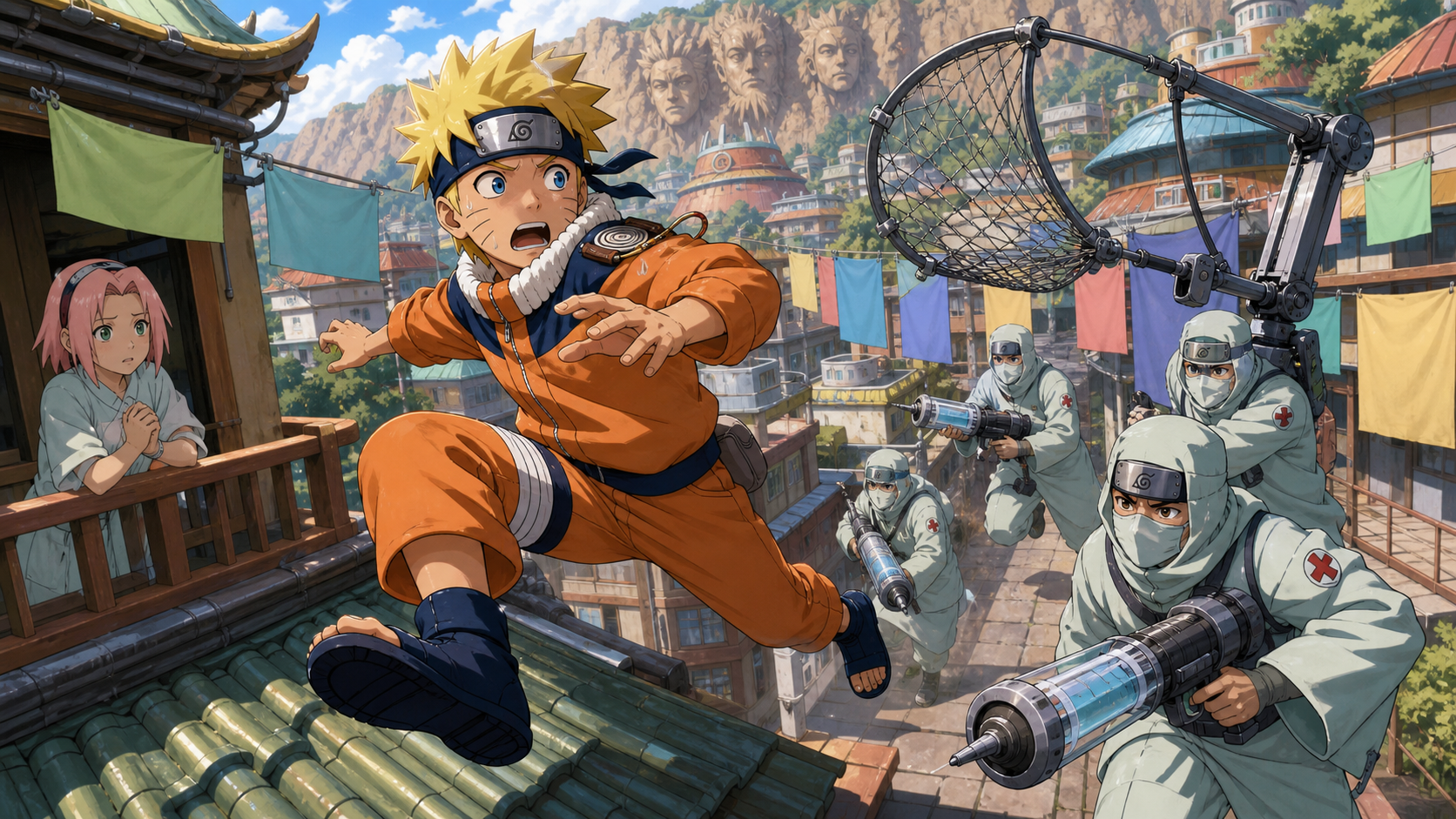
A suspected chakra virus turns a medical precaution into a village-wide chase when nobody explains to Naruto why every medic wants to catch him.
What happens in Naruto Shippuden Episode 183?
Naruto Shippuden Episode 183, "Naruto: Outbreak," returns to the temporary medical camp where Sakura, Shizune, and Tonton watch over the unconscious Tsunade. Naruto and Chōji bring lunch, and Naruto soon rushes away to help rebuild Ichiraku. A joke about his impossible energy reminds Sakura of the day Konoha mistook him for the carrier of a dangerous chakra virus.
In the flashback, Naruto returns from a mission sneezing and accidentally sprays Sakura just before her own assignment. Sakura later collapses, and Tsunade recognizes symptoms resembling a rare illness that disrupts a person's ability to mould chakra. Because Naruto recently visited an affected village, she orders the medical corps to isolate him before a possible outbreak spreads.
The present-day camp gives the comedy a serious frame
Tsunade's coma remains the emotional reality around the flashback. Sakura is doing medical work beside the mentor who cannot respond, while Naruto deals with worry by staying useful. Food, rebuilding, and constant movement are his answer to helplessness.
That context keeps the episode from becoming pure slapstick. The earlier quarantine was chaotic, but it also demonstrated the village's dependence on Tsunade's judgment. In the present, her absence is felt in every temporary tent and improvised decision.
Sakura's memory is affectionate because the crisis ended safely. She can laugh at Naruto's escape now while knowing how frightening the symptoms appeared at the time.
A sneeze becomes evidence because the timing is terrible
Naruto looks ill after returning from a village linked to the virus. He sneezes directly on Sakura, and she later develops the feared symptoms. The chain is circumstantial, but it is strong enough to justify immediate caution.
Tsunade cannot wait for perfect certainty before limiting exposure. A chakra virus threatens more than ordinary discomfort. If shinobi lose the ability to mould chakra, the village's medical, defensive, and communication systems can fail together.
The episode makes the response funny through oversized equipment and Naruto's refusal to cooperate. The underlying public-health problem remains legitimate: one highly mobile ninja could expose an entire village before laboratory confirmation arrives.
Naruto interprets capture as hostility instead of containment
Medical ninja approach Naruto with restraints and enormous injection devices. Nobody begins by calmly explaining the suspected infection, so Naruto sees an unexplained attack. His instinct is to run.
That reaction fits his history. Konoha has treated him as a danger since childhood, often without telling him why. When masked adults surround him, he does not assume the institution is acting for his benefit.
The medical team's urgency makes clear communication harder, but the failure costs them. Every escalating trap convinces Naruto that escape is necessary, while every escape convinces them that stronger containment is required.
The chase turns medical procedure into a village-wide mission
Naruto moves across rooftops, alleys, and training areas while medical units coordinate mechanical nets, injection launchers, and sealing formations. Familiar characters are recruited to close routes and keep civilians away.
The spectacle is funny because the village deploys mission-level resources against one sneezing teenager. It also shows how difficult Naruto is to contain. His stamina, clones, improvisation, and knowledge of Konoha turn quarantine into a tactical exercise.
Every technique designed for combat becomes a containment tool. The episode reveals that emergency response in a ninja village must account for patients who can run on walls and create hundreds of copies.
Tsunade's order is responsible even when its execution is messy
It would be easy to treat Tsunade as overreacting, but her information supports isolation. Naruto has the exposure history. Sakura has compatible symptoms. The illness could disable chakra across the population.
Her responsibility is asymmetric. If she waits and the virus is real, the consequences could be catastrophic. If she isolates Naruto and the suspicion is wrong, he loses freedom temporarily and the village expends resources.
The reasonable choice is containment paired with rapid testing. The comedy arises because Naruto prevents the second half from happening. He cannot be cleared until the team can examine him, and he will not submit because nobody gave him enough reason to trust the process.
Sakura's collapse raises the stakes beyond Naruto's cold
Sakura is not merely someone Naruto sneezed on. She is a teammate and a medical trainee. Seeing her unable to mould chakra makes the suspected transmission personal.
For Naruto, learning that Sakura may be ill changes the meaning of the chase. His own discomfort is easy to ignore. The possibility that he harmed someone else forces him to confront why the medical corps is desperate.
This is where an explanation accomplishes what restraints could not. Naruto responds strongly to responsibility for people he loves. Treating him only as a dangerous object activates resistance; telling him who may be at risk activates cooperation.
The diagnosis depends on separating correlation from cause
Sakura's symptoms match the virus, and Naruto's travel history supplies a plausible source. Neither fact proves transmission. The episode builds its misunderstanding from the difference between a convincing pattern and confirmed causation.
Medical work requires acting on preliminary evidence while continuing to test it. The first step protects people. The second prevents a provisional diagnosis from becoming permanent truth.
The eventual resolution reveals that Naruto is not carrying the feared chakra virus. The apparent pattern has another explanation, and the village can stand down. That correction is as important as the initial caution.
Naruto's body has never been treated as entirely his own
The quarantine story carries an uncomfortable echo of Naruto's jinchūriki status. Since birth, adults have discussed the danger inside him and made decisions about his life without his participation. Now another invisible threat is supposedly contained in his body.
The situations are not identical. A contagious disease genuinely requires community protection. Still, Naruto's panic becomes more understandable when viewed through that history. He has learned that being labeled dangerous can override personhood.
Good containment therefore needs dignity as well as equipment. Explaining the risk, providing evidence, and treating the patient as a participant would reduce both harm and resistance.
The false alarm still reveals useful preparedness
Konoha's response is excessive in appearance but impressively coordinated. Medical teams mobilize quickly, routes are controlled, and specialized tools are available. The village understands that an outbreak is an operational threat, not merely an individual health problem.
The failure is communication. Teams know the objective, but Naruto does not. The people designing emergency plans have prepared for a powerful carrier's abilities without preparing for his need to understand what is happening.
That imbalance mirrors many of Naruto's early conflicts with the village. Institutions develop elaborate systems around him while neglecting the simple relationship that might make those systems work.
Naruto rebuilds because motion is how he carries fear
The present opens beside an unconscious Tsunade, so Naruto’s energy is not simple cheerfulness. He brings food, checks on people, and races toward Ichiraku because useful work gives his worry somewhere to go.
Sakura recognizes the pattern. When Naruto cannot repair the central problem, he repairs whatever is within reach. That instinct once made medical containment almost impossible. After Pain, it helps a wounded village stand up.
Tsunade’s silence changes the meaning of the memory
In the flashback she evaluates evidence, commands specialists, and holds responsibility for a threat nobody else fully understands. In the medical tent, that decisive voice is absent while Sakura and Shizune maintain care around her.
The joke therefore carries grief underneath it. Sakura can laugh about the outrageous chase and still miss the leader whose judgment once turned confusion into a plan.
A chakra virus threatens the village’s entire operating system
For shinobi, losing chakra control is not equivalent to catching an inconvenient cold. Medical treatment, defense, transportation, intelligence, and emergency communication all depend on people who can mould chakra reliably.
Tsunade hears exposure history plus compatible symptoms and recognizes a risk capable of disabling Konoha faster than an invading army. Immediate isolation is not hysteria. It is the burden of acting before certainty arrives.
The evidence is persuasive without being complete
Naruto visited an affected area, returned visibly unwell, sneezed directly on Sakura, and then Sakura collapsed. Every fact points in the same direction, which makes the wrong conclusion feel responsible rather than foolish.
The episode understands a crucial medical distinction. A pattern can justify precaution without proving cause. Good response protects people during uncertainty and keeps testing the explanation instead of marrying the first theory.
The medical corps looks terrifying from Naruto’s side
Masked adults arrive with restraints and injection launchers before anybody gives him a calm explanation. Viewers know they are medics. Naruto sees an organized group treating his body as a target.
His escape is inconvenient, but it is not irrational. Konoha has spent his entire childhood making decisions about the danger inside him while withholding the truth. The village trained this distrust long before the first needle appeared.
Communication is an emergency tool, not decoration
Every failed trap proves the same point. The team prepared nets, formations, equipment, and personnel, yet neglected the sentence most likely to secure cooperation: Sakura may be sick, and we need to test you.
Speed matters during suspected contagion, but explanation can increase speed. Treating a person like an enemy creates resistance that no amount of technical preparation can cheaply solve.
Naruto turns quarantine into an S-rank chase
The comedy earns its size because Naruto is uniquely difficult to contain. He knows the rooftops, improvises under pressure, produces clones, and possesses enough stamina to make a whole medical division regret its career choices.
Konoha must design outbreak response for patients who can climb walls and multiply. That ridiculous truth is excellent worldbuilding tucked inside slapstick.
Combat technology becomes public-health equipment
Nets, launchers, pursuit formations, and route control would normally belong to a capture mission. Here they are repurposed to stop exposure without injuring the suspected carrier.
The change in objective exposes how much shinobi infrastructure assumes force first. Konoha can adapt its tools, but adapting its relationship with the person being contained proves harder.
The village sees a carrier before it sees Naruto
Once the warning spreads, his identity collapses into risk. Every sneeze becomes confirmation. Every escape becomes evidence that stronger control is justified. Nobody pauses to ask what information he has received.
Naruto knows this pattern intimately. The jinchūriki label reduced a lonely child to a sealed threat. The virus suspicion is temporary and legitimate, yet it presses against the same old wound.
Sakura’s collapse reaches him where orders cannot
Naruto can dismiss danger to himself and treat pursuit like a challenge. Learning Sakura may have become sick through contact changes the moral equation. Responsibility for someone he loves gets through immediately.
This is why personhood matters to emergency response. Naruto is not merely a difficult body to secure. He is a teammate whose strongest motivation is protecting other people once he understands what protection requires.
Tsunade carries the unfair mathematics of prevention
If she waits for perfect proof and the virus spreads, the damage could be catastrophic. If she isolates Naruto and the theory proves wrong, he loses freedom temporarily and the village burns resources.
Leadership means choosing under unequal consequences. Her decision is defensible even though the execution becomes absurd. The episode criticizes communication failure without pretending caution itself was unnecessary.
Sakura’s diagnosis must remain provisional
Matching symptoms and plausible contact create a working theory, not a final truth. Testing eventually separates coincidence from transmission and allows the village to release Naruto without pretending the initial concern was invented.
That correction protects more than his freedom. It preserves trust in medicine by showing that responsible authorities revise conclusions when evidence changes.
The false alarm still produces real information
Konoha learns that it can mobilize quickly, coordinate specialized teams, restrict routes, and protect civilians. It also learns that its plan can be defeated by one frightened teenager who does not know why anyone is chasing him.
Preparedness is not only equipment stored for a crisis. It includes language, consent where possible, and a way to make the affected person part of the response.
Slapstick keeps institutional criticism from becoming a lecture
The giant needles, frantic rooftop pursuit, and escalating gadgets are funny because every serious solution creates a sillier problem. Naruto reacts exactly as anyone would react to a syringe the size of a spear.
Beneath the exaggeration, the episode asks a sharp question: how often does an institution call resistance irrational after making cooperation feel unsafe?
Ichiraku turns the same energy into hope
At the end, Naruto races away to help rebuild the ramen shop. The body Konoha once chased as a possible source of collapse now becomes one of the forces restoring ordinary life.
Nothing essential about his energy changed. Context and relationship changed how the village reads it. Motion can look like danger when people expect contamination, or hope when they finally recognize devotion.
RaeRae's reaction to Naruto: Outbreak
This episode is ridiculous in the most deliberate way. Watching an entire medical corps chase Naruto with giant injectors and a mechanical net feels like the village accidentally turned a checkup into an S-rank mission.
I still sympathize with Tsunade. Based on the exposure and Sakura's collapse, doing nothing would be irresponsible. The problem is not that she orders quarantine. It is that Naruto receives the order as an ambush.
The story works best as a lesson about trust. Naruto is almost impossible to contain by force, but he is very willing to protect others once he understands the danger. A clear explanation would have been more effective than half the equipment deployed across Konoha.
In the present, Naruto racing off to rebuild Ichiraku is a perfect closing echo. His energy once made him the village's most difficult suspected patient. Now the same energy is part of how the village recovers. Context changes whether people see motion as danger or hope.
Public safety and dignity belong in the same plan
The episode never proves that quarantine is cruel by definition. It proves that a justified safety measure can still be delivered badly. Community protection works best when the person under restriction receives reasons, updates, and humane treatment.
Naruto’s history makes that especially urgent. Any system that handles him only as a container repeats the village’s oldest mistake, even when the immediate concern is real.
Sakura remembers chaos as evidence of attachment
The flashback begins because Naruto drops lunch, creates a mess, and immediately runs toward another rebuilding job. Sakura’s exasperation carries affection now. She has watched his restless energy survive missions, grief, rejection, and the destruction of home.
Remembering the quarantine lets her hold two versions of him together: the boy who could turn one sneeze into municipal warfare and the young man whose first response to crisis is to find somebody who needs help. Comedy becomes a way to measure growth without sanding away the personality that made growth recognizable.
Being wrong does not make the village foolish
The final diagnosis could tempt everyone to dismiss the response as wasted effort. That would ignore what Tsunade knew when she acted. Responsible decisions are judged by available evidence and proportional risk, not only by outcomes revealed afterward.
The failure belongs elsewhere. Konoha did not build explanation into containment, did not anticipate Naruto’s learned distrust, and allowed a precautionary label to consume the person carrying it. Those errors can be corrected without pretending the suspected virus was harmless.
Naruto cooperates when care replaces control
Orders alone make him fight for escape because authority has rarely earned automatic trust from him. Concern for Sakura changes his posture because care gives the restriction a human purpose. He can accept discomfort when it clearly protects someone else.
That response is one of his most consistent traits. Naruto may resist rules, titles, and procedures, but he understands bonds with startling speed. The medical team keeps trying to overpower the strongest part of him when it could have spoken directly to it.
The village after Pain needs both competence and connection
Temporary clinics, rebuilding crews, food deliveries, and leadership decisions keep Konoha physically functioning. Naruto’s presence helps those separate tasks feel like one recovery rather than isolated survival.
Gaara named that power in the previous episode. Here Sakura sees it operating through errands and motion. Naruto does not need a podium to become civic glue. He needs a damaged place, people he loves, and one more useful thing he can do before sitting with his fear.
That is community care.
RaeRae’s final word on Naruto: Outbreak
I laughed at the medical corps arriving like they planned to vaccinate a tailed beast, because subtlety left Konoha before breakfast. Then Naruto ran, the equipment got bigger, and a basic examination became a village campaign.
Tsunade was still right to take the danger seriously. Sakura’s symptoms and Naruto’s travel made isolation reasonable. What failed was the assumption that urgency excused explanation.
Naruto has spent his life being told that something inside his body makes everyone else unsafe. Surrounding him without context was always going to sound like the old accusation wearing medical gear.
The solution arrives when responsibility becomes personal. Tell Naruto Sakura may be in danger and he understands the need immediately. Respect is not a sentimental extra here. It is the fastest route to cooperation.
That final dash toward Ichiraku lands beautifully. His impossible energy was once the problem every medic chased. Now it is part of Konoha’s recovery, carrying food, labor, and stubborn hope wherever the village needs him next.
RaeRae’s call
Konoha had a responsible reason to isolate Naruto and a terrible way of telling him. The outbreak was false, but the lesson is real: safety plans need evidence, revision, and enough dignity that the person at the center can help.