
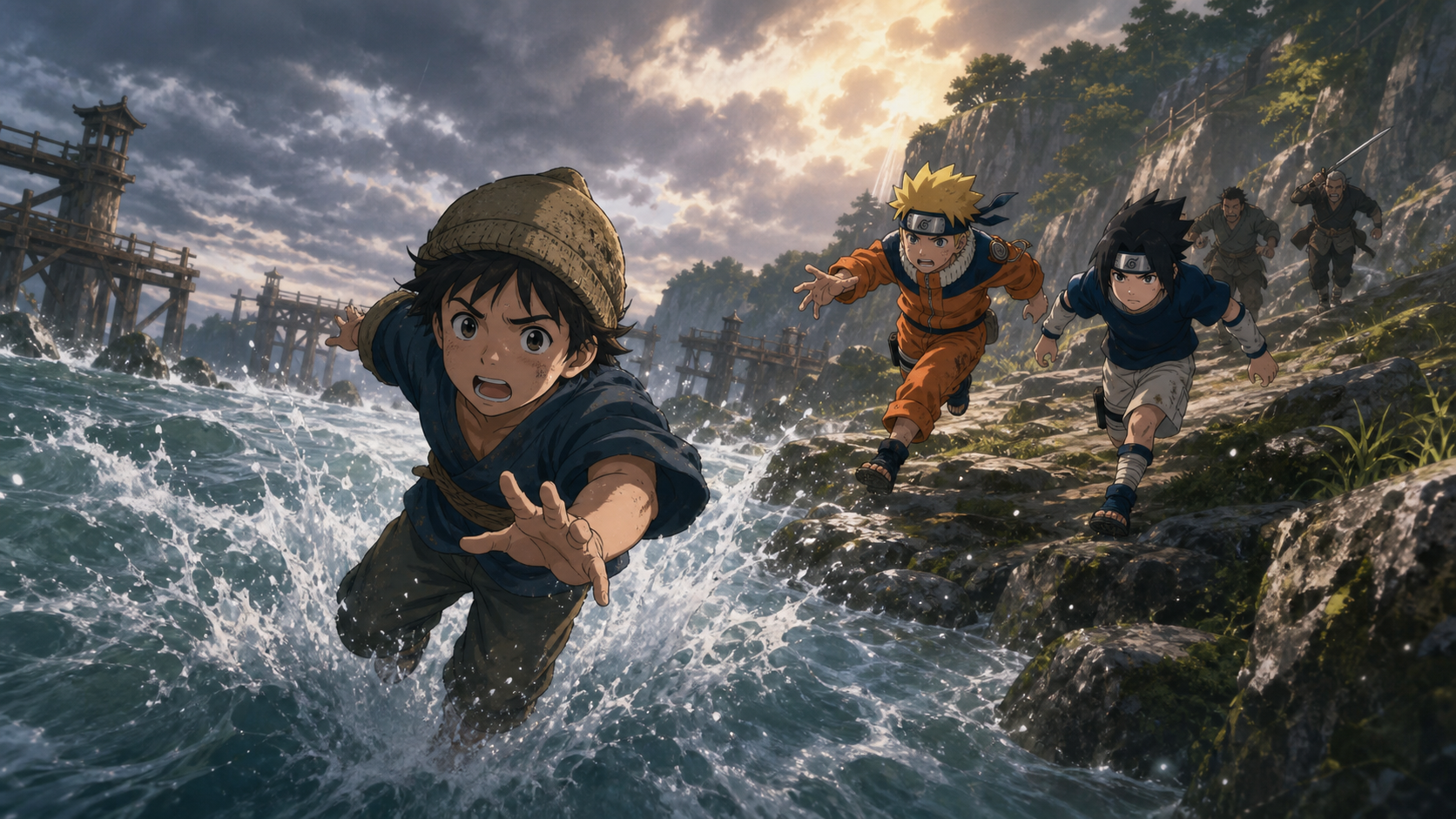
Inari’s Courage Put to the Test
Inari returns to help rebuild the Leaf, carrying proof that courage learned from Naruto became a responsibility he could pass forward.
What happens in Naruto Shippuden Episode 180?
Naruto Shippuden Episode 180, "Inari's Courage Put to the Test," begins during the reconstruction of the Hidden Leaf Village. Yamato uses Wood Release to raise new buildings while shinobi and civilians work through the damage left by Pain. Naruto and Sakura are surprised by two familiar volunteers: Tazuna and his grandson Inari have traveled from the Land of Waves to help.
Their reunion opens a memory from just after Team 7 completed its first major mission. Naruto realizes he left a coupon for a free bowl of ramen at Tazuna's house. Inari finds it and sets out to return it, only to encounter local boys who resent his new confidence. The confrontation becomes dangerous when Zōri and Waraji, former enforcers for Gatō, kidnap the children and attempt to restore the old criminal order.
Reconstruction makes the Land of Waves reunion meaningful
Tazuna and Inari do not return for a ceremonial visit. They arrive with tools and practical skills when the Leaf needs them. The choice completes an exchange that began when Team 7 defended their bridge. Naruto helped the Land of Waves recover the courage to resist Gatō. Years later, its builders answer Konoha's crisis with labor.
That reciprocity gives the reunion more weight than nostalgia alone. A successful mission is not only an enemy defeated or a client escorted. It can create a relationship that survives after the official contract ends. The Leaf's recovery becomes stronger because people outside its walls remember being protected by its children.
Inari has also grown into his grandfather's work. The frightened boy Naruto met is now a carpenter willing to travel into a disaster zone. His development is visible before the flashback explains it.
A ramen coupon gives the memory its child-sized scale
The story begins because Naruto values a coupon for one free bowl at Ichiraku. It is a wonderfully small motive after the life-and-death struggle against Zabuza and Haku. For Naruto, however, ramen is never just food. Ichiraku is one of the few places where he receives ordinary welcome.
The coupon also lets Inari act for Naruto instead of waiting to be rescued by him. Returning it is simple gratitude. He recognizes something important to his friend and takes responsibility for delivering it.
That small errand becomes a test because courage rarely announces the scale of the danger in advance. Inari leaves home expecting a walk. He finds jealousy, intimidation, and the remnants of the system that killed Kaiza.
Akane's bullying targets Inari's new confidence
Akane and the other boys accuse Inari of acting superior now that Team 7 has defeated Gatō. Their cruelty is rooted in insecurity. They interpret Inari's changed posture as arrogance because his courage exposes their own accommodation to fear.
Inari could answer by hiding behind Naruto's reputation, but that would prove the accusation. Instead, the episode pushes him to act after Team 7 has left. The question is whether Naruto inspired dependence or taught a transferable way of confronting fear.
The boys are still children, and their taunting does not deserve the adult violence that follows. Zōri and Waraji overhear them and see an opportunity. Their kidnapping reveals how quickly petty social divisions can be exploited by people who benefit from a frightened community.
Gatō's defeat did not automatically remove his system
Zōri and Waraji survived their employer. They wait for Team 7 to leave, then try to rebuild the coercive structure that gave them power. This is a useful reminder that defeating one visible villain does not instantly repair every institution or habit he created.
The Land of Waves still has to enforce its freedom. People must communicate, organize, and refuse the return of intimidation. Naruto helped create the opening, but the residents have to occupy it.
Inari becomes part of that work. He recognizes that escape is not enough if the other captured children remain vulnerable. His courage is social rather than theatrical: he creates a chance for them to reach the village, even though staying behind puts him at greater risk.
Inari turns Kaiza's lesson into his own decision
Kaiza taught Inari that protecting what matters may require action without any guarantee of success. Gatō's murder twisted that lesson into evidence that resistance was useless. Naruto helped Inari understand that Kaiza's defeat did not make his courage meaningless.
Episode 180 shows the lesson becoming Inari's rather than remaining borrowed inspiration. He distracts the thugs so the other boys can escape. Nobody promises that Naruto will arrive. He acts because their safety matters and because waiting would hand the decision back to the kidnappers.
This distinction is essential. Inari is not fearless. He is a child facing armed adults, and the danger is real. Courage is his decision about what to do with fear, not the absence of it.
The river jump proves how much Inari has changed
Cornered near the rapids, Inari jumps into the water rather than submit. The river is not a safe route, but it is a choice he controls. The boy who once believed resistance could only end in loss now risks himself to preserve the escape he created for others.
Naruto and Sasuke reach him because the children Inari freed alert the village. That chain matters. Inari's sacrifice creates messengers, the messengers create a rescue, and the rescue brings the community to the confrontation. Courage spreads through cooperation.
Naruto pulling Inari from the water does not cancel the boy's achievement. Rescue is not proof that the rescued person failed. Inari made every later action possible by protecting his peers long enough for them to find help.
Naruto and Sasuke work as the team the bridge mission formed
Naruto's shadow clones and Sasuke's shuriken tactics overwhelm the returning thugs. Their coordination reflects the partnership Team 7 began building during the Land of Waves mission. They still compete, but they read the same threat and combine their strengths without needing a speech.
The fight also puts Zōri and Waraji in perspective. They were frightening when backed by Gatō's money and an isolated population. Against trained ninja and mobilized villagers, their authority collapses. Their power depended on convincing everyone that resistance would remain solitary.
When Tazuna and the community arrive, the criminals surrender. The resolution belongs to the village as much as Team 7. This time the people are present to secure their own freedom.
Akane's future shows that accountability can lead somewhere
In the present, Inari explains that Akane and the other boys became carpenters too. The episode does not pretend their bullying was harmless. It shows that one shameful choice did not have to define their adulthood.
Inari protected them when he had every reason to resent them. Their later work suggests that the rescue became a responsibility rather than merely a debt. They now build the community they once weakened through jealousy.
That outcome fits the series at its best. Mercy is not the erasure of consequences. It is the possibility that someone can respond to consequences with changed conduct.
Yamato turns chakra into immediate shelter
Wood Release can dominate battlefields, restrain tailed beasts, and build impressive structures. During reconstruction, the same ability produces walls and roofs for displaced people.
Power becomes most meaningful when it answers ordinary survival. Konoha needs homes more urgently than another demonstration of force.
Tazuna arrives with labor instead of gratitude speeches
The bridge builder remembers what Team 7 did and responds to Konoha’s need through the skill he actually possesses. He does not have to become a shinobi to participate in recovery.
Reciprocity respects difference. Communities help one another through distinct forms of expertise rather than identical sacrifice.
Inari’s growth appears in his hands before the flashback
He is older, capable, and working beside his grandfather. The child who once believed resistance was useless now helps reconstruct another community after catastrophic violence.
Development becomes practice. Courage has matured into the steady labor required after heroic moments end.
The ramen coupon belongs to Naruto’s emotional geography
One free bowl sounds trivial beside the bridge battle. Ichiraku represents a place where Naruto receives food without disgust, conversation without fear, and welcome before achievement.
Of course the coupon matters to him. Small comforts carry enormous weight when ordinary care has been scarce.
Returning the coupon lets Inari care in Naruto’s language
Inari understands the object matters to his friend and chooses to deliver it. Gratitude becomes attention to another person’s specific joy rather than a generic declaration of debt.
The errand is child-sized, affectionate, and exactly the kind of ordinary exchange Naruto rarely receives.
Akane attacks the change he cannot dismiss
Inari now stands differently after Team 7’s mission. Akane calls confidence arrogance because acknowledging growth would require examining his own accommodation to Gatō’s fear.
Bullying tries to restore the old hierarchy where Inari’s grief made him easy to isolate.
The dare creates risk only Inari must carry
The boys can challenge, mock, and watch while Inari enters danger. Their social approval is offered through a test whose consequences remain his alone.
Conditional belonging is not friendship. It converts a child’s need for connection into entertainment for the group.
Zōri and Waraji recognize a divided community
Gatō is dead, but his former enforcers see jealousy and intimidation as openings for renewed control. They do not need his entire organization if residents can be separated again.
Authoritarian power often returns through habits left behind after the leader falls.
The intelligence report raises stakes nobody explained to the children
A weapon carries information valuable to hostile adults. Inari sees proof for a dare. The pursuers see a security threat. Two meanings collide around a child without his knowledge.
Adult conflict enters ordinary life through objects, secrets, and consequences young people were never prepared to read.
Inari protects boys who did not protect him
He could use the kidnapping as proof that the bullies deserve whatever follows. Instead, he creates an escape and remains behind to draw danger toward himself.
Mercy does not declare their cruelty harmless. It refuses to make cruelty the rule governing whose life matters.
The rescue plan depends on messengers
The children Inari frees carry warning back to the community. His risk produces information, and information mobilizes people capable of helping.
Courage becomes a chain rather than a solitary pose. Every person completes one part of the response.
The river jump claims one choice inside captivity
Cornered by armed adults, Inari chooses dangerous water over submission. The jump is not safe or magically fearless. It is movement he controls.
The boy who once believed resistance guaranteed loss now decides uncertainty is preferable to obedience under threat.
Naruto and Sasuke arrive because Inari’s actions worked
Rescue does not replace his courage. He enabled other children to alert the village, stayed alive long enough to be found, and refused to surrender the report.
Being rescued is not evidence that independence failed. Healthy courage includes creating routes through which help can reach you.
Team 7’s coordination carries the bridge mission forward
Naruto’s clones and Sasuke’s precision operate together against Gatō’s former thugs. The boys still compete, but the shared threat organizes rivalry toward protection.
Their teamwork is another legacy of the first mission, where Haku and Zabuza taught them what shinobi systems cost people.
The community’s arrival ends the criminals’ borrowed authority
Zōri and Waraji were powerful when residents believed resistance would remain isolated. Tazuna and others arrive together, removing the social condition that made intimidation effective.
Team 7 helps. The Land of Waves secures its own freedom by showing up.
Akane’s adulthood allows accountability to become work
Inari explains that the former bullies became carpenters. Changed conduct does not erase the dare. It demonstrates that shame need not become permanent identity.
They now build the community whose weakness they once exploited socially. Repair becomes ongoing labor.
Rebuilding Ichiraku places welcome inside infrastructure
The restaurant fed Naruto and treated him normally when much of Konoha did not. Restoring it is not a frivolous side project beside official buildings.
Communities require places where belonging is practiced through meals, names, and repeated ordinary contact.
RaeRae's reaction to Inari's Courage Put to the Test
Inari's return works because the episode gives him something more meaningful than a cameo. He gets to prove that Naruto's influence lasted after the hero left. His decision to remain behind for the other children is the clearest evidence that the frightened boy from the bridge arc grew into someone who protects people.
I also love the circular generosity of the present-day framing. Konoha once sent a team to protect Tazuna's bridge. Tazuna and Inari now bring their craft to rebuild Konoha. Neither community is reduced to a backdrop for the other.
The lost ramen coupon keeps the story warm without making the danger trivial. Naruto runs back for a free bowl and discovers that courage has continued growing in the place he helped. Years later, Inari promises to rebuild Ichiraku first. The joke lands because food, shelter, and welcome are all part of what makes a village worth saving.
Courage proves transferable when Naruto is absent
Inari does not wait for the hero to return before acting. Naruto’s influence becomes useful because Inari translates it through his own history, fear, and responsibility to others.
Inspiration succeeds when it creates another decision-maker rather than another dependent follower.
RaeRae’s final word on Inari’s Courage Put to the Test
I love that Tazuna and Inari arrive with tools. Gratitude is not decorative. They see damaged homes and bring the work their family knows how to do.
The coupon is adorable and serious at the same time. Inari notices what comfort means to Naruto and tries to return one small piece of it. That care leads him into a danger much larger than the errand.
Protecting the boys who mocked him proves Naruto’s lesson became Inari’s own. He does not confuse accountability with abandonment and does not need guaranteed success before choosing who he wants to be.
The river rescue completes a network Inari started. He frees messengers, the community responds, and Team 7 arrives. Courage spreads because nobody treats needing help as failure.
The episode understands that liberation needs maintenance
Gatō’s defeat created an opening. It did not automatically remove everyone who benefited from his rule, heal every social wound, or teach residents how to respond when intimidation returned. Freedom becomes durable through people practicing it after the famous battle ends.
Zōri and Waraji mistake the absence of Team 7 for the absence of resistance. Their confidence depends on believing courage belonged to visiting ninja rather than the community. Inari disproves that assumption before Naruto ever appears.
His method differs from the heroic confrontation on the bridge. Inari creates an escape, accepts danger, and depends on the freed children to carry information. The plan works through trust rather than individual power.
That trust includes boys who treated him badly. Protecting them does not tell Akane the bullying was acceptable. It refuses the logic that a person must earn humanity through kindness toward you first. Accountability remains possible because everyone survives to face what happened.
The later carpentry matters for that reason. Akane’s changed adulthood is not a speech apologizing for childhood cruelty. It is sustained participation in rebuilding community. Conduct gives remorse a shape other people can evaluate over time.
Inari’s own construction work extends Kaiza’s legacy without copying his final sacrifice. Kaiza built and protected connections, then Gatō murdered him to make courage look futile. Inari honors him by staying alive, organizing help, and building structures people can continue using.
Naruto’s influence also becomes healthier because it does not demand imitation. Inari cannot summon clones or fight like a shinobi. He can act while afraid, recognize another person’s danger, and refuse to let power decide who deserves protection.
Tazuna and Inari bringing those lessons to Konoha closes a moral circle. The powerful village once helped a smaller community resist exploitation. The smaller community now possesses skills and relationships the powerful village needs. Assistance moves both ways.
That reciprocity challenges the hierarchy exposed by Nagato’s story. Smaller nations should not exist only as clients, battlefields, or sources of gratitude for great-village heroes. They are communities capable of contributing knowledge, labor, and political memory.
Rebuilding Ichiraku adds another layer. Teuchi’s shop offered Naruto ordinary welcome when official Konoha institutions failed him. A restaurant can be as important to recovery as an administrative building because belonging needs physical places where people repeatedly practice it.
The ramen coupon therefore earns its place at the center of this memory. It connects food, gratitude, friendship, and the ridiculous specificity through which people show they know each other. Inari does not return a generic favor. He returns something Naruto would genuinely miss.
Inari’s courage matters because it survives Naruto’s absence. He does not wait for Naruto to tell him which choice is brave. He remembers what Naruto made possible, reads the danger in front of him, and acts through the skills and relationships available in his own life. That is influence without ownership. Naruto helped open a door and Inari walked through it far enough to hold the door for other children. Years later, he arrives in Konoha carrying tools instead of a trophy. The progression is: fear became action, action became responsibility, and responsibility became the patient work of rebuilding shelter for people outside his home. Heroism is not one bridge battle preserved forever. It is courage becoming ordinary enough to travel, change hands, and keep constructing places where the next frightened child has more choices.
RaeRae’s call
Inari returns Naruto’s courage through carpentry, protection, and one reckless river jump. The child Naruto inspired grows into someone who can carry another community’s rebuilding without waiting to be rescued first.