
RaeRae Reacts · One Piece Episode 74
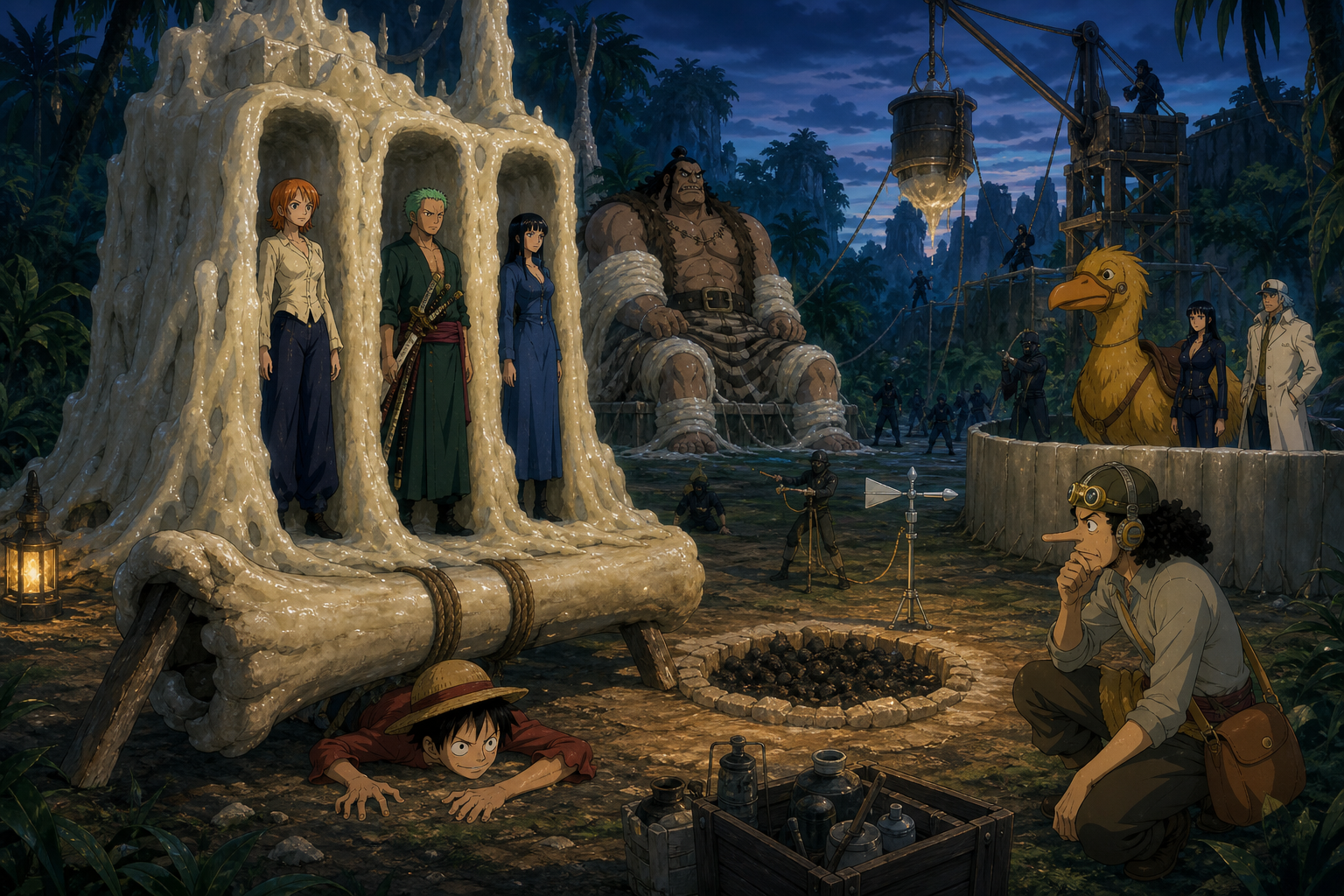
Mr. 3’s Giant Wax Trap
One Piece Episode 74 exposes Mr. 5’s sabotage and turns Mr. 3’s giant wax candle into a coordinated hostage rescue involving the Straw Hats, Vivi, Karoo, and Brogy.
Episode information
Japanese title: Ma no Candle! Munen no Namida to Ikari no Namida
English title: The Devilish Candle! Tears of Regret and Tears of Anger
Japanese broadcast: July 15, 2001
Saga: Alabasta
Script: Junki Takegami
Episode direction: Konosuke Uda
Animation direction: Hideaki Maniwa
Art: Yuri Sanami
Brogy faces the people behind the trap
Episode 74 brings Mr. 3 and Miss Goldenweek openly before Brogy after the sabotaged duel. Their appearance changes suspicion into an identifiable criminal operation.
Brogy needs truth about Dorry’s condition and the interference before grief becomes uncontrolled retaliation.
Mr. 5 planted the explosive
The official summary confirms Mr. 5 put the bomb in Dorry’s alcohol. That confession clears Nami, Usopp, and Brogy of intentional contamination.
The confession also links the earlier blast to Baroque Works rather than a random failure.
Preserve the admission. Record exact words, witnesses, location, surrounding evidence, and whether the statement was voluntary. A confession is powerful but should be supported by physical proof.
Do not destroy the vessel or residue after hearing the admission.
Brogy should not carry false guilt. He shared the drink and later struck Dorry without knowing about either trap. Mr. 5 and Mr. 3 manipulated his trust and ritual.
Tell him clearly that responsibility belongs to the saboteurs.
Grief can coexist with urgent rescue
Brogy may cry, freeze, rage, or struggle to hear plans. A calm supporter can state immediate priorities and remain nearby.
Do not demand emotional control as proof of warrior dignity.
Mr. 3 restrains Brogy with wax
The official account says the giant is captured. Wax can restrict movement, circulation, breathing, and access to injured areas.
Rescue needs to understand temperature, structure, adhesion, and secondary traps before breaking material.
Giant size does not make restraint safe. A larger body creates more weight against fixed wax and greater risk if support suddenly fails. Secure limbs and clear the fall zone.
Monitor skin color, sensation, pulse, and breathing where possible.
Wax is both weapon and evidence. Photograph shape, layers, tool marks, contact surfaces, and residues. Preserve samples from different points.
Removal should balance urgent welfare with forensic value.
Miss Goldenweek supports indirect control. Her role may involve psychological or behavioral influence rather than obvious force. The crew should observe changes in mood, motivation, attention, and decision-making.
Do not shame a person whose behavior may be externally manipulated.
Use paired observation. Crewmates should check one another for sudden unexplained emotional shifts. Record time, location, colors, symbols, substances, and proximity to agents.
A shared reality check can interrupt covert influence.
Karoo is captured
Mr. 5 and Miss Valentine bring the riding bird before Vivi, Usopp, and immobilized Luffy. Karoo becomes leverage against people who care about him.
He is a hostage with independent welfare needs, not equipment owned by Vivi.
Keep the animal calm. Avoid shouting, sudden approach, projectiles, and threats near Karoo. Offer water and room to balance where captors allow.
Rescue should not force him through wax, fire, or unstable terrain.
Do not make Vivi choose. Captors may pressure her to surrender, disclose information, or accept harm to protect Karoo. Coerced choices are not meaningful consent.
Responders should take responsibility for finding an alternative.
Luffy remains immobilized
The giant bone limits his ability to intervene. Check breathing, circulation, limb position, and whether the support has shifted.
Freeing him requires controlled lifting rather than a dramatic pull.
Usopp is the mobile planner. He can observe agents, Karoo, wax equipment, wind, routes, and the captives. His fear does not prevent useful analysis.
Give him clear priorities so guilt about the alcohol does not drive reckless action.
Vivi can identify the agents. Her Baroque Works knowledge helps explain code names, abilities, hierarchy, and likely objectives. She should share concise information without exposing herself unnecessarily.
Her identity already makes her the highest-value target.
Mr. 3 builds a giant candle structure
The official summary places Vivi, Zoro, and Nami in an oversized wax mechanism. The structure combines restraint, environmental exposure, and staged execution.
Rescue must address both fixed wax and whatever process the candle is designed to create.
Faces and airways must remain clear. Wax near nose, mouth, chest, or neck can become rapidly fatal. Monitor breathing, speech, and consciousness.
Prioritize airway access before limbs or weapons.
Heat can rescue and harm. Wax may soften with warmth, but uncontrolled flame can burn captives, consume oxygen, produce fumes, ignite vegetation, and collapse supports.
Use measured heat, ventilation, barriers, and extinguishing water.
Cold can change brittleness. Cooling may make some wax easier to fracture but can injure captives or create sharp pieces. Test a remote sample first.
Avoid sudden temperature changes against skin.
Mechanical release may be safer. Identify seams, supports, thin sections, anchors, and load paths. Cut away from bodies and support each section before removal.
Zoro’s swords should only be used with visibility and consent.
Zoro cannot solve the trap by cutting blindly. His strength and precision are valuable, but hidden layers may hold Nami or Vivi upright. One strike could collapse the structure.
Usopp or Nami can help map the safest cut sequence.
Nami needs control over her rescue. She can report pressure points, numbness, heat, and structure movement. Rescuers should listen rather than treat her as passive cargo.
Her navigation knowledge remains essential after escape.
Vivi should not be separated alone. Baroque Works may prioritize moving her during confusion. Assign a named protector and secure route as wax removal begins.
Protection should preserve her ability to make decisions.
The candle may create harmful fumes. Burning or heated wax in a humid clearing can irritate lungs, reduce visibility, and settle on skin. Position people upwind and limit exposure.
Karoo may show respiratory distress before humans.
Use wind direction as a rescue tool. Usopp or Nami can identify airflow. Approach from upwind, vent fumes away from captives, and position fire suppression downwind.
Weather changes require continuous monitoring.
The jungle is a fire environment. Even green vegetation contains dry material, oils, tents, rope, and supplies. Create a cleared perimeter and assign extinguishing teams.
Never let flame become the only plan.
Multiple hostage groups require coordination
Brogy, Karoo, Luffy, Vivi, Zoro, and Nami face different mechanisms. One rescue action may trigger retaliation elsewhere.
Use synchronized signals and assign leaders for each group.
Prioritize immediate threats, not status. Airway obstruction, unstable support, active heat, and direct violence come before royal identity or combat importance. Triage should follow medical urgency.
Every captive deserves the same welfare standard.
Agents may have dead-man triggers. Wax machinery or restraints could respond if an operator falls or leaves. Observe controls and ask captives what changed during setup.
Do not incapacitate every agent before understanding the mechanism.
Offer surrender and safe custody. Mr. 3, Mr. 5, Miss Goldenweek, and Miss Valentine should have a path to stop mechanisms, release hostages, and receive due process. Promises must remain lawful and realistic.
Once surrendered, protect them from revenge.
Brogy’s strength can help after release. He may lift supports or block agents, but grief and restraint effects could impair judgment and circulation. Assess him first.
Ask consent before making him responsible for every rescue.
Dorry still needs care. The focus on new captives must not leave the injured giant unattended. Maintain airway checks, monitoring, and protection from wildlife or agents.
Assign a dedicated care team rather than assuming he is dead.
Evidence ties the operation together
Mr. 5’s confession, explosive residue, wax at Dorry’s foot, Brogy’s restraints, captured Karoo, and the candle structure show coordinated intent.
Record locations and timeline before the clearing is altered.
The goal may be bounty extraction. Mr. 3 treats strong bodies and royal identity as assets to convert into reward. Wax lets him immobilize targets without matching their power directly.
The operation resembles trafficking as much as combat.
Miss Goldenweek’s role needs individual review. Working beside Mr. 3 does not prove equal authority, intent, or freedom. Investigate actions and coercion separately.
Do not infantilize or excuse her based on appearance.
Mr. 5’s confession does not close every question. Determine who ordered sabotage, who prepared the explosive, who selected the vessel, and who knew Dorry would drink. The wider chain matters.
Preserve communication devices and code records.
Luffy’s anger needs a rescue objective
Once free, he should protect hostages, interrupt active mechanisms, and avoid uncontrolled impacts near wax supports. Revenge can wait for lawful accountability.
Strength is useful only when directed.
Usopp can engineer the release
He can test wax samples, build leverage, manage wind, distract agents, and coordinate signals. His technical contribution should not be overshadowed by combat.
Give him tools and time where immediate danger allows.
Karoo may support communication after rescue. Once assessed and calm, he can carry messages along known safe routes. Do not send him before checking feet, breathing, restraint injuries, and fatigue.
A rescued hostage is not instantly available for work.
Post-release care matters
Check circulation return, skin injury, inhalation, dehydration, temperature, panic, and delayed pain. Remove wax gently and preserve contaminated clothing if relevant.
Provide privacy and allow captives to choose who remains nearby.
The giants control the cultural response. Brogy and Dorry should decide how Elbaf understands sabotage of the duel. The Straw Hats can present evidence and support care.
They should not claim authority over the ritual because they helped rescue its participants.
Junki Takegami turns the clearing into a system
Takegami’s script connects separate captives, wax technology, emotional influence, and confession. Baroque Works wins by managing space and attention.
The rescue therefore requires coordination rather than one stronger attack.
Konosuke Uda keeps hostage geography readable. Uda’s direction must show who is restrained, who can move, where agents stand, and how wax machinery relates to the candle. Clear geography creates suspense without confusion.
Karoo remains visible as a person in danger.
Hideaki Maniwa makes wax physically distinct. Animation direction can show glossy flow, hardening, brittleness, weight, and support without body horror. Captive breathing and small movements communicate urgency.
Brogy’s grief contrasts with Mr. 3’s control.
Yuri Sanami gives ivory wax an unnatural presence. Pale structures against green jungle show an invasive material reshaping the habitat and people. Shadows reveal machinery and escape routes.
The clearing looks engineered rather than magical chaos.
RaeRae’s real-time reaction
Mr. 5 admitting he planted the bomb clears Nami and Usopp, but the admission also proves this whole operation was planned around making friends blame each other.
Do not light a giant candle under three captives and call uncontrolled fire a rescue. Map the supports, protect airways, test the wax, manage fumes, free Karoo, and keep Brogy from carrying guilt that belongs to the agents.
The moment that lands. Mr. 3 turns wax into architecture: a giant restrained, three people displayed, one captain immobilized, and Karoo held as leverage. The scene is terrifying because the control system is organized.
Every relationship has been converted into a control point.
What should happen immediately. Stabilize airways, monitor Dorry, secure Karoo, map wax structures, test remote samples, establish wind and fire control, assign synchronized rescue teams, preserve Mr. 5’s admission, and prepare safe custody.
Do not use uncontrolled flame.
What accountability requires. Document the command chain, bomb, wax traps, emotional influence, hostage treatment, injury, and intended bounty transfer. Protect surrendered agents, separate individual responsibility, return control of the duel to Dorry and Brogy, and provide post-release care.
Preserve evidence before dismantling the scene.
Rescue command must survive disruption. One person should coordinate priorities, but every team needs the next named lead if that coordinator is restrained, influenced, or injured. Share the rescue map, signals, airway status, and fire plan before movement begins.
A redundant command structure prevents Mr. 3 from stopping the entire response by controlling one strong or knowledgeable crewmate.
The crew also needs a shared status board once movement begins. A single visible record should identify each captive, airway status, restraint point, assigned rescuer, known trigger, and cleared exit. That record prevents one dramatic rescue from hiding a quieter emergency elsewhere in the clearing. Every update should be repeated aloud so Brogy, Karoo, and the restrained crew remain included in decisions affecting their bodies and safety.
Bottom line
Episode 74 exposes Mr. 5 as the alcohol saboteur and expands Mr. 3’s operation into a multi-hostage wax system involving Brogy, Karoo, Luffy, Vivi, Zoro, and Nami. The correct response is coordinated rescue built around airway, heat, fumes, structure, animal welfare, evidence, and the captives’ own information.
RaeRae rating: 9.4/10. The agents weaponize grief, friendship, and rescue urgency. Clear Nami and Usopp, free Karoo as a living hostage, keep flame away from bodies, and dismantle the candle like an engineered crime scene rather than a target for one dramatic strike.