
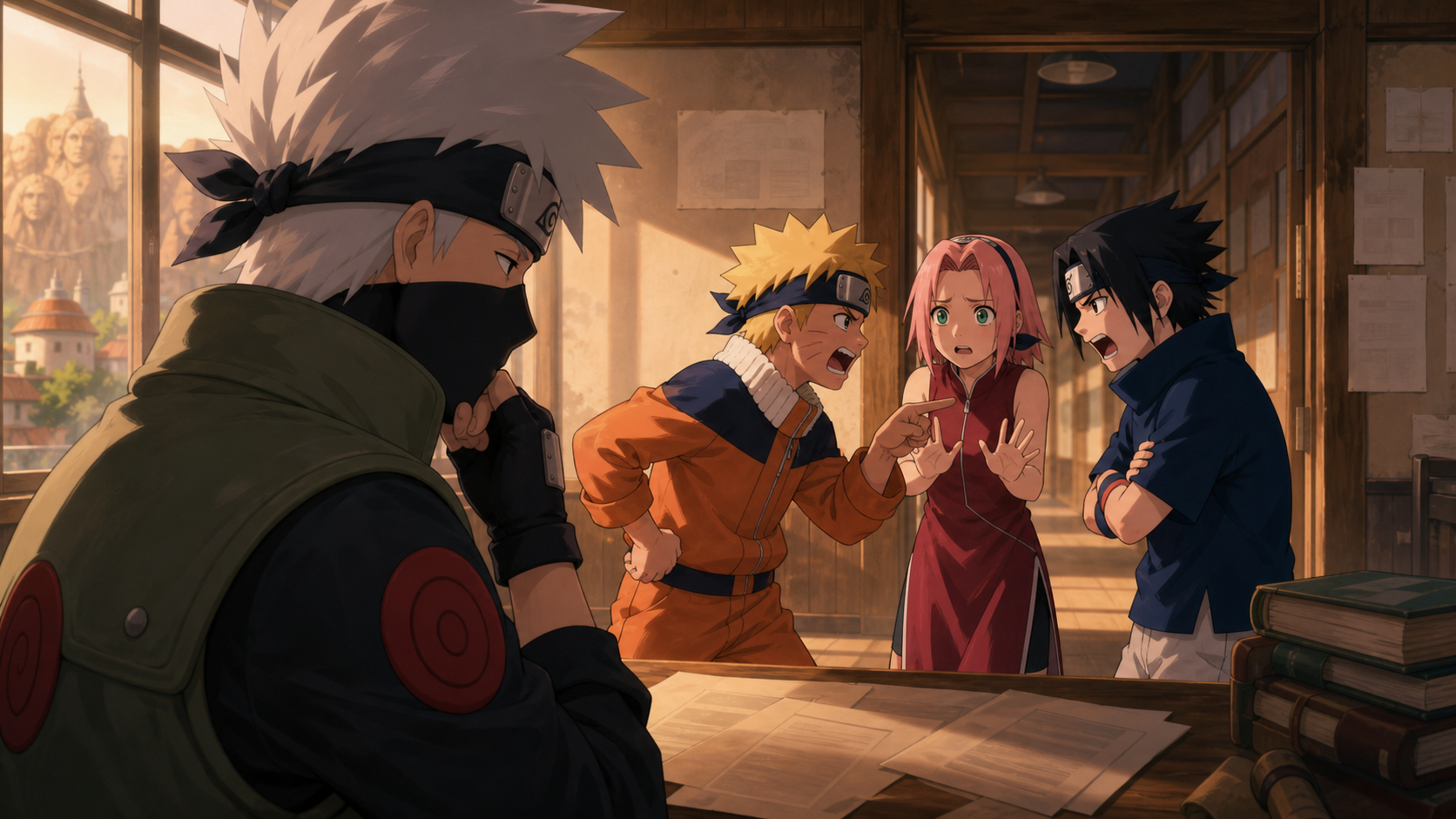
Kakashi Hatake, the Jōnin in Charge
While the Leaf debates its next Hokage, Kakashi remembers the first responsibility that made his quiet leadership matter: three clashing new genin.
What happens in Naruto Shippuden Episode 179?
Naruto Shippuden Episode 179, "Kakashi Hatake, the Jōnin in Charge," opens in the political uncertainty left by Pain's assault. Tsunade remains unconscious while the Leaf needs money, labor, and leadership for reconstruction. At an emergency council before the Fire Daimyō, Danzō argues that the village cannot wait for Tsunade to recover and pushes the selection of a replacement Hokage.
Back in the village, Naruto and Kakashi visit Tsunade. Naruto's worry makes the political question personal, while Kakashi remembers the moment he was assigned Naruto, Sasuke, and Sakura as a new genin team. The episode uses that memory to ask what leadership means before someone receives a title.
The Hokage debate begins with a damaged village
The council is not happening in an abstract chamber. Homes, defenses, medical facilities, and public services need rebuilding. The village needs decisions now, which gives Danzō's demand a legitimate surface. An unconscious Hokage cannot sign orders or negotiate resources.
The danger is that urgency can disguise ambition. Danzō frames succession as practical necessity while positioning his own worldview as the answer. He treats the crisis as evidence that the village must become harder and more secretive, even though Naruto's victory came from cooperation, empathy, and information shared across generations.
This tension matters because government is more than identifying the strongest available ninja. The next Hokage will decide what the village learns from the attack. Reconstruction can restore the same walls and suspicions, or it can protect the social bonds that enabled survival.
Kakashi sees the distance between appointment and trust
Kakashi's memory begins before Team 7 has earned its name. Naruto, Sasuke, and Sakura are three students placed together by an institution. Their skills, rivalries, and private wounds do not automatically form a unit simply because a roster says they should.
Kakashi understands that problem better than most. His own history taught him the cost of prioritizing rules above people, but knowledge does not make teaching simple. He has to translate loss into a method that three very different children can understand.
The episode therefore connects the current Hokage question to the smaller assignment. Both positions can be granted officially. Neither becomes meaningful until the person in charge accepts responsibility for people whose needs do not fit neatly into policy.
Naruto and Sasuke arrive as a conflict, not a partnership
Young Naruto and Sasuke treat every interaction as a contest. Naruto wants acknowledgment and sees Sasuke's effortless popularity as an insult. Sasuke protects his isolation by refusing to admit that anyone else matters. Their argument looks childish, but it is built from two different forms of abandonment.
Sakura stands between them while carrying her own expectations. She is attentive to Sasuke, irritated by Naruto, and not yet confident enough to challenge the shape of the group. Kakashi does not inherit a balanced team. He inherits three children who use performance to hide what they cannot say.
That makes the familiar conflict worth revisiting from his perspective. The noise is not evidence that Team 7 is hopeless. It is diagnostic information. Kakashi has to notice what each student is defending before he can teach them to defend one another.
A jōnin leader is responsible for more than techniques
Kakashi could evaluate the students only through combat skills, grades, and obedience. Those measurements would favor Sasuke, expose Naruto's weak fundamentals, and leave Sakura's uncertainty mostly invisible. Instead, his leadership begins with the question of whether they can act as a team.
That priority comes directly from experience. Kakashi knows a mission can be technically completed and still destroy the people carrying it out. He also knows sentiment without discipline can get a squad killed. The bell test he plans is designed to force those truths into the same exercise.
Episode 179 stops before retelling every detail of that test, which keeps its focus on the appointment itself. Kakashi's first task is not producing a victory. It is deciding what standard will define success for the children placed in his care.
The spoiled milk detail exposes Naruto's neglected life
Kakashi's observation of Naruto's home makes the assignment more concrete. Naruto's spoiled milk is funny in the immediate scene, but it also reveals how little ordinary supervision he receives. No parent checks the refrigerator, replaces groceries, or notices that the child is living on food that can make him sick.
This is the kind of information a personnel file misses. The village knows Naruto contains the Nine-Tails. It knows his grades and disciplinary record. It does not consistently respond to the daily evidence that he is raising himself.
For Kakashi, leadership begins by seeing that environment. Naruto's lateness, pranks, and poor preparation do not vanish, but they gain context. Accountability becomes useful only when an adult also recognizes the conditions under which the child is expected to succeed.
Team assignments reveal the village's long memory
Placing Naruto, Sasuke, and Sakura together concentrates several major village histories in one squad. Naruto carries the Nine-Tails seal and the Fourth Hokage's legacy. Sasuke carries the Uchiha massacre and a dangerous hunger for revenge. Sakura arrives without a famous clan burden, which gives her a different relationship to the institutions around them.
Kakashi is an appropriate leader not because he can solve each history, but because he understands that talent and trauma can coexist. His Sharingan, war record, and reputation may impress the council that assigns him. His more important qualification is the painful knowledge that a gifted child can still be emotionally unprepared for what adults demand.
The episode lets that qualification remain understated. Kakashi watches, assesses, and remembers. His leadership style is quiet because he has learned how badly loud certainty can fail.
Present-day Kakashi is being measured by the same principle
While Kakashi remembers becoming Team 7's leader, the council considers who might lead the entire village. The parallel invites us to judge Hokage candidates by the standard Kakashi used for his students: can they put collective survival ahead of individual ambition?
Danzō presents decisiveness, but his decisions consistently preserve control. Kakashi has authority without chasing the title. That contrast does not make Kakashi perfect. It shows why reluctance can sometimes be a qualification when power attracts people who value possession more than service.
Naruto's presence at Tsunade's bedside adds another measure. The village has just celebrated him as a hero, yet he is focused on the person who protected his growth. Leadership creates bonds that outlast a battle. A replacement chosen solely for immediate efficiency may miss that deeper obligation.
Tsunade’s unconsciousness creates a constitutional problem
The village cannot wait indefinitely for signatures, resource decisions, and diplomatic authority. Reconstruction requires functioning leadership while the current Hokage cannot speak.
That practical need makes the succession debate legitimate. It also gives ambitious people cover to turn temporary crisis into permanent control.
Danzō narrates urgency toward the answer he already wanted
He treats Pain’s assault as proof that Tsunade’s cooperative methods failed and that the Leaf needs harder leadership. The argument omits how his own past interference helped create Nagato’s tragedy.
A person who contributed to the danger is using the damage to demand greater authority over the response. That is not security. It is opportunism with official language.
Reconstruction money carries political leverage
The Fire Daimyō and council are not only discussing a symbolic title. Resources, labor, contracts, and outside support depend on who can represent Konoha.
The material emergency makes process vulnerable. People may accept a dangerous leader because rubble creates pressure for immediate certainty.
Kakashi’s name enters because competence is visible
He has experience, reputation, judgment, and connections across the village. Those qualifications make sense. Kakashi does not treat the possibility as a prize he has been waiting to claim.
Reluctance alone does not guarantee good leadership, but it contrasts sharply with Danzō’s readiness to convert crisis into elevation.
The bedside keeps Tsunade a person, not a vacancy
Naruto visits because he is worried about her, not because he wants to evaluate succession. Tsunade protected his growth, trusted his choices, and spent herself shielding villagers through Katsuyu.
Political necessity cannot erase the living woman whose body paid for the response everyone is now administering.
Kakashi remembers receiving responsibility before authority felt comfortable
Team 7 was assigned through a roster. The paper established his role and did not create trust, cooperation, or understanding among the four people involved.
The memory asks whether leadership begins with appointment or with the choices made after other lives become your responsibility.
Three genin arrive as three incomplete files
Academy scores, clan histories, conduct reports, and reputations describe Naruto, Sasuke, and Sakura. None captures the needs each child is hiding through performance.
Kakashi must observe beyond the record if the assignment is going to become a team rather than an administrative grouping.
Naruto’s file can document behavior and miss neglect
Pranks, weak fundamentals, lateness, and failure are easy to record. Spoiled milk in an unsupervised apartment reveals a child raising himself with no ordinary adult checking whether food is safe.
Context does not eliminate accountability. It changes what resources should accompany expectations.
The spoiled milk is a governance failure in miniature
Konoha monitors the jinchuriki as a strategic asset while failing to replace basic groceries. The village knows where Naruto is important to security and not always whether he is eating safely.
Leadership that protects abstractions while missing daily care has confused surveillance with responsibility.
Sasuke’s excellence also conceals institutional failure
He performs competence after his clan is massacred and lives alone inside the district left behind. Adults can praise his scores without confronting what isolation is doing to him.
Talent makes neglect look less urgent. Kakashi knows from experience how dangerous that assumption can become.
Sakura’s normalcy makes her needs easier to overlook
She lacks the spectacular burden attached to Naruto and Sasuke, so the team can treat her as the uncomplicated member. She still arrives with insecurity, social pressure, and an identity organized around how others evaluate her.
Quiet needs remain needs. A leader must not reserve attention only for the loudest trauma.
Kakashi recognizes survival strategies disguised as personalities
Naruto performs confidence, Sasuke performs indifference, and Sakura performs certainty around Sasuke. Each presentation protects a vulnerable point.
Teaching begins when Kakashi stops asking whether the personalities are convenient and starts asking what they prevent the children from saying.
His own team history shapes the standard
Kakashi once prioritized rules, then learned through Obito and Rin that abandoning comrades can make technical success morally empty. The lesson arrived through irreversible loss.
He builds Team 7’s first test around cooperation because he refuses to let another group discover that principle too late.
The bell test measures who becomes disposable
Three students compete for two bells, apparently requiring one child to fail. The setup invites selfishness and exposes whether they accept scarcity as permission to abandon a teammate.
Kakashi is testing the social rule beneath the combat exercise. Skill without solidarity does not pass.
Jōnin leadership includes resisting the institution’s easiest metrics
Sasuke can outperform, Naruto can disrupt, and Sakura can follow formal expectations. Ranking them individually would reproduce the behaviors keeping them apart.
Kakashi changes the success condition from personal acquisition to collective responsibility.
The Hokage comparison is deliberately uncomfortable
A village leader also receives people with conflicting histories, needs, and power. Winning a title cannot substitute for building conditions where they survive together.
Danzō offers command. Kakashi’s best teaching offers responsibility that questions its own authority.
Observation becomes Kakashi’s quiet form of care
He watches homes, interactions, habits, and what each student avoids. The distance can feel emotionally frustrating, but it gathers context before intervention.
The method works only when observation eventually becomes reliable presence rather than permanent detachment.
RaeRae's reaction to Kakashi Hatake, the Jōnin in Charge
I like the episode most when it treats administration and teaching as versions of the same moral problem. A title can tell everyone who is responsible. It cannot guarantee that the person will value those responsibilities above ego.
The Team 7 memory is familiar, but Kakashi's viewpoint changes its weight. Naruto, Sasuke, and Sakura are not yet legendary names. They are loud, defensive children whose adult supervisor must decide whether their friction is a reason to reject them or the material from which teamwork can be built.
The spoiled milk may be the smallest detail, and it is the one that stays with me. Naruto's public reputation makes him seem like a village-wide problem. His kitchen reveals a child-sized need. Kakashi's job begins when he sees both scales at once.
Episode 179 ends with the future still open. Team 7 has not yet proven itself, Tsunade has not awakened, and the council's choice carries real danger. The episode's answer is not that Kakashi deserves authority because he is famous. It is that his best leadership has always started with observation, restraint, and the refusal to give up on people before they learn how to stand together.
A title can identify the person in charge without proving leadership
Kakashi became Team 7’s jōnin through assignment. Trust grew through choices. The same distinction should govern the Hokage debate.
Konoha needs someone empowered to act and worthy of being questioned while acting.
RaeRae’s final word on Kakashi Hatake, the Jōnin in Charge
The spoiled milk makes me angrier than the council. Konoha tracked Naruto as a weapon and left a child alone with a refrigerator nobody checked. That tiny detail exposes priorities more clearly than a speech.
Kakashi inherits three children carrying different versions of abandonment. He does not solve them. He starts by refusing the Academy’s individual rankings as the final definition of success.
Danzō sees Pain’s destruction and asks how crisis can justify control. Kakashi’s memory asks how authority can become accountable to people placed beneath it. Those are opposite leadership instincts.
Team 7 begins as paperwork and becomes relationship because Kakashi makes solidarity the condition of passing. A Hokage should meet the same standard: nobody becomes expendable so the person in charge can call the mission complete.
Kakashi’s leadership is strongest where Danzō’s is weakest
Danzō begins with the village as an abstraction that must survive, then decides which people can be used, hidden, or sacrificed toward that goal. Kakashi begins with three difficult individuals and asks how survival can include all of them. The difference is not softness. It is whose life remains visible inside strategy.
Team 7’s bell test creates artificial scarcity, but Kakashi does not endorse the rule suggested by that scarcity. He wants the students to question a setup that says one person must be discarded. Danzō repeatedly accepts that setup at political scale and calls his willingness realism.
Kakashi has also made choices shaped by rigid rules and fear. His leadership is not naturally enlightened. Obito and Rin became the cost of lessons he carries into every later assignment. Experience becomes ethical only when it changes what the survivor does with authority.
That is why his quiet observation matters. Naruto’s apartment, Sasuke’s isolation, Sakura’s social positioning, and the group’s rivalry all supply information beyond Academy scores. Kakashi cannot protect what he refuses to notice.
Observation alone can become another form of distance, and Kakashi sometimes leans too heavily on it. Children need adults who eventually speak, intervene, and remain emotionally available. His growth as their teacher continues after the first test.
The village succession raises the same demand. A Hokage must understand intelligence reports, military readiness, budgets, clan politics, and diplomatic risk. Those systems exist to serve people, not replace them as the object of care.
Tsunade demonstrated that principle during Pain’s assault by directing chakra through Katsuyu toward individual lives. Her body collapsed because leadership remained connected to civilians beneath the abstraction “Konoha.” Danzō hid while preserving himself for succession.
Kakashi carrying Naruto home in the previous episode becomes another qualification the council cannot measure neatly. He knows the strongest available fighter may return unable to stand and that leadership includes becoming the support beneath him rather than demanding one more performance.
Naruto’s worry beside Tsunade reveals what titles can build when authority is used relationally. He does not mourn a vacant office. He fears losing the woman who believed in him, defended him, challenged him, and spent herself protecting the village.
A new appointment cannot inherit that trust automatically. The office transfers powers. Relationship must be earned through repeated decisions whose consequences reach people outside the chamber.
Episode 179 therefore uses a familiar Team 7 memory for a sharp political question. Who should lead after catastrophe? The person most eager to possess control, or the person whose history taught him that completing the mission means nothing when the people entrusted to him become expendable?
Kakashi does not need the Hokage title to demonstrate the standard. He sees Naruto’s spoiled milk, Sasuke’s weaponized competence, and Sakura’s quieter uncertainty before the team has accomplished anything worth celebrating. That attention says leadership begins below the level of public achievement. It asks what conditions people are surviving and what support lets them become responsible to one another. Danzō sees the same damaged village and reaches upward for power. Kakashi’s memory reaches backward toward obligation. The contrast tells us why one man’s decisiveness should frighten the council and why the other man’s reluctance deserves serious attention. Authority is not proven by wanting the final say. It is proven by accepting that every order remains accountable to the lives carrying it, especially when those lives are inconvenient, wounded, young, or unable to reward the leader with immediate success.
RaeRae’s call
Kakashi’s first leadership test is not whether three talented children can take bells. It is whether authority can teach them that no teammate becomes the price of somebody else’s success.