
Rookie Instructor Iruka
A scarred Academy pillar returns Iruka to the years when he was still learning how grief shaped his teaching and how Naruto turned loneliness into disruption.
What happens in Naruto Shippuden Episode 176?
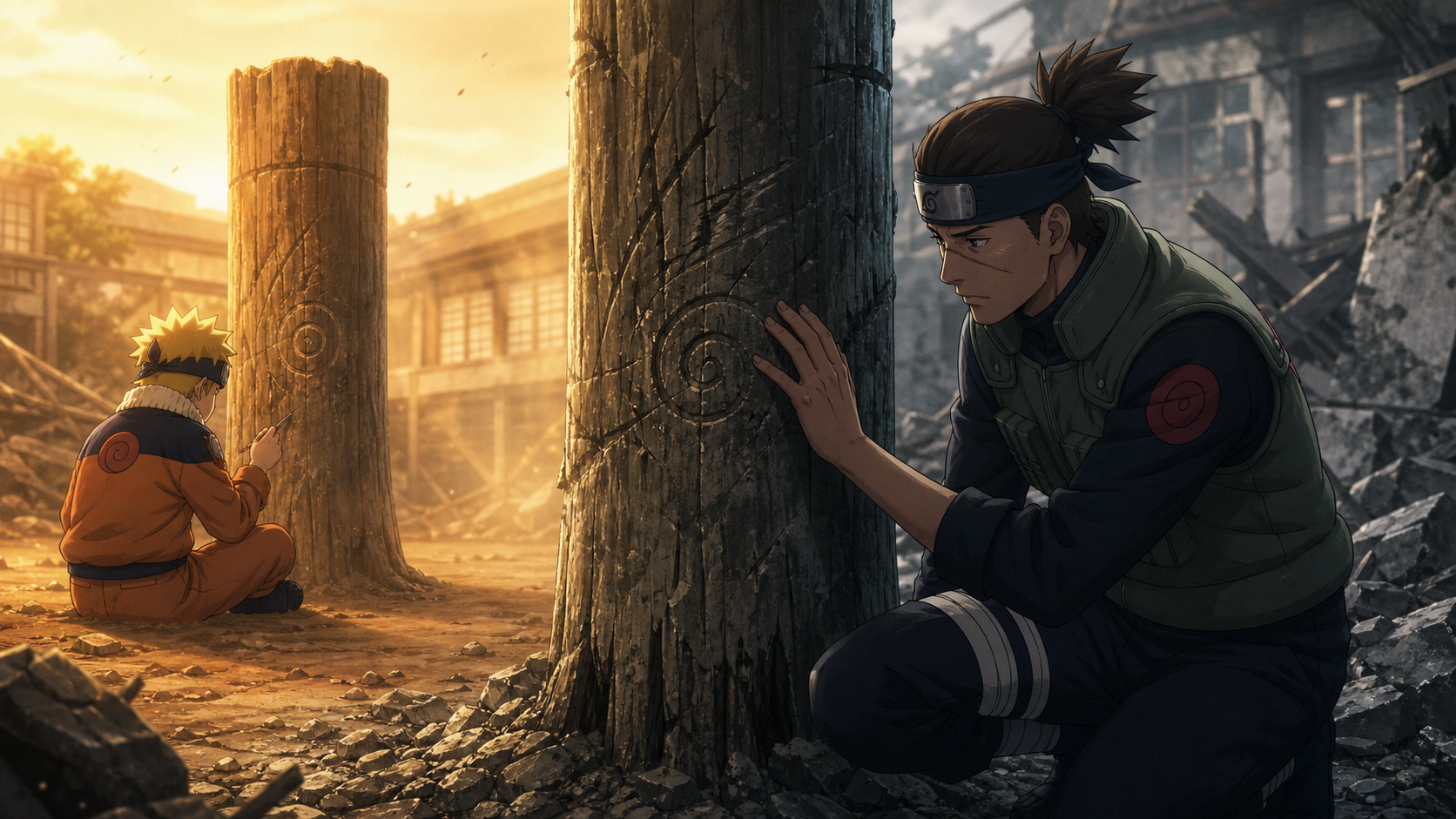
Naruto Shippuden Episode 176, "Rookie Instructor Iruka," begins in the ruined Ninja Academy after Pain's assault. While helping clear debris, Iruka finds an old training pillar marked by Naruto during his Academy years. The damage opens a memory of Iruka's first days as an instructor and the child he did not yet know how to teach.
Young Naruto is already famous for pranks, poor classroom performance, and the loneliness adults refuse to name. Iruka wants to prove himself as a teacher, but Naruto's presence touches the grief he still carries from losing his parents to the Nine-Tails.
The episode does not pretend their bond formed immediately. It returns to the period when Iruka saw Naruto's behavior as disruption and Naruto saw another adult likely to reject him. The pillar survives as evidence that both of them were learning before either understood what the relationship would become.
The ruined Academy turns memory into part of rebuilding
Iruka is not reminiscing in a preserved classroom. He is standing inside wreckage. The Academy that once held Naruto's loneliness now needs to be rebuilt for another generation.
Finding the pillar connects physical reconstruction to emotional history. Replacing walls is not enough if the village forgets how easily children can become invisible inside its institutions.
Iruka's memory asks what the Academy taught beyond jutsu. Naruto learned that failure drew laughter and misbehavior produced attention. Iruka had to learn that discipline without recognition could repeat the rejection already waiting outside class.
Rookie Iruka wants to perform competence
As a new instructor, Iruka is worried about controlling the room and meeting expectations. Naruto is the worst possible student for someone relying on a clean lesson plan to prove he belongs at the front of the class.
Every interruption feels personal because Iruka has not yet developed the confidence to separate a child's need from the challenge to his authority. He reacts to the visible behavior before understanding the reason beneath it.
That does not make him cruel. It makes him inexperienced. The episode gives his later compassion a history of mistakes rather than presenting it as a quality he always used perfectly.
Naruto's pranks are requests with nowhere to land
Young Naruto understands that negative attention is still attention. A painted monument, a disrupted class, or a scratched pillar forces adults to say his name.
The village reads these actions as proof that he is a problem. Naruto experiences them as proof that he can still affect a world committed to acting as if he should not exist.
The difference between excusing behavior and understanding it matters here. Iruka still has to set boundaries. He also has to recognize that punishment alone confirms Naruto's belief that adults only approach him to remove him.
Iruka's grief creates distance before it creates empathy
Iruka lost his parents during the Nine-Tails attack. The village's decision to place the fox inside Naruto makes the child a living trigger for grief he has not resolved.
Knowing intellectually that Naruto is not the Nine-Tails does not make the emotional association vanish. Iruka has to confront the part of himself that responds to the container as if it were the cause.
This is why his eventual bond with Naruto matters so much. Iruka does not care because he lacks a reason to fear or resent. He learns to distinguish the child from the tragedy even while carrying that tragedy.
The Third Hokage's responsibility is complicated
Hiruzen protects Naruto in important ways, but he also presides over a village where adults isolate the child. Assigning instructors and issuing rules against discussing the Nine-Tails cannot substitute for a community willing to care for him openly.
Iruka is asked to handle a problem created by collective silence. Naruto's classmates do not understand why adults treat him differently, and Naruto does not receive language for his own life.
The result is behavior everyone can punish without discussing the conditions that produced it. Iruka's growth begins when he looks beyond the official boundary and sees a lonely student.
The pillar records a child who expected no archive
Naruto's scratches are not an elegant memorial. They are the kind of mark adults might sand away during repairs. Iruka recognizes them because he remembers the person behind them.
That recognition transforms damage into testimony. The pillar says Naruto was here before the village called him a hero. He was here when he failed, irritated people, and kept returning to a place that rarely made him feel wanted.
The surviving mark is valuable because it preserves the version of Naruto public celebration could flatten.
Teaching begins when Iruka becomes curious
The shift in Iruka does not happen because Naruto suddenly behaves. It begins when the teacher asks what the behavior communicates.
Curiosity changes the relationship from control to attention. Iruka can still be frustrated, assign consequences, and expect effort. The difference is that Naruto becomes a person in the room rather than an obstacle to a successful class.
That is the foundation of their later bond. Recognition arrives before achievement. Iruka sees Naruto while there is little public reason to celebrate him.
The episode reframes the hero welcome
Episode 175 showed the entire village recognizing Naruto. Episode 176 immediately returns to the smaller, earlier act that made that moment possible.
Before a crowd could welcome Naruto, one teacher had to stand beside him. Before the village could call him a hero, someone had to tell him he was not the fox that killed Iruka's parents.
Public recognition feels powerful because private recognition kept Naruto alive long enough to receive it.
Rebuilding should preserve the lesson, not only the structure
Iruka's memory gives the damaged Academy a responsibility. The rebuilt school can reproduce the same silences or learn from what Naruto endured.
Future instructors will teach children carrying losses from Pain's assault. Some will be disruptive, frightened, or angry. The adults can label those responses as problems, or they can remember that trauma often enters a classroom through behavior.
The pillar should not become a shrine that freezes Naruto's story. It should become a reminder to notice the next child before heroism makes noticing easy.
The pillar survives when the classroom does not
Pain’s assault tears apart walls, desks, records, and the ordinary structure of the Academy. Naruto’s old marks remain on a piece of training space Iruka recognizes immediately.
The survival is accidental and meaningful. A child who believed nobody wanted evidence of him left evidence strong enough to outlast the building around it.
Reconstruction opens a question about what deserves restoring
Konoha needs classrooms quickly. Children require routine, instruction, and somewhere to gather after catastrophe. Rebuilding the Academy exactly as it was would also rebuild the silences that failed Naruto.
Iruka’s memory asks whether institutions can preserve lessons from harm instead of only replacing damaged material.
Rookie Iruka mistakes order for proof of teaching
He wants students seated, attentive, and responsive because a controlled room makes him look competent. Naruto’s disruptions threaten that performance before Iruka has confidence in his actual practice.
A quiet class can still contain ignored children. Discipline is a tool, not evidence that learning or care is happening.
Naruto understands attention as a scarce resource
Positive attention rarely arrives. Being loud, painting monuments, scratching property, or interrupting lessons reliably makes adults use his name. Misbehavior becomes a strategy for refusing social disappearance.
Understanding that logic does not require approving every prank. It changes what an effective consequence must address.
Punishment confirms the pattern when nobody asks why
If every adult approaches Naruto only after he creates a problem, punishment still rewards the need beneath the behavior with contact. It also confirms that care is unavailable through ordinary routes.
Iruka must create attention not purchased through disruption before Naruto has a reason to choose another method.
The class inherits adult prejudice without receiving its explanation
Children notice parents pulling them away, teachers watching Naruto differently, and villagers lowering their voices. The official rule prevents discussion of Kurama without preventing stigma from traveling.
Silence does not protect Naruto from the story. It leaves him trapped inside effects nobody will name.
Hiruzen manages information and leaves care fragmented
The Third Hokage limits public discussion and offers Naruto some protection. He does not create a consistent household or village-wide practice capable of confronting the prejudice.
Individual adults are left to discover responsibility unevenly. A child’s safety depends too heavily on whether one teacher becomes curious.
Iruka’s parents are present in every early reaction
Kurama killed them during the attack. Naruto’s face and reputation activate grief Iruka understands intellectually but has not separated emotionally. The child becomes associated with the force sealed inside him.
Iruka’s eventual love matters because it grows through confronting that association, not because he never felt it.
Grief explains Iruka’s distance without excusing harm
Losing parents as a child gives Iruka real pain. Naruto did not cause that loss. Adults remain responsible for how unresolved trauma shapes their treatment of children.
The episode allows compassion for the teacher and accountability to the student at the same time.
A rookie teacher needs support too
Iruka enters a difficult classroom carrying grief and pressure to prove himself. The institution offers authority faster than mentorship. Naruto exposes every gap immediately.
Supporting teachers is part of supporting students. An overwhelmed adult with unchecked bias can turn institutional neglect into daily practice.
Naruto tests whether Iruka will become another temporary adult
Disruption can push people away before attachment makes their departure hurt. If Iruka rejects him quickly, Naruto receives confirmation without risking deeper hope.
The behavior is self-protective and self-defeating. Reliable presence has to interrupt the cycle before trust can grow.
The scratches are not a noble childhood artifact
Naruto did not mark the pillar intending to inspire a future village. The act belongs to frustration, play, defiance, and a need to prove presence.
Iruka honors the child by remembering the mess honestly instead of polishing every old mistake into destiny.
Curiosity changes the direction of authority
When Iruka asks what Naruto’s behavior communicates, discipline stops being only something done to him. The teacher begins designing responses around a person’s needs and responsibilities.
Authority becomes relational. Iruka can set boundaries while making clear that connection will survive the consequence.
Recognition must arrive before achievement
The village cheers Naruto after he saves everyone. Iruka’s importance comes from seeing him when grades, conduct, and reputation offered no public reward for doing so.
Care that waits for excellence teaches children that humanity is conditional. Iruka eventually rejects that condition.
The Academy taught Naruto exclusion alongside ninjutsu
Lessons about teamwork happened in a room where classmates absorbed adult distance. The curriculum said village cooperation while the social environment treated one child as dangerous contamination.
Rebuilding should confront the contradiction rather than preserving it beneath new walls.
Pain’s orphans make this memory politically relevant
Nagato, Yahiko, and Konan survived war partly because an adult stayed and taught them. Naruto survived village prejudice partly because Iruka learned to stay.
The comparison does not make their histories identical. It shows how one adult relationship can alter what grief becomes without solving the system that caused it.
The hero celebration needs this corrective memory
Public applause risks making Naruto’s story begin at Sage Mode. The pillar insists he existed before usefulness, when his needs were inconvenient and his strength unproven.
Any honest celebration must include the village’s delay, not only Naruto’s eventual triumph.
RaeRae's reaction
I love that the series follows Naruto's biggest public celebration with Iruka touching an old scratched pillar. The crowd saw the finished moment. Iruka remembers the messy years that made it possible.
Rookie Iruka is difficult to watch because I know how important he will become. He is not ready yet. Naruto's face brings back the worst day of his life, and teaching skill does not automatically resolve grief.
That imperfection makes his later choice stronger. Iruka had to move through resentment, fear, and institutional silence to see Naruto clearly. He did not begin as the perfect adult Naruto needed.
The ruined Academy is the right place for this memory. Rebuilding after Pain cannot mean restoring the village exactly as it was. The village that isolated Naruto helped create the loneliness Pain tried to exploit. Iruka's pillar holds a smaller history of how change actually started: one adult stopped asking only how to control a child and began asking why the child needed to be noticed so badly.
Iruka’s memory turns nostalgia into instruction
He is not recalling a perfect past lost beneath rubble. The past contained failures worth refusing and relationships worth carrying forward.
The pillar becomes useful when it changes how the next classroom treats the next child whose pain arrives as disruption.
RaeRae’s final word on Rookie Instructor Iruka
I love Iruka because he learned. Making him naturally perfect would erase the work required to separate Naruto from the trauma Kurama caused him.
Young Naruto is exhausting and painfully legible. He creates proof of existence everywhere because ordinary belonging has been withheld. Adults call that attention-seeking as though seeking attention is mysterious for an abandoned child.
The ruined Academy keeps this from becoming soft nostalgia. Konoha has to decide whether reconstruction means restoring the same institution or building one capable of recognizing trauma before a student saves the world.
Iruka touching the pillar remembers Naruto without demanding heroism. That private recognition made the public welcome possible, and it remains the standard the rebuilt village owes every child afterward.
Iruka’s growth refuses the myth of the naturally perfect teacher
Good teaching is often discussed as temperament, as though the right adult simply walks into a classroom already patient, perceptive, fair, and healed. Rookie Iruka disproves that comfort. He enters with unresolved grief, insecurity about authority, and habits shaped by the same village prejudice affecting his students.
What distinguishes him later is not purity. It is willingness to revise himself. Naruto’s behavior frustrates him, then curiosity begins changing the question. Instead of asking only how to stop the disruption, Iruka asks what the child has learned to expect from adults.
That revision requires more than private kindness. Iruka must recognize how institutional rules conceal the reason Naruto is treated differently. The ban on discussing Kurama prevents classmates from receiving facts, but it does not prevent adults from transmitting fear through gestures, exclusions, and warnings. Naruto lives inside a secret everybody behaves as though they know.
The result is a classroom where one student experiences collective judgment without language to challenge it. He cannot explain why people avoid him or why the same prank seems to confirm something adults already believed. Creating noise is one of the few ways he can control when rejection arrives.
Iruka’s grief makes that dynamic harder because the Nine-Tails genuinely killed his parents. He has to separate the force responsible from the child used to contain it. That emotional work is not automatic just because he understands the seal intellectually. The episode respects grief by showing the distinction must be practiced.
It also respects Naruto by refusing to make him responsible for healing the adult. A child’s pain may reveal where a teacher needs growth, but the child should not have to become exemplary before receiving fair treatment. Iruka’s professional and moral responsibility comes first.
The present-day rubble gives all of this urgency. Pain’s assault has created more bereaved children, frightened families, displaced households, and instructors carrying trauma. If Konoha rebuilds without supporting those people, the Academy will receive pain disguised as behavior for years.
Naruto’s story can become a useful institutional memory or a flattering legend. A legend says the troublesome child became great, so patience was rewarded. A useful memory says adults harmed him before greatness and must notice children whose future importance is unknown.
The scratched pillar belongs to the second version. It is ugly, ordinary evidence that Naruto existed in the building while everyone was waiting for him to become easier to value. Preserving it should challenge the rebuilt school, not decorate it.
Iruka’s eventual bond works because relationship does not eliminate boundaries. He can correct Naruto, expect effort, and acknowledge consequences while remaining present. Consistency teaches that a mistake will not end belonging.
That lesson becomes part of Naruto’s ability to face Nagato. Somebody once showed him anger and care could coexist without abandonment. Iruka helped build the emotional vocabulary that lets Naruto say he cannot forgive Nagato and still refuse to kill him.
Present-day Iruka is not standing beside a monument to his own goodness. The pillar records how long it took for teacher and student to understand each other. That honesty makes the memory worth keeping. Naruto needed an adult who would stop confusing attention-seeking with proof that attention was unnecessary. Iruka needed to learn that grief can explain an instinct without authorizing the harm that instinct causes. Konoha needed both of them to demonstrate that belonging grows through repeated, ordinary choices before any crowd calls the result heroic. The rebuilt Academy should carry that lesson into policy, mentorship, classroom practice, and every conversation adults would rather avoid. If the village preserves the scratch marks while continuing to isolate children whose trauma looks inconvenient, it has created a shrine and learned nothing. The pillar matters only if the next rookie instructor receives enough support to become curious sooner, and the next lonely student receives care before disruption becomes the only reliable way to be seen when that new school opens.
RaeRae’s call
The Academy can replace its walls and repeat its failure. Naruto’s scratched pillar asks Iruka and Konoha to remember that one disruptive child needed recognition long before anybody had a hero to celebrate.