
Hero of the Hidden Leaf
Nagato’s last choice restores lives, while Naruto returns exhausted to the village that finally sees the lonely child and the person he became as one whole story.
What happens in Naruto Shippuden Episode 175?
Naruto Shippuden Episode 175, "Hero of the Hidden Leaf," closes the Pain assault with two acts of belief. Nagato accepts Naruto's promise and uses Gedo Art Rinne Rebirth to restore the people killed during the attack. The technique costs him his remaining life.
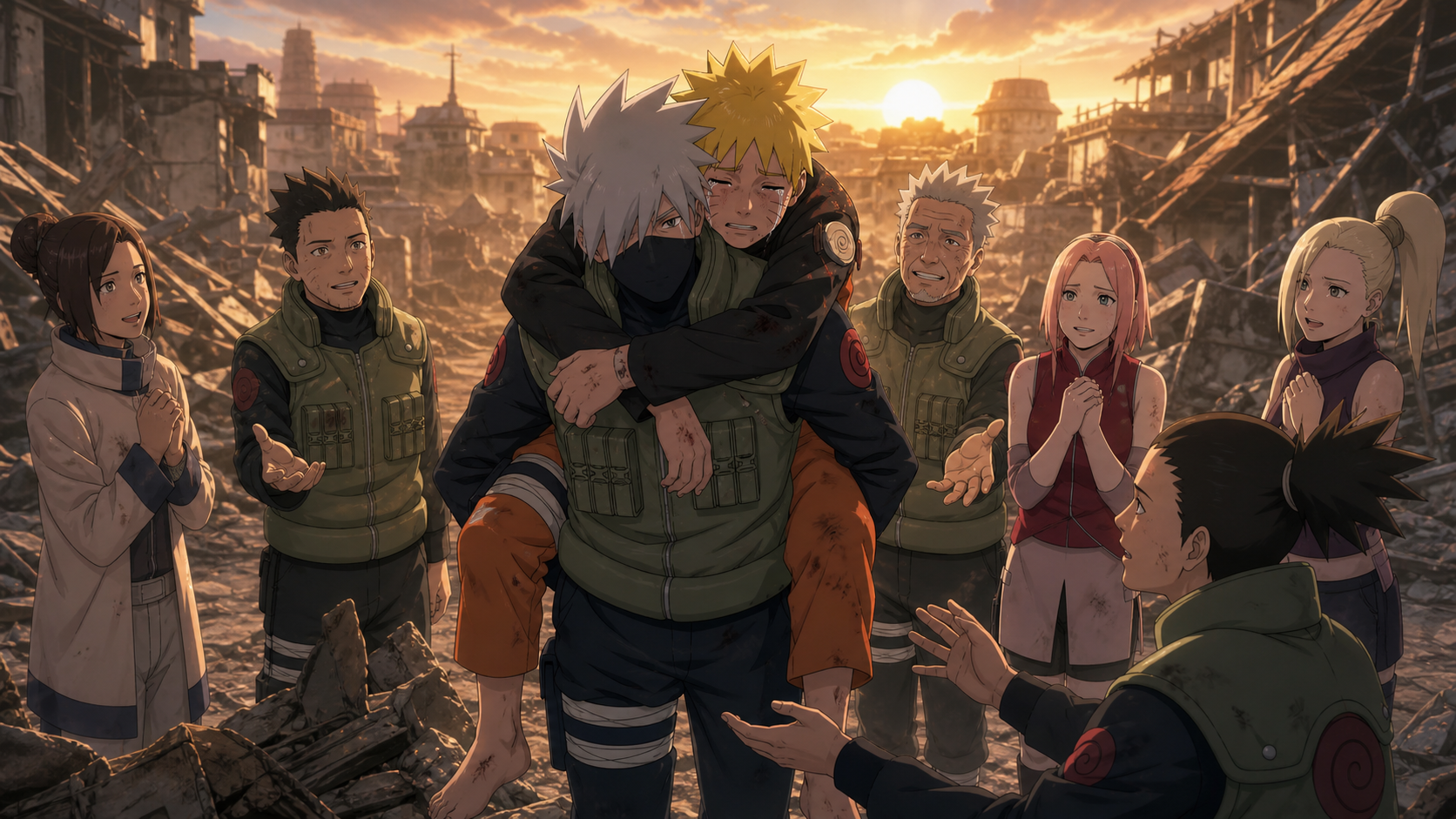
Konan leaves with Nagato and Yahiko's bodies, entrusting their shared hope to Naruto. Kakashi finds Naruto after the confrontation and carries him back toward the ruined village.
The villagers run to meet him. People who once whispered about the Nine-Tails now reach for Naruto as the person who protected them. Iruka remembers the lonely child demanding attention, and Naruto finally receives the recognition he pursued for years. The celebration is real, but it stands among rubble and after Nagato's final sacrifice.
Nagato's last choice is belief expressed through power
Nagato has spent years using overwhelming techniques to force the world into his theory of pain. His final technique is different. It restores lives and leaves the outcome outside his control.
Rinne Rebirth does not erase everything he did. Homes remain destroyed. Fear remains. Jiraiya and Yahiko do not return. Nagato cannot repair history by spending his life in one moment.
What he can do is refuse to add more irreversible loss. He chooses to believe that Naruto's interruption might become something larger, then gives that possibility room to exist.
Resurrection does not make the assault consequence-free
Bringing Kakashi and the other victims back could have made the arc feel as if damage were canceled. The episode avoids that by keeping the village visibly broken and Nagato's cost permanent.
People return to families and teammates, but they wake inside a disaster. The political failures that created Pain still exist. The masked man Minato warned about still moves in the background. Danzo's choices have not been exposed to everyone.
Relief is allowed without pretending recovery is complete. That distinction matters for a story about cycles. Survival creates another chance; it does not guarantee people will use it differently.
Konan carries both bodies and a revised promise
Konan's departure is quiet. She has spent years protecting Nagato's version of Yahiko's dream. Now both men are gone, and she has to decide what loyalty means without either voice directing her.
She does not join the Leaf or ask Naruto to absolve the Akatsuki. She acknowledges him as the person Nagato chose to trust and takes her friends home.
That choice restores dignity to the trio. Yahiko and Nagato are no longer bodies used to broadcast Pain. They are Konan's loved ones, and their story returns to the Rain with her.
Kakashi carrying Naruto changes the image of strength
Naruto entered the ruined village on a giant toad in Sage Mode, framed as the fighter everyone needed. He returns unable to walk, carried by someone whose life has just been restored.
The image refuses the solitary-hero fantasy. Naruto succeeded because Hinata reached him, Minato stopped the seal, Katsuyu shared information, the village trusted his decision, and Nagato made a final choice.
Kakashi's back is part of the victory. A hero can be exhausted, dependent, and held by the people he protected.
The village finally sees Naruto instead of the Nine-Tails
Naruto has wanted acknowledgement since childhood, but the form it takes here is more meaningful than applause for a flashy technique. The villagers know he stood between them and Pain. They also know he chose to confront the source rather than simply destroy it.
Their welcome reverses the distance that defined Naruto's earliest years. Hands that once pulled children away from him now reach forward. Faces that treated him as a container recognize a person.
The change did not happen because Naruto proved the prejudice reasonable until he became useful. It happened because relationships slowly challenged the village's refusal to see him, and this crisis made denial impossible.
Iruka remembers the child behind the celebration
Iruka's memories keep the crowd scene from reducing Naruto to a new public symbol. He remembers the boy acting out, eating ramen, failing exercises, and asking for attention in every way he knew.
Iruka was the first adult to recognize Naruto's loneliness without fearing it. His pride carries the entire distance between the child on the swing and the teenager welcomed home.
The village calls Naruto a hero, but Iruka knows heroism did not replace that child. It grew from the same stubborn need to be connected.
Recognition arrives after Naruto stops chasing it directly
Young Naruto imagined becoming Hokage so everyone would acknowledge him. Episode 175 gives him acknowledgement before the title because his goal has changed.
During the Pain arc, Naruto is not fighting to make people admire him. He is trying to protect them, understand Jiraiya's killer, and prevent grief from choosing his response. Recognition arrives as a consequence of responsibility rather than a prize for demanding attention.
That does not mean his childhood dream was shallow. Wanting to be seen kept him alive. Growth changes what being seen is for.
The word hero carries an uncomfortable weight
The village's celebration is emotionally earned, but Naruto has just heard how one village's hero can be another country's source of pain. The title should not become permission to forget Nagato's story.
Naruto is a hero because he protected the Leaf. His larger task is to carry that care beyond the village boundary. If recognition closes his attention inward, Pain's lesson will remain intact.
The best version of this celebration is not a finish line. It is a community giving Naruto enough belonging to continue the harder work.
The arc ends with collective relief, not private conquest
Pain tried to isolate Naruto as a jinchuriki and reduce every relationship to leverage. The ending gathers people around him. Their presence answers the visual loneliness of the crater.
No single punch created this outcome. Naruto's victory includes combat, restraint, testimony, a book, Nagato's agency, Konan's witness, and a village willing to change how it sees someone.
That complexity is why the welcome lands. Naruto did not only defeat an enemy. He made room for another person to choose something Pain's system said was impossible.
Nagato’s final technique changes the direction of his power
For years, the Rinnegan extended Nagato’s pain through corpses, summons, receivers, and destruction. Rinne Rebirth uses the same extraordinary capacity to return lives and surrender control over what those people do next.
The difference is not scale. It is purpose. Nagato stops forcing the world to carry his conclusion and creates space for other people’s futures.
Believing Naruto requires Nagato to accept uncertainty
Pain’s system promised predictable peace through fear. Naruto offers no guarantee, only a commitment to continue searching. Trusting him means Nagato cannot control whether the promise succeeds.
That risk reaches the part of Nagato that existed before Hanzo taught him trust was a trap. His final choice is faith without possession.
Rinne Rebirth is repair and not absolution
Restoring the people killed in the assault matters enormously. Families regain loved ones. Teams recover members. Kakashi opens his eyes. None of that declares the attack acceptable.
Nagato performs the repair available to him and pays with his life. Accountability should recognize repair without pretending one act balances every harm.
The people who remain dead keep the ending honest
Jiraiya does not return. Yahiko does not return. Nagato’s parents, Chibi, and the victims of earlier wars remain gone. The technique cannot reset history to a painless beginning.
Relief exists beside permanent grief. That combination prevents resurrection from turning the arc into a consequence-free spectacle.
Konoha’s buildings remain destroyed
Residents return to life inside a crater. Homes, records, workplaces, roads, and the physical systems of community still require rebuilding. Survival creates labor rather than a magical restoration of normal.
The visible ruin keeps Nagato’s political warning present even after his methods are rejected. Villages must repair what violence exposed, not only what it broke.
Konan chooses care after the ideology collapses
She does not defend Pain’s methods once Nagato changes course. She receives his decision, protects his final moments, and prepares to carry both men home.
Her loyalty stops functioning as armor around certainty. It becomes grief allowed to move somewhere beyond the paper chamber.
Taking Yahiko and Nagato home restores their bodies to relationship
The Deva Path made Yahiko’s corpse a public god. Nagato’s body became hidden machinery supporting that image. Konan gathers them as the two people she loved before either role existed.
The departure refuses Akatsuki’s ownership. Their remains belong to memory, mourning, and Amegakure rather than another weapon system.
Konan’s paper flower changes allegiance without becoming shallow
She offers Naruto a symbol rooted in the same art that welcomed Nagato as a hungry child. The flower does not erase her history with Akatsuki. It carries the original hope forward.
Trusting Naruto is a political choice and a personal risk. Konan decides Yahiko’s dream can survive outside her control.
Kakashi’s return answers one grief without erasing the others
Naruto believed his teacher was dead while fighting Pain. Seeing Kakashi alive offers relief after emotional pressure nearly opened the Nine-Tails seal.
The reunion remains quiet because both are exhausted. Sometimes survival needs no speech large enough to compete with what almost happened.
Kakashi carries the person everyone expects to carry them
Naruto arrived as the village’s final answer. He returns unable to walk. Kakashi places him on his back without treating exhaustion as failure.
The image corrects solitary hero worship before the celebration begins. Protection moves in both directions when community works.
The walk home reverses Naruto’s childhood isolation
Young Naruto often sat alone while villagers maintained distance and parents pulled children away. Now someone carries him toward a crowd running forward.
The physical route is short. Emotionally, it crosses years of deliberate exclusion, desperate pranks, failed attempts, and relationships built one person at a time.
Iruka sees the entire timeline inside one face
The crowd sees Sage Mode, Pain’s defeat, and the village’s survival. Iruka remembers the child on the swing, the classroom troublemaker, and the boy who needed one adult to say he belonged.
His memory prevents the title “hero” from replacing Naruto with another useful symbol.
The village did not earn innocence by changing its mind
Welcoming Naruto is right and overdue. It does not make the earlier prejudice a necessary trial that improved him. The village hurt a child and eventually learned to see what was always there.
Naruto’s heroism belongs to him and the people who supported him, not to mistreatment retroactively recast as motivation.
Recognition arrives after Naruto’s goal has expanded
He once wanted the Hokage title to force acknowledgment. During Pain’s assault, he fights to protect people and understand an enemy whose home Konoha helped harm.
The crowd’s love arrives when recognition is no longer the only horizon. Growth did not make the childhood need illegitimate. It gave belonging a larger purpose.
The cheering crowd contains people who once feared him
Some villagers changed gradually through missions and witnessed choices. Others may be responding to one undeniable rescue. The emotional result is beautiful and politically complicated.
A community should not require a child to save every life before granting personhood. Celebration must include accountability for why recognition took so long.
Hinata’s survival belongs inside the victory
Her intervention reached Naruto when he was pinned and alone. Learning she survived restored evidence after Pain weaponized uncertainty. She is not merely a trigger for Kurama.
The ending should remember the person whose choice changed Naruto’s experience of captivity before the village arrived to cheer.
Naruto’s heroism includes refusing the expected killing
The crowd knows he defeated Pain. The deeper victory occurred outside their view when he listened to Nagato and chose not to retaliate.
Strength protected Konoha. Restraint protected the possibility that Konoha’s survival would not require another community to inherit revenge.
RaeRae's reaction
I cried the second Kakashi carried Naruto back. The entrance in Sage Mode was iconic, but this return feels truer. Naruto is finished. He has no heroic pose left, and the village meets him anyway.
Iruka's memories are what broke the last defense. He knows how badly Naruto wanted this moment when nobody else believed it would come. The crowd sees the savior of the village. Iruka sees the entire child who survived long enough to become him.
I am relieved Kakashi and the others return, but I do not want the resurrection to flatten Nagato's responsibility or sacrifice. He cannot undo every loss. He uses his last agency to stop adding to them and places trust somewhere he once believed trust could only lead to betrayal.
Naruto finally becomes the village's hero at the moment he understands that a hero cannot belong only to one village's version of the story. The welcome is beautiful. The promise he carries out of Nagato's chamber is what will determine whether it means more than one morning of relief.
The title is earned and should remain uncomfortable
Naruto is the Hero of the Hidden Leaf. Nagato’s story taught him that every hidden village writes heroes from its own side of a border. The title becomes ethical only if it expands responsibility instead of closing memory.
Being loved by Konoha must help Naruto see beyond Konoha, not excuse looking inward forever.
RaeRae’s final word on Hero of the Hidden Leaf
Kakashi carrying Naruto ruins me every time. The boy everybody expects to carry the future gets to be exhausted, held, and brought home without performing one more ounce of strength.
Iruka’s face carries the whole series. He remembers Naruto before power made acknowledgment convenient. His pride belongs to the child and the hero as one continuous person.
I celebrate the returned lives without calling the assault erased. Nagato repairs what he can, accepts the cost, and leaves political damage the survivors still have to face. Redemption is an action, not a clean record.
Naruto finally receives the welcome he wanted. The reason it lands is that he no longer needs applause to tell him who he is. He carries Jiraiya’s promise, Nagato’s history, and enough belonging to attempt a peace larger than one village’s relief.
The celebration is a beginning disguised as an ending
The crowd gathers as though one battle has settled Naruto’s relationship with Konoha forever. Emotionally, the moment deserves that release. Politically, belonging cannot depend on permanent heroism. Naruto should still be one of them on the morning he fails, disagrees, needs help, or has nothing spectacular to offer.
That is the test waiting beneath the applause. A community has changed when recognition becomes ordinary care, not when fear temporarily flips into worship. Naruto knows what it feels like to be treated as a monster and now risks being flattened into the opposite symbol.
Iruka protects the person between those labels. His memories include misbehavior, loneliness, hunger, stubbornness, humor, and effort. He does not need Naruto to become flawless before loving him. That earlier relationship gives the public celebration a human foundation.
Kakashi’s act does similar work. Carrying Naruto says dependence belongs inside strength. The village does not need another untouchable monument standing above everyone. It needs people capable of holding and being held when capacity runs out.
The returned lives create obligations beyond gratitude. Survivors can investigate how Danzo’s actions helped produce the enemy, rebuild systems that failed civilians, and ask what Konoha does beyond its borders. Resurrection gives the village time. It does not answer how that time should be used.
Nagato’s final action also deserves moral precision. He believes Naruto and restores lives, but sacrifice does not purchase control over how victims interpret him. Some may mourn him, some may condemn him, and some may hold both responses. Redemption cannot require the harmed people to supply absolution.
Konan understands that uncertainty when she departs. She entrusts hope to Naruto without demanding membership in his future or asking Konoha to approve her grief. Carrying Yahiko and Nagato home keeps their story connected to Amegakure, where their wounds and choices began.
Naruto now possesses recognition Nagato’s younger self never received from a secure national community. That difference should become responsibility. If Naruto uses Konoha’s love only to protect Konoha, the borders of Pain’s argument remain untouched.
The hero title matters most when it gives Naruto enough security to reject the village’s worst instincts later. Belonging should not make loyalty obedient. It should make honest criticism possible without threatening exile.
I want the joy and the discomfort together. Naruto earned every hand reaching for him. He should never have needed to earn basic humanity through catastrophe. The scene heals something real while exposing how long the village waited to participate in that healing.
Naruto’s smile belongs to the child on the swing as much as the Sage who defeated Pain. He did not become worthy when the crowd finally noticed. The crowd became more worthy of him when it stopped letting fear define what it saw. That difference matters because fandom loves turning suffering into a qualification for love. Naruto should have been held before he saved anyone. The welcome cannot return those years, but it can promise that the next version of belonging will not demand another catastrophe first. Kakashi’s back, Iruka’s tears, Sakura’s relief, Hinata’s survival, and the villagers’ hands create a home through action. The hero has already done his work. Now Konoha must prove recognition can become responsibility, memory, and ordinary care after the cheering stops and rebuilding begins for everyone, every day.
RaeRae’s call
Kakashi carries Naruto home because the hero has nothing left to perform. Konoha finally reaches for the person it once rejected, while Nagato’s last choice gives that changed community another chance to do better.