
RaeRae Reacts · One Piece Episode 70
Little Garden’s Ancient World
One Piece Episode 70 lands at Little Garden, where dinosaurs, giants, and an unknown observer turn exploration into a test of habitat respect, biosecurity, and escort planning.
Episode information
Japanese title: Taiko no Shima! Little Garden ni Hisomu Kage!
English title: An Ancient Island! The Shadow Hiding in Little Garden
Japanese broadcast: May 27, 2001
Saga: Alabasta
Script: Junki Takegami
Episode direction: Yuji Endo
Animation direction: Kazuya Hisada
Art: Shoichiro Sugiura
The voyage returns to the Straw Hats
Episode 70 moves back from Coby and Helmeppo to the Merry carrying Vivi and Karoo deeper into the Grand Line. The crew has accepted an escort mission tied to Alabasta’s survival.
Every island now combines ordinary navigation risk with the possibility of Baroque Works surveillance.
Little Garden is the second Grand Line island
The official summary identifies Little Garden as the crew’s next major stop after entering the route. A Log Pose destination is not automatically a safe port or inhabited settlement.
Nami should establish anchorage, lock time, weather pattern, and departure requirements before anyone explores.
The island looks prehistoric. Giant ferns, ancient plants, volcanic terrain, and unfamiliar animal calls signal an ecosystem outside the crew’s experience. Visual wonder should increase caution rather than invite immediate contact.
The crew needs to treat the island as habitat, not an attraction built for adventurers.
Nami hesitates to land
Her reluctance reflects navigation responsibility and the absence of reliable information. She must protect the ship, passengers, route, and crew while the Log Pose stabilizes.
Caution is not cowardice when the environment contains unknown disease, weather, predators, and terrain.
Usopp also fears the island. His anxiety may identify hazards others minimize. He often imagines worst cases, but a risk inventory is useful when converted into practical checks.
The crew should not shame him into joining an expedition against his judgment.
Fear can support planning. List likely threats, probability, impact, and mitigation. Separate evidence from imagination without mocking either.
A person who names danger can become lookout, recorder, signal operator, or ship guard.
Luffy wants immediate adventure
His curiosity drives the voyage and helps the crew meet the unknown without paralysis. That curiosity also creates a pattern of entering environments before shared plans are ready.
A captain’s enthusiasm should operate inside agreed expedition boundaries.
Vivi chooses to explore
She has a country-level mission yet joins the island expedition. Her decision may reflect knowledge, urgency, trust in Luffy, or desire to contribute.
Escort status does not require confinement to the ship, but risk should be discussed honestly.
Karoo carries Vivi. The official account places Vivi on Karoo during exploration. The riding bird needs safe footing, water, rest, and freedom from loads beyond capacity.
Dense roots, soft ground, insects, and sudden animal movement can make riding more dangerous than walking.
Karoo is not emergency equipment. He can move quickly, but the crew should not assume Karoo can outrun every predator or carry an injured person indefinitely. Build alternatives.
Vivi should dismount when terrain or animal stress requires a slower pace.
Use an expedition register. Record who leaves, route, supplies, signal, turnaround time, and expected contact. The ship team needs to know when absence becomes an emergency.
Changing route requires a marker or message that does not expose Vivi to hostile agents.
Pairs should remain within signal range. Ancient vegetation can block sight and sound. No explorer should follow an animal or landmark alone.
Whistles, colored cloth, and predetermined calls can support regrouping without constant shouting.
The Merry needs a guarded anchor watch. Nami, Usopp, or another designated crewmate should monitor tide, weather, Log Pose, shoreline movement, and sabotage. Baroque Works may already know the likely route.
The ship must remain ready to receive people quickly.
Biosecurity starts before landing. Cover skin, treat water, protect food, inspect footwear, and avoid touching unknown plants. On return, clean equipment and check for insects, spores, seeds, or parasites.
Do not carry specimens aboard without a reason and containment.
Unknown plants may be dangerous. Large scale and bright color do not identify toxicity. Sap, pollen, thorns, fruit, and airborne compounds can harm humans or Karoo.
Observe from distance and avoid using local plants as food, medicine, rope, or firewood until verified.
Ancient ecosystems can carry unfamiliar disease. Bites, scratches, water exposure, animal waste, and insects require prevention. First-aid supplies should include cleaning, coverings, fever monitoring, and allergy response.
A sick explorer should return early rather than hide symptoms to preserve the adventure.
Luffy and Vivi encounter a brontosaurus
The official summary describes a huge long-necked dinosaur. Its size inspires awe, but a herbivore can still injure through defensive movement, tail sweep, or accidental trampling.
Distance and a clear escape path are essential.
Do not feed the dinosaur. Feeding changes behavior, spreads disease, and can draw an animal toward future visitors or the ship. Human food may be harmful.
Observe quietly without training wildlife to approach people.
Watch the whole herd. Focusing on one giant animal can hide juveniles, adults, or predators nearby. Maintain awareness behind and beside the group.
Never stand between an animal and its young, food, water, or exit route.
Photographs and sketches need restraint. Documentation can support safety and learning, but flashes, noise, or close positioning may disturb wildlife. Location data can also attract hunters.
Usopp’s field notes should omit sensitive nesting or migration details from public stories.
Little Garden contains giants
The official account says giant people exist on the island. Size difference creates communication, proximity, and accidental-injury risks without proving hostility.
The crew should announce presence from a respectful distance and avoid entering shelters or taking property.
Giants are people, not attractions. Their culture, language, boundaries, and history deserve the same respect as any community. Staring, measuring without consent, or treating them as proof of a legend is dehumanizing.
Ask before recording names, images, or personal stories.
Scale changes ordinary interaction. A friendly gesture, step, tool, cooking fire, or voice can be dangerous at human distance. Meeting zones should allow space and clear sight.
Karoo may be frightened by unfamiliar size and sound, so keep him calm and able to retreat.
The island may not be uninhabited. Ancient appearance does not mean empty land. Giants and any other residents hold claims, routines, and knowledge the crew lacks.
Exploration should begin with seeking permission and local guidance where possible.
A hidden shadow watches
The title warns of concealed presence on Little Garden. The shadow may refer to Baroque Works agents, local residents, predators, or observers using the dense terrain.
The crew should look for tracks, repeated sounds, disturbed vegetation, signal marks, and evidence of camps.
Do not assume every observer is hostile. Residents may watch strangers before approaching. Wildlife may track movement defensively. Baroque Works may be hunting Vivi.
Respond to behavior and evidence, not simply the feeling of being seen.
Vivi is a high-value target
Her presence changes the risk of every footprint and campfire. Use a simple cover story and avoid royal titles in open terrain.
Protection should not silence her when local diplomacy requires her voice.
Routes should avoid predictable landmarks. Water sources, clearings, high points, and beaches attract both explorers and ambushers. Approach them with observation and alternate exits.
Do not create a trail that leads directly back to the Merry.
Sanji and Zoro need defined responsibilities. Competition over hunting, supplies, or exploration can split the crew and increase harm to wildlife. They should agree on food limits, search sectors, and return time.
No contest justifies killing animals that are not needed for survival.
Food planning should protect the ecosystem. Use ship provisions first. If local food becomes necessary, seek guidance, take minimal amounts, and avoid breeding or nesting sites.
Pack out waste and prevent fire from spreading through unfamiliar vegetation.
Fire control is critical. Humidity does not eliminate wildfire risk, especially near dry volcanic zones or resinous plants. Use contained cooking, water nearby, and complete extinguishment.
Smoke may reveal the crew to agents and disturb animals.
The Log Pose creates a waiting problem
The crew may be unable to leave until the magnetic route stabilizes. That makes the Merry a temporary base in a hazardous environment.
Ration planning, watches, health monitoring, and diplomacy should assume more than a brief visit.
Emergency evacuation may not follow the Log Pose. Immediate danger could require moving offshore without a new island heading. Nami should identify safe holding water and return approach.
Survival takes priority over preserving an exact schedule.
The crew needs a missing-person protocol
At the missed check-in, confirm last route, weather, signals, and known hazards before sending a second team. Searchers work in pairs and leave the ship guarded.
Do not allow every crewmate to disappear into the same jungle.
Medical triage should happen aboard. On return, check heat stress, dehydration, bites, rashes, cuts, breathing, and unusual behavior. Separate contaminated gear.
Record exposure so later symptoms can be connected to likely causes.
Wonder should not erase consent
Luffy’s joy, Vivi’s curiosity, and the audience’s excitement can coexist with careful boundaries. A place does not owe access because the place is extraordinary.
Responsible adventure leaves the habitat and residents able to continue without the visitors.
Junki Takegami opens a new ecological scale
Takegami’s script moves from political conspiracy into a living prehistoric system without disconnecting the risks. Vivi remains a target even among dinosaurs and giants.
The island expands wonder while keeping the escort mission relevant.
Yuji Endo balances ship and shore. Endo’s direction contrasts Nami and Usopp’s caution with Luffy and Vivi’s movement through giant plants. The audience sees why both responses make sense.
Distant scale cues prepare the giant reveal without reducing the giant to shock.
Kazuya Hisada gives animals weight. Animation direction uses slow neck movement, ground vibration, leaf displacement, and careful reactions to make the dinosaur feel alive rather than a moving obstacle.
Karoo’s body language keeps animal welfare visible.
Shoichiro Sugiura makes Little Garden feel inhabited. Layered forest, worn paths, smoke, water, volcanic rock, and distant silhouettes suggest history and use. The island is ancient but not frozen in time.
Beauty carries signs that the crew is not alone.
RaeRae’s real-time reaction
Nami and Usopp are correct to hesitate. A Log Pose pointing at giant plants and dinosaur calls is not an invitation to run ashore without water, signals, and a return time.
Luffy and Vivi can explore, but Karoo is not a getaway vehicle for every bad decision. Respect the habitat, keep distance from the dinosaur, and announce yourselves before treating giants like sightseeing.
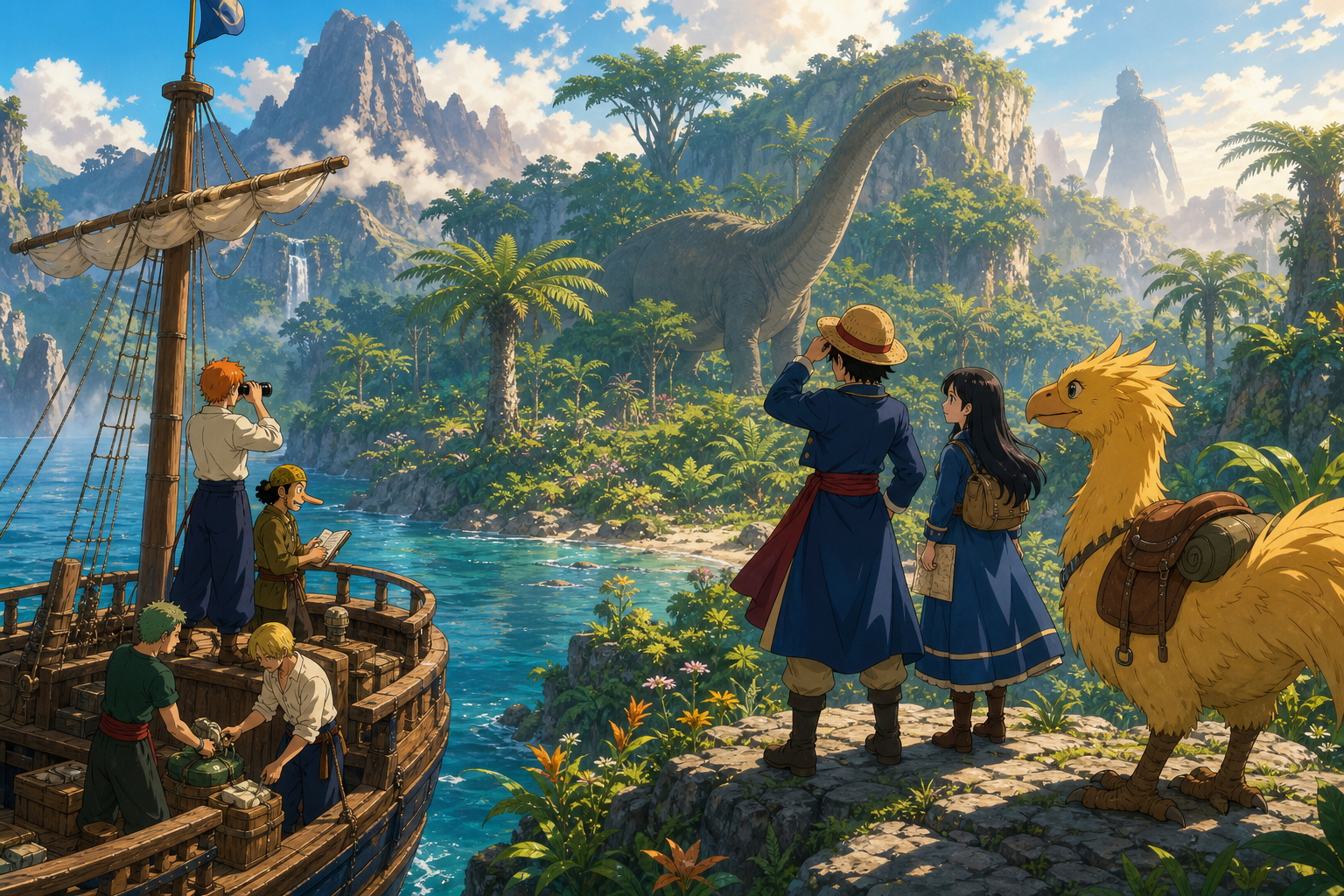
The moment that lands. A long-necked dinosaur rises above the ancient forest while a giant silhouette exists beyond the dinosaur. The Grand Line reveals that scale itself has changed.
The crew is no longer the biggest or most important presence in the landscape.
What should happen immediately. Secure the Merry, confirm Log Pose timing, register expedition teams, pack water and first aid, protect Karoo, establish signals, avoid feeding wildlife, and seek consent before approaching giant residents.
Watch for Baroque Works without treating every shadow as an enemy.
What responsible departure requires. Account for everyone, inspect health and gear, remove waste, extinguish fires, avoid taking specimens, protect sensitive location data, thank residents, and leave no trail toward Vivi.
Document navigation hazards for future safety rather than tourism.
Local stewardship should guide future contact. If the giants or other residents manage parts of Little Garden, their knowledge should lead decisions about safe routes, wildlife distance, fire, water, and culturally important areas. Outside explorers should not invent conservation rules that remove local authority.
The crew can share observations and offer help, but any future map or story should protect community consent and prevent hunters from using their experience as an access guide. Long-term protection must remain accountable to the people who live there.
Before departure, the Straw Hats should clean footwear and equipment, remove seeds or residue, count supplies, and record every place where food or waste changed hands. Those simple steps protect the next island as well as Little Garden. Nami should keep sensitive landmarks out of general navigation notes, while Vivi records only the safety information Alabasta genuinely needs. Discovery does not create ownership, and a useful map can still become a weapon in careless hands.
Bottom line
Episode 70 brings the Merry, Vivi, and Karoo to Little Garden, where Nami and Usopp’s justified caution contrasts with Luffy’s immediate appetite for exploration. A brontosaurus and the existence of giants reveal a prehistoric ecosystem that demands distance, planning, biosecurity, and respect for residents.
RaeRae rating: 9.2/10. The island is beautiful because Little Garden is alive, not because the island belongs to the crew. Guard the ship, protect Karoo, stop treating fear as failure, and enter every ancient habitat as a guest who may not yet understand the rules.